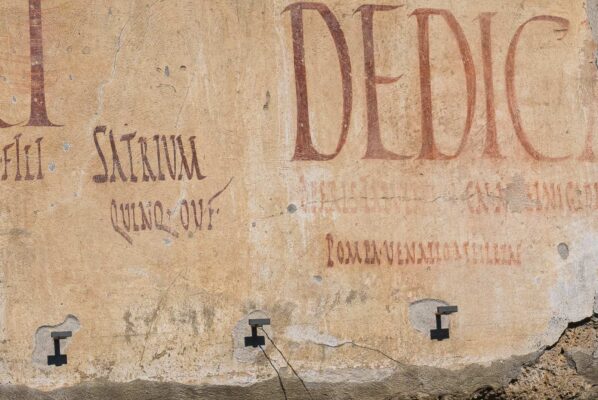
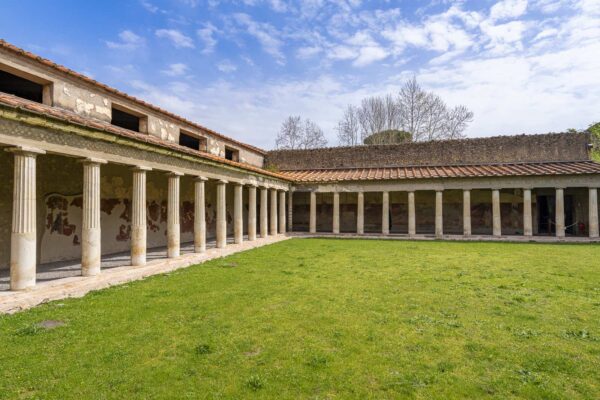
Boscoreale is a municipality located on the slopes of Vesuvius, north of Pompeii, which is why it is strategically located and easily accessible. It has been known since antiquity for its remarkable fertility, thanks to which it was devoted mainly to cultivating vines, olives and cereals.
Some scholars identify Boscoreale with the ancient Pagus Augustus Felix Suburbanus, a suburban area of Pompeii, of which we can admire important archaeological evidence today.

The history of Boscoreale is closely linked to the eruptive events of Vesuvius, especially the famous one in 79 A.D. that buried Pompeii and the entire surrounding area under a blanket of ash and lapilli.
This tragic event, while it ended the lives of many people, has extraordinarily preserved buildings, objects and testimonies that today allow us to take a true journey back in time.
The area of Boscoreale, thanks to its rustic villas and the artefacts found, represents an extraordinary treasure chest of information about the daily life of the Romans, agricultural techniques, production activities and art almost two thousand years ago.
Where is it located?
Google MapsWhy visit Boscoreale
Visiting the Archaeological Excavations of Boscoreale is not only about admiring the remains of ancient villas or learning about ancient history; it is also an opportunity to immerse oneself in the rural atmosphere of Campania Felix in Roman times.

- Archaeological richness: More than thirty villas from the Roman period have been unearthed here, some with an agricultural vocation (devoted to cultivation and the production of wine and oil), others with sumptuously decorated halls, which the owners used for periods of rest or vacation.
- Proximity to Pompeii: Boscoreale is only a few kilometres from the entrance to the Pompeian excavations. This makes visiting extremely convenient, especially with new transportation links, such as the Pompeii Artebus shuttle and the Circumvesuviana. The short ride makes it possible to combine a visit to Pompeii and Boscoreale in a day, enjoying two complementary perspectives of ancient Roman life.
- Antiquarium of Boscoreale: The local museum, reopened in October 2023 with new exhibition rooms and a section devoted to recent excavations in the suburban villa of Civita Giuliana, offers artefacts of considerable interest. With a modern exhibition layout and informative panels, you can better understand the times’ customs, traditions, and agricultural techniques and admire the monumental ceremonial chariot found in 2021.
- Immersive experience in Roman rural culture: At Boscoreale you can still see casts of ancient vine roots dating back to 79 AD, reconstructions of wine presses, dolia (large buried containers for storing must) and other agricultural tools, which offer a vivid idea of how wine, oil and other typical products of the area were produced.
Opportunity to delve into local culture: Boscoreale is a lively centre, far from the mass tourism focused mainly on Pompeii and Herculaneum. Here you can enjoy a quieter pace and, if you wish, savour food and wine specialities that keep the local agricultural tradition alive.
A Brief History of the Archaeological Excavations of Boscoreale

The first archaeological explorations in Boscoreale territory (a term sometimes used to refer to the inhabitants of Boscoreale) date back to the late nineteenth and early twentieth centuries.
Often, the excavations were conducted by private owners, who were mainly interested in recovering frescoes, precious objects and furnishings to resell to collectors or essential international museums.
Thus, many finds of great historical and artistic value were dispersed among the National Archaeological Museum in Naples, the Louvre in Paris, the Metropolitan Museum in New York, and various private collections.

Most of the uncovered villas were later re-covered for safety and conservation reasons. Still, some remained partially visible, such as the Villa della Pisanella (now almost completely covered) and the Villa Regina, which has been fully unearthed and can be visited.
The surrounding area, called ager Pompeianus (or “Pompeian countryside”), was between the present-day municipalities of Pompeii, Torre Annunziata, Boscoreale, Boscotrecase, Terzigno and Scafati.
Much of the finds consist of rustic villas, often family-run or servile, devoted to agricultural production, especially wine for export and oil that supplied the local market.
Villa Regina: The Jewel of Boscoreale

If you want to visit a perfectly preserved example of a rustic Roman villa, the Villa Regina is your destination.
- Origin and structure: It dates back to the first century BC and was expanded in the Augustan and Julio-Claudian periods. It is organised around a central courtyard on three sides, where various rooms are arranged. The fulcrum of production activity is the wine cellar (cella vinaria), which houses 18 large underground dolia for storing must.
- Agricultural function: The villa was surrounded by a vineyard, of which root casts have been made. Now, the vineyard is partially reproduced with new plantings, restoring the idea of the ancient agricultural layout.
- Noteworthy features: The only room of stately character is a triclinium, decorated with paintings in the III style (later revised in a transitional phase to the IV style). The rest of the spaces were used for farm activities: stables, storage rooms, an area for pressing grapes, kitchens and rooms for servants.
- Discoveries during the excavations: Among the objects found are kitchen utensils, various pottery, agricultural tools, some oil lamps and a small herm of the god Bacchus, testifying to the importance of wine in this area.
The Antiquarium of Boscoreale
A short walk from Villa Regina stands the Antiquarium of Boscoreale, an archaeological museum created to illustrate the life and environment of the Vesuvian territory before the eruption of 79 AD.

- History: Founded in 1991 and then renovated and reopened in October 2023, the Antiquarium has enriched its exhibition with previously unseen artefacts and a room dedicated to the ongoing excavations in the suburban villa of Civita Giuliana, including the ceremonial chariot found in 2021.
- Exhibition route:
- First room: Here, you will find artefacts documenting cultivation, fishing, animal husbandry, and craft activities of Roman times, such as agricultural tools (hoes, sickles, presses) and textile tools. There is also evidence regarding cosmetics, medicine, and religious worship. Casts of animals, such as dogs and pigs, confirm the extreme richness and variety of the fauna.
- Second Hall: It displays remains and objects from the rustic and stately villas of Boscoreale, such as the Villa of Pisanella, the Villa of Numerius Popidius Florus, the Villa of Marcus Livius Marcellus, and the Villa Regina itself. Here you can see winemaking tools, architectural models of the villas, frescoes and some significant decoration pieces.
- Educational Aim: The Antiquarium is designed to bring visitors closer to Roman daily life, providing information about crops (vine and olive tree in primis), agricultural practices, animals raised and the use of natural resources. Through explanatory panels, photographs and casts, it is possible to understand how the rural landscape was structured and what technical innovations were adopted.
- Visiting hours and tickets:
- April 1 to October 31: 9 a.m. to 7 p.m. (last admission at 6 p.m)
- November 1 to March 31: 9:00 a.m.-5:00 p.m. (last entry at 4:00 p.m)
A POS at the Boscoreale ticket office lets you purchase tickets by credit card.
Rustic and Stately Villas of Boscoreale
In addition to the Villa Regina, Boscoreale preserves numerous other archaeological structures. Some of these are not accessible to the public today because they are buried for protection reasons, but they have yielded valuable finds.
Villa della Pisanella
- Location: It was discovered between 1894 and 1898.
- Structure: The villa featured a pars urbana (residential area for the owner) with finely decorated reception rooms and a bath complex and a pars rustica with stables, storerooms, and areas for producing wine and olive oil—including a large olive press and a circular wine press (circular).
- Treasure of Boscoreale: During excavations, a famous treasure comprised 1,037 gold coins and 108 pieces of silverware (cups, jugs, plates), some preserved in the Louvre and some in private collections. Some pieces, depicting mythological or imperial scenes (such as the Triumph of Tiberius or Emperor Augustus enthroned), are considered among the finest examples of Roman gold and silverware.
Villa of Publius Fannio Sinistore
- Discovery: In 1899, excavations continued until 1900.
- Paintings: The city is famous for its Pompeian-style II frescoes, preserved in several museums (including the Metropolitan Museum of Art in New York and the National Archaeological Museum in Naples). The walls feature architectural views, cities in perspective, and megalographies of gods and mythical figures, believed to be among the finest examples of ancient Roman painting.
Villa of Numerius Popidius Florus
- Discovery: In 1906, with findings of frescoes in the Second and Fourth Pompeian Styles, marble, bronze and terracotta objects, now partly on display at the Antiquarium of Boscoreale.
- Owner: Two votive inscriptions identified it as the home of Numerius Popidius Florus.
Other Villas of Interest
- Villa on the D’Acunzo estate: This was a farm with an attached caupona (tavern), found in the early 1900s. Some artefacts are displayed in American museums (such as the Walters Art Museum in Baltimore).
- Villa in Cangiani locality: Discovered in 1904, where casts of roots and plants were made, further evidence of the agricultural activity of the place.
- Villa on Casone Grotta Street: Dating from the 2nd-3rd centuries AD, thus after the eruption of 79 AD, it testifies to the reoccupation of the area. From the villa come statuettes and religious artefacts.
- Villa of Marcus Livius Marcellus: This is attributable to the discovery of a seal with this name. Again, this is a partially excavated and partly backfilled structure.
How to Reach the Archaeological Excavations of Boscoreale
By Shuttle Bus: Pompeii Artebus
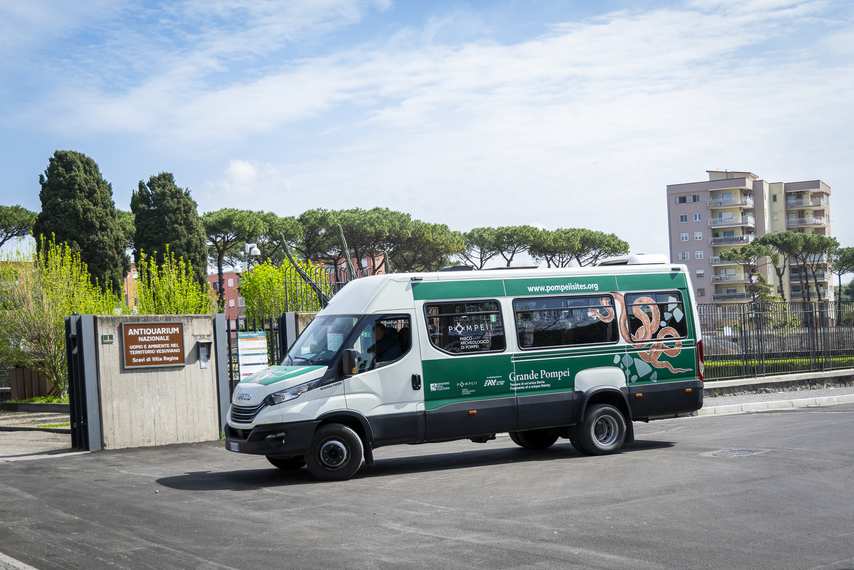
One of the most convenient ways to get to Boscoreale from Pompeii is by Shuttle 1 of Pompeii Artebus. Three routes are currently in operation:
- Shuttle 1 (Pompeii – Villa dei Misteri – Boscoreale)
Departs from Piazza Esedra every hour. Makes one stop at Villa dei Misteri, where only passengers going to Boscoreale can board. (Access to the Villa of the Mysteries is impossible from this stop: to visit it, you must enter the Pompeii Archaeological Park and have the Pompeii+ ticket, which includes a visit to the Villa of the Mysteries.)
In about 15 minutes, the shuttle takes you directly to the entrance of Villa Regina in Boscoreale. - Shuttle 2: Connects Pompeii to Oplontis (Torre Annunziata), where you can visit the Villa Poppaea.
- Shuttle 3: Leads to the Stabia Villas (Villa Arianna and Villa San Marco) in Castellammare di Stabia.
Schedules vary between summer and winter, generally departing from 9:30 a.m. until 4:00 p.m. (in winter) or 6:00 p.m. (in summer), with a one-hour break in the early afternoon. We recommend that you check the updated schedules on the official website.
By Train
- Circumvesuviana Napoli-Sorrento: The recommended stop is “Villa Regina-Boscoreale.” From here, you can continue on foot.
By Car
- From Naples or Salerno, take the A3 highway. The recommended exit is Boscoreale if you are coming from Naples; if you are coming from Salerno, exit at Torre Annunziata Sud. Then, follow the signs toward Boscoreale and Viale Villa Regina.
Practical Information and Visiting Hours
- Address: Viale Villa Regina, Boscoreale (NA).
- Opening hours:
- April 1 to October 31: 9 a.m. to 7 p.m. (last admission 6 p.m)
- November 1 to March 31: 9:00 a.m.-5:00 p.m. (last entry 4:00 p.m)
- Ticketing: At the ticket office, you can pay by credit card (POS available).
- Length of visit: You can consider about one and a half to two hours to visit Villa Regina and the Antiquarium of Boscoreale. If you want a more in-depth itinerary, you could devote the entire morning to exploring the archaeological surroundings as well.
What to Expect from the Visit
During your visit to the Archaeological Excavations of Boscoreale, you will get to:
- Learn about the everyday life of a Roman farm: From the vineyard to the wine storage rooms, from the rooms where servants lived to the reception rooms.
- Admire unique artefacts: The oil lamps, kitchen and tableware, and agricultural tools found will give you an insight into how people lived in these places almost two thousand years ago.
- Understand the importance of agriculture: Boscoreale was a rural area where the production of wine and oil was the primary source of wealth. Archaeological structures testify to this eloquently.
- Delve into the history of Vesuvian eruptions: The stratigraphy of the ground around Villa Regina shows the layers of ash and lapilli deposited during the 79 A.D. eruption, offering a lesson in geology and natural history.
- Rediscovering the value of the entire area: Boscoreale is an integral part of the archaeological heritage of the “Grande Progetto Pompei (Great Pompeii Project)” and, together with Oplontis, Stabia and Herculaneum, offers a complete picture of how life was organized in the different types of settlements (urban, suburban, rustic, maritime).
Combining a Visit to Pompeii
Since Boscoreale is located close to Pompeii, an excellent idea is to plan an itinerary that includes a visit to the Pompeii Archaeological Park and a visit to Boscoreale on the same day or two consecutive half-days.
Recommended route:
- In the morning, visit Pompeii.
- From Piazza Esedra, board Shuttle 1 “Pompeii Artebus—Villa of the Mysteries—Boscoreale” and reach Villa Regina in 15 minutes.
- Visit the Villa Regina and the Antiquarium of Boscoreale, discovering the secrets of Roman agriculture.
- If you have time, stop and enjoy the local cuisine at some of the farmhouses in the surrounding area, to savour the typical products of Campania.
This tour will take you from the magnificence of Pompeii’s public buildings, temples, and frescoed domus to the tranquil rural atmosphere of Boscoreale, giving you a 360-degree view of ancient Roman civilisation.
Conclusions
To visit the Archaeological Excavations of Boscoreale is to immerse oneself in a reality different from the famous Pompeii, but equally fascinating and fundamental to understanding the life and economy of the Vesuvian territory in Roman times.
The rustic villas of Boscoreale tell of wine presses, of vine and olive crops, of warehouses full of amphorae and dolia, of domestic and productive activities that allowed these areas to prosper, just a few steps from the sea and in the shadow of Vesuvius.
Thanks to the reopening of Villa Regina in October 2023 and the renovated Antiquarium of Boscoreale, enriched by the room dedicated to the excavations of Civita Giuliana and the ceremonial chariot, a visit to Boscoreale can offer a truly complete cultural and educational experience and will allow you to live an authentic journey through time: you will discover a place rich in history, beauty and authenticity, in close contact with nature and the agricultural tradition of one of the most fertile areas of the Roman Empire.
If you plan to visit Campania and the Pompeii Archaeological Park, do not miss the opportunity to discover Boscoreale: you will be fascinated!
FAQ About the Archaeological Excavations of Boscoreale
Boscoreale is about 4 kilometres from Pompeii. You can reach the Boscoreale Archaeological Site by Pompeii Artebus Shuttle 1 (departure from Piazza Esedra in Pompeii) or by Circumvesuviana (stop “Villa Regina”). By car, follow the A3 Highway and take the Boscoreale or Torre Annunziata south exit, depending on which direction you are coming from.
The most important site is the Villa Regina, a rustic villa from the first century B.C. dedicated to wine production. Next door is the Antiquarium of Boscoreale, a museum that houses artefacts from various villas in the Pompeian countryside and illustrates rural life in Roman times.
Generally, a couple of hours is enough to visit Villa Regina and the Antiquarium of Boscoreale in depth. If you want to combine a visit to Pompeii on the same day, you could devote the morning to Pompeii and the afternoon to Boscoreale (or vice versa).
Yes, at the Villa Regina ticket office, you will find a POS for credit card payments. Alternatively, you can inquire about possible cumulative tickets for Pompeii, Boscoreale, and other Vesuvian sites.
Some areas, such as the Antiquarium hall, are generally accessible. However, as these are archaeological excavations, some sections may be less accessible. You should check the official website or contact the ticket office directly for up-to-date accessibility information.