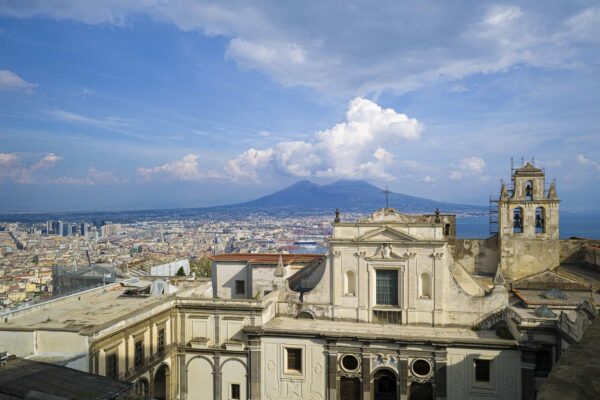
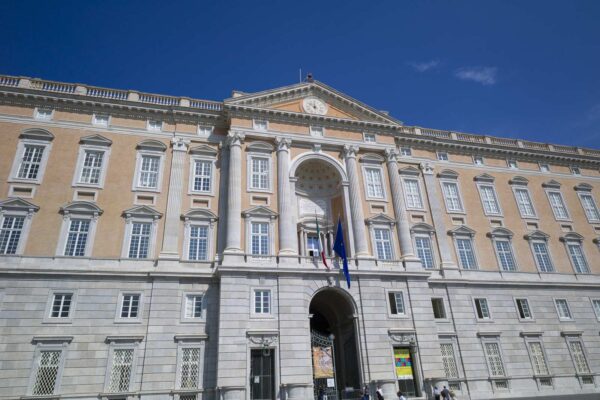
With the name of Resina until 1969, Herculaneum in Campania is a place steeped in history and tradition, known worldwide for its Archaeological Park, but also for its proximity to popular tourist attractions, such as Vesuvius National Park and the 18th-century villas of the so-called Golden Mile.
Today Herculaneum has about 50,000 inhabitants and is a lively town, full of contrasts: on the one hand, the remains of the ancient Roman city buried by the eruption of Vesuvius in 79 A.D.; on the other, signs of modernity and an economy that has changed over the centuries, ranging from the working of lava stone to textile manufactures to a prominent cultural and touristic renaissance.
Strolling through the streets of Herculaneum, one encounters the many historical layers of the area’s past: from the Roman period to the Middle Ages, from the Renaissance to the Bourbon era and the present day, every corner holds a page of history.
Many tourists focus almost exclusively on the Herculaneum Archaeological Park, but the city offers much more. A visit to the Archaeological Park can also become an opportunity to explore the famous Miglio d’Oro (Golden Mile) with its Vesuvian villas, to climb to the top of Vesuvius, and to enjoy an exceptional view of the Bay of Naples.
Finally, from Herculaneum, it is easy to reach Pompeii, another unmissable tourist destination and UNESCO heritage site, ideally forming a “cultural twinning” under the banner of discovering ancient Roman splendours.
Where is it located?
Google MapsA Look at the History of Herculaneum
According to legend, ancient Herculaneum was founded by Hercules returning from Iberia in 1243 BC. Beyond the myth, historical sources indicate that the city had an Oscan or Etruscan origin between the 12th and 8th centuries B.C., then fell to the Greeks (according to some, as early as the 5th century B.C.) and later to the Samnites.
After the Social War in 89 BC, Herculaneum came into the orbit of Rome, becoming a municipality and a popular resort for the Roman aristocracy.

The earthquake of 62 AD marked the city’s first stroke of bad luck; however, the real calamity came with the terrible eruption of Vesuvius in 79 AD, the same one that buried Pompeii, Oplontis, and Stabia.
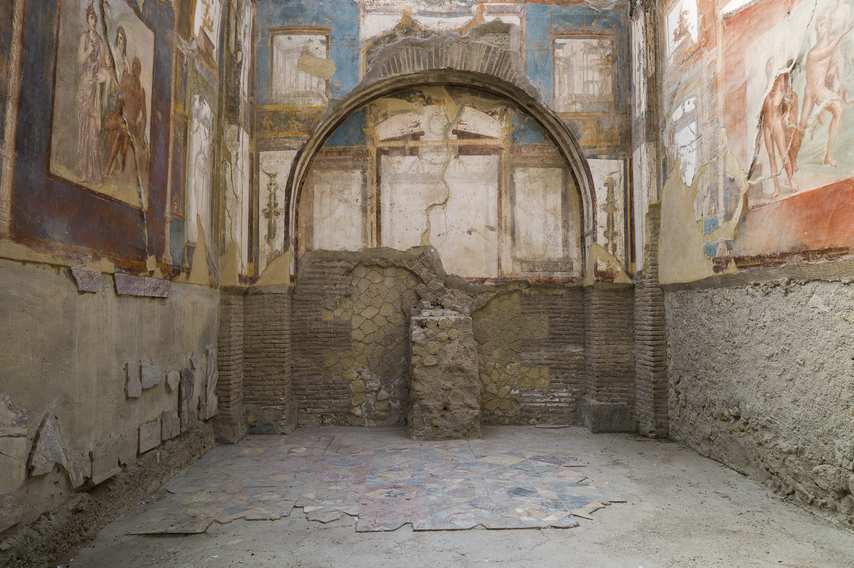
Herculaneum was covered by a blanket of mud and pyroclastic material between 10 and 25 meters thick, which sealed most of the buildings, encouraging extraordinary preservation of wooden structures, architecture, and objects of daily use.
Over the centuries, a new settlement gradually arose above the remains of Herculaneum.
The ancient city’s memory was almost completely lost until, in the early 18th century, some chance excavations brought to light a large underground theatre, columns, marbles, and statues.
The news spread quickly, attracting the interest of the Bourbons and the whole of Europe, in the 18th century, when Grand Tour travellers were looking to Italy for the charms of classical ruins.
If the eruption of 79 A.D. ended the history of ancient Herculaneum, a second foundation, Resina, developed on the same lands: the new community grew under various feudal domains and redeemed itself from the baronial yoke in 1699.
Finally, in 1969, the name Resina was officially replaced by Herculaneum, in homage to the glories of the Roman city.
The Herculaneum Archaeological Park
The centrepiece of any visit to the city is undoubtedly the Archaeological Excavations of Herculaneum (Herculaneum Archaeological Park), which has been declared a UNESCO World Heritage Site along with Pompeii and Oplontis.
Unlike Pompeii’s excavations, those at Herculaneum are smaller in size but boast an exceptional degree of preservation, especially in terms of wooden structures and organic fabrics, which have remained sealed in the so-called “pappamonte” – a local term for solidified pyroclastic deposits that sealed the ruins.

At one time, the archaeological area directly overlooked the sea; today, the elevation difference from the current coastline is several meters, so much so that some of the most famous finds, such as the Roman boat kept in the “Boat Pavilion,” were located on the ancient beach.
Walking along the entrance walkway, one can immediately see the depth at which the original level of the Roman city lies.

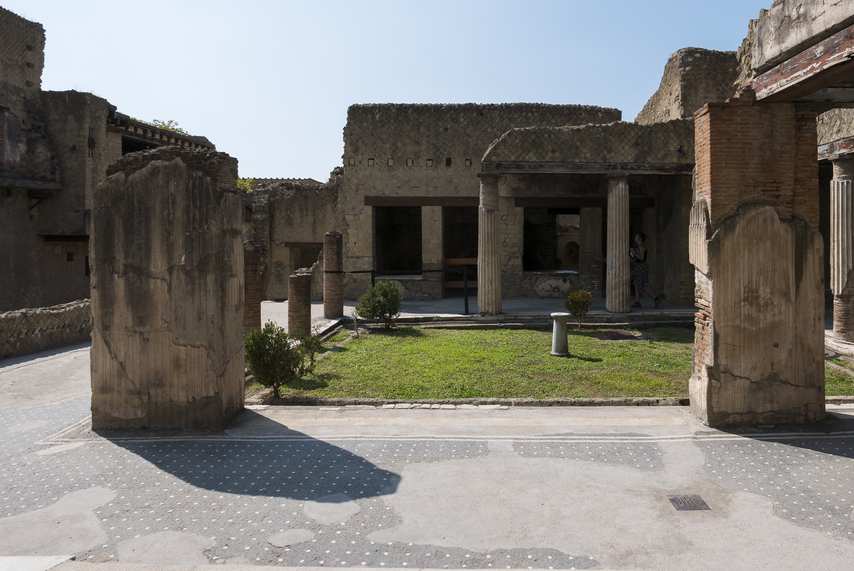
One of the most striking experiences is visiting Herculaneum’s private houses, which often feature multi-story terraces, polychrome frescoes on the walls and splendid floor mosaics. Among the best-known buildings are:
- The House of the Relief of Telefo is famous for a marble relief dedicated to Telefo, son of Heracles.
- The Bicentennial House, so called because it was discovered in 1938, two centuries after the first systematic explorations began (1738); a Latin inscription was found inside that some have associated with Christian symbols.
- The House of the Deer is characterised by a beautiful peristyle overlooking the sea and sculptures of deer in the act of being attacked by dogs.
- The Central Baths, an excellent example of a Roman spa facility with black and white mosaics.
- The Palaestra and the Forum Baths testify to the social and sporting vibrancy of the ancient community.
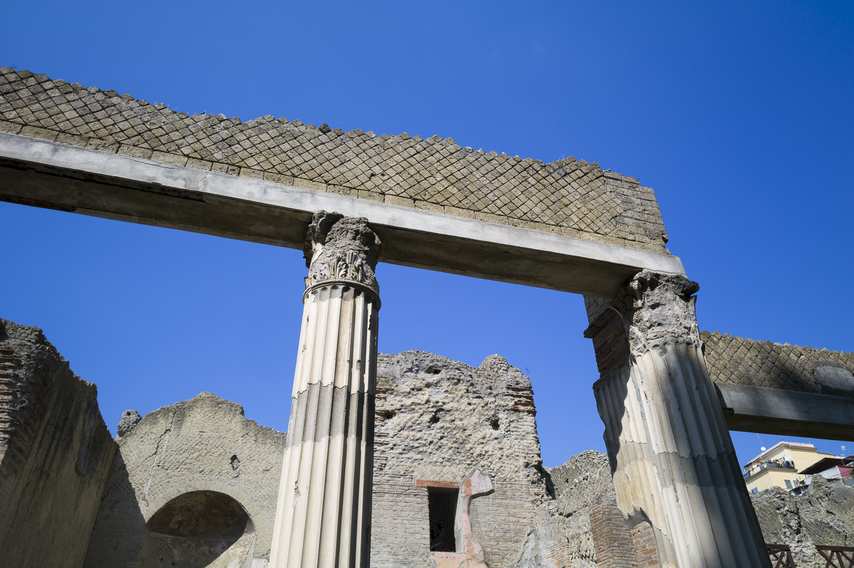
The tour route is enriched with information panels and a multilingual itinerary, which provides a better understanding of the history of the various rooms and pictorial decorations.
Since 2022, it has been possible, with prior permission or on certain guided tour days, to descend into the depths to admire the Roman Theatre, initially discovered in the 18th century and still partly buried under the modern city.
How to Reach Herculaneum
Herculaneum is well connected to Naples and other towns in Campania. For those coming from outside the region, Naples Capodichino Airport is about 15 km away. Then, by land, there are several options:
- By train: the “Ercolano Scavi” station of the Circumvesuviana, on the Naples-Sorrento and Naples-Pompei-Poggiomarino lines, is a few minutes’ walk from the entrance to the Scavi. Alternatively, the Portici-Ercolano station on the Naples-Salerno national railway is another arrival point, from which one can continue by bus or cab.
As an alternative to the Circumvesuviana, you can take advantage of the Campania Express, a tourist train designed for visitors, with guaranteed seats, air conditioning and space for luggage.
It connects major tourist destinations such as Naples, Herculaneum, Pompeii, and Sorrento, about 30 minutes from Naples to Pompeii.
The cost is €15 one way or €25 round trip, with tickets purchasable online, at ticket offices or through Trenitalia with a 10% discount for those arriving by train.
You can freely hop on and off at intermediate stops.
Trains offer comfort and tourist information and are partially accessible; details on accessibility are available at 800211388.
- Car: The A3 (Naples-Salerno) highway has two exits, “Ercolano-Portici” and “Ercolano Scavi.” From both, the city centre can be reached in a few minutes. In Corso Resina, near the entrance to the Scavi, there are paid parking lots and equipped parking areas.
- Bus: From Naples, suburban lines (ANM 5, 176, and 177) connect the Portici FS station area to Herculaneum (centre and hilly areas). A collective cab service is stationed near the Circumvesuviana station in Herculaneum.
The Archaeological Park Experience: Useful Information
To better organise your visit to the Herculaneum Archaeological Park, here is some practical information:
- Hours and tickets: The archaeological park is open every day except January 1, May 1, and December 25 (always check official communications for any changes). To avoid long waits, making reservations online or arriving early in the morning is advisable, especially in high season.
- Access: The main entrance is on Corso Resina, which has a large reception area with refreshments, toilets, and recently enhanced level parking.
- Guided tours: Although the information panels are comprehensive, hiring a licensed guide will allow you to grasp every detail and fully understand the differences between life in Herculaneum and nearby Pompeii.
- Safety and clothing: Much of the tour takes place outdoors on ancient pavements or modern walkways; therefore, it is a good idea to wear comfortable shoes, bring water, a head covering, and sunscreen during the hottest times of the year.
- Time organisation: to visit the Herculaneum Archaeological Park in depth, it is advisable to devote at least half a day. Adding the MAV and perhaps one or two Golden Mile villas can easily fill the day.
- We recommend you take the tour with a guide, possibly an archaeologist. It is an experience that completely changes the way you see things. It is not just a visit, but a journey through time, where every detail comes alive thanks to the explanations of someone who knows every site’s nook, cranny, and story. By purchasing this ticket, you will discover things you would not notice and understand how special this place is. If you have the chance, don’t miss it, it is worth it:
The Virtual Archaeological Museum (MAV)
Next to the archaeological area, a recommended stop is the MAV, Virtual Archaeological Museum.
Here, technology and interactive research come together to “reconstruct” specific environments, such as streets, houses and places of worship of ancient Herculaneum.
Thanks to 3d projections, multimedia installations and virtual reconstructions, visitors can “immerse” themselves in the daily life of the 1st century AD, observe what the original paintings looked like or follow the stages of the eruption of Vesuvius.
The MAV, opened in 2008, offers a complementary experience to the Excavations. If one directly admires the ancient city’s material remains in the Archaeological Park, one is transported by visual and sound reconstructions, which help one understand what the architecture and urban spaces must have looked like in colour.
It is a popular opportunity for younger people, families, and history and technology enthusiasts.
The Villas of the Golden Mile and the Charm of the 18th Century
Often, those who come to Herculaneum to admire the remains of the ancient Roman city are unaware of another treasure: the Vesuvian Villas of the Golden Mile, a stretch of road (Corso Resina) that runs from Herculaneum to Torre del Greco.
This stretch of road is known for its concentration of splendid eighteenth-century residences commissioned by kings and nobles of the Kingdom of Naples.
In particular, the most famous residences include:
Villa Campolieto, designed by the great architect Luigi Vanvitelli, is distinguished by its scenic double-ramp portico overlooking the sea and its precious interior frescoes.
Villa Favorita is so named because Queen Maria Carolina of Habsburg particularly prized it. Purchased in 1792 by King Ferdinand IV of Bourbon, it features a park that extends down to the sea and a royal landing place that still exists.
Villa Aprile (formerly Riario Sforza) and Villa Ruggiero, home to the latter, to the “Giovanni Buonajuto” civic library.
The complex of more than one hundred Vesuvian villas, scattered among the municipalities of Herculaneum, Portici, San Giorgio a Cremano, Barra and Torre del Greco, is protected by the Fondazione Ente Ville Vesuviane, which has been involved in the restoration, enhancement and opening to the public of many of these mansions since 1971.
Visiting at least one or two of these villas, including Villa Campolieto (open year-round for exhibitions, cultural events and concerts) and the park portion of Villa Favorita, is a journey into the art and history of 18th-century Naples.
Herculaneum’s Cultural Heritage: From the School of Resina to religious Traditions
Herculaneum is not only archaeology. It was an important artistic and cultural centre during the nineteenth and early twentieth centuries.
Suffice it to recall the School of Resina, founded by the painter Marco De Gregorio in 1863.
This school was characterisedby painting “from life,” close to the Macchiaioli current, and counted among its protagonists artists such as Giuseppe De Nittis, Federico Rossano, and Adriano Cecioni.
The city was also a place of residence and inspiration for various intellectuals and politicians. Famous is Gabriele D’Annunzio’s stay at Villa D’Amelio, where he lived between 1892 and 1893, which influenced some of his works from the Neapolitan period.
Prominent figures such as Adriano Tilgher, philosopher and literary critic, and Amadeo Bordiga, among the founders of the Communist Party of Italy, were also born here.
Another important cultural aspect is religious devotion, particularly to Our Lady of Pugliano, whose basilica, built on the hill of the same name, is the main church in Herculaneum and the oldest in the Vesuvian area.
Along with the Madonna, the cult of St. Gennaro, protector against volcanic eruptions, is widespread: not surprisingly, busts and statues of the saint often look in the direction of Vesuvius, in defence of the city.
The Pugliano (or Resina) Market
The Pugliano market, known as the “Resina market” (named after the former name of Herculaneum), offers a lively glimpse of the post-World War II era.
Established as a sale of military uniforms left behind by American troops during World War II, it soon became a celebrated second-hand market specialising in vintage clothing, leather, and accessories.
By the 1960s and 1970s, it was famous throughout Italy and beyond, to the point that it even attracted movie costume designers looking for vintage garments.
Despite having experienced several crises and downsizing, the Resina market retains a certain charm, both because of the availability of rare and original pieces and because of its location in the historic centre of Herculaneum, near Piazza Pugliano. Here, you can take a step back in time as you browse through the many stalls that still display items from all over the world.
Local Gastronomy and Typical Products
Herculaneum is not only a culture, but also a flavour. As a town at the foot of Vesuvius and close to the sea, local cuisine ranges from fish dishes to garden specialities. Famous, for example, is the production of Vesuvius piennolo tomatoes, small, intensely sweet tomatoes, grown on volcanic soils.
Here you can also taste traditional Neapolitan dishes such as pizza, pasta with friarielli, and various desserts made with ricotta, cream, and chocolate.
Local wines (such as Lacryma Christi del Vesuvio) and artisanal limoncello are good choices for those looking for a gastronomic souvenir.
There is no shortage of restaurants and trattorias along Corso Resina and neighbouring streets offering fresh seafood menus and pubs and clubs to spend the evening.
Here is a suggestion for an excellent dining experience in a modern osteria in the heart of the Golden Mile:
Viva Lo Re
Corso Resina, 261 – Herculaneum
Tel: 081 7390207
Tuesday – Saturday: 12:30 – 15:30 | 19:00 – 23:00
Sunday: 12:00 – 16:00
Sunday evening and Monday: closed
Located along Herculaneum’s prestigious Golden Mile, Viva Lo Re stands out for its cosy atmosphere and thoughtful aesthetics. Its elegant furnishings and large windows create a bright and refined ambience.
The cuisine strikes a perfect balance between tradition and innovation, offering both land and seafood dishes.
Specialities include the Viva Lo Re appetiser, linguine with chicory and shrimp, blue lobster ravioli, spaghetti aglio, olio e fonduta di parmigiano, raw and cooked amberjack, stuffed veal and baby squid on white onion stew.
Desserts include the cream and black cherry pasticciotto and the chocolate tris, considered a real must.
The wine list is impressive. A large selection is displayed on the walls, allowing guests to choose from numerous labels.
Service is attentive and friendly, contributing to a pleasant and relaxing dining experience. Viva Lo Re is an excellent choice for those wishing to enjoy Campanian cuisine in an elegant and modern setting.
The Renaissance of Herculaneum: Between Conservation and Sustainable Tourism
In recent decades, Herculaneum has undergone a rediscovery and revival phase. On the one hand, the crisis of some industrial sectors and building expansion that was not always controlled has created significant challenges; on the other, UNESCO recognition and cultural promotion have encouraged greater attention to recovering the artistic and architectural heritage.
Today, thanks to the efforts of institutions, associations and private individuals, the focus is on sustainable tourism, respectful of the environmental context (the presence of Vesuvius and the National Park is a key element), and capable of enhancing the local economic fabric, from crafts to quality commerce.

Projects completed or in progress include:
- The restoration and reopening of important historic villas in the Golden Mile.
- The expansion and arrangement of the access area to the Excavations, with a renovated parking lot and new paths.
- Promotion of cultural and musical events, festivals, and temporary exhibitions at Villa Campolieto and in the spaces of the Fondazione Ente Ville Vesuviane.
- Integrating traditional crops, such as Vesuvian vineyards and orchards, into food and wine tours preserves them.
From Herculaneum’s City Centre to Mount Vesuvius
Another element that characterises Herculaneum is its privileged position on the slopes of Vesuvius, one of the most famous volcanoes in the world.
In fact, the road that leads to the Gran Cono starts from Herculaneum. It is a scenic route that climbs towards the Vesuvius National Park and allows you to get closer to the crater, which can be reached on foot in the last sections (the walk takes about 30-40 minutes uphill).
The hike to Vesuvius is a unique opportunity for those who want to observe the volcano up close and admire a breathtaking view of the Gulf of Naples and the islands of Capri, Ischia, and Procida.
Along the way, you can visit the Vesuvius Observatory, founded in 1841 and considered the world’s first volcanological observatory. It is now home to a small museum. In addition, a contemporary art installation, “Creator Vesevo,” displays ten sculptures made of lava stone by internationally renowned artists outdoors.
An Alternative Way to Explore Vesuvius: Vesuvius Express
If you want an even more convenient and organised experience, you can book a tour that leaves directly from Herculaneum and takes you to the top of Vesuvius. With the Vesuvius Express service, you’ll have everything you need to visit the volcano with total peace of mind.
What the tour includes:
- Skip-the-line ticket for access to the Vesuvius National Park.
- Round-trip transportation from Herculaneum to the National Park.
- Expert volcanological guide to discover the secrets of the volcano.
Vesuvius Express offers the shortest and most spectacular route to admire the Great Cone and breathtaking views of the Gulf of Naples, Capri, Ischia, and Procida. This is the perfect opportunity to immerse yourself in the nature and history of one of the world’s most iconic volcanoes. Don’t miss this adventure!
Pompeii: The “Big Sister” of the Herculaneum
Once a visit to Herculaneum is over, it is impossible not to consider a trip to Pompeii, just a few kilometres away.
If Herculaneum Archaeological Park offers an intimate and exceptionally well-preserved experience (thanks to the solidified mud that has kept many objects intact), Pompeii impresses with the breadth of its Archaeological Park, which houses forums, temples, theatres, residential quarters and workshops spread over a vast area.
Visit both Herculaneum and Pompeii to get a comprehensive view of life in Roman cities on the Bay of Naples before the disaster of 79 AD.
For many travellers, discovering these two locations represents a unique experience that can reconnect the present with the past in a fascinating journey.
For this very reason, there are combination packages, which invite tourists to devote at least two days to exploring the two archaeological sites:
Conclusions: An Invitation to Discover Herculaneum
If you plan a vacation in the Gulf of Naples, don’t miss the opportunity to include Herculaneum in Campania among your priority destinations.
The unique appeal of the Herculaneum Archaeological Park, unique in the world for the state of preservation of the finds, deserves to be paired with a visit to Pompeii, which is more extensive and equally fascinating, to complete your trip to ancient Rome best.
At Herculaneum, you can combine history and art, visit the MAV for a virtual immersion in the past, explore the villas of the Golden Mile, sample the delicacies of Campania’s cuisine and indulge in an unforgettable excursion to Mount Vesuvius, all within easy reach of Naples, a city of art and millennial culture.
This is a perfect combination for those who love variety: archaeological tourism, nature tourism, museums, and local folklore.
Herculaneum in Naples is not just an appendix to Neapolitan excursions, but an essential stop for any curious traveller interested in quality tourism. Let yourself be surprised by the beauty and complexity of this city, which has been reborn from the past and now offers one of Europe’s richest historical and cultural heritages.
FAQ About the Herculaneum Archaeological Park
For a complete experience, it is advisable to devote at least half a day to the Herculaneum Archaeological Park. If you would also like to visit the MAV (Virtual Archaeological Museum) and perhaps one or two of the villas in the Golden Mile, please budget for the whole day.
You can comfortably get there by train, with the Circumvesuviana (Naples-Sorrento or Naples-Pompei-Poggiomarino line) getting off at the “Ercolano Scavi” station, a few minutes’ walk from the entrance to the Scavi. Alternatively, the A3 highway (Naples-Salerno) has “Ercolano-Portici” and “Ercolano Scavi” exits. Suburban bus lines (ANM 5, 176, 177) and collective cabs are also available.
Although both were buried by the eruption of Mount Vesuvius in 79 A.D., Herculaneum is smaller but boasts extraordinary preservation of wooden structures and organic materials, thanks to the thick layer of solidified mud. Pompeii is much more extensive and offers a general picture of life at the time, with forums, temples and theatres over a larger area. If you have time, both are well worth a visit.
Yes, especially in high season. By booking online (even combined Pompeii + Herculaneum tickets or the Campania Express), you can avoid lines and plan for the day. In addition, a guided tour with an archaeologist makes the experience more in-depth and interesting.
Absolutely. The road to Vesuvius National Park starts from Herculaneum. Many visitors combine a visit to the excavations or the historic centre of Herculaneum with an excursion to the Great Cone in a single day. The Vesuvius Express tour, which includes transportation and a volcanological guide, is available if you prefer a more organised service.