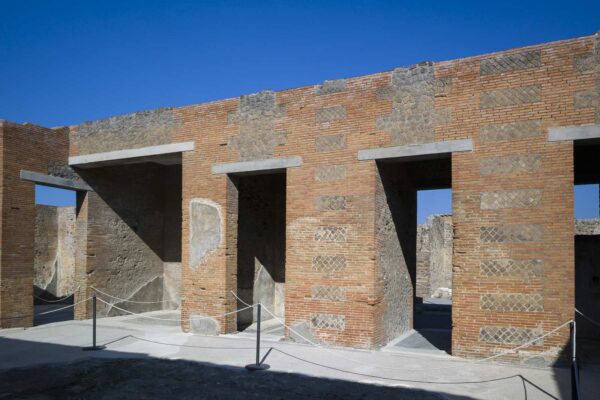
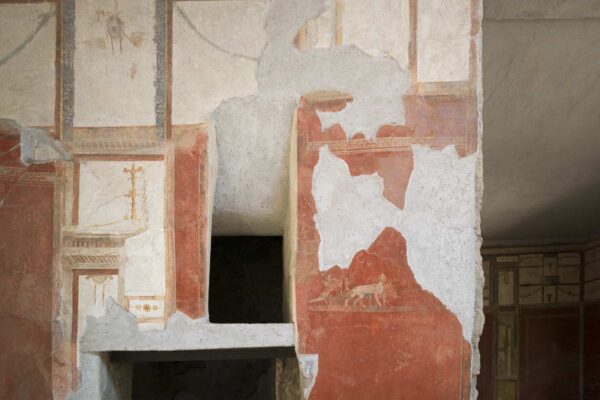
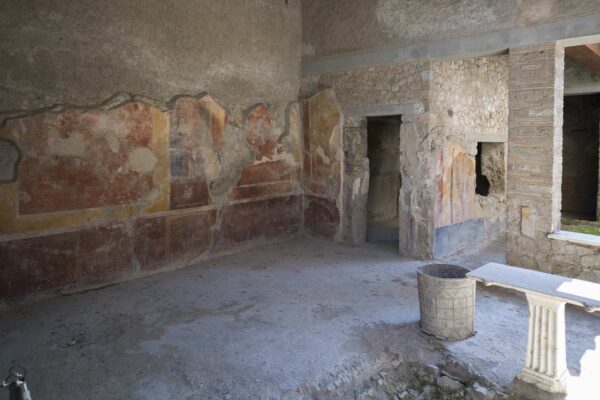
Pompeii often evokes images of the significant public buildings, theatres, temples and private domus decorated with splendid frescoes.
Yet the city buried by Vesuvius in 79 A.D. is still a site of surprises: ongoing excavations and restorations continue to return to us, nearly two millennia later, unique works of art and evidence of life in the Roman world.
A recent and sensational example is the House of Thiasus, so called because of the grandiose “megalographic” (i.e., with almost life-size figures) frieze depicting the procession of Dionysus, also known as the “Dionysian Thiasos.”
Where is it located?
Map of Pompeii: Regio IX – 10
Google MapsIntroduction
The House of Thiasus is located in Regio IX, Insula 10, in the central sector of Pompeii. Archaeologists unearthed it as part of an excavation and securing project that started in February 2023 and was financed with significant resources allocated by the Ministry of Culture.
The results, to say the least, are spectacular: in a room used for banquets, researchers discovered frescoes of rare beauty, dating back to the first century B.C., that illustrate the stages of an initiation rite into the mystery cults of Dionysus.
Why is this discovery so important? Until now, the only major pictorial cycle dedicated to the Mysteries of Dionysus was known from the celebrated Villa of the Mysteries.
The new “megalography” thus offers additional building blocks for understanding Dionysian religiosity as it was expressed in the private lives of ancient Pompeians.
The Urban Context: Regio IX, Insula 10
The area in which the House of Thiasus stands (Regio IX, Insula 10) is one of the nine large “regions” into which Pompeii is divided. The excavation in this area covered about 3,200 square meters, almost an entire city block of the ancient city.
Excavations revealed more than 50 newly uncovered rooms, spanning an area of over 1,500 square meters. Notable discoveries include two Samnite-era houses that were later renovated into workshops, a laundry or fullonica and a bakery equipped with an oven and millstones.
Further south, a large domus is also found, equipped with thermal rooms, decorated rooms, and a partially excavated peristyle (a garden with a colonnade).
It is in this large complex that the hall with the Dionysian Thiasos was identified. During the eruption of 79 AD, the entire block was buried under several layers of ash and lapilli.
Eighteenth-century excavations, of which ample traces remain (tunnels, galleries and trenches), heavily damaged parts of the complex, removing marble floors and pieces of fresco. Incredibly, however, the main frieze with the Bacchic scenes remained almost intact, saving itself from devastation.
A Masterpiece of the Second Style: What does “Megalography” mean?

Before we delve into the religious significance of the frescoes, let’s explain two terms that are fundamental to understanding the discovery. Second Style (Pompeian painting) refers to a style of painting that developed in Rome and Campania between the mid-1st century B.C. and the end of the 1st century B.C.
It is characterised by the use of architectural perspective and the depiction of elements in trompe-l’oeil (i.e., “deceive-the-eye”).
Typical are colonnades, faux marbles, and extensive urban or rural views that simulate a larger space than the real one. It is in this style that some of Pompeii’s most famous frescoes, such as precisely those in the Villa of the Mysteries, are to be found.
The term megalography derives from the Greek and means “large painting”; it indicates a cycle of frescoes in which the figures are depicted life-size or slightly smaller. This gives a remarkable visual impact, so much so that it gives the impression that human or divine figures “come out” of the wall to invite the viewer into an immersive experience.
In the House of Thiasus, this pictorial format becomes the perfect medium for narrating the procession of Dionysus, known as the Thiasos, with bacchae and satyrs engaging in scenes of dance, hunting, and sacrifice.
Particularly striking is the figure of a woman, a possible initiate, who, according to archaeologists’ interpretation, is about to enter the mysteries of this deity, so beloved in the Greco-Roman world.
Dionysus and the Mystery Rites
The star deity of the frescoes found in the House of Thiasus is Dionysus (also known as Bacchus to the Romans), the god of wine, ecstasy, fertility, and renewal. While at first glance Dionysus might appear to be merely the patron of banquets and wild parties, the ancient religious reality was much more complex: there were secret cults called “mysteries” (from the Greek etymon myein, “to close”-referring to the lips or eyes-to guard the secrets of the rite), accessible only to those who passed a particular initiation rite. In return, the deity promised knowledge, protection and, in many cases, a new afterlife.
In Pompeii, the cult of Dionysus was far from rare. The presence of numerous Bacchic depictions in frescoes, mosaics, and household objects testifies to its popularity.
The Villa of the Mysteries itself owes its name to a large frieze that illustrates a Dionysian ritual. Female figures, satyrs, and the god himself appear in one of the most famous paintings in the entire Vesuvian area.
With the House of Thiasus, discovered more than a century after that of the Villa of the Mysteries, we come into contact with another similar pictorial cycle, but with significant variations. It speaks of hunter bacchae, depicted with a slaughtered kid on their shoulders or while wielding a sword and the entrails of an animal.
These are strong images, reminiscent of the mythological figure of the maenad, a woman in the grip of divine ecstasy, capable of abandoning ordinary life to follow the god among woods and mountains.
The Significance of the “Hunt” in the Cult of Dionysus
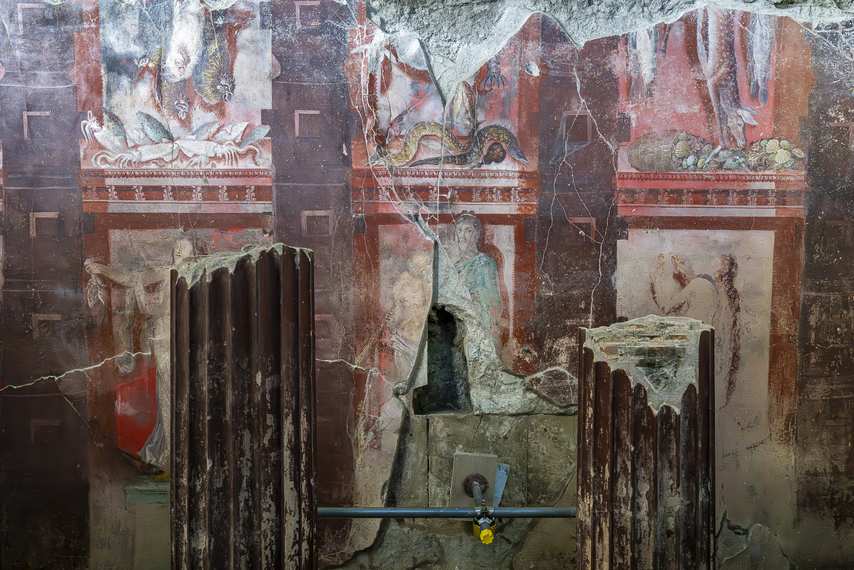
One of the most original elements in the frieze of the House of the Thiasus is the theme of hunting. While Artemis (Diana) represents the fair hunt governed by sacrificial norms, Dionysus and his Bacchae, by contrast, embody the “frenzied hunt.”
In Euripides’ Bacchae, a tragedy from 405 BCE, the image of a woman abandoning home and domestic duties to roam the mountains becomes a powerful metaphor for rebellion against social norms. Hunting thus becomes a liberating, yet terrifying, moment in which the maenad kills and tears animals apart with her bare hands.
In the House of Thiasus, this is reflected both in scenes showing wounded and disembowelled animals and in a smaller frieze (placed above the main one) where fish, birds, and other animals appear, as if they were “spoils” of this savage hunt.
The overall message is very theatrical: on the one hand, festivity and music (with flute-playing satyrs); on the other, the frenzy of these female figures, embodying ecstatic abandon and, after all, the primal power of nature.
The Initiate and the Torch-Bearing Silenus
In the centre of the composition, a scene stands out in which an old Silenus, that is, a half-man, half-animal being (his companion, the satyr, has pointed ears and a horse’s tail), holds a torch and accompanies a deadly serious woman.
It looks like a real “handover”: the maiden is about to be introduced to the mysteries of Dionysus, symbolised by the presence of mythical figures and the suggestion of a nocturnal ritual.
In contrast to the Villa of Mysteries, where Dionysus is present enthroned beside Ariadne, here the god is the great absentee; yet, everything revolves around him, as if he were “behind the scenes,” ready to receive the new adept.
Silenus, with his torch, is a characteristic element of many Dionysian rites. The dim light suggests a mysterious atmosphere and alludes to nocturnal ceremonies. It is an image also found in vascular representations and other paintings, where followers of the god appear armed with torches to celebrate sacrifices and ritual banquets.
Why “House of Thiasus?”
Archaeologists chose to christen the dwelling with the name “House of Thiasus” precisely because of the Dionysian procession (thiasos). This technical term in Greek religion denotes the group of participants in the cult, including bacchae, satyrs, Silenus, and others. In our fresco, these characters are depicted almost life-size.
Although they appear as statues placed on pedestals, their movements and expressions are incredibly vivid and dynamic.
For the ancients, however, this was more than just decorating the triclinium (banquet hall); it was a way of combining art with religiosity, of recalling festivals and processions that played a deep role in the Greco-Roman mindset.
By the first century B.C., however, Dionysian cults had long been subject to various restrictions and interpretations, as evidenced by the famous senatus consult that in 186 B.C. had sought to suppress the Bacchanalia in Italy. In Pompeii, people continued to evoke the Bacchic world, but in more domestic, private, and, to some extent, theatrical forms.
Visits and Access to the House of Thiasus

A particularly fascinating aspect of this discovery is that, from the earliest stages of excavation, the House of Thiasus has been open in a “visitable building site” mode.
Visitors to Pompeii, Monday through Friday at 11:00 a.m., can participate in a dedicated tour that allows them to observe the excavation and restoration work up close. Two groups of 15 people each, accompanied by site staff, have the opportunity to admire the rooms with the Dionysian megalography and learn about the methods used by archaeologists to explore the site.
Reservations
- Reservations must be made by calling +39 327 2716666, operating from 9:30 a.m. to 1:30 p.m., Monday through Friday.
- Reservations are required because access is limited to a small number of visitors for security and artefact protection reasons.
Duration and Modalities
- The visit lasts about 45 minutes.
- It is accompanied by site staff, who illustrate the most significant findings.
- It is compulsory to have a regular entrance ticket to the Pompeii Archaeological Park.
Meeting Point
- Via Nola (Nola Street), at the northwest corner of Insula 10 of Regio IX, between Via Nola and Vicolo dei Gladiatori (Gladiator Alley).
The Importance of Discovery
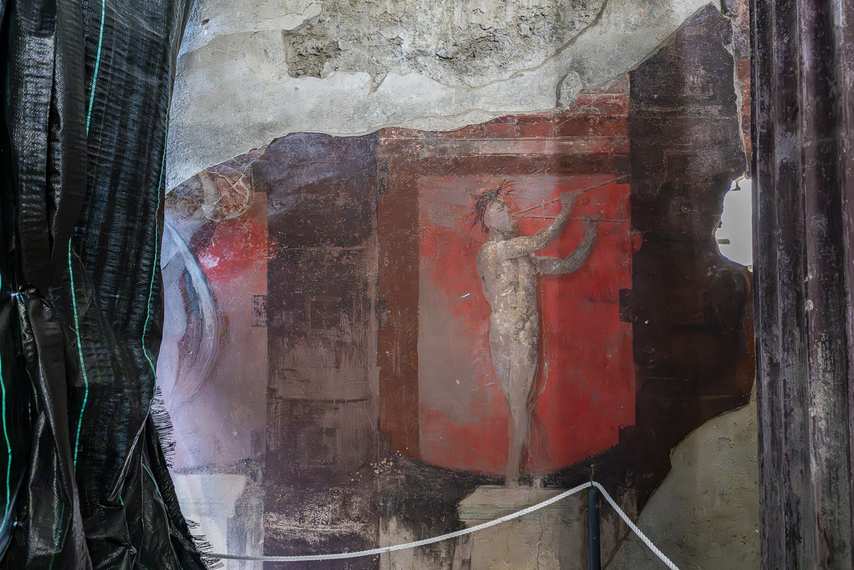
Why is this discovery so extraordinary? From an artistic point of view, the House of Thiasus represents the second known example of a nearly life-size fresco with a Dionysian subject in Pompeii, after the Villa of the Mysteries. Although there are other frescoes of the II Stile in the city, it is infrequent for them to illustrate scenes of initiation and bacchic hunting with such a dramatic slant.
In religious terms, the fresco reveals new details about the Mysteries of Dionysus, supplementing the knowledge we already possess from other archaeological and literary sources. The hunting element was known in Dionysus-related tragedies and myths, such as Euripides’ Bacchae, but had rarely been depicted in such an explicit pictorial form.
The contrast between female ecstasy and the domestic dimension (a banquet hall) sheds light on how the Pompeians lived and reinterpreted the Dionysian cult, mixing devotion, celebration, and artistic ostentation.
From a cultural tourism perspective, the news that the House of Thiasus can already be visited in “open-site” mode captures the interest of those who want to see “live” how an archaeological excavation is carried out. This is more than a static monument; it’s a place where archaeology happens right before the public’s eyes.
This experimental formula, which has been used in the past in other areas of Pompeii, allows people to understand the various levels of interpretation: architectural, pictorial, geological and even sociological.
An Immersive Post-Excavation Experience
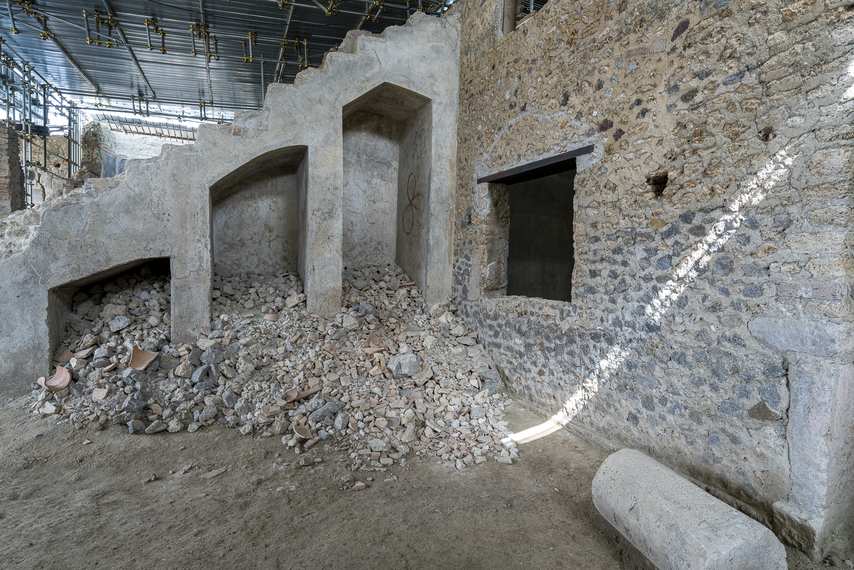
Excavation work in the House of Thiasus is drawing to a close, with the final steps of securing and restoration.
The ultimate goal is to ensure that all visitors, not just small groups, can enjoy the room permanently in the future. For now, those who manage to book a visit on one of the available dates and times can enjoy the unique experience of stepping onto the grounds of a working archaeological site.
It is important to remember that the Dionysian Thiasos Hall is not yet on a 100% museumized route.
This means that the visitor can experience the intricacies of archaeological work, which includes stratigraphic analysis, consolidating pictorial surfaces, cleaning plaster, and studying the finds.
This is an approach that enriches the classic “spectator” visit and brings tourists very close to the reality of the archaeologist’s craft.
A Parallelism with the Villa of the Mysteries
The question on everyone’s mind is, “How does this discovery relate to the Villa of the Mysteries?” The large frieze in the villa outside the walls of Pompeii remains one of the masterpieces of ancient art, featuring scenes of female initiation into Dionysus, complete with symbolic figures and a young woman undergoing various trials and purifications.
In the House of Thiasus, the theme of initiation is equally evident, but a wilder component is added, related to hunting and ritual dismemberment.
We could say that the discovery “integrates” the Pompeian Bacchic imagery, showing us a crueller and bloodier side of the god.
While in the Villa of the Mysteries the figure of Dionysus appears enthroned, here we do not see him at all, as if to emphasize that the crucial moment of initiation is the absence/presence of Dionysus: the god is elsewhere, ready to receive the young adept, but his influence is manifested in the dancing bacchae and in the ritual tension of the entire composition.
Conclusions: A Dive into the Most Secret Pompeii
TheHouse of Thiasus is not just a new public space: it is a convergence of art, religion, and history, capable of surprising both casual visitors and archaeology enthusiasts.
Its Style II frescoes, the depiction of Bacchae and Satyrs, the centrality of the Dionysian rite, and the dramatic character of the hunting scenes make it unique in Pompeii, while complementing the more famous frieze of the Villa of the Mysteries.
If you have already visited Pompeii, returning to discover the House of Thiasus may prove to be an equally exciting experience. You will see the work in progress, experience the reality of an active excavation site, and discover an aspect of Dionysus-the frenzied hunter, the god of uncontrolled passions-that enriches and complements the Bacchic imagery developed over the past centuries.
Each additional step through ancient Pompeii helps bring the Roman world vividly back to life, opening us up to ever-new perspectives on its religion, art, and everyday life.
FAQ about the House of Thiasus
It is located in Regio IX, Insula 10, in the central area of Pompeii. It can be reached by entering the main entrances to the excavations and walking along Via di Nola. The construction site is well marked along the way. Link to Google Maps: https://maps.app.goo.gl/LEpo3x9o2BKBBZCt6
The name comes from the extraordinary megalography fresco depicting the procession (thiasos) of the god Dionysus, with satyrs and bacchantes. This dwelling was so named to emphasise the Dionysian theme of the frieze.
Monday through Friday, at 11 a.m., you can join a 45-minute tour in two groups of 15 people each. Reservations can be made by phone at 327 2716666, and you must have a ticket to the excavations. During the tour, site staff illustrate the environment with the Dionysian frescoes and explain the stages of excavation and restoration.
While sharing the same Dionysian theme, the House of Thiasus presents more “wild” and bloody scenes, with bacchae engaged in hunting and sacrificial activities. Moreover, the figure of enthroned Dionysus, central in the Villa of the Mysteries, is missing here.
Yes, but since this is a construction site area, access is restricted, and sturdy footwear is recommended. Some of the hunting and sacrifice scenes may be strong, but the pictorial ensemble remains of great charm and interest, even to a non-specialised audience.