Among the most spectacular and fascinating monuments of the Pompeii Archaeological Park, theLarge Theatre stands out for its size, history and cultural relevance. Located near the Doric Temple, the theatre took advantage of the natural slope of a hill, in full Hellenistic style, to accommodate thousands of spectators.
Over the centuries, it has undergone restorations and extensions that have gradually brought it closer to the Roman architectural model, while retaining peculiarities of the Greco-Samnite style.
Built around the middle of the second century B.C., but preceded by an earlier structure in the Samnite period, the Large Theatre represented a crucial centre of the city’s social life.
Comedies, tragedies, and forms of entertainment such as mimes, pantomimes, and atellas were performed here. Much of the information we possess today comes from inscriptions on site and archaeological evidence, brought to light thanks to excavation campaigns that began as early as the Bourbon era and continued over the following centuries.
Today, its imposing cavea, stage, and distinctive “horseshoe-shaped” structure are must-sees for anyone wishing to immerse themselves in the culture of ancient Pompeii.
Where is it located?
Map of Pompeii: Regio VIII – 10
Google MapsHistorical Background
Samnite Origins and Remaking in the Hellenistic Period

The earliest version of the theatre most likely dates back to the Samnite age (4th-3rd centuries BC), when Pompeii was still under the influence of these people. From Campania to Molise, the Samnites erected several theatres with an elongated U-shaped plan, typical of Greek-Hellenistic traditions.
The remains of this early construction phase have been identified thanks to the analysis of the stone walls and the original conformation of the cavea, which takes advantage of the conformation of the terrain.
With the gradual Hellenization of the Campanian area and Greek architectural influence, the theatre of Pompeii took on features closer to Hellenistic models. One such feature was the choice to build the cavea on a slope, a solution that facilitated the construction of the tiers of seats without having to develop imposing artificial supports.
The separation of cavea (tiered seating) and scaena (stage) also harkens back to Greco-Italic models, where the two sectors were often distinct and sometimes connected by side corridors called parodoi.
Renovations in Roman Times
In the 2nd century BC, the Large Theatre was renovated entirely “according to Roman taste,” as some inscriptions record. Between 80 and 70 BC, new sectors were built as the city became a Roman colony, including the summa cavea (the highest part of the steps, dedicated to lower-class spectators) and the tribunalia (boxes reserved for distinguished people).
One of the most active families in these interventions was the gens Holconia, to whom several celebratory epigraphs commemorating the modernisation work financed out of their pockets date back.
In the Augustan age (late 1st century B.C.-early 1st century A.D.), the theatre underwent further improvements: the velarium, a large sheet that protected spectators from the sun, was added, and the tiers of seats were numbered.
An inscription, located at the entrance to the east access corridor, mentions a freedman, traditionally considered of lower social rank, testifying that even people of “lower social rank” could take on the role of builders and curators, effectively making public construction a crucial area of social mobility.
The decline and rediscovery
Like the rest of the city, the Large Theatre was damaged by the earthquake of 62 AD and then buried by the eruption of Vesuvius in 79, remaining hidden until the first excavation campaigns in the Bourbon era (between the mid-18th and early 19th centuries).
During the excavations, the excellent masonry and structure of the cavea resurfaced, allowing us to appreciate the complex architectural evolution of the theatre.
While the stage was partly damaged and not completely rebuilt, the cavea was partially restored to restore the idea of its former splendour.
Today, the theatre is employed in the summer months for outdoor musical and theatrical events, giving visitors the thrill of attending a performance in a unique setting.
Architecture and Structure
Quarry and Sectors
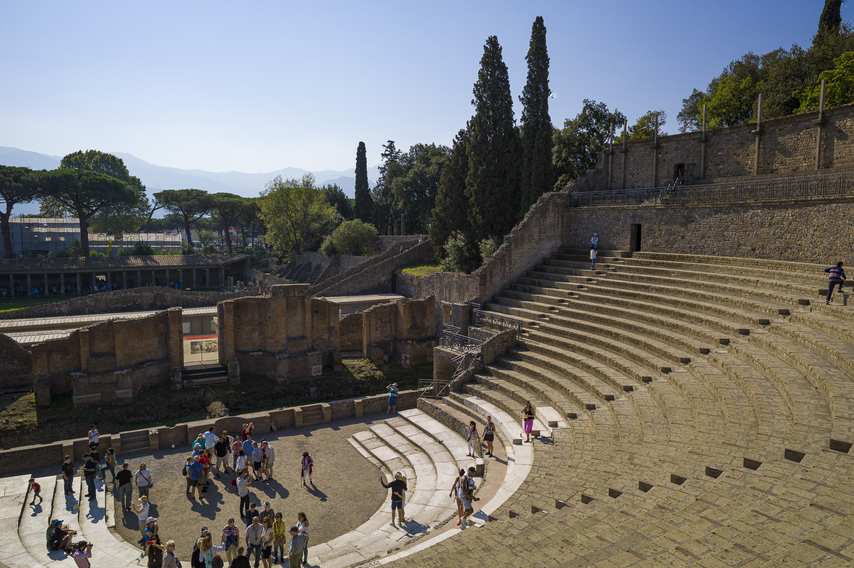
The Large Theatre has the characteristic “horseshoe” shape (sometimes called elongated U-shaped), a type more similar to the Hellenistic than the Roman, often hemicycle. The cavea is divided into several zones:
- Ima cavea: the lowest part, once covered with marble and reserved for the authorities and decurions (city council members). From the ima cavea, it was possible to see the scene frontally, with considerable visual privilege.
- Media cavea: The middle section is the largest and usually the best for viewing the performance, intended for corporations and wealthy citizens.
- Summa cavea: the highest section of the tiers, intended for the less affluent classes. Following the earthquake of 62, many of the barrel vaults that supported this section collapsed, and only a partial section remains today.
Each area was divided into five sectors (wedges), separated by radial stairs that provided access to the seats. The seats could also be numbered, as attested by some fragments showing small engraved numerals.
Tribunes and Parodoi
Several tribunalia, or special boxes (or small tribunes of honour) strategically placed for a perfect view of the stage, completed the audience area. Parodoi (covered side aisles) also allowed spectators to quickly reach the orchestra or access back courtyards and the nearby Triangular Forum.
Additional tiers of seats rested on the parodoi, another peculiarity of this theatre and probable evidence of renovations after the Greco-Hellenistic phase.
Orchestra and Stage
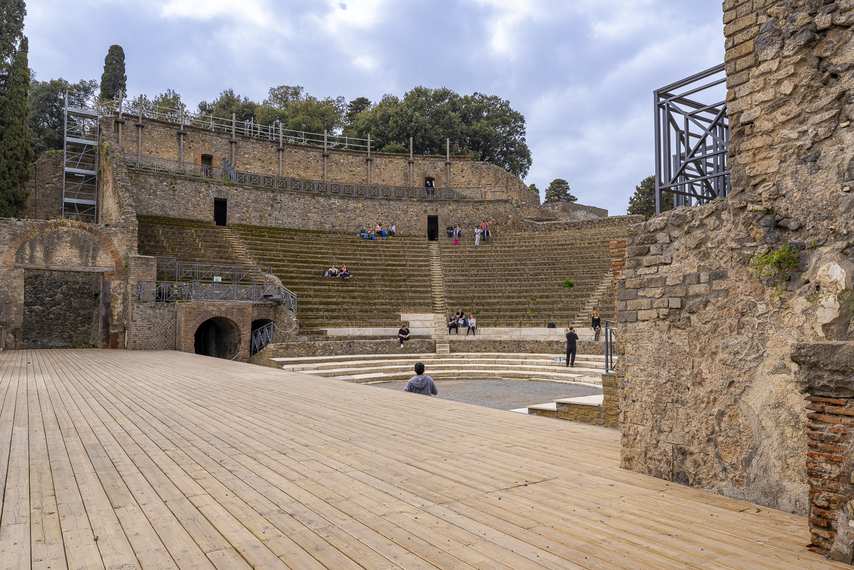
The orchestra is that semicircular (or horseshoe-shaped) area between the cavea and the scaena. During the Greco-Hellenistic era, it was used for choreography and as part of performances.
At the same time, in Roman times, it tended to be a space reserved for prominent figures (e.g., senators), provided with special seating. The sides of the orchestra were accessed via the two covered parodoi.
The stage (scaena) was elevated, about five feet from the orchestra level. The front had two ladders that allowed actors to climb onto the stage or descend to the orchestra. An imposing architectural backdrop (scaenae frons) with several rows of columns and niches, with stage doors, was developed on the scaena.
This backdrop often imitated the facade of a princely palace, adorned with statues and reliefs, and served as a background for performances. Unlike modern curtains descending above, the curtain (auléum) rose from below, sliding in a slot.
Velarium and Covers
A particularly ingenious aspect of the large theatre was the possibility of covering the cave with a velarium, a large curtain that protected spectators from the sun on hot days. Some perforated blocks along the upper end of the cave reveal the presence of poles on which the curtain was attached.
The mechanism, operated by a group of trained sailors or slaves, allowed the curtain to spread and retract, providing shade and coolness for much of the audience.
Spectacular Capacity and Functions
In its heyday, the Large Theatre could accommodate about 5,000 spectators, a considerable number for a city like Pompeii, which had a population of around 10-12,000.
Each had a well-defined place according to social class: senators and decurions in the first rows (ima cavea), the better-off citizens in the middle cavea, the people in the summa cavea, and the most important visitors in reserved boxes.
Comedies and tragedies in the Greco-Roman tradition were performed, as well as mimes, pantomimes, and atellanes, genres that were very popular and sometimes closer to the taste of local audiences.
For example, in the comedies of Plautus and Terence, music, singing, and dancing played a prominent role, while tragedies could rely on more sombre and solemn sets. Mimes and atellanes often resorted to farce, the grotesque and improvisation, while also depicting moments of intense realism and social criticism.
Pompeian audiences were thus accustomed to a wide range of performances.
From the 18th Century to the Present: Rediscovery and Restoration
Bourbon Excavations
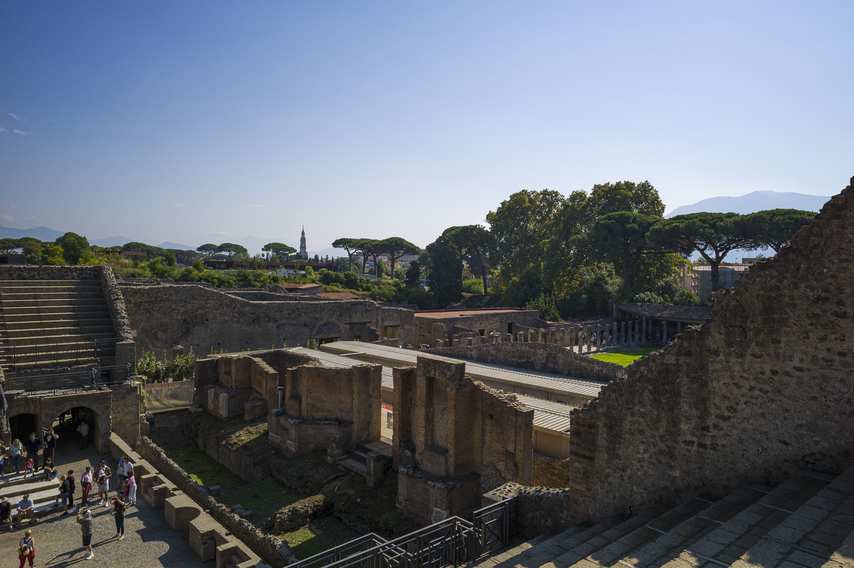
With the advent of the Bourbon dynasties in the Kingdom of Naples in the second half of the 18th century, archaeological excavations, including the theatre, began that unearthed much of the Pompeii area. Between 1764 and 1794, workers and scholars had already explored volcanic sediments, removing debris and lapilli.
The fascination of these excavations influenced many European artists, giving rise to the so-called “Grand Tour“, which brought nobles, writers and artists to visit Vesuvius and the ruins of the ancient city.
From Contemporary Use to Recent Restorations
During the 20th century, theLarge Theatre began to be used for summer concerts, operas, and theatrical performances.
The surviving tiers of the cave were partially restored, recreating, albeit in a reduced way, the original atmosphere.
The current capacity is smaller than in ancient times (about 2,200 spectators as opposed to 5,000 at one time), but the scenic effect remains impressive.
In the early 2000s, further work led to the consolidation of the structure and the addition of removable seating, to preserve archaeological integrity as much as possible without sacrificing the cultural use of the theatre.
Although they did not reconstruct the scaena as it was in Roman times, it allows visitors to see an example of what it was like to attend a performance in antiquity, stepping into a unique and evocative context.
Visiting Experience

What to Watch For
- Cavea: Admire the horseshoe shape and the partially reconstructed steps, and imagine the huge crowds that filled the stands during a performance by Plautus or Seneca.
- Parodoi and tribunalia: Pay attention to the access corridors and any remnants of the boxes of honour.
- Scaena: Although partially reconstructed, it offers a glimpse of the pomp of ancient stage design. A walk on the stage allows one to experience the thrill of being in the centre of a millennial theatre space.
- Structural details: Perforated blocks, niches and traces of the velarium mechanisms tell of Roman ingenuity in creating comfort for spectators.
- Back rooms: They lead to service courtyards and access steps. The remains of fountains and nymphaea are often found here, which is evidence of the desire to make the environment even more pleasant.
Shows and Events
The Large Theatre hosts musical events (operas, jazz or pop concerts) and theatrical performances with a significant scenic impact during the summer.
Attending a performance in such an ancient and history-laden setting is an unmissable experience, providing a journey through time and an emotionally powerful experience.
The play of evening lights, combined with the excellent natural acoustics, makes each performance particularly evocative.
Why Visit the Large Theatre of Pompeii
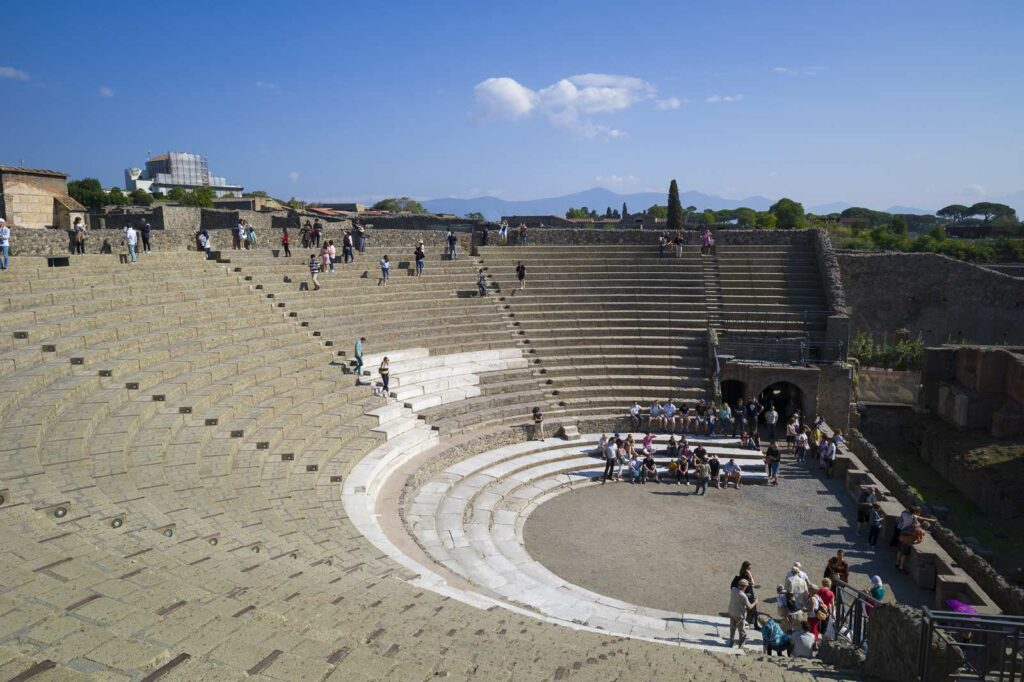
The Large Theatre is a masterpiece of ancient engineering, where culture, art, and history come together.
Through its tiers of seats, one can imagine the daily life of a Pompeii resident who, after work or household chores, would go here to enjoy a performance, meet friends, or attend a public debate.
The theatre testifies to the passion of the Romans (and before that of the Samnites and Greeks) for stage performance, collective entertainment, and cultural competition.
Visiting the building shows how Pompeii was a lively and dynamic city, able to attract people from various walks of life to popular events. Its size, 5,000 original seats, exceeded half of the city population at the time, revealing how vital and participatory theatrical performances were.
Today, sitting on those steps, even if partially reconstructed, gives the feeling of having a direct line with history, of listening to the echo of ancient voices and music that blended with the spectators’ enthusiasm.
The Odeon: the Small Theatre of Pompeii
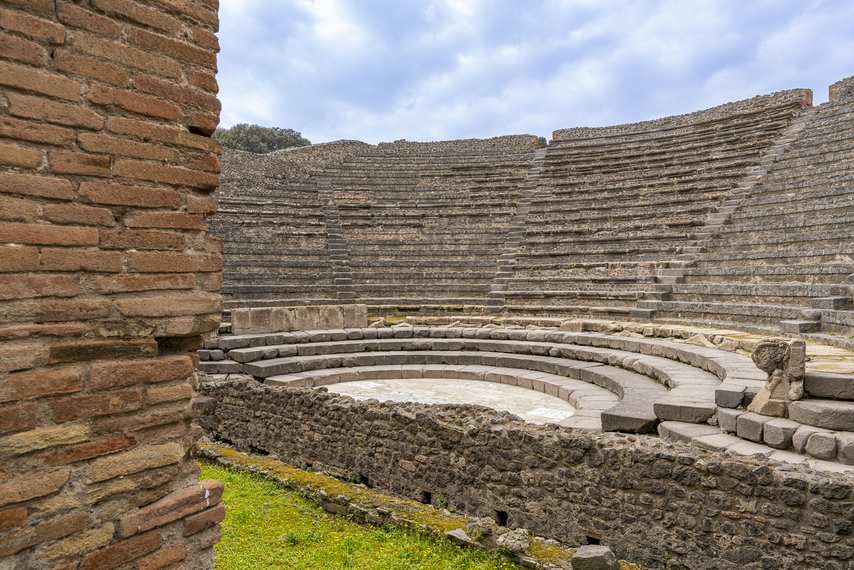
Next to the majestic Large Theatre, the most intimate structure in the Pompeian theatre complex is the Odeon, also known as the Small Theatre. Dating from a few years after Lucius Cornelius Sulla’s conquest of Pompeii, the Odeon was financed by prominent magistrates such as Caius Quincius Valgo and Marcus Porcius.
This elegant building was designed to host musical performances and poetic declamations. Its covered environment provided excellent acoustics, ideal for recitals and poetic performances.
The Odeon’s structure is characterised by its semicircular shape, inscribed in a square, optimising its sound distribution and the audience’s visual experience.
With a capacity of about 1,300 spectators, the Little Theatre features bleachers made of opus incertum (a Roman masonry technique using irregular stones), with some brick inserts that complement the design to improve acoustics.
The orchestra, with its colored marble slab floor- a gift during the Augustan era- represents the performance’s centrepiece. In contrast, the stage, decorated initially in marble, has spaces for the curtain and access to the dressing rooms.
The audience area is divided into tribunalia, located along the parodoi, and a functionally organised cavea, although it lacks the summa cavea typical of larger theatres.
Special attention was given to the design of the steps: they have a cavity in the back, designed to prevent the movement of spectators’ feet from disturbing those seated in front.
Although the pictorial decorations are reduced, the Odeon retains iconic elements of the Hellenic tradition, such as kneeling telamons carved in tuff stone, which once held frames for further ornamentation.
While not as imposing as the Large Theatre, the Odeon embodies the sophistication and delicacy of spaces dedicated to intimate entertainment in Pompeii. Its original function, dedicated to musical performances and poetic recitals, adds significant cultural value to the Pompeii Archaeological Excavation complex, highlighting how art and culture were an integral part of the daily lives of Pompeii’s inhabitants.
The discovery of this small theatre, dating from the Bourbon excavations of the late 18th century, has enriched our understanding of the diversity of artistic and social manifestations in the ancient city.
Conclusion
If you want to dip into the past and immerse yourself in a unique atmosphere, the Large Theatre is a must-see on your trip. Its horseshoe-shaped tiers, covered corridors, stage that evokes stories of ancient comedies and tragedies, and recent adaptations that still make it “alive” with events and concerts make it one of the best examples of how archaeology can dialogue with the contemporary.
Also, don’t forget to explore the surrounding area: the Triangular Forum and nearby domus complete the picture of a city where religion, entertainment and daily life were deeply intertwined.
Choose a good itinerary, wear comfortable shoes, and get ready to discover one of the most striking places in the Pompeii Archaeological Park.
The Large Theatre will never cease to amaze you, opening a window on Roman society, Greek and Samnite influences and, above all, the tastes and pastimes of a population that, although it lived two thousand years ago, shows traits of surprising modernity.
FAQ about the Large Theatre and Odeon in the Pompeii Archaeological Park
The main theatre at the Pompeii Ruins is called the Large Theatre. It is an imposing structure, built initially in Samnite times and renovated in Hellenistic and Roman times. The Odeon is next to the Large Theatre, often called The Small Theatre.
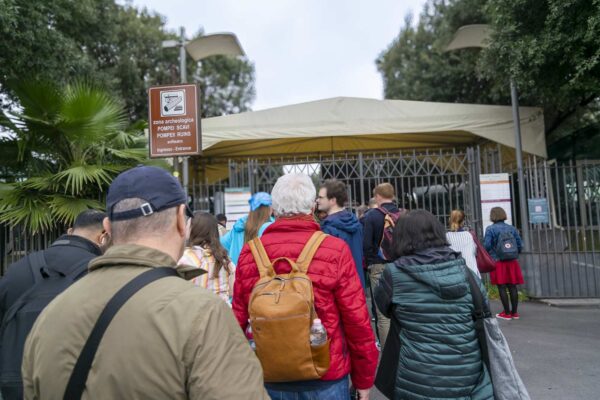
Entering the Pompeii Archaeological Park (usually from Porta Marina), one heads toward the Forum and then along Via dell’Abbondanza. Turning onto Via dei Teatri, one will soon find the Large Theatre and, adjacent to it, the Odeon. The area is well marked by the signs on the archaeological site, and by consulting a map of Pompeii, one can easily reach the location of the two theatres.
The Large Theatre: larger and with a capacity of about 5,000 spectators, it was used to host large performances such as comedies, tragedies, mimes, and pantomimes. Odeon (Small Theatre): more intimate, with about 1,300 seats, it was used for musical performances and poetic declamations, thanks to excellent acoustics favoured by the partial roof.
The Large Theatre was built around the middle of the 2nd century B.C. but originates from an earlier Samnite structure (4th-3rd centuries B.C.). Later, it was renovated according to Hellenistic models, and it was modified in Roman times, with the addition of sectors such as the summa cavea, reserved tribunes, and a velarium to protect spectators from the sun. Damaged by the earthquake in 62 AD and then buried by the eruption of Vesuvius in 79 AD, it was rediscovered and partially restored beginning in the 18th century during Bourbon excavations.
Horseshoe shape (typical Hellenistic), with cavea divided into ima, media, and summa cavea.The covered side parodoi is for audience entrance and access to the parts behind. Raised scaena, with ladders for actors and decorated scaenae frons.Velarium: a large retractable curtain to shield spectators from the sun. These features combine Hellenistic and Roman elements, making the theatre a unique case of ancient architecture.
The Odeon (or Small Theatre) was intended for musical performances, poetry readings, and declamations. Thanks to its covered semicircular structure, it offered excellent acoustics. It was also a more intimate venue than the Large Theatre, suitable for events that required more attention to sound, such as concerts and recitations.
The Large Theatre: In its heyday, it could seat about 5,000 spectators, a considerable number in relation to Pompeii’s population.Odeon: It had a capacity of about 1,300, perfect for smaller musical performances and meetings.
Yes, during the summer season, musical events and theatrical performances are often organised in the Large Theatre. Attending a concert or an evening performance under the stars in a unique archaeological setting is a truly evocative experience and is highly sought after by visitors.
Upper Marine Gate Entrance: cross the Forum of Pompeii and walk down Via dell’Abbondanza, then turn right onto Via dei Teatri.Piazza Esedra Entrance: Past the ticket office in Piazza Esedra (Lower Marine Gate), continue along Viale delle Ginestre heading east. Until you reach the Quadriportico dei Teatri. Passing the Quadriportico, you can reach the Large Theatre and the Odeon.
Near the Large Theatre and the Odeon, you can visit: The Triangular Forum, a sacred space with the Doric Temple. The Temple of Isis is one of the most fascinating buildings in the city, buried by Vesuvius in 79 AD. Built in the second century B.C. and rebuilt after the earthquake in 62 A.D., it was a centre of worship dedicated to the Egyptian goddess Isis, who was highly revered in antiquity. The corridors and courtyards behind where actors once prepared to go on stage were filled with fountains and nymphaea.
Both theatres testify to the ancient Pompeians’ passion for entertainment, music, and culture. Visiting the Large Theatre, with its horseshoe-shaped cavea and large tiers of seats, allows one to imagine the audience’s enthusiasm during performances. The Odeon, on the other hand, reveals the more intimate and refined aspect of the stage art of the time. Together, the Large Theatre and Odeon offer a journey through time to discover how Roman and Hellenistic architecture merged, and to understand how central collective events were to daily life in Pompeii.