The Antiquarium of Pompeii is a place of extraordinary historical and archaeological interest, located within the Pompeii Archaeological Park, in the north-east area.
Here, in a completely renovated museum space, one can admire unique artefacts and tangible evidence of the thousand-year history of a city that, in 79 AD, was buried by the eruption of Vesuvius along with Herculaneum, Stabiae and Oplontis.
Open to the public in alternating phases since the 19th century, the building now houses an exhibition that traces Pompeii’s evolution from its founding in the Samnite period (4th century BC) to its tragic end, also shown through casts of victims of the catastrophe.
Using archaeological finds, frescoes, everyday objects, sculptures, and religious artefacts, the Antiquarium of Pompeii recounts the daily life of a “rediscovered” city that has remained frozen intime.
The recent exhibition, which opened on January 25, 2021, has enriched this collection with new multimedia supports and archaeological discoveries resulting from the most recent excavation campaigns, thus offering visitors an immersive experience.
The exhibition follows in the footsteps of the great scholars of the past, foremost among them Amedeo Maiuri, but enriches the itinerary with modern technological tools that provide a thorough understanding of Pompeii’s history and importance.
Where is it located
Map of Pompeii: Regio VIII – 19
Google MapsAn Overview of the Building’s History
Archaeologist Giuseppe Fiorelli commissioned the first version of the Antiquarium of Pompeii between 1873 and 1874. It stood under the terrace of the Temple of Venus, near Porta Marina, and housed a selection of artefacts from the excavations, including the famous casts of eruption victims.
Over the decades, especially since 1926, the building was enlarged and reorganised by archaeologist Amedeo Maiuri, who created an exhibition itinerary that chronologically tells the story of Pompeii.
It illustrates the city’s origins, its moments of maximum splendour in Samnite and Roman times, and up to the fatal eruption of AD 79.
Unfortunately, World War II bombings severely damaged the structure in 1943. It was Maiuri again who was in charge of reconstruction. In 1948, the Antiquarium reopened to mark the bicentennial of the excavations (1748-1948).
A new chapter of damage occurred with the 1980 earthquake, which forced the authorities to close the building to the public for more than 30 years. Only in 2016, after a long phase of restoration and adjustments, was the Antiquarium of Pompeii reopened as a visitor centre and museum space.
Finally, on January 25, 2021, the building reopened with a modern, permanent layout, becoming a landmark for understanding the city’s historical journey.
The Current Layout and Visiting Experience
Today, the Antiquarium of Pompeii is an archaeological museum of great interest. The visitor is taken through the city’s development chronologically.
The exhibition is divided into thematic rooms, accompanied by explanatory panels in multiple languages and digital tools that shed light on the most important events, including screens, projections, and audio narratives.
The Samnite Age and the “Dark Century”
One of the sections introduces the earliest phase of Pompeii, when the Magna Graecia and Etruscan colonies strongly influenced the city in the Gulf of Naples. In the 6th century BCE, Pompeii saw the construction of its first temple buildings, such as the sanctuary of Apollo and that of Athena at the Triangular Forum, and was protected by mighty walls.
The crisis of the 5th century BCE is illustrated by finds that show a decline in temple attendance and a population decline. Objects from excavations along the Sarno Valley, such as fragments of pottery and bronze artefacts and some grave goods found in tombs from the 9th to 8th centuries BCE, are on display.
Pompeii allied with Rome
The section on the 3rd century BCE shows how Pompeii was incorporated among the federated towns of Rome. This period of “Romanisation” led to a construction frenzy: the oldest temples were renovated, and new defensive structures were developed, such as a wall circuit built using construction techniques similar to those of Rome (the so-called “agger”).
In addition to fragments of architectural decorations, such as lion heads and rosettes, inscriptions in the Oscan language can be seen, which testify to the city’s defensive organisation in case of conflict.
The “Golden Century” (2nd century B.C.)
This was the city’s heyday economically and culturally. The discovery of new trade routes, especially to the East, brought vast riches to Pompeii, fueling the construction of public and private monuments.
Antiquarium of Pompeii displays artefacts that illustrate the magnificence of this phase: statuettes of deities, exquisitely crafted bronze pottery, and wall decorations that testify to Hellenistic influence and entry into the Roman sphere.
Crucial monuments, such as the Teatro Grande, the Stabian Baths, and the Forum, were built or expanded in this historical context. Particular attention is paid to foreign cults, as evidenced by several decorative fragments and frescoes related to temples dedicated to Egyptian deities, most notably Isis.
Rome vs Pompeii: The Siege during the Social War
Another room recounts the dramatic phase of the conflict between Rome and the Italic cities (91-89 BC), during which Pompeii sided with the insurgents. Ancient sources mention General Sulla’s intervention against Pompeii, and preserved archaeological finds show signs of a siege: catapult bullets, fragments of damaged walls, and inscriptions documenting the city’s military organisation.
The Augustan Era
With the victory of Rome, Pompeii became a colony and adopted the architectural and urban stylistic features of the emerging Empire. This was the period when the Eumachia Building and the Temple of Fortuna Augusta were built, while celebratory statues of emperors and influential families found prominent spaces in the Forum.
The exhibits in this section showcase the luxurious decorative styles of the Augustan era, featuring wall frescoes of the highest artistic calibre, sculptures of great elegance, and marble reliefs.
The Luxury of Pompeian Dwellings
Strolling through the rooms devoted to the Julio-Claudian age (27 B.C.-68 A.D.), one discovers how Pompeii was also frequented by the imperial court and prominent figures associated with the entourage of Tiberius, Caligula and Nero.
On display at the Antiquarium of Pompeii are some of the most significant objects found in the villas and homes of wealthy owners, including the triclinium from the House of Menander, silver furnishings (such as the renowned silverware from Moregine), and various mythological or landscape frescoes.
These pieces recount the daily life of wealthy families, including banquets, feasts, and religious rituals celebrated in rooms decorated with exquisite paintings.
The Earthquake of 62 AD and the Reconstruction
An obligatory stop on the tour is the account of the terrible earthquake that struck Pompeii in 62 AD, anticipating by only 17 years the final destruction by Vesuvius.
The extensive reconstruction project is explained with the help of reconstructive models and artefacts, showing how the inhabitants tried to put houses and monuments back together. Skilled workers, such as masons (structores) and decorators (pictores), and other craftsmen also arrived outside the city to cope with the extensive restoration work.
Building-site objects, such as measuring instruments and work tools, illustrate the hectic life that followed the earthquake in Pompeii. On this city-building site, efforts were underway to recover its lost splendour.
The Eruption of 79 AD.
The narrative concludes with space devoted to the eruption of Vesuvius in 79 A.D.: a dramatic event described in Pliny the Younger’s letters to Tacitus, and which we can also reconstruct today through casts of the victims and artefacts “fossilised” by the ashes and lapilli.
The Antiquarium of Pompeii preserves casts that show the last moments of life of the inhabitants and numerous objects that testify to the attempts by many to get to safety. Charred remnants of food, jewellery and furnishings found clutched in the hands of those who fled recount the tragedy with significant emotional impact.
Halls and Exhibits of Great Interest
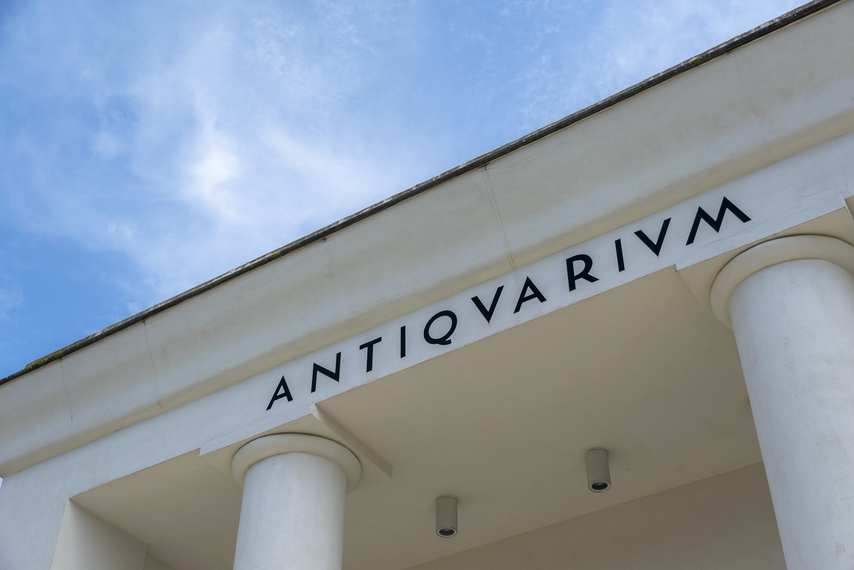
Inside the Antiquarium of Pompeii, each room offers a glimpse of various artefacts and related stories. Among the most fascinating works, it deserves mention:
- The four bronze dolphins from the House of Ceres.
- The bust of Dionysus was found together with interesting graffiti in the House of Fabius Rufus.
- The architectural terracottas from the Doric Temple and the Temple of Apollo, dating from the 6th to the 5th centuries BC.
- The tufa metope with the Supplizio di Issione, from the Triangular Forum.
- The capitals with Dionysian busts, datable to the 3rd-2nd century BC.
- The tufa pediment with a depiction of Dionysus lying down and several mythological figures is evidence of a typically Greek artistic taste.
- The room dedicated to Livia, featuring an imposing statue from the Villa of the Mysteries and portraits of Marcellus, Vesonius Primus, and Cornelius Primus.
- The so-called Pompeian Suppllex, a section that gathers furnishings from Pompeian houses, including bronze pottery, statues of deities, seals, needles, and studs. According to some interpretations, marble shields can be seen on the walls to ward off the evil eye.
- Various architectural models of the Portico dei Triclini and other artefacts tell the story of Pompeii’s commercial life, including materials found in workshops, food remains, and a range of tools (such as terracotta stoves, fishing tools, and surgical tools).
- Signs of caupona (inns) and bronze elements from the House of Fabius Rufus transport the visitor to Pompeii’s daily atmosphere almost two thousand years ago.
The New Antiquarium of Pompeii: The Permanent Exhibition from 2021
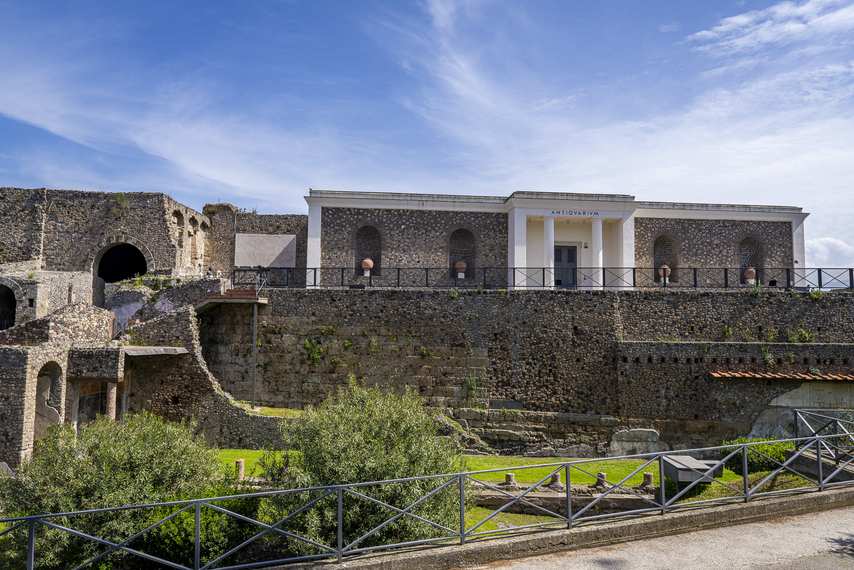
January 25, 2021, marked a turning point in the history of the Antiquarium of Pompeii. The inauguration of the new exhibit brought to the forefront some of the most significant finds of Pompeii’s heritage, such as the frescoes from the House of the Golden Bracelet and the silverware from Moregine, as well as discoveries from recent excavations (stucco fragments, the treasure of amulets from the House with Garden, and the last casts of victims found in the villa of Civita Giuliana).
Two digital media flank the exhibition: a web bot, that is, a virtual assistant that provides quick and accurate service information, and an audio narration that, starting from the Antiquarium, guides tourists to the park’s significant points of interest.
The Immersive Room on the Mezzanine Floor
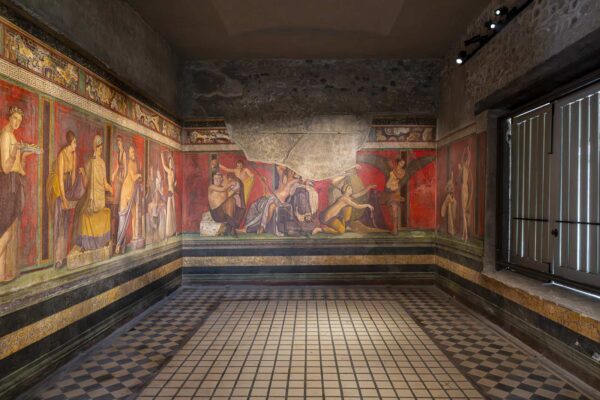
One of the most popular new features is the so-called “immersive room,” a space where mirror games and digital projections recreate the environments of some of Pompeii’s famous domus, such as the House of the Vettii, the House of the Cryptopórtico, the Villa of the Mysteries and many others.
Here, through digitised and animated frescoes, the visitor experiences a journey through time, encountering the beauty and colours of Pompeian decorations, enhanced by music and descriptions that highlight their historical and artistic value.
Practical Information for the Visit
For those planning a visit to the Antiquarium of Pompeii, it’s helpful to know that access is included in the entrance fee for the Pompeii Archaeological Park.
As a result, there is no need for an extra ticket: purchase tickets to the Pompeii Archaeological Park (online or at on-site ticket offices), and the right to enter the Antiquarium is guaranteed.
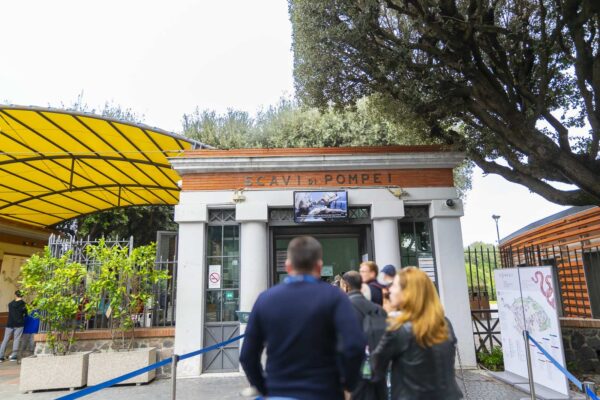
The recommended entrance to reach the Antiquarium of Pompeii is from Piazza Esedra. Still, you can also get there from other entrances (Porta Marina and Piazza Anfiteatro), although the route from Piazza Esedra is more straightforward. Remember that entry is often restricted to small groups to avoid gatherings and preserve the exhibits.
Hours may vary depending on the season and current regulations. Still, as a general rule, the Archaeological Park (including the Antiquarium) opens around 9:00 a.m. and closes between 5:00 p.m. and 7:00 p.m., with the last admission allowed about an hour to an hour and a half before closing time.
It’s always a good idea to check the official Pompeii Archaeological Park website or information channels, such as the online ticket office, for updated hours and closing days.
Useful tips
- Length of visit: To best appreciate the Antiquarium, budget at least one hour. If you also wish to visit the rest of the Excavations, a full day is recommended, as Pompeii is vast and full of areas worth exploring.
- Accessibility: Much of the Antiquarium building is accessible to people with mobility impairments. The main halls and exhibition routes have ramps and elevators, although some areas in the excavations may have barriers due to uneven ground and the presence of ancient stones.
- Attire: There is no formal dress code, but remember that you will be visiting an extensive archaeological park with ancient cobblestone streets and dusty areas. Opt for comfortable shoes and, in hot weather, protect yourself from the sun with hats and sunscreen.
- Map of the Antiquarium: You can obtain a small brochure at the entrance that will help guide you through the various rooms and exhibits.
The Importance of the Antiquarium of Pompeii in your Visit to the Park
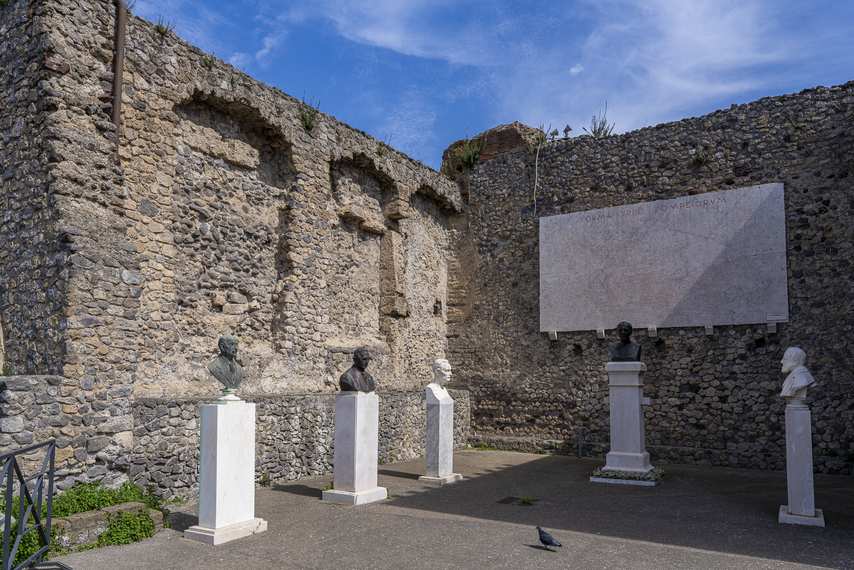
First, the Antiquarium allows you to historically frame what you are going to see as you wander among the ruins: the display cases, panels, and multimedia supports provide an essential historical, political, and social framework for grasping the true meaning of the temples, theaters, houses, and streets you will encounter as you explore.
Second, the Antiquarium preserves precious and fragile objects that, if left outdoors, would have risked deterioration; here, they are protected and enhanced, giving visitors the most authentic image of the city.
Finally, interactive spaces and a well-thought-out itinerary make the visit suitable for a broad audience, from those with a solid foundation in archaeology to those curious about Pompeii’s history, clearly and engagingly.
After visiting the Antiquarium, many tourists move through the ruins with greater awareness, able to recognise pictorial styles, architectural elements, and details that would have otherwise gone unnoticed.
A Glimpse into the Future
Studies on Pompeii and its neighbouring areas (Herculaneum, Stabiae, Oplontis, Boscoreale) never stop: new excavations and archaeological discoveries periodically enrich the exhibition holdings.
Thus, the Antiquarium of Pompeii plays a key role in showcasing the latest research to the public. Newly restored finds, new virtual reconstructions, and scientific insights into the eruption and Pompeii inhabitants’ lives will continue to fuel and renew the museum’s offerings.
To make archaeological heritage accessible to all, the Pompeii Archaeological Park invests in popularisation, enhancement and research projects.
The Antiquarium thus becomes the starting point for understanding the entire ancient city.
When you finish your visit, you will feel that you have come to know Pompeii, have understood its most everyday aspects, and can read the ruins with greater depth, whether you are about to explore them or have already admired them.
Conclusion
Visiting the Antiquarium of Pompeii is like treating yourself to an exciting journey into the past, where you’re immersed in objects, frescoes, sculptures, and stories that reveal the life of a city before the eruption of Vesuvius. This museum, conceived in the late nineteenth and early twentieth centuries, has undergone several transformations over the years. Today, it stands as a modern exhibition centre, equipped with state-of-the-art technology that facilitates an understanding of Pompeii’s historical and cultural context. Whether you are an archaeology enthusiast, a curious tourist or a traveller looking for a unique cultural experience, the Antiquarium of Pompeii is a must-see. It will provide you with the essential keys to fully appreciate the remains of the buried city, revealing the secrets of the ancient Pompeians and leaving you wanting to learn more about this extraordinary civilisation.
FAQ About the Antiquarium of Pompeii
The Antiquarium of Pompeii is a museum and exhibition centre located within the Pompeii Archaeological Park, which tells the story of the city buried by Vesuvius in 79 AD. From its Samnite origins (4th century B.C.) to the fatal eruption, the exhibition tour guides visitors through artefacts, frescoes, casts of victims, and multimedia tools that illustrate Pompeii’s urban, political, and cultural evolution.
No, you don’t need a separate ticket: entrance to the Antiquarium of Pompeii is included in the Excavations ticket. Once you purchase your ticket to the Pompeii Archaeological Park (online or at the ticket office), you can visit both the archaeological area and this museum space.
The recommended entrance is Piazza Esedra, as it allows you to reach the Antiquarium more immediately. Alternatively, you can also enter from Porta Marina Superiore. In this case, the Antiquarium is located just below the Temple of Venus, and you can get there by following the directions on the internal routes.
The layout of the Antiquarium, which was renovated in 2021, is divided into thematic rooms covering the different eras of Pompeii, from the Samnite Age to the Imperial Age, with artifacts of various kinds: frescoes, everyday objects, sculptures, religious decorations, and casts bearing witness to the catastrophe of AD 79.
Yes, photography without flash and without using tripods is allowed. It is always good to check the regulations in place during your visit, but generally, there are no special restrictions, as long as you respect the exhibits and avoid using too bright lights or bulky equipment.
It is suggested that you devote at least 45-60 minutes to the visit so you can read the information panels, take your time looking at the main exhibits, and use the multimedia content. If you want a more in-depth experience, especially if you combine the museum with a full visit to the Pompeii Ruins, it may be worthwhile to plan a full morning or afternoon, depending on your interest in archaeology.
This museum not only displays simple artefacts, but also contextualises daily life in ancient Pompeii, from everyday objects to major artistic masterpieces, including frescoes and sculptures, as well as casts that capture the last moments of Pompeiians’ lives during the eruption. It is a key site for understanding the entire archaeological area, as it offers an overview of the city’s urban, religious, and cultural history.
Casts of victims: moving evidence of the eruption of 79 A.D. High-quality frescoes and sculptures, such as those from the patrician domus.Sacred objects and relics of worship (busts, votive offerings, liturgical furnishings).Everyday tools (pottery, household utensils, work tools). Architectural elements and temple decorations (rosettes, capitals, friezes) illustrate Pompeii’s urban development.
Yes, the Pompeii Antiquarium is accessible to a broad audience, including families, school groups, and history buffs. Thanks to explanatory panels, multimedia devices, and a well-structured chronological route, anyone can understand Pompeii’s main evolutionary stages, even without specific knowledge of archaeology.
The Antiquarium allows you to contextualise the buildings and streets you will see in the Pompeii Archaeological Park, offering essential insights into the customs, traditions and transformations the city underwent. After the visit, you will clearly understand how Pompeii evolved, its relationship with Rome, and how life came to a tragic end in 79 A.D. It is an essential complement to a truly comprehensive and engaging experience.