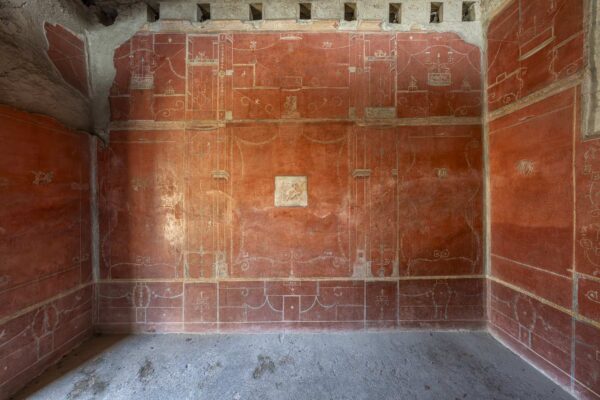
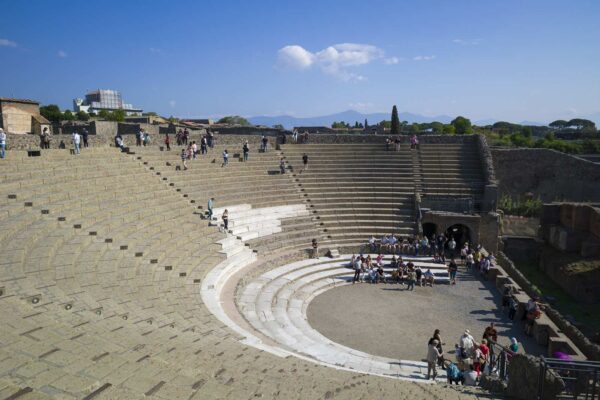
The House of the Silver Wedding is among the most impressive and refined residences in ancient Pompeii.
This dwelling, located in insula 2 of Regio V along Vicolo delle Nozze d’Argento, is famous for its extraordinary artistic and architectural heritage and its connection to a significant historical event: the celebration of the Silver Wedding of the Kings of Italy, Umberto and Margherita di Savoia, in 1893.
Reopened to the public on July 16, 2023, the house is an excellent example of an aristocratic dwelling, capable of combining residential, commercial, and spa functions in a single complex. It offers visitors a privileged glimpse into the life and culture of ancient Pompeii.
Where is it located?
Map of Pompeii: Regio V – 3
Google MapsStructure and Features of the House
Origins and Historical Context

The history of the House of the Silver Wedding in Pompeii has its roots in Samnite times. The building was initially constructed around 300 B.C. on already developed land, with plans to fill and regularise pre-existing urban areas.
Initially, the property also included the adjacent Upper House, later separated and made autonomous in subsequent transformations of the building.
Over time, the dwelling was modernised, and at the beginning of the 1st century A.D., during the Augustan Age, it underwent renovations that transformed its structure, making it a large domus owned by a wealthy resident.
During this long period, the House of the Silver Wedding stood out for its refined style and innovative architectural solutions.
The original Samnite structure was completely renovated and enriched with elements typical of Roman architecture.
The transition from a simple residence to a multifunctional complex was favoured, among other things, by important historical events, such as the earthquake of 62 AD, which prompted many owners to intervene with massive restoration and redecoration works.
In particular, the transformation of the rooms was remarkable: the dwelling was enriched with a large atrium, an elegant peristyle and two distinct gardens, elements that still testify to the luxury and sophistication of Pompeian life.
The Architecture of the House of the Silver Wedding

The House of the Silver Wedding in Pompeii is characterised by its classical and imposing architecture, making it one of the most important monuments of the Pompeii Archaeological Park.
The entire complex is developed through three large functional areas, each dedicated to different activities and reflecting the “princely” style of Pompeian living.
The Atrium and Portico

The atrium, one of the most majestic areas of the house, opens onto a vast eastern garden. The main entrance features tall Corinthian tufa columns, elements that lend a solemn and imposing air to the entire facade.
The adjacent portico provided shelter for the inhabitants and guests, creating a transitional space between the exterior and interior of the dwelling. This space, with its elegant design, was perfect for hosting visitors and social activities in a refined setting.
The Rhodium Peristyle and Secondary Atrium

The second key area is the rhodium peristyle, a garden covered by a colonnade designed with attention to spatial arrangement. In this area, the richness of architectural details is evident through the use of columns that vary in height, creating a dynamic and harmonious effect.
The secondary atrium, adjacent to the peristyle, was intended for reception activities and entertainment functions. Private dining rooms were arranged here, and part of the commercial activities of the estate were carried out.
The Living and Decorative Areas
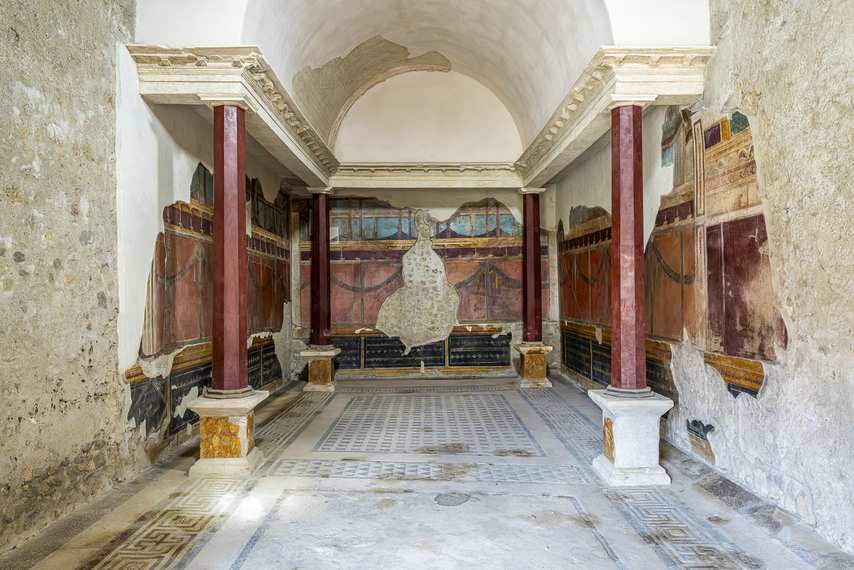
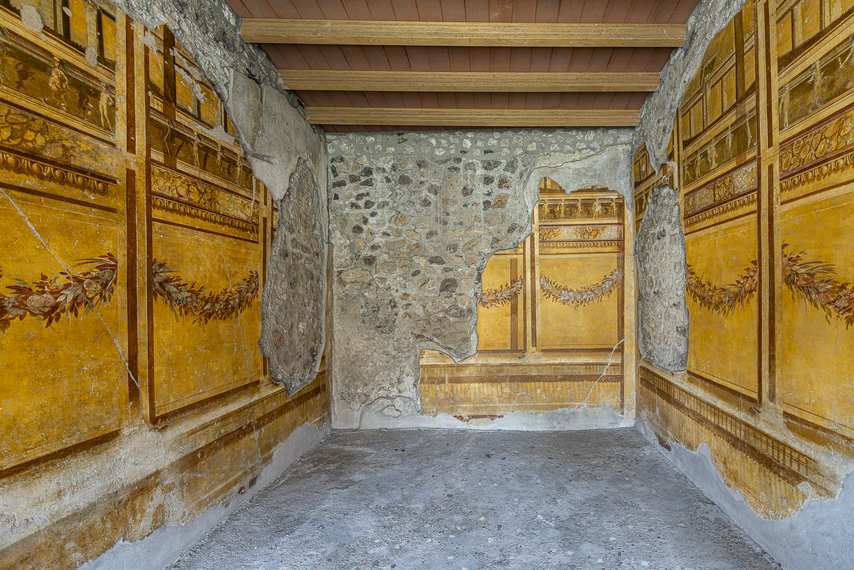
The interior part of the House of the Silver Wedding includes numerous residential rooms, including halls, kitchens, and bedrooms. Special attention is paid to the frescoes and mosaics that decorated the walls and floors, evidence of the artistic refinement and decorative techniques of the time.
The renowned pictorial cycle of portraits and landscapes, created using the megalography method, offers an exceptional insight into Pompeian daily life.
In the area dedicated to thermal services, the presence of a natatio (open-air swimming pool) and a hall with a mosaic and vaulted ceiling, supported by octagonal columns, further enriches the complex.
These rooms were designed to provide comfort and promote the well-being of the inhabitants, reflecting the importance of relaxation and personal care in ancient Roman society.
A Greek Graffito in the House of the Silver Wedding

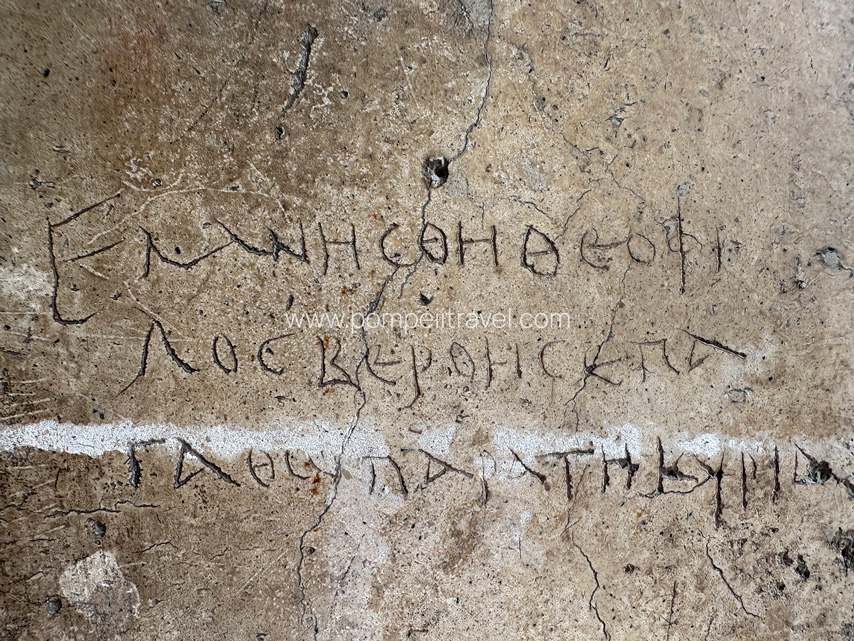
Inside the House of the Silver Wedding, a short graffito in Greek is preserved on a peristyle column that reads:
“ἐμνήσθη Θεόφιλος Βερόης ἐπ’ ἀγαθῷ παρὰ τῇ κυρίᾳ”
Translated as:
“Theophilus remembered Beroe, wishing her well, before the Lady (Isis).”
Although “Beroe” has sometimes been misunderstood as an ethnic reference to Berea in the past, epigraphic studies have clarified that it is a feminine name. In addition, the expression “παρὰ τῇ κυρίᾳ” – “before the Lady” – is interpreted as a reference to the goddess Isis, a sign of the lively presence of Eastern cults in the city.
This small Greek text, like many other Pompeii graffiti, does not necessarily imply that the author was a native Greek.
On the contrary, the use of Greek was widespread among Romanised Pompeians (slaves, freedmen, as well as citizens of various ranks), who used it for commercial or religious reasons or due to bilingual education.
The graffito, then, testifies to the linguistic and cultural vibrancy of Pompeii, which was well connected to the Mediterranean, where Greek often served as a lingua franca.
The mention of Isis also highlights the strong influence of Egyptian cults on the city’s life, where Hellenistic culture, Roman traditions, and new religious currents mingled in original ways.
The very House of the Silver Wedding, with its architectural and artistic magnificence, offers a valuable glimpse into this fusion of ideas that made Pompeii a cosmopolitan city open to multiple traditions. (Solin, Heikki. “On the Use of Greek in Campania.” Variation and Change in Greek and Latin. Edited by M. Leiwo, H. Halla-Aho & M. Vierros (Papers and Monographs of the Finnish Institute at Athens 17), Helsinki 2012, 97-114. .)
The Renovation and Restoration Work
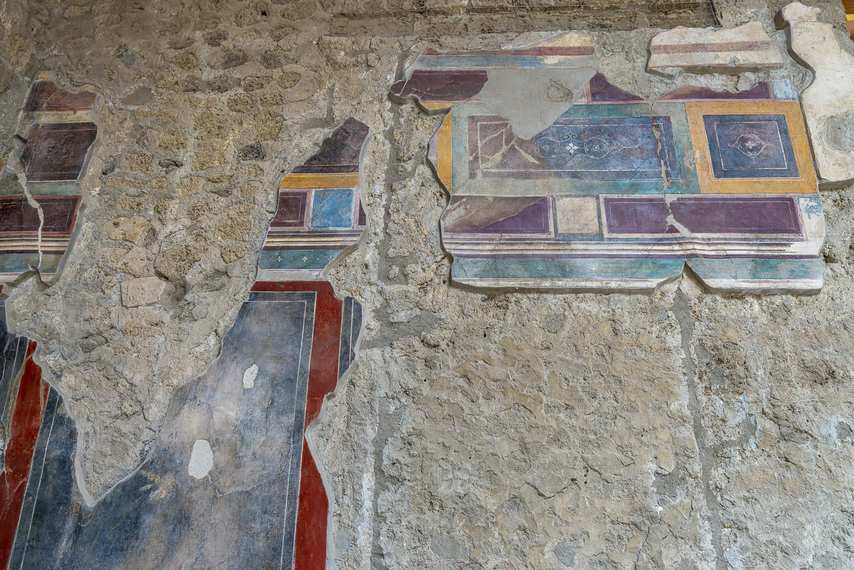
The House of the Silver Wedding in Pompeii has undergone numerous restorations since its discovery in 1893, during the first excavation campaigns directed by architect Michele Ruggero. Due to the damage suffered from the multiple transformations and erosion caused by the eruption, many of the original structures were in critical condition.
Over the years, various phases of restoration have sought to preserve and, as far as possible, reconstruct the original appearance of the dwelling.
Among the most recent interventions, the one launched in 2019 as part of the Great Pompeii Project focused on structural consolidation and architectural restoration, replacing the heavy reinforced concrete structures with lighter and more innovative materials, such as micro-lamellar beech wood and lamellar fir.
These works not only ensured the site’s safety but also allowed for the recovery and enhancement of the most significant decorative spaces, such as the vestibule, tetrastyle atrium, rhodium peristyle, and exedras, restoring the house to its former glory.
Cultural Importance and Significance of the House
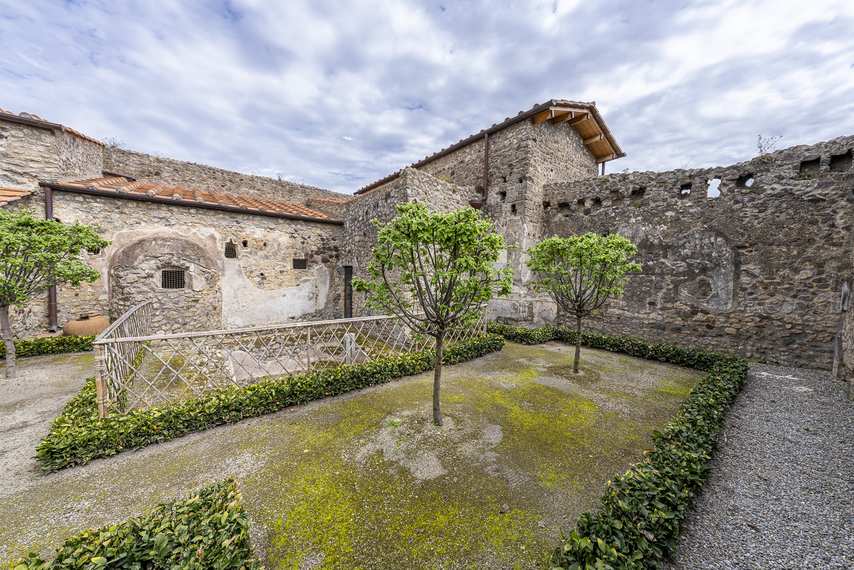
The House of the Silver Wedding is more than just a building: it is an open window into the aristocratic life of ancient Pompeii. Its history testifies to the transition from Samnite to Roman tradition, showing how urban dwellings evolved over the centuries to meet changing social and economic needs.
The transformations that affected the atrium and the later separation of the Upper House highlight the continuous adaptations of the house over time.
During the Neronian age, for example, the property was further redecorated and renovated according to new housing models, while preserving the beauty of the original frescoes and enhancing elements of decoration that fell within the Second Style and a transitional phase between the Second and Third Styles.
The introduction of a new water supply, made possible by the connection to the Serino aqueduct, was crucial for the creation of a private spa district and the creation of water features that embellished the gardens.
These interventions demonstrate how the House of the Silver Wedding was at the forefront of providing comfort, luxury and functionality, elements that still fascinate and inspire those who visit it today.
Visiting Experience and Practical Suggestions
Visiting the House of the Silver Wedding in Pompeii is to immerse oneself in a multisensory experience, where each room tells a unique story. During the visit, tourists can admire the ornate atriums, the magnificent peristyle with its columns, and the manicured garden, as well as explore the richly decorated interiors with frescoes and mosaics that narrate the daily life and traditions of ancient Pompeii.
To fully enjoy the experience, it’s advisable to plan your visit in advance, book tickets online, and consider hiring an audio guide or joining a guided tour. This way, you can get detailed information and historical anecdotes about the various rooms. Wearing comfortable shoes, bringing water, and sunscreen are additional practical tips for navigating such a vast site.
The Impact of Tourism and Heritage Preservation
The House of the Silver Wedding is part of the unique and irreplaceable heritage of the Pompeii Archaeological Park. With millions of visitors each year, the biggest challenge is striking a balance between tourism enhancement and site protection.
Restoration and consolidation work aims not only to preserve the architecture but to preserve the memory of a civilisation that has left an indelible mark on history.
Visiting this mansion means not only admiring the art and architecture, but also taking an active role in preserving the cultural heritage for future generations. In this context, each visit becomes a gesture of respect and an invitation to awareness, so that the story of life in Pompeii will continue to be handed down.
Concluding Reflections
The House of the Silver Wedding is a treasure of ancient Rome that testifies to the sophistication and complexity of Pompeian society. From its Samnite origin, through the many transformations that made it a splendid aristocratic residence, to its modernisation and restoration, every corner of the domus tells a part of the story.
It is a place where the past and present converge, offering a unique and engaging experience for history and art enthusiasts.
To visit the House of the Silver Wedding is to immerse oneself in a journey that goes beyond mere observation: it is an opportunity to understand how the Pompeians lived, loved, and did business, to grasp the essence of a civilisation that, despite the passage of time, continues to speak through its ancient walls and indelible memories.
FAQ About the House of the Silver Wedding in Pompeii
It is an aristocratic residence located in Regio V, along Vicolo delle Nozze d’Argento, within the Pompeii Archaeological Park. Built in the Samnite period and then enlarged in the Augustan age, it represents an architectural masterpiece that combines the typical elements of a luxury residence-such as the peristyle, the majestic atrium, and the thermal quarter-with a past rich in historical events, including the celebration of the Silver Wedding of the royals Umberto and Margherita di Savoia in 1893 (from which it takes its name).
The name comes from the fact that the house was opened to the public on the occasion of the 25th wedding anniversary (silver wedding) of King Umberto I of Italy and Queen Margherita of Savoy in 1893. This circumstance made it famous and helped give it the name it still retains today, although it has no direct connection with its ancient Roman owners.
The House of the Silver Wedding preserves remarkable frescoed rooms and mosaics, documenting the evolution of Pompeii’s pictorial styles from the second to the third style. Highlights include a tetrastyle atrium with tall Corinthian tufa columns, which lend majesty to the entrance, a rhodium peristyle, a collonaded garden rich in architectural detail, a symbol of Pompeii’s aristocracy. The thermal area, with a swimming pool and spaces dedicated to wellness, is evidence of the luxury and comfort sought by the owners.
The house stands in a central area of the Pompeii Archaeological Park, accessible by walking down Vicolo delle Nozze d’Argento in Regio V. To visit it, it is advisable to check if it is part of a guided tour or if special openings are planned, since some afternoon domus may be subject to maintenance or restoration work as part of the Great Pompeii Project. It is always recommended to purchase tickets online and to have a map of the excavations for easy orientation.
In addition to offering a rare example of a Pompeian domus of high lineage, the House of the Silver Wedding allows one to immerse oneself in the splendor of ancient Rome: from the refined architectural choices to the pictorial decorations, the residence tells the story of the daily life of a wealthy family and the continuous urban transformation of Pompeii. Admiring its frescoes, Corinthian columns, and various spaces dedicated to private and commercial life provides a complete picture of how the local aristocracy organised its existence, making this house an essential stop for those who wish to discover to the full the history and art of the city buried by Vesuvius.