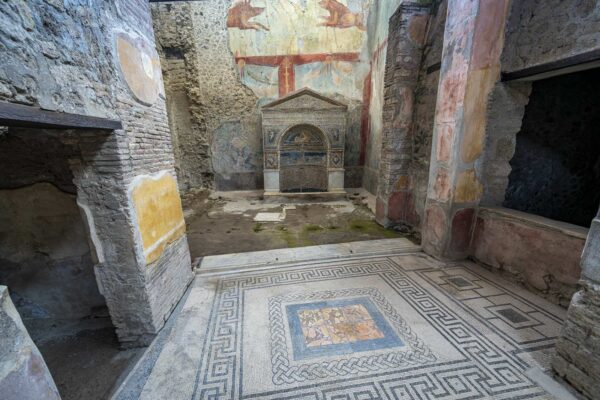
The House of the Red Walls is a captivating example of a Roman domus, famous for having rooms with walls painted in an intense Pompeian red. Located in Regio VIII, in the southwestern part of the ancient city, this dwelling has a layered history, marking the construction phases from the Republican period to the renovations undertaken after the 62 AD earthquake.
At the time of Vesuvius’s eruption in 79 AD, the house was still undergoing partial maintenance, as indicated by the presence of unpainted plaster in some rooms.
Yet, in at least two rooms, the unmistakable shade of red, which would have given the domus its name, had already been completed, revealing itself in all its brilliance.
Over time, the House of the Red Walls has undergone multiple phases of archaeological excavation and conservation. In 1832, the first investigations were initiated, followed by further work in 1882, which brought to light various architectural and decorative elements.
With the most recent restorations, promoted as part of the Great Pompeii Project, the House of the Red Walls has been reopened to visitors on special occasions, offering a wider tour in Regio VIII.
Where is it located?
Map of Pompeii: Regio VIII – 7
Google MapsOrigins and Development: From the Republican Age to the Earthquake of 62 AD.

The original layout of the House of the Red Walls dates back to the Republican period (2nd century BC to 1st century BC). In this early phase, the domus had the typical elements of older Roman architecture: an atrium equipped with an impluvium to collect rainwater, rooms arranged around it and some service rooms.
The location, close to the area overlooking the Triangular Forum, suggests that the owner must have held a particular social importance. However, it was not one of the largest houses in ancient Pompeii.
Over the years, the Campanian city underwent urban and architectural transformations, and the House of the Red Walls was no exception.
Scholars speculate that as early as the Sillan period (1st century BC) the domus may have been enlarged or renovated, to improve the efficiency of the interior spaces.
However, it was after the devastating earthquake of 62 AD that the most significant interventions took place, aimed at repairing cracks in the masonry and renovating the decorative elements in line with the tastes of the first century AD.
The Allure of Pompeian Red: Between Art and Social Status

To understand why the domus is called the “House of the Red Walls,” it is necessary to consider the type of pigment used and the historical significance of Pompeian red, also known as Herculaneum red or red ochre.
It is a colour obtained from an iron oxide, a natural inorganic pigment, and often produced, in ancient times, also from waste from the processing of cinnabar. Pompeian red was expensive and intended for prestigious walls: it expressed wealth and artistic taste.
In Pompeii, Pompeian red decorated many dwellings, especially in reception rooms, where the owner’s refinement and wealth were intended to be emphasised. In this domus, at least two rooms have masonry entirely covered with a layer of bright red plaster, sometimes embellished with geometric elements or small squares featuring mythological figures.
One might ask why invest money in painting the walls of a house with such expensive pigments. In Pompeii, as in other cities of the Roman Empire, wall painting was a means of showcasing one’s status.
Showing walls painted in bright tones, such as Pompeian red, was a way to convey the message of affluence and cultural sophistication. Added to this was the functional aspect: bright colours helped enliven rooms, especially in houses with low ceilings and small windows.
In addition, the frescoed decorations, primarily traceable to the pictorial styles of the last Pompeian phase (second half of the 1st century AD), often included panels with mythological scenes or fantastical architecture on dark backgrounds. Red shone in contrast to black or yellow portions, making the rooms more vivid and scenic.
The Lararium in the Atrium: Domestic Worship and Bronze Figurines
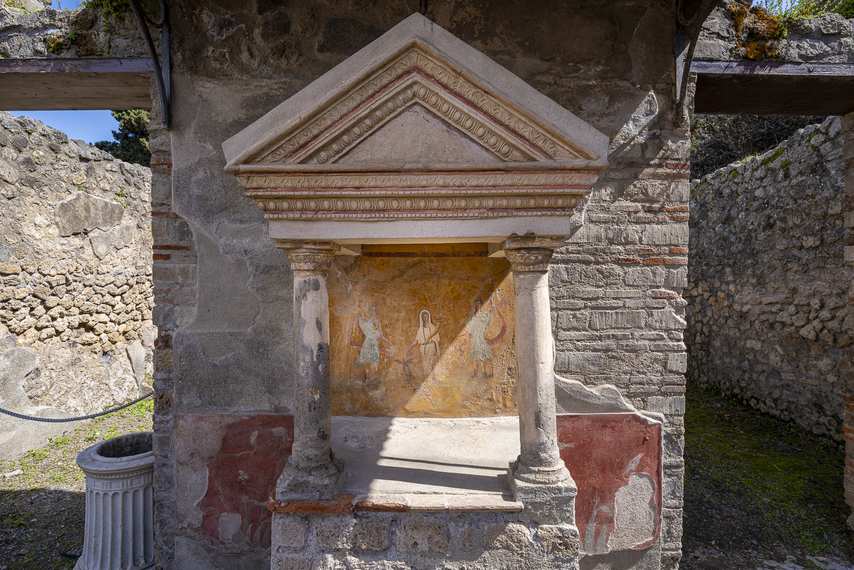
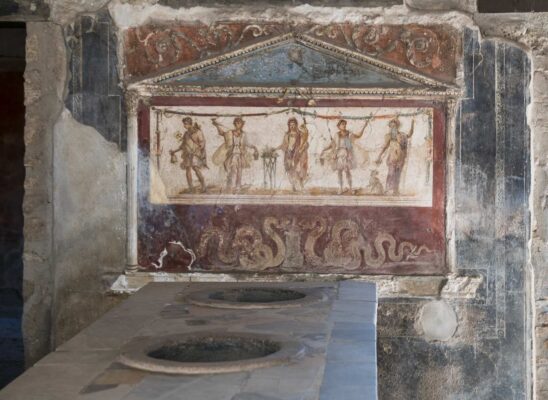
An element of great importance in the House of the Red Walls is the lararium, located in the atrium. In a Roman home, the lararium was a small sacred aedicule dedicated to the Lares (the patron deities of the house), the Penates (the ancestor spirits), and, more generally, to household worship.
Here, rites and offerings were performed to propitiate the protection of the family and the domus.
According to archaeological evidence, six bronze statuettes were found inside the lararium: depictions of the Lares and other tutelary deities, which confirms the domestic devotion common to many Pompeian families. The find is remarkable since such bronze objects were often lost or melted down in later periods.
The assemblage of statuettes and wall decorations suggests the extent to which spiritual life was intertwined with daily life in ancient Pompeii.
Post-Earthquake Renovation and the Situation at the Time of the Eruption
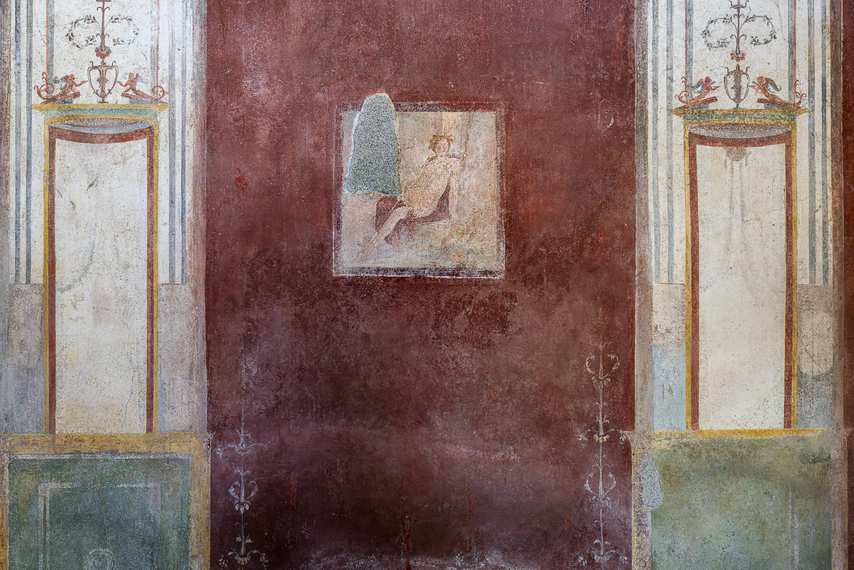
In 62 AD, a very violent earthquake shook Pompeii, damaging houses, temples and infrastructure. In the immediate aftermath, the city underwent an intense phase of reconstruction. Some wealthy families took advantage of this to modernise their buildings, adapting them to new tastes in decoration.
The House of the Red Walls thus underwent profound changes: tearing down interior walls, resurfacing floors, and, most importantly, laying new decorative plaster.
However, the construction site was not finished in 79 CE: in the rooms still awaiting decoration, “roughs” of unpainted plaster could be observed. This phenomenon is well-documented in Pompeii, where the eruption of Vesuvius halted a city in transition.
Anyone walking through the archaeological remains today can see, in some domus, examples of completed frescoes alongside unfinished walls, revealing how the city’s life was abruptly interrupted during renovation work.
The Excavation Phases and Eecent Recovery
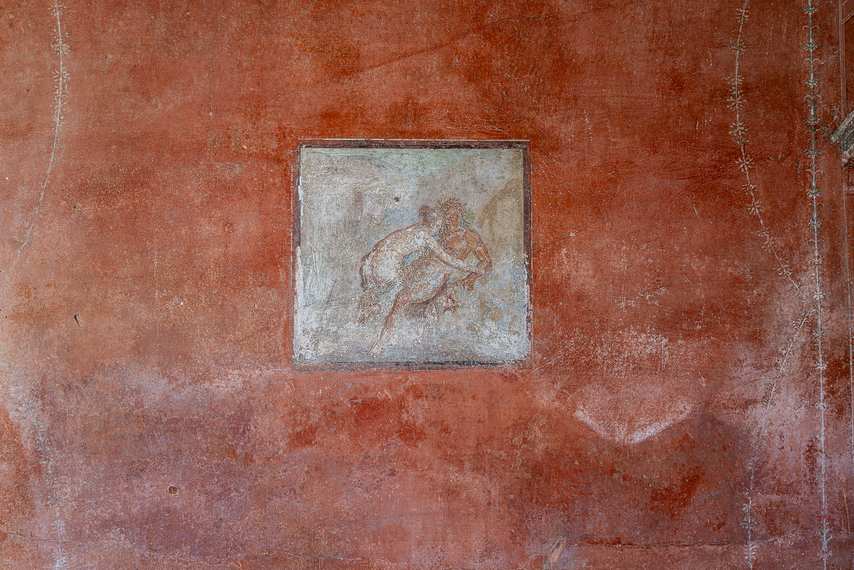
The House of the Red Walls was first explored in 1832, a time when Bourbon excavations were primarily focused on finding luxury items for display in royal collections. In 1882, new excavation campaigns uncovered other parts of the domus, including the frescoed lararium and fragments of bright red wall paintings.
During the 20th century, the house suffered periods of neglect and sporadic restoration. Only with the advent of the Great Pompeii Project, launched in recent years to preserve and enhance the archaeological area, did the domus undergo targeted interventions.
From 2013 onward, work focused on consolidating the masonry, replacing deteriorated wooden lintels, installing new roofing, and protecting the frescoed rooms from water infiltration.
A crucial aspect involved the restoration of the colored plasters. Specialists consolidated the surfaces, removing dust deposits and encrustations, and supplementing the gaps with techniques that were recognisable but respectful of the original appearance.
This made it possible to recover the vividness of Pompeian red, revealing details and small decorated figurations in the late Nero style.
The Importance of Regio VIII and Alternative Routes
Regio VIII, where the House of the Red Walls is located, is one of the areas less travelled by Pompeii’s classic routes (traditionally focused on Via dell’Abbondanza, the Forum, the Amphitheatre, the House of the Faun, etc.).
Instead, this part of the ancient city, developed on the slopes of the plateau on which Pompeii stands, offers an itinerary rich in points of interest: the Triangular Forum, some minor baths and other stately homes, such as the recently restored House of the Golden Cupids or the House of Triptolemus.
The choices of vegetation and garden restoration (historical or painted) follow philological criteria, providing a clearer idea of what the environment must have looked like in Roman times.
An alternative itinerary that includes the House of the Red Walls allows visitors to discover a more intimate and less crowded side of Pompeii, offering tourists an up-close look at the history of a family and its domestic cult.
Conclusion: A Jewel of Pompeii Waiting to be Unveiled
Although the House of the Red Walls in Pompeii may not enjoy the same fame as other famous dwellings (such as the House of the Vettii or the House of the Faun), its appeal lies precisely in the evidence of a “middle- to high-ranking” dwelling, strongly linked to the post-earthquake dynamics of 62 AD and the evolving decorative style.
The recent restoration, part of the Great Pompeii Project, not only restored the original polychromy of the walls but also reaffirmed the importance of a conservation approach that is attentive to the history and stratification of each domus.
To visit this house is to immerse oneself in an environment where spirituality, care, hospitality, and aesthetic pleasure come together, giving a vivid glimpse of what daily life must have been like for a Pompeian family just before the tragic eruption.
Today, thanks to the institutions’ commitment, the domus is sometimes made available to the public with special openings, offering curious visitors and scholars the chance to admire and study up close one of the many “hidden” treasures of the Pompeii Archaeological Park.
FAQ About the House of the Red Walls in Pompeii
It owes its name to frescoes characterised by intense Pompeian red, an iron oxide pigment. At the time of the eruption, the walls in at least two rooms had already been completely painted in this hue.
The lararium is a votive shrine dedicated to the Lares and Penates household cult. In the House of the Red Walls, six bronze statuettes, referable to the household’s patron deities, were discovered, a valuable find that testifies to private religious practice.
Initial excavations began in 1832 and continued until 1882. Modern restoration began mainly in 2013 as part of the Great Pompeii Project and involved consolidating the structures, re-roofing with wood and tiles, and cleaning the frescoes.
In the atrium of the Red Wall House is a lararium, a small aedicule for household worship. Six bronze statuettes representing the home and family’s patron deities were discovered here. This sacred space testifies to the centrality of private worship in Pompeii and the daily devotion of the owner and his family members.
Not continuously. Generally, the House of the Red Walls is occasionally open to the public during special events to protect the frescoes and better manage the flow of tourists. For the most up-to-date information on openings, it is recommended that you visit the official website of the Pompeii Archaeological Park.