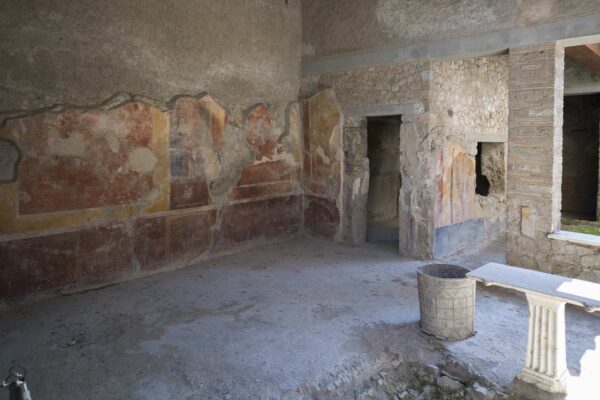
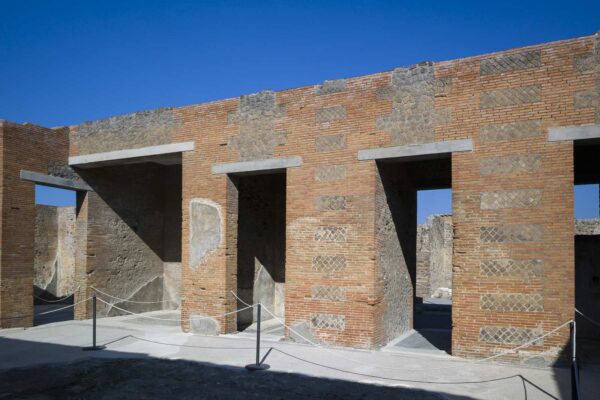
The House of Leda in Pompeii, located in Regio V along the Vesuvius road, represents one of the most impressive archaeological discoveries of recent years.
It is an open window on the ancient world, giving us a vivid insight into the daily life, social ambitions and mythological imagination of a Pompeian family on the eve of the eruption of 79 AD.
Where is it located?
Map of Pompeii: Regio V – 6
Google MapsA Surprising Discovery
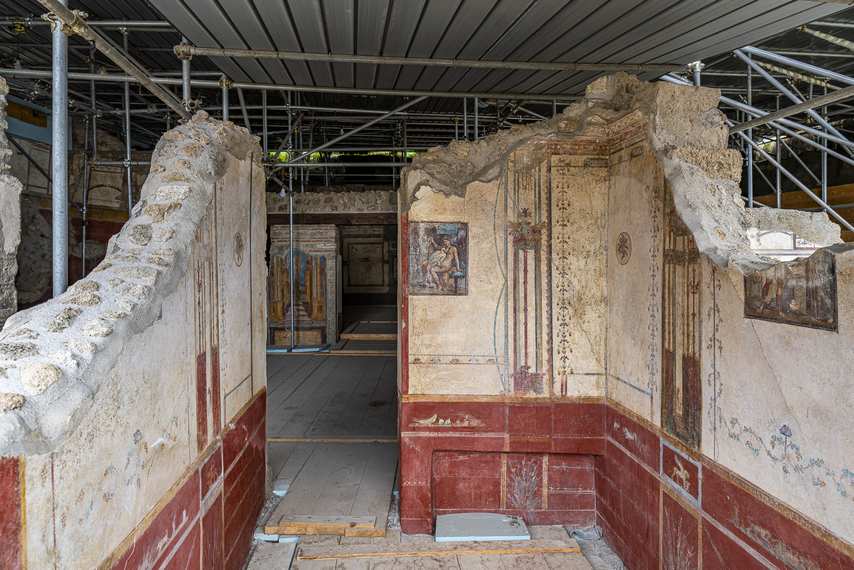
During the work of securing the excavation fronts, the initial objective was not the systematic excavation of the house, but the stabilisation of the slope. However, a fortuitous landslide caused by rain brought to light part of a fresco: a knee, then a calf.
It was Leda, the famous queen of Sparta, caught in the moment when she welcomed Zeus, transformed into a swan. The painting of Leda and the Swan, painted with great skill, immediately became a symbol of the new season of Pompeii excavations, for its refinement and emotional charge.
The discovery aroused great interest among scholars and the general public, as it brought attention back to Pompeii’s cultural heritage and the importance of archaeological conservation.
The discovery of such a fresco, in an astonishing state of preservation, required a substantial modification to the current plans, with a retreat of the excavation front to allow for the complete exploration of the environment.
The Domus: Structure and Decorations
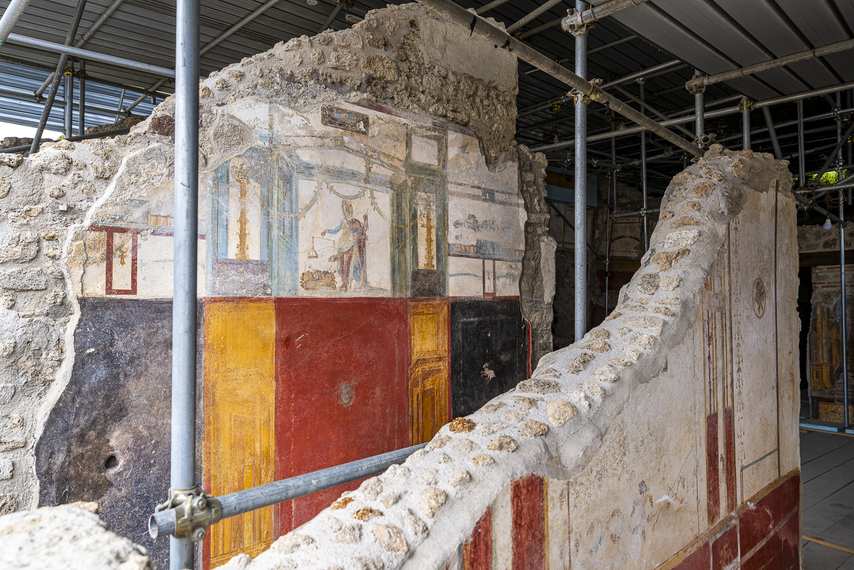
The House of Leda, still partially excavated, has yielded several rooms: the entrance (fauces), the Tuscanic atrium, two cubicula (bedrooms), a tablinum, and other rooms.
The fauces present decoration in the IV style, with a middle register dominated by an image of the god Priapus weighing his phallus against a money bag on a scale—a symbolic representation of fertility and prosperity.
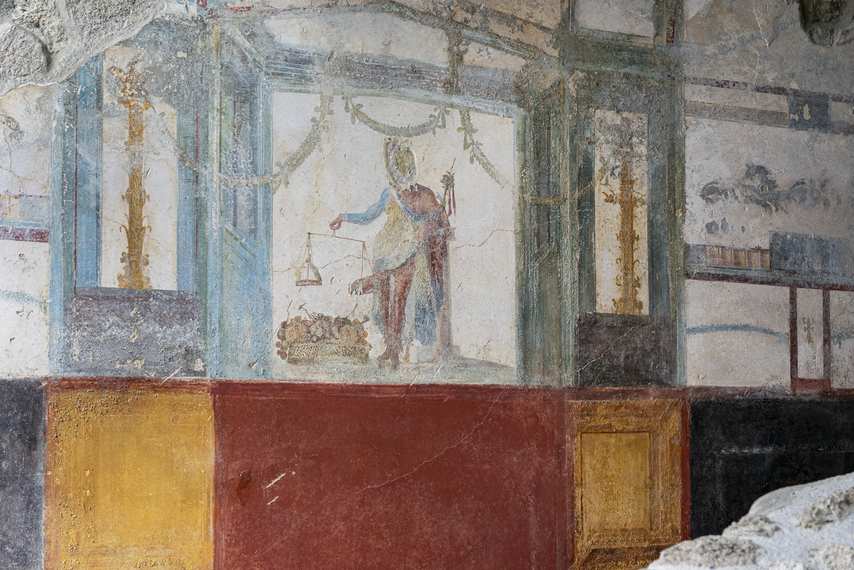
This iconography is not accidental: it represents the owner of the domus’s wish to convey a clear message to those entering the house. The figure of Priapus, dressed in the Oriental style, was also depicted in the famous House of the Vettii, another example of a Pompeian dwelling decorated according to the refined tastes of an emerging social class, often composed of enriched freedmen.
The atrium is decorated with mythological scenes, including the myth of Narcissus and a small Hermes on a plinth. The walls are richly frescoed with yellow, red and black background panels, while the earthenware floor features marble inserts, particularly around the impluvium.
This central space, which connected the main rooms and served to welcome guests, was intended to impress visitors upon entry.
Cubiculum 9 (Leda’s room) is decorated with a pictorial cycle in the 4th style, with a predella alternating hunting scenes and mythological animals. The painting of Leda and the Swan stands out on the east wall and is framed by illusionistic architectural views.
Opposite, in cubiculum 7, four female portraits within medallions (clipei) were found, each with different attributes (olive branch, vine crown, jewellery): images likely related to household cult practices or the celebration of beauty and virtue.
The tablinum, the space devoted to the self-representation of the dominus, features frescoes rich in architectural and ornamental references. Although still in the excavation phase, one can already sense the perspective lines, aedicules, and garlands decorating the walls, which are in a refined taste consistent with the rest of the house.
Daily Life and Objects Found
Numerous ceramic objects have emerged in the corridor and adjacent rooms: cups, ollae, plates, and amphorae, including one inscription referring to garum, the famous fish sauce. These finds confirm that the house was still in active use at the time of the eruption and that those rooms served as a kitchen and pantry.
Some labelled amphorae provide valuable information on food consumption and the trade networks that connected Pompeii to the rest of the Mediterranean.
A space interpreted as an understairs was also identified, where utensils and containers were found: an indication of the intelligent reuse of spaces within the domus.
The combination of fine decorative elements and everyday objects gives an authentic picture of life in 1st-century AD Pompeii.
Symbolic and Social Significance
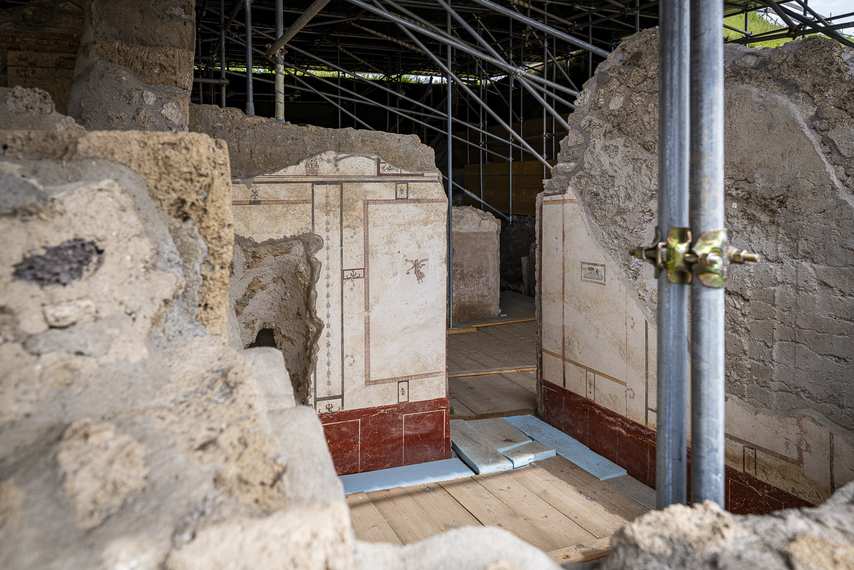
The frescoes of the House of Leda are not simply decorations: they tell a vision of the world.
The image of Priapus and that of Leda and the still lifes and mythological landscapes testify to the dominus’s desire to assert a social status achieved, perhaps through trade. It is not unlikely that the house belonged to an enriched freedman, like many others in Pompeii in the imperial age.
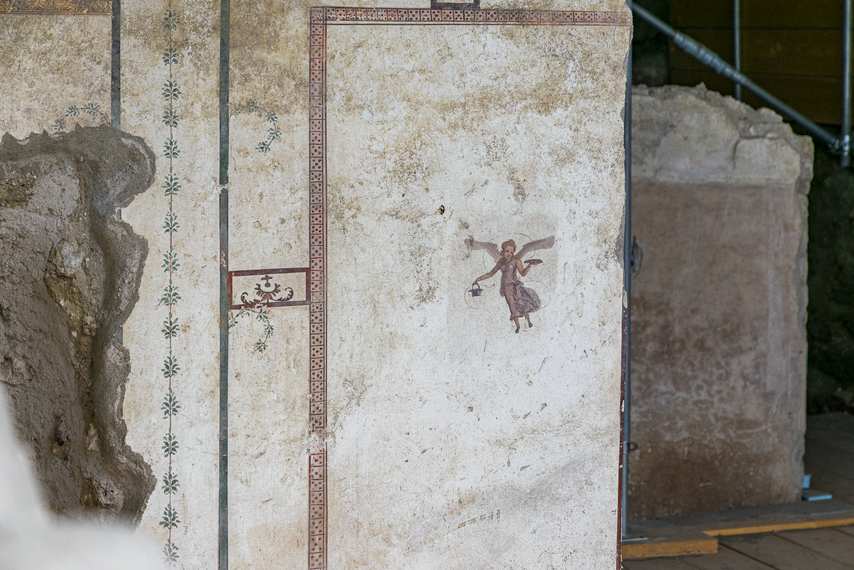
The use of myth in decorating the house’s main rooms had a substantial communicative value: it evoked culture, aesthetic taste, and symbolic links with the Roman ideology of power and prosperity.
The myth of Leda, in particular, combined eroticism, beauty, and divinity, emphasising a sensuality exhibited by awareness and control.
Adjacent Houses: House V, 6, 14 and the House of Elle and Frisso
During the excavations, two new domus emerged, one to the north and one to the south of the House of Leda.
House V, 6, 14, to the north, presents a layout with an atrium, tablinum, frescoed cubicles and service rooms. Of particular note is the discovery of a votive niche with thirteen polychrome terracotta statuettes, including elements related to the cult of Cybele and Attis, such as a pine cone and a walnut.
This discovery reveals the presence of complex and refined domestic religious practices and shows how the spiritual world was deeply rooted in family life.
To the south, the House of Elle and Frisso owes its name to a fresco in the triclinium depicting the myth of Phrixus and Helle fleeing on the ram with the golden fleece. The painting depicts the dramatic moment when Helle falls into the sea (the Hellespont).
The pictorial apparatus is also in the IV style, with illusionistic architectural perspectives, animals, still life, and marine elements. The house has a similar structure to that of Leda: atrium, cubicles, corridor, triclinium and courtyard.
The triclinium of the House of Elle and Frisso is particularly rich: frescoes with perspective views, painted architectural elements, and a central painting depicting Helle about to drown, seen transparently through the waters. The pictorial effect is highly refined and testifies to the quality of the workshops active in Pompeii in the 1st century AD.
Conservation and Restoration
One of the priority objectives of the Pompeii Archaeological Park is the in situ conservation of the paintings, in particular that of Leda, which suffered from humidity, salt efflorescence, and plaster flaking.
Restoration work has included temporary coverings, wall consolidations, and continuous monitoring. The future perspective is to allow the public permanent access to the house, which is only visible from the outside today.
The restoration also aims to preserve the floor surfaces, which are often compromised by concreted volcanic layers. The controlled removal of these layers is essential to restoring the legibility of the decorations and ensuring visitors’ safe use of the site.
A Wish for the Future
Today, the House of Leda is one of the most fascinating testimonies of Pompeii’s heritage. We hope that, thanks to the efforts of the Archaeological Park and ongoing projects, this splendid domus will soon be completely open to the public.
It would be a unique opportunity for all visitors to enjoy firsthand the beauty of its paintings, the refinement of its rooms, and the eternal charm of the myth.
FAQ About the House of Leda in Pompeii
It is located in Regio V, insula 6, along Via del Vesuvio, between Porta Vesuvio and Via di Nola.
It is only visible from the outside, but restoration work is underway to make it accessible to the public.
The painting shows the mythical union between Zeus, in the form of a swan, and Queen Leda, a theme charged with eroticism and symbolism.
A symbol of fertility and wealth, the image of Priapus expresses the owner’s social status and serves as a protective talisman.
Yes, the houses of Elle and Frisso and the recently excavated House V, 6, 14 share similar building types and decorative devices.