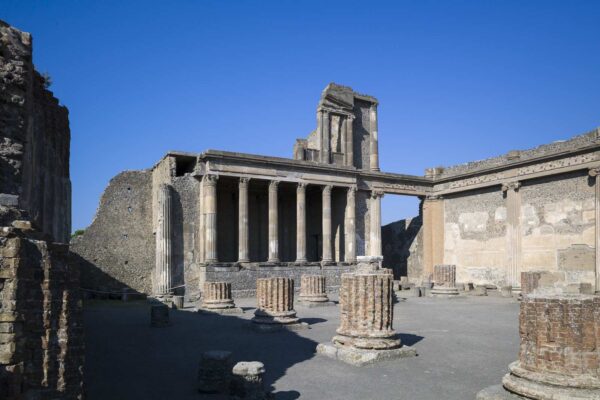
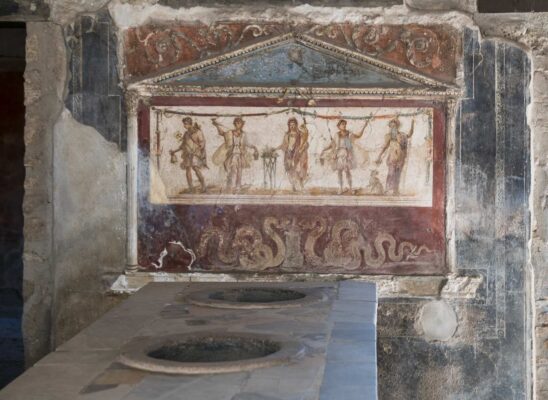
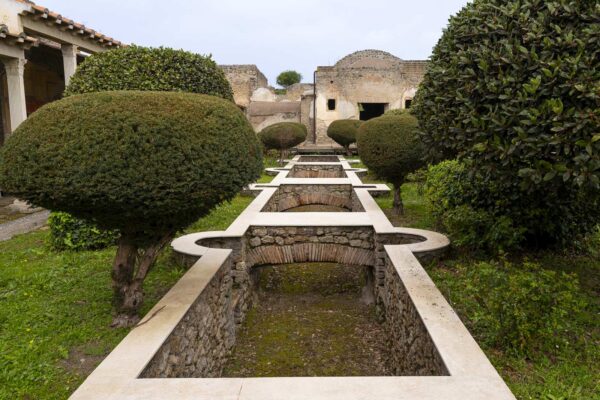
When one thinks of the Pompeii Archaeological Park, images of ancient dwellings, time-worn basalt streets, and frescoes that tell the story of life more than 2,000 years ago often come to mind.
What many visitors do not know is that, alongside lavish villas and public buildings, Pompeii also preserves explicit evidence of the private and sexual lives of its inhabitants.
One of the places that best documents this is the Lupanar of Pompeii, a building that provides a clear example of how eros and daily life were deeply intertwined in ancient Rome.
Where is it located?
Map of Pompeii: Regio VII – 18
Google MapsWhat is Meant by “Lupanar”
The word “lupanare” comes from the Latin lupa, meaning “she-wolf” and figuratively, “prostitute.” Lupanars (or brothels) were places intended for paid sexual pleasure, found throughout Roman times.
In Pompeii, several can be found, testifying to the widespread practice. Many visitors are fascinated by the Lupanar of Pompeii because it allows a glimpse into an intimate and often unspoken aspect of ancient society.
The building is a small complex of rooms where prostitutes offered their services to clients. The inscriptions and erotic frescoes still preserved on walls and vestibules add historical and cultural details of extraordinary interest.
A Look at History: From the Origins of “She-Wolf” to the cult of Lupa

Before Roman times, what has been called “sacred prostitution” was practised in the Mediterranean basin, linked to the worship of a female deity, the goddess Lupa or “Great Mother.”
The young women who participated in these rites were called lupas. When these cults fell into decadence, the term “she-wolf” and related practices were transferred to common prostitution and the designated buildings, i.e., lupanaria.
With the advent of Roman culture, the cult of Lupa was succeeded by the festivities of Lupercalia, rites dedicated to the god Luperco, always centred on the theme of fertility.
Prostitution was also considered a fairly common activity in Pompeii, practised in various forms: some women offered their services inside private homes, others ran or worked in lupanaria. One of the best-known examples is Regio VII, where inscriptions inform us of figures such as Victor and Africanus, two tenants who ran a very active brothel.
Diffusion of Pleasure Houses in Pompeii
Before we delve into the details of the most famous Lupanar in Pompeii, it is worth noting that many places in the city before the eruption of Vesuvius in 79 AD offered sexual services for a fee. Some modern sources suggest that there were even more than thirty brothels, making them especially numerous compared to Pompeii’s 8,000 to 10,000 inhabitants.
However, not all these places were large structures: sometimes they were a single meretricious cell carved out inside a taberna or tavern, separated from the street by a simple curtain.
In these tiny spaces, often occupied by a single prostitute, sexual intercourse took place quickly and discreetly, though entirely without real intimacy. At other times, as can still be observed today within walking distance of some inns, the rooms were located on the upper floor of “bars” or small taverns.
Another phenomenon, no less widespread, involved prostitutes who waited for clients directly in the street, ready to seclude themselves behind improvised shelters. Some of them would stop near the city walls or in cemeteries, such as that of Porta Nocera, giving rise to situations that are, in many ways, similar to those in today’s urban suburbs.
The cemetery area was also a place of clandestine dating. On a funerary monument, a mocking inscription was found, denouncing Hedoné’s betrayal of Pilades, using rather crude words to mock her betrayed husband.
The Official Lupanar: A Prime Example
One of the best-known places to understand the daily dimension and frankness of sexual mores of the time is the Lupanar of Pompeii, located in Regio VII. This structure stands at the corner of two streets and has a double entrance, a feature that facilitated the flow of clientele and, perhaps, ensured a certain discretion in exit.
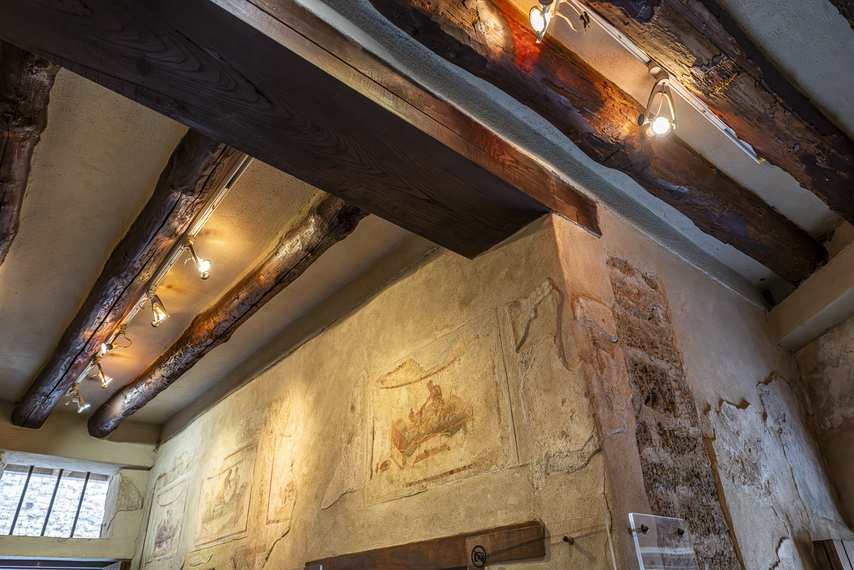
The building has two floors, featuring small rooms, or cellae, on both the ground and upper levels.
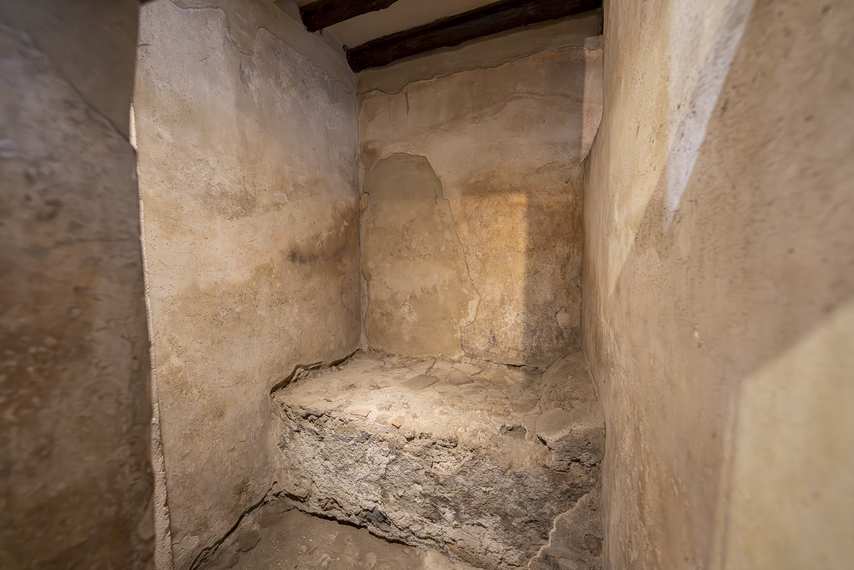
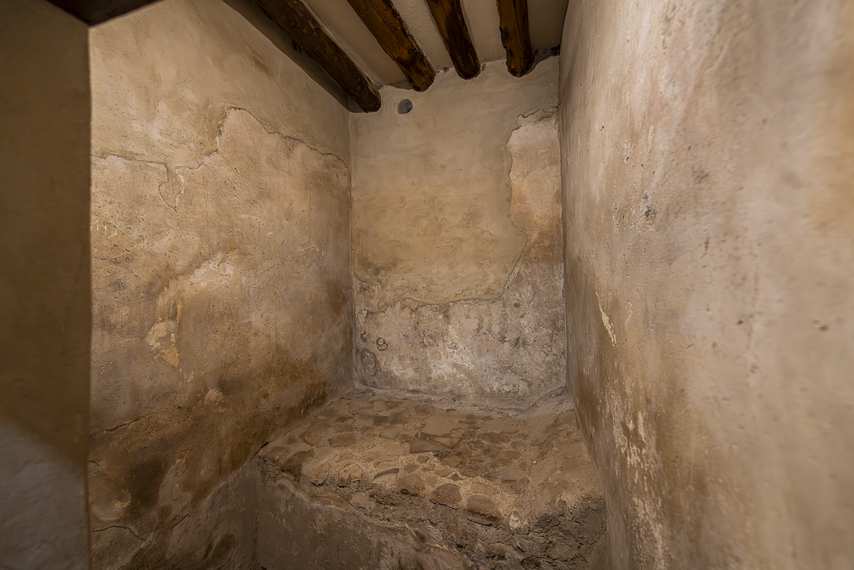
Inside, the appearance recalls a corridor with five small rooms opening onto it.
The beds, simple masonry counters covered with a straw mattress, were intended for quick meetings. The drawn curtains allowed glimpses of the activities within, and it seems that – for a fee – it was even possible to spy on sexual intercourse in progress.
Lighting was dim, often provided solely by small oil lamps that left soot on the walls. On the walls, in addition to graffiti with explicit content, there are traces of spiked soles, proving that customers often did not even take off their shoes.
The Decorations and Graffiti: A Mirror of Everyday Life

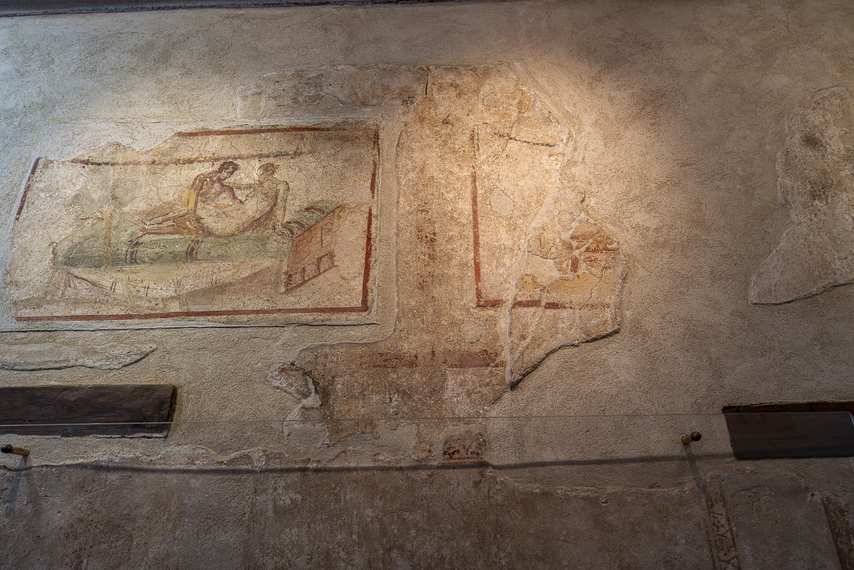
One of the most fascinating aspects of the Lupanar of Pompeii is the presence of erotic frescoes on the walls. These paintings depict various sexual positions, but they should not be understood as a “catalogue” complete with rates.
According to some scholars, they would be figurae Veneris, images inspired by “Kamasutra-type manuals already widespread in Roman times. It is, in essence, an erotic decoration apt to create the atmosphere and evoke an imagery familiar even to more refined environments: many private mansions had small rooms dedicated to amorous encounters, adorned with frescoes of similar content.
Numerous graffiti testify to a frankness in language that may appear crude today: phrases such as “Hic ego puellas multas futui” (“Here I have made myself many maidens”) still decorate walls.
One graffito, sometimes interpreted as evidence of poor hygiene, seems instead to provide a clue to the use of rudimentary contraceptive methods: the author describes the feeling of “mud” inside, which could refer to an ointment or “spermicidal cream” mentioned in some ancient texts (made from old olive oil, cedar resin, lemon juice or myrtle).
In Roman society, there was no concept of a “condom” as we understand it today, and to avoid unwanted pregnancies, people often resorted to homemade systems or expensive pills, out of the reach of poorer prostitutes.
How a Brothel Was Run
The management of a lupanar was, often, in the hands of owners who used female slaves, sometimes with “exotic” (usually Greek) names to emphasise a certain charm.
These women were exploited as long as their health permitted, without enjoying any rights. The atmosphere inside was far from jolly: a noisy, crowded environment where relationships were quickly consumed.
The regular customers largely belonged to the lower classes (slaves, poor freedmen), while the rich preferred to invite prostitutes of higher rank directly to their homes.
In the spaces of the lupanar, in addition to the sexual encounter, small forms of entertainment could be found, such as observing other relationships “on the sly” by paying an additional fee.
Some entries have suggested that, in addition to heterosexual intercourse, homosexual intercourse was also practised for a fee, sometimes involving teenagers.
The whole organisation of the brothel aimed at constant profit: the prostitutes were mere “tools” and, from an economic point of view, represented small “businesses” that yielded money for the tenant.
Moral Judgment in Ancient Rome
One element that intrigues visitors to the Lupanar of Pompeii is understanding the moral perception of prostitution in the Roman world.
Contrary to what one might think, meretricious activity was not considered immoral: it was seen as a natural need, and many Romans considered it normal to frequent brothels.
Of course, there were “unwritten rules”: men had to maintain an “active” role to not diminish their manhood. At the same time, sexual relations with lower-ranking partners (slaves, prostitutes) were tolerated or even encouraged.
In wealthy families, the presence of concubines or the use of domestic slaves to satisfy sexual urges constituted a custom, which explains why lupanaries were more often frequented by the poorer social classes.
Homosexual relationships were widespread, as long as they respected the same role hierarchies. In practice, Roman society established rules of decorum outwardly, while what happened between individuals was often left to their own free will.
How to Visit the Lupanar of Pompeii
Planning a visit is essential for tourists who want to discover the Lupanar of Pompeii. The building is relatively small and frequently attracts numerous visitors eager to explore its unique rooms. Here are some tips:
- Buy tickets for the Pompeii Archaeological Park in advance. You can do this online or directly at the ticket office, but the lines can be very long, especially during high season. For this reason, we recommend buying your entrance tickets in advance.
- Choose a guided tour: many specialised guides speak several languages and provide interesting details not only about the Lupanar, but also about Pompeii’s other buildings, explaining how they were integrated into the life of the ancient city.
- Study a route: The official maps of the Pompeii excavations highlight the main buildings, including the Lupanar, located in Regio VII, a short distance from Via dell’Abbondanza, one of the city’s main thoroughfares. You can easily reach it from the entrances of Porta Marina or Piazza Anfiteatro by following the signs inside. Since this is a very famous site, you will be able to recognise it from the stream of visitors waiting at the entrance.
- Pay attention to the information signs: The Lupanar of Pompeii is also sometimes visited by school groups. There are notices indicating the presence of explicit images to inform any accompanying minors.
- Respect and care for the site: despite its “spicy” content, the Lupanar remains a valuable archaeological site. The frescoes and wall structures should not be touched or damaged.
Why is it Worth Visiting the Lupanar of Pompeii?
The Lupanar is not merely a curiosity or a site to indulge morbid fascination with antiquity. On the contrary, it is an essential fragment of history that sheds light on aspects often overlooked by schoolbooks.
The building, with its tiny rooms, daring graffiti, and explicit images, tells the story of Pompeii’s more ordinary, everyday dimension, often overshadowed by the monumentality of the Forum of Pompeii or the splendid frescoes of the patrician villas.
Moreover, comparing this reality to today’s mentality allows us to reflect on how values, customs, and perceptions of sexuality have changed over the centuries.
For many visitors, seeing how prostitution was organised in Roman times is an opportunity to reevaluate stereotypes about a mythicized past and discover that the city was made up not only of wealthy merchants and powerful politicians, but also of workers, servants, slaves, and prostitutes, each with their own needs and roles.
An Educational and Cultural Experience
Despite the provocative reputation that sometimes surrounds the Lupanar, visiting it is a direct way to understand how rich and articulate social life was in the Roman city.
The writing on the walls, the small rooms with blackened walls, the remains of masonry beds- every element contributes to recreating an environment where life took place without too much censure, with quick and practical dealings.
The moral judgment we might make of this structure today was very different in antiquity: prostitution was considered a licit, functional activity, and brothels themselves did not arouse scandal in the ordinary mind.
From a cultural perspective, the Lupanar of Pompeii helps us broaden our understanding of women’s status, slavery, sexuality, and the economy of the time. Many of the women who worked within it were slaves or libertae, yet these rooms also offer evidence of female autonomy, with women running their businesses.
The rooms of the lupanar, the graffiti, and the erotic frescoes tell stories of power, economic necessity, human relationships, and even dreams and hopes in a world that, though remote, still appears alive to us through its material remains.
Conclusion
If you’re looking for something different during your visit to the Pompeii Archaeological Park, the Lupanar of Pompeii offers a unique insight into the more intimate aspects of ancient Roman society.
However, the real atmosphere of the lupanaria had nothing romantic or joyful about it: the girls were enslaved, the clients were mostly humble, and the environment was often poorly lit, noisy, and unhygienic. While wealthy patricians had other channels for satisfying their desires, these places remained the only resource for those, such as slaves and poor freedmen, who lived on the margins.
All this took place unaware of the impending catastrophe. On October 23, 79 A.D., many Pompeians were lying down, perhaps distractedly observing the constellation Scorpio in the sky.
None of them suspected that they would never see a sunrise again. In the suggestion of last night, as a statue of Venus falls and shatters, Pompeii is set to disappear, submerged in a sea of ash and lapilli that would make it immortal only centuries later.
Every fragment of daily life, including the wolf-houses and the stories of love, sex and misery that revolved around them, would remain buried, a testament to a civilisation that never ceases to amaze for better or worse.
FAQ About the Lupanar of Pompeii
The Lupanar of Pompeii is a building in Regio VII of the Pompeii Archaeological Park, intended to house a real Roman brothel. Here, in small rooms (or cellae) on two floors, sexual services were offered for a fee. The term “lupanare” derives from the Latin “lupa” (meaning “prostitute”), and its presence testifies to how eros was an integral part of daily life in ancient Rome.
It is located a short distance from Via dell’Abbondanza, one of the city’s main thoroughfares buried by Vesuvius. From the Forum, walk about 180 meters until you meet the Vicolo del Lupanar (Alley of the Lupanar) on the left; walk 80 meters into the alley, and you will reach the Lupanar. Thanks to the Pompeii Archaeological Park map, it’s pretty easy to locate and access by following the indicative signs, starting from the entrances of Porta Marina or Piazza Anfiteatro.
The Lupanar offers a unique glimpse into the private life of ancient Roman society. In contrast to the patrician villas, full of lavish frescoes, this site tells the story of the everyday life of the less affluent social strata, their interpersonal relationships, and the economic dynamics associated with prostitution. Understanding its function helps to perceive the true dimension of ancient Pompeii’s culture and the breadth of its customs.
The building is divided into two levels, with small rooms arranged along a corridor. The first floor opened into five cells equipped with masonry beds, where prostitutes received clients. The upper floor housed additional rooms, probably more private and intended for less intimate encounters. Lighting was sparse, provided by oil lamps, while the double entrance helped ensure a steady flow of customers.
The walls feature erotic frescoes showing scenes of sexual intercourse in different positions. These are not a “catalogue” with rates, but decorations that recall imagery familiar throughout Roman culture. Numerous graffiti, often in direct and colourful language, testify to the frequency with which sex was openly discussed. These inscriptions tell personal stories, offer ironic opinions, or recount encounters inside the brothel.
In Roman society, prostitution was considered a licit and widespread activity, seen as a social necessity. Contemporary moral judgment did not coincide with that of the time: brothels (lupanaria) did not arouse scandal, and men of different social classes used them. However, many prostitutes were slaves or libertae, subjected to harsh living conditions and often exploited by the brothel keeper.
Pompeii probably had dozens of lupanaria and small cellae meretriciae, often housed in taverns or tabernae. Not all were large structures: some were simple rooms with a masonry bed separated from the public passage by a curtain. The prevalence of these places testifies to how deeply rooted prostitution was in the economic and social reality of the ancient city.
The Lupanar of Pompeii features explicit images and direct references to sexuality. Access is not forbidden to minors, but parents should assess the explicit content of the decorations. Inside the Pompeii Archaeological Park, signs and directions warn of the erotic nature of the frescoes, leaving it up to the chaperones to decide on the visit.
Before leaving, it’s recommended that entrance tickets to Pompeii be purchased online to avoid the queues at the ticket office. A guided tour of Pompeii with a licensed guide can provide more in-depth information, contextualising the Lupanar of Pompeii in the broad panorama of Pompeii’s attractions, such as the Forum, the Macellum, and the House of the Faun. Guides often offer details about the customs and traditions of the period, enriching the experience.
Based on inscriptions and historical sources, it can be inferred that clients might pay extra to observe others’ relationships or participate in more complex practices. The main goal of this place remained profit for the owners, who managed both heterosexual relationships and the possibility of homosexual encounters, albeit with roles rigidly defined by Roman ideology.
The Lupanar of Pompeii chronicles a reality often ignored in history books: the sexual sphere and the lives of those who did not belong to the elite. Through the erotic frescoes, graffiti and the very structure of the building, one understands how the needs, desires and social dynamics of ancient Rome were much more complex than a mere glance at the main monuments might suggest. Looking at these archaeological evidences, one reflects on the continuities and differences between past and present, enriching one’s knowledge of ancient Pompeii and the human condition two thousand years ago.