The House of the Vettii in Pompeii is, for many visitors, one of the must-see stops during an itinerary in the Pompeii Archaeological Park.
Recently reopened to the public after a lengthy restoration, this first-century AD Roman dwelling captivates with its Fourth Style frescoes and ornamental statues scattered throughout the garden, as well as the incredible variety of mythological scenes that adorn the walls.
What’s more, the story of the owners, two former slaves who became wealthy merchants, adds a touch of charm and social dynamism to the setting, reminding us that in Pompeii, even freedmen could climb the social ladder and live in luxury.
Where is it located?
Map of Pompeii: Regio VI – 11
Google MapsHistorical Introduction: Origins and Owners

The House of the Vettii in Pompeii is located in Regio VI (insula 15, number 1), in the heart of Pompeii’s urban fabric. It was unearthed in 1894 and has since been considered one of the best examples of Roman-era dwellings, especially for its pictorial and sculptural decorations in the Fourth Style.
The name “Vettii” comes from two freedmen who were its last owners before the fateful eruption of Vesuvius in 79 AD: Aulus Vettius Restituto and Aulus Vettius Conviva.
The Vettii: Enriched Freedmen
In the Roman world, freedmen were former slaves who had been enfranchised; their emancipation often depended on the will of their masters. Some freedmen ended up in poverty, but others were able to channel their new freedom into prosperous business ventures, such as trade.
The Vettii, probably devoted to the sale of wine (although wine from Pompeii was not considered of high quality at that time), amassed considerable wealth to the extent that they were able to purchase and restore a stately home adorned with an impressive decorative program.
Several seal rings and electoral inscriptions found in the excavations testify to their political activity and social rise. The names Aulus Vettius Conviva and Aulus Vettius Restitutus appear repeatedly, indicating that they had acquired a prominent role in first-century AD Pompeii.
The Construction Stages
The dwelling has ancient origins, probably dating back to the 2nd or 3rd century BC. Initially, it was supposed to follow the “classical” pattern of a Roman domus, with an atrium and a tablinum in a straight axis. However, significant changes occurred in the 1st century AD, when the house was purchased by the Vettii and completely renovated. Two main renovations are mentioned:
Augustan Age (1st century BC): elimination of the tablinum and enlargement of the inner garden (peristyle) with columns, statues and water features.
Post-earthquake A.D. 62: new frescoes in the Fourth Style and further modifications to the interior spaces, but these were not completed when Vesuvius erupted in 79.
In December 2016 (and again in 2023), after extensive restoration, the house was reopened to the public, offering the opportunity to admire the rooms and decorations once again in their original appearance.
General Structure: The Main Spaces
The House of the Vettii in Pompeii is not huge compared to other dwellings, such as the House of the Faun, but it possesses a well-organised layout. It is distinguished by the elegance of the paintings and the sumptuousness of the peristyle. The dwelling is organised around two main atria and a vast peristyle garden, the heart of domestic life and social events.

The Vestibule and the Fresco of Priapus
Stepping through the entrance door, one enters the vestibule. Immediately to the right is the famous fresco of Priapus, deity of abundance, depicted in the act of resting his large phallus on one plate of the scales. In contrast, on the other plate stands a bag of denarii. This image, seemingly “daring” to modern eyes, had a dual purpose in ancient Pompeii:
Scaramantic: to keep away the evil eye.
Benaugural: wishing prosperity and abundance to the owners.
Next to it is also a cockfighting scene, another decorative theme that appears in several Pompeian contexts, often associated with the animal fights that took place in ludi.
The First Atrium
Passing the vestibule, one reaches the first atrium, which is Tuscan in type (without internal columns). In the centre is visible the impluvium made of tuff, a basin that collected rainwater from the opening in the roof (compluvium). Unlike other houses of high rank, here the impluvium is not covered with marble.
However, the presence of two large iron safes with bronze decorations and beautifully crafted frescoes nonetheless testifies to a particular level of luxury.
The walls of the atrium have decorations with Cupids engaged in various activities (sacrifices, games, harvesting, etc.), symbolising prosperity and family celebrations. It is significant to note the absence of the tablinum, the study of the pater familias: the Vettii probably preferred to eliminate this room to give more space to the garden and mundane representation.
The Rooms Around the First Atrium
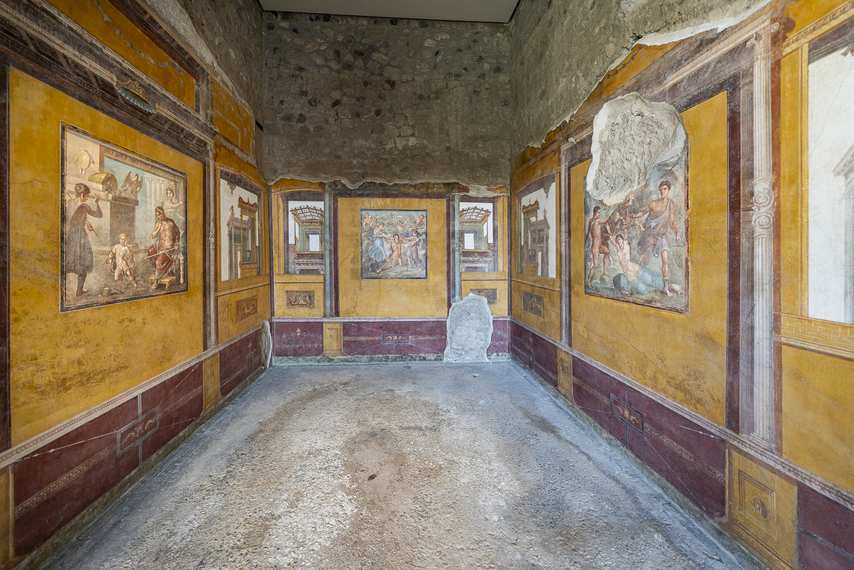
Surrounding the atrium are several cubicles (sleeping or rest rooms) and an oecus.
One cubiculum preserves paintings depicting the myth of Hero and Leander, Ariadne abandoned at Naxos, and images of fish, unfortunately partly lost. An interesting detail is that these frescoes were restored in Roman times—a rare occurrence, as it was often preferred to destroy and redo them from scratch during renovation work.
Another cubicle, perhaps intended for the janitor or a janitor, shows frescoes with marine fauna, evidence of a “marine” taste quite typical in houses near the sea.
In the oecus (a large reception room), we find frescoes with mythological scenes: the struggle between Pan and Love, observed by Dionysus and Ariadne, and the story of Cyparissus, the young man who accidentally kills the deer sacred to Apollo. These Dionysian themes alluded to the sphere of pleasure, wine and feasting, reiterating the opulence and cultural sophistication of the owners.
Along one of the sides of the atrium, two small alae (sort of niches or side rooms) completed the living area. One was converted into a built-in closet, the other retains the Fourth Style decorations.
The Second Atrium and the Servant Quarters
A corridor (where the staircase to the upper floor was once located) leads to the second atrium, around which the servile quarter is developed. Here, too, there is a tufa impluvium.
Still, the most fascinating feature is the large lararium, a domestic chapel dedicated to the Lares and Penates, depicted with Corinthian half-columns, a triangular tympanum, and, in the centre, the Owner’s Genius in the act of making a sacrifice. On either side, the Lares and a serpent (the agathodemon) symbolise the protection and fecundity of the house.
The kitchen
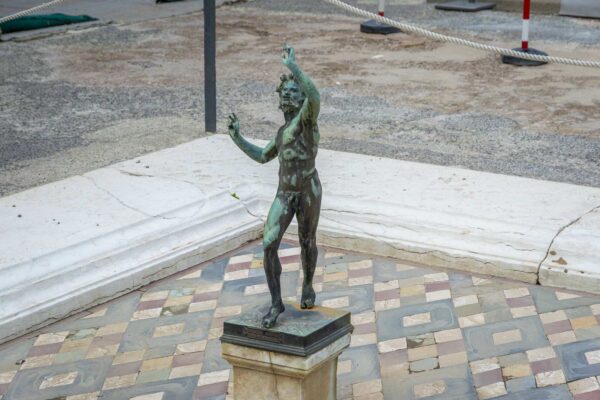
Next to it is the kitchen, featuring a masonry top, bronze boilers, and a variety of pots and pans. During excavations there were found various utensils (basins, earthenware pots, grills) and a small statue of Priapus, which probably served as a fountain in the garden.
The erotic environment
Next to the kitchen opens a small cubicle with frescoes of an erotic nature, of modest pictorial quality. According to some scholars, this room may have been used for in-house prostitution activities (perhaps run by a slave named Eutychis, as a graffito would suggest), but there is no absolute certainty.
In any case, the existence of erotically themed rooms was not unusual in Pompeii, where the depiction of sexuality was far less taboo than in later centuries.
The Triclinium and the “Gynaeceum”
A finely frescoed triclinium opens into the prestigious residential quarters, where mythological scenes such as Ariadne and Theseus or Ixion tied to the wheel for outraging the goddess Hera stand out.
The plinth of the triclinium shows marine figures (sea oxen, horses and busts of gods), while symbolic “flights” of the Seasons follow one another in the medallions. In adjacent rooms, some more intimate rooms may have been intended for the women of the house, sometimes referred to, analogously to Greek usage, as a ‘gynaeceum’.
In analogy with the Greek world, but the hypothesis is not entirely confirmed by the typology of Roman dwellings.
The Peristyle: The Heart of the House
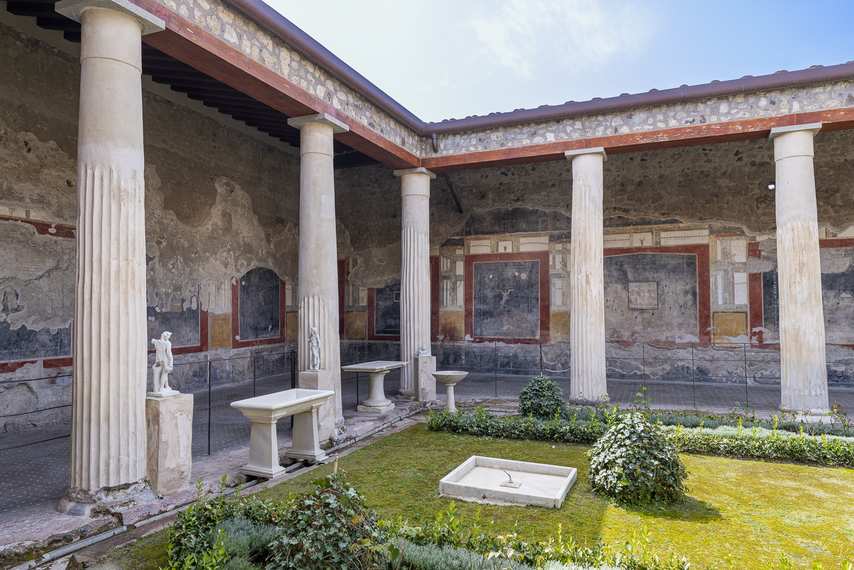
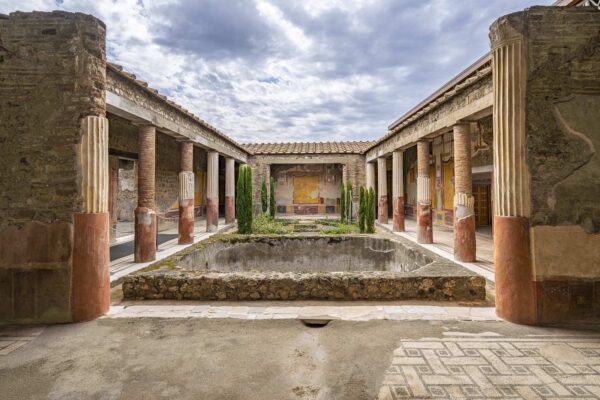
The peristyle forms the architectural and aesthetic centrepiece of the House of the Vettii in Pompeii. Surrounded by eighteen columns, it formed an indoor garden adorned with pools, bronze statues, and fountains, with water features that amazed guests.
The Roman passion for gardens was expressed not only through plants and flowers but also through sculptures and small fountains. The statues, now partly preserved elsewhere, included figures of gods and small putti (cupids) supporting dolphins or pitchers, from which water gushed.
On the walls of the peristyle portico are several still life frescoes, landscapes, and mythological scenes. Among the most famous:
Daedalus presents Pasiphae with the wooden cow (an allusion to the myth of the Minotaur).
Dionysus discovers Ariadne asleep (a future falling in love between the goddess and the god of wine).
Zeus punished Iasion in a composition rich in pathos.
From here, there is also access to further oeci (reception or banquet rooms), including one rich with black-and-white mosaics and decorations with gods and muses. Another, with a yellow background, features large scenes from Thebes: Amphion and Zetus tying Dirce to a bull, child Hercules strangling snakes, and Pentheus mauled by the Bacchae.
The Fourth Style of Frescoes and the Taste of the Vettii

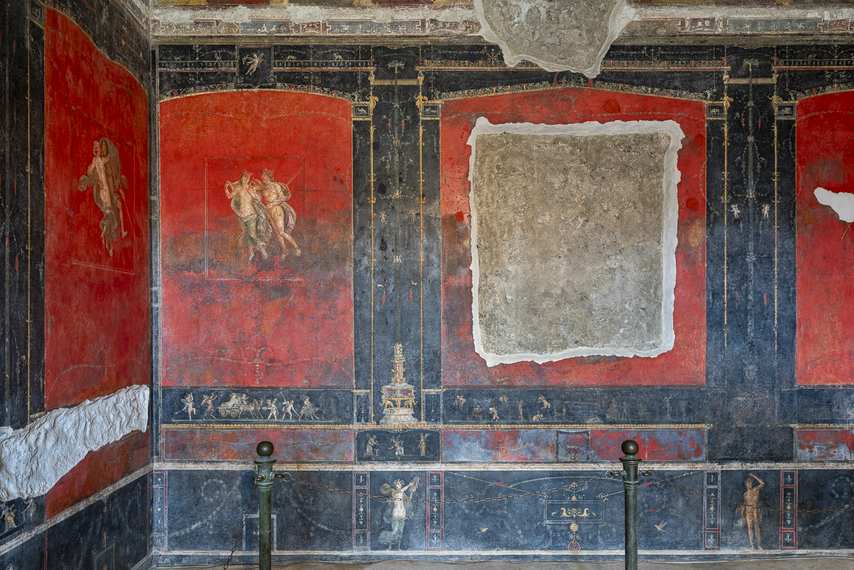
One of the peculiarities of the House of the Vettii in Pompeii is the wide range of frescoes in the Fourth Style, the final phase of Pompeian painting (following the I, II, and III Styles).
This style, widespread from about AD 50 until the eruption of 79, combines “illusionistic” elements with fantastic architecture, mythological central panels and secondary panels populated by minor figures or decorative scenes.
The Vettii, as enriched freedmen, had no ancient lineage or frescoes of past styles behind them to preserve as evidence of a glorious family legacy.
They therefore leaned toward new, glittering decorations, updated with the fashion of the time: large mythological paintings (Daedalus and Pasiphae, Hystione, Cyparissus, Ariadne and Theseus) and architectural panels with unreal columns and perspectives, often enriched by trompe-l’œil (false windows or suspended balconies).
With this pictorial apparatus, the Vettii declared their adherence to Hellenistic culture and their desire to appear “cultured” and aristocratic by emphasising complex themes and little-known stories that could entertain cultured guests and friends at banquets.
Daily Life, Rituals and Curiosities

The Lararium and Domestic Worship
One of the most striking elements is the lararium in the second atrium, with Corinthian half-columns, a triangular tympanum, and depictions of Lares, Genius, and the serpent agathodemon. This sacred space testifies to domestic devotion to the ancestors and patron deities of the house, to whom libations and incense were offered.
The presence of an elaborate lararium indicates the affluence of the owners and the importance of family religiosity in everyday Pompeian life.
Prostitutes, Slaves and Social Stratification
Alongside the pageantry are also traces of a more humble reality. The servile quarter, with its kitchen and ambience of erotic paintings, evinces the presence of slaves and probably a small prostitution business. An inscription mentions a certain Eutychis, “Greek and of fine manners.”
These details reflect Pompeii’s complex social stratification: if the Vettii enjoyed luxury, let us not forget that their house housed and exploited servile labour.
Sculptures, Fountains and Water Features
The passion for water games typical of the Romans is evident in the garden, with fountains, pools, gushers, and bronze statuettes of children or sea gods. Many of these original statues, due to conservation issues, have been transferred to museums or repositories.
Today, visitors can admire faithful reproductions of them in a restoration project that has reconstructed the garden with plants and tree species similar to those of the time.
Modern Restoration and Ancient Methods
Contemporary restoration efforts have removed layers of wax and paints applied in previous decades, which obscured the original colours. Curiously, it is documented that the Vettii themselves, when renovating, decided to preserve some of the older frescoes, renewing them, as in the case of the marine painting in one of the cubicles.
This attitude was not typical: many houses preferred to redo the decorations entirely.
The Discovery and the New Tour Route
The House of the Vettii in Pompeii was excavated between 1894 and 1896 under the direction of Giulio De Petra. Right away, researchers realised the extraordinary artistic richness of the complex. To preserve the frescoes, part of the roofs was reconstructed, preventing rain and weather from further damaging the paintings.
In recent decades, the house has been closed for restoration several times due to its delicate conservation conditions. Since 2016 (and more fully since 2023), it has been possible to revisit most of the rooms, with a tour that enhances the central atrium, garden, frescoed oeci and the servile quarters.
Exciting is the possibility of admiring “in situ’ copies of the original statues, while other exhibits can be found at the National Archaeological Museum of Naples, a place dedicated to the preservation of many Pompeian works.
Why Visit the House of the Vettii

The House of the Vettii is an open window into the society of the time. Strolling through its atriums and gardens provides insight into how the wealthy classes of Pompeii lived in the 1st century AD, the deities they worshipped, the pace of domestic activities, and the entertainment they offered guests.
The intriguing story of the freedmen owners teaches that, in imperial Rome, social mobility was possible: from slave status, one could rise to great wealth, radically transforming one’s social standing.
The visitor will be able to appreciate:
The richness of the myths depicted-Dedalus and Pasiphae, Issione, Ariadne, Cyparissus, Pan and Love.
The scenes of everyday life (working cupids, still lifes, erotic paintings) that tell of amusements, religion and customs.
The settings for slaves and their lifestyle contrast with the finely decorated rooms for masters.
The garden and water features: evidence of Roman skill in plumbing and the pleasure of enjoying green areas at home.
As you plan your visit to the Pompeii Archaeological Park, it’s worth including the House of the Vettii in your itinerary. Exploring it will give you a taste of the vibrancy and sophistication of a once cosmopolitan and culturally effervescent city, abruptly interrupted by the eruption of 79 AD.
FAQ About the House of the Vettii in Pompeii
They were two freedmen, Aulus Vettius Restitus and Aulus Vettius Conviva, who amassed wealth through trade, especially in wine, and became the owners of the house. They embellished it with fine frescoes and sculptures.
It is famous for its Fourth Style frescoes, one of the last developments in Pompeian painting, and its large peristyle with fountains and statues. The mansion is also an example of the social rise of freedmen in first-century AD Pompeii.
This is a sacred aedicule dedicated to the Lares and Penates, the household deities protecting the home. The decoration, featuring Corinthian half-columns, a tympanum, and figures such as the Master Genius, the Lares, and the serpent agathodemon, underscores the importance of family worship in ancient Rome.
Yes, the fresco of Priapus weighing his member on a scale, a symbol of fertility and wealth, is preserved in the entrance vestibule. It represents a classic example of Roman attitudes toward eroticism and prosperity.
The peristyle with its 18 columns and water features, along with the frescoed reception rooms (oecium and triclinium), is the real scenic centrepiece of the House of the Vettii in Pompeii. Here you can admire most of the mythological paintings in all their splendour.