In the heart of the Archaeological Excavations of Pompeii, one of the most fascinating and historically rich sites is undoubtedly the Temple of Venus in Pompeii.
This Roman temple, buried by the eruption of Vesuvius in 79 AD, is an extraordinary testimony to the religious and cultural life of the city. In your visit to the Archaeological Excavations of Pompeii, the Temple of Venus deserves a not-to-be-missed stop on your itinerary, allowing visitors to experience the grandeur and spiritual significance of one of the most revered deities of ancient Rome.
Where is it located?
Map of Pompeii: Regio VIII – 1
Google MapsHistory of the Temple of Venus in Pompeii

The Temple of Venus in Pompeii was built in the period immediately following the city’s founding as a Roman colony, in the context of the conquest of Pompeii by Lucius Cornelius Sulla.
Initially, another temple in the city was dedicated to Venus Physica (a local aspect of Venus possibly linked to Aphrodite or Astarte), whose identity could be traced to the Greek goddesses Aphrodite or the Phoenician goddess Astarte.
As the city evolved, the Temple of Venus became the principal place of worship dedicated to the goddess, a symbol of love, beauty and fertility. The temple’s construction required the demolition of numerous houses and stores, except for a few located along the southern slope, reserved for the priests.
Despite the damage sustained during the Pompeii earthquake in 62 AD, the temple continued to perform its functions thanks to the construction of a small votive shrine, which made it possible to keep religious activities alive during the restoration work.
However, the eruption of Vesuvius in 79 AD ended this revival phase, burying the Temple of Venus completely under a blanket of ash and lapilli.
Architecture and Description of the Temple of Venus
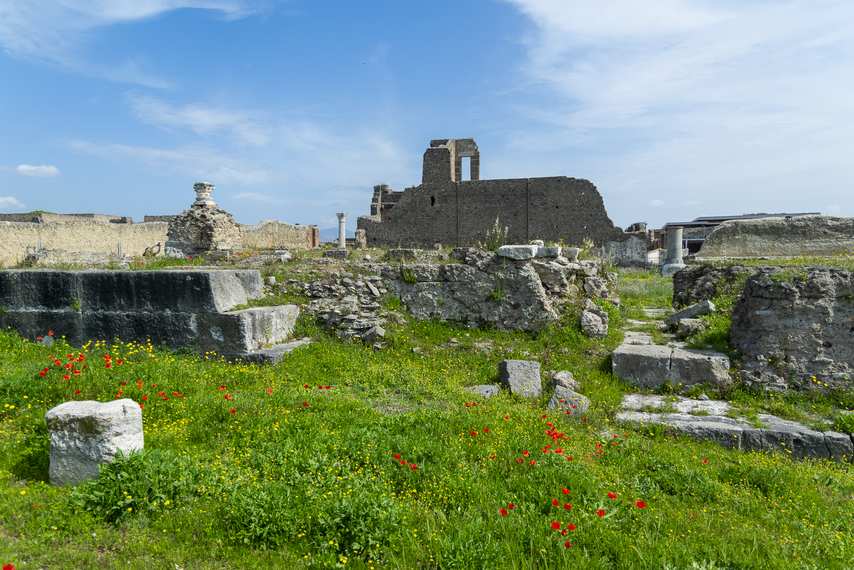
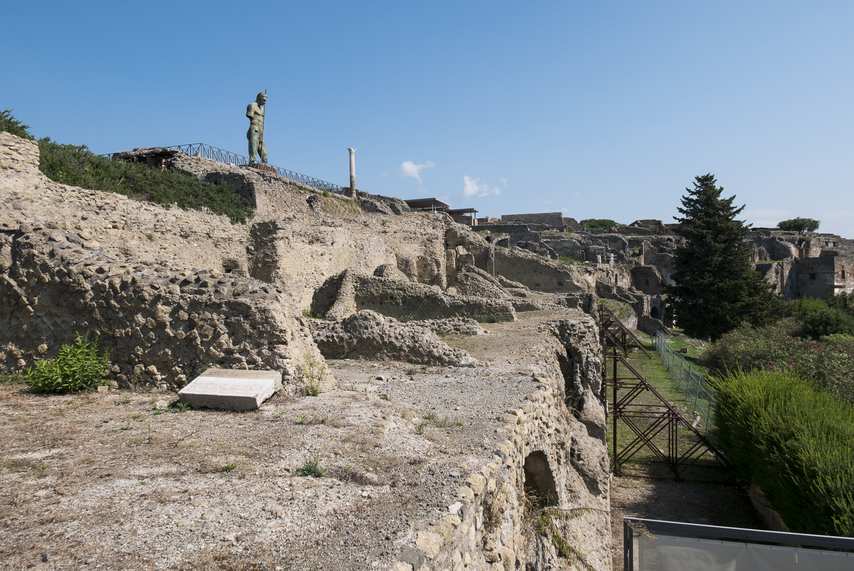
The Temple of Venus in Pompeii stood in a panoramic position, overlooking the surrounding plain and the Gulf of Naples. This location was strategic and symbolic, representing the goddess’s protection over the city and its inhabitants.
The temple’s structure, surrounded by massive perimeter walls, was expanded during the Julio-Claudian era, reflecting the architectural evolution and ritual needs of the Pompeian community.
The Podium and Columns
The temple was developed along the north-south axis, surrounded by columns that gave it a majestic and imposing appearance. Two columns spanned the east and west sides, while a third row was located along the north side. The south side, however, remained column-free, perhaps for ease of access or structural reasons.
During the Sillan period, an additional colonnade was added with gutters for rainwater runoff, demonstrating attention to the building’s functionality and durability.
The temple podium, about 29 meters long and 15 meters wide, was made of concrete and lava, typical Roman building materials. It featured a basalt wall likely marking the perimeter of the cella, or inner chamber. Some studies suggest the presence of a second podium, joined to the first by a concrete pour, testifying to the modifications made over time.
Decorations and Flooring
The Temple of Venus was richly decorated in marble, a material symbolic of prestige and refinement. Although much of the decoration has been lost over the centuries, some significant fragments remain, such as the remains of an architrave, columns, and a pediment.
The original pavement, made with an outer strip of white tesserae, a central part of colored marble, and a large central area destroyed, testifies to the elegance and complexity of Roman construction techniques.
Remaining elements include a travertine altar, two pedestals that probably housed equestrian statues, and a staircase that connected the temple to an underground conduit, leading to some dwellings on a slope near the temple. These details offer an in-depth look at ancient Pompeians’ ritual practices and daily life.
The Religious and Social Role of the Temple of Venus
The Temple of Venus was a place of worship and social and cultural gathering. The goddess, venerated as the city’s patroness, hosted numerous ceremonies and public festivities that strengthened the sense of community and Pompeian identity.
The temple hosted rituals dedicated to fertility, love, and prosperity, fundamental elements of a prosperous city like Pompeii.
In addition to its religious functions, the temple may have served a political role, acting as a meeting place for citizens and prominent societal figures, including priests. Its scenic location and impressive architecture reflected the power and influence of religion in both public and private life.
What to See at the Temple of Venus in Pompeii
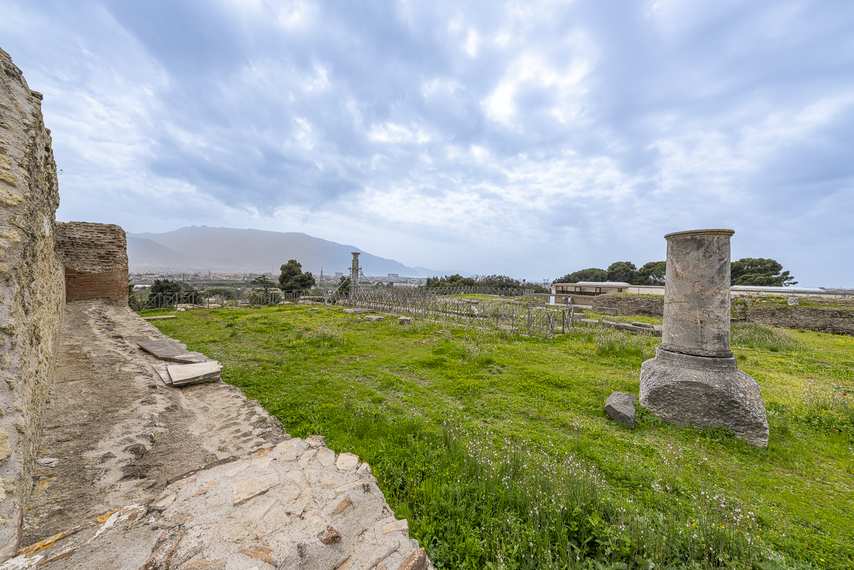
While visiting the Pompeii Ruins, the Temple of Venus offers several fascinating elements to admire:
- Travertine altar — One of the best-preserved elements of the temple, still visible on the site, was once used for offerings and sacrifices dedicated to Venus.
- Equestrian pedestals — There are still two pedestals that probably housed equestrian statues symbolising power and prestige.
- Staircase and underground conduit — The remains of the stairs leading to a subterranean passage offer a glimpse into the temple’s hidden infrastructure.
In addition to these still observable elements, some of the temple structures are now reduced to ruins or gone:
- Ionic colonnade — Once 11 meters high, the elegant columns are almost entirely gone, and only a few remain visible.
- Decorated pediment — The original decorations dedicated to Venus have been destroyed, and no significant traces remain.
- Original paving — The fine mosaic of colored marble and white tesserae has mainly been stolen or destroyed, with only a few fragments remaining.
Despite the losses, the Temple of Venus offers a striking testimony to architecture and religious devotion in ancient Pompeii.
Why Visit the Temple of Venus in Pompeii

Visiting the Temple of Venus in Pompeii is an experience that goes beyond mere architectural admiration. Here are some reasons why this Roman temple should be a must-see during your visit to the Pompeii Archaeological Park:
- Understand roman religion: The temple offers a window into ancient Rome’s spirituality and religious practices, allowing you to better understand the deities’ central role in daily life and political affairs.
- Appreciate roman architecture: The majesty of the Ionic columns, the use of fine materials, and the structural complexity of the temple provide an extraordinary example of Roman architectural skill and creativity.
- Immersion in history: Walking among the temple remains is to immerse oneself in Pompeii’s history, reliving moments of glory and tragedy that shaped one of the most fascinating cities of antiquity.
Educational experience: A visit to the Temple of Venus in Pompeii enriches your knowledge of Roman archaeology and offers valuable information about the rituals, ceremonies, and social dynamics of the time.
Conclusion
The Temple of Venus in Pompeii is one of the most emblematic sites of the Pompeii Archaeological Park.
It offers visitors a fascinating combination of history, architecture, and spirituality. Its grandeur and scenic location make it a must-see for anyone wishing to fully understand the magnificence and complexity of the ancient Roman city.
To visit the Temple of Venus in Pompeii is to immerse oneself in a journey through time, exploring the vestiges of a sacred place once at the centre of Pompeii’s religious and social life.
Through its majestic columns, exquisite decorations, and historic remains, the shrine tells stories of deities, rituals, and the resilience of a Roman community in the face of natural disasters.
FAQ About the Temple of Venus at the Pompeii Archaeological Park
The Temple of Venus is one of the main Roman temples at the Pompeii Archaeological Park, dedicated to Venus, goddess of love and beauty. Built after Pompeii was founded as a Roman colony, it testifies to the relevance of the cult of Venus in the religious, social and political life of ancient Pompeians.
You can reach the Temple of Venus by entering the excavations through Porta Marina Superiore. Walking along Via Marina, the ancient road leading to the Forum, you will find the temple complex on your right, overlooking a splendid view of the Gulf of Naples.
The shrine dates from the period immediately following Pompeii’s transformation into a Roman colony, following the conquest by Lucius Cornelius Sulla. Initially, another temple was dedicated to Venus Fisica, which can be correlated with the Greco-Phoenician deities (Aphrodite or Astarte). In time, the cult of Venus became predominant. Despite the damage caused by the earthquake in 62 AD, the temple was partly restored until the eruption of Vesuvius in 79 AD, which destroyed it and left it buried under lapilli and ash.
Ionic colonnade: At one time, large columns of the Ionic order (about 11 meters high) surrounded the temple on three sides.Concrete and lava podium: Measuring about 29 meters long by 15 meters wide, with an outer basalt wall bordering the cella.Travertine altar: Well-preserved, it formed the centrepiece of sacrificial rites dedicated to Venus—marble and white tessellated flooring: Today largely damaged, but still visible in some fragments.
Venus was revered as Pompeii’s patroness, a symbol of love, beauty, and fertility. Her shrine served as a place of worship and a social gathering centre, where festivals, ceremonies, and processions were celebrated. The presence of priests made this complex a religious and, in part, political landmark.
Celebrations included ritual offerings and sacrifices at the travertine altar, often accompanied by processions involving the community. On festivals related to love and fertility, Pompeians gathered in the temple to worship Venus, asking her for protection and prosperity. Such ceremonies reinforced communal identity and popular devotion..
A travertine altar is still in situ. Equestrian pedestals, remnants of statues of influential personalities or mythological figures, are also present. Traces of the colonnade and podium suggest the building’s ancient monumentality. A staircase and underground conduit, evidence of Roman engineering, connected the temple to some dwellings on the slope.
Much of the Ionic colonnade, decorated pediment, and original flooring have disappeared due to spoliation, natural damage, and illicit trafficking of artefacts over the centuries. What remains, however, continues to offer a valuable glimpse into Roman architecture and religious life in antiquity.
A visit to the Temple of Venus can take about 10 minutes, depending on how much detail you wish to observe. To better understand the historical and archaeological context of the entire area, include it in a larger tour of the Pompeii Ruins. Plan 2-3 hours if you also want to visit the Forum, Basilica, Temple of Apollo, and other iconic sites.
Historical insight: You will discover the importance of the cult of Venus and its connection to the city.Example of Roman architecture: You will admire remains that demonstrate the building skills of the time.Landscape context: The panoramic location on the Bay of Naples makes for an evocative visit.Connection to daily life: You will understand how religion influenced sacred rituals, politics, and society.