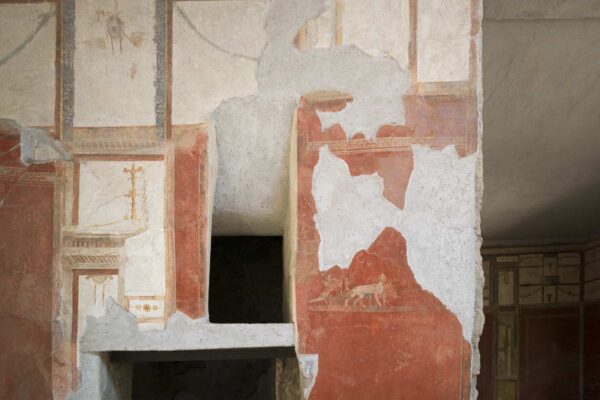
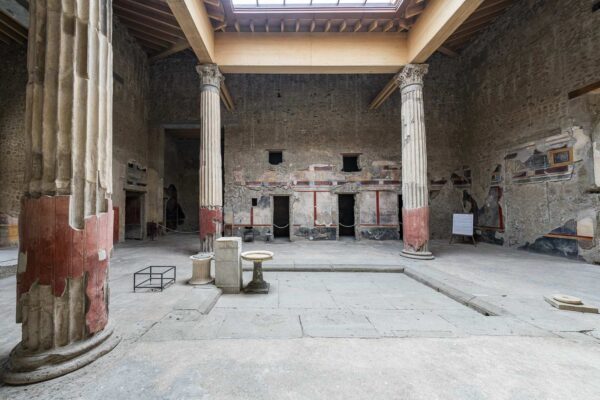
Pompeii is an archaeological site of extraordinary beauty and vastness, and finding your way around its ruins can seem challenging, especially with little time to spare. If you are wondering what to see in Pompeii in 3 hours, this itinerary is an ideal option: a balanced route that allows you to discover the essential stops without rushing through too much.
The Archaeological Park of Pompeii is extensive, but most visitors can get a general idea of the ancient city and its most characteristic spots in about three hours. In this time, you can explore some of the most iconic sites, such as the Forum, the Large Theatre, the Lupanar, and the House of the Faun, true symbols of Pompeii.
However, these are just some of the wonders the site holds.
If you wish to delve deeper into Pompeii’s history and secrets, you may need more time to visit the less-travelled areas and discover hidden details among the ruins. Three hours, however, already offers a comprehensive overview of the ancient city and its most significant attractions.
Whatever the length of your visit, good planning will allow you to have a memorable experience and immerse yourself in the timeless atmosphere of Pompeii.
Suppose you would like to return after this itinerary to explore even more. In that case, you can choose one of our more in-depth tours to discover every corner of this extraordinary archaeological site.
Note: Each stage of the recommended route is indicated in parentheses with a Roman numeral followed by an Arabic numeral, for example (Regio VI – 1).
The Roman number, known as Regio, represents one of the official subdivisions of the archaeological site of the Pompeii Archaeological Park.
Each Regio corresponds to a specific geographical area or functional zone within the ancient city, such as residential, commercial, public or religious areas. The Arabic number following the Regio identifies the exact location of the place within that specific area, according to the official map of the Pompeii Archaeological Park.
This numbering system facilitates orientation and navigation between the different attractions, allowing visitors to follow the route organised and informed, ensuring an efficient visit.
Suggested Itinerary to Visit Pompeii in Three Hours
A visit to Pompeii with our three-hour itinerary starts from Piazza Esedra. Past the ticket office in Piazza Esedra (Porta Marina Inferiore), continue along Viale delle Ginestre in an easterly direction. Until you reach the Quadriporticus of the Theatres.
Quadriporticus of the Theatres (Regio VIII – 11)
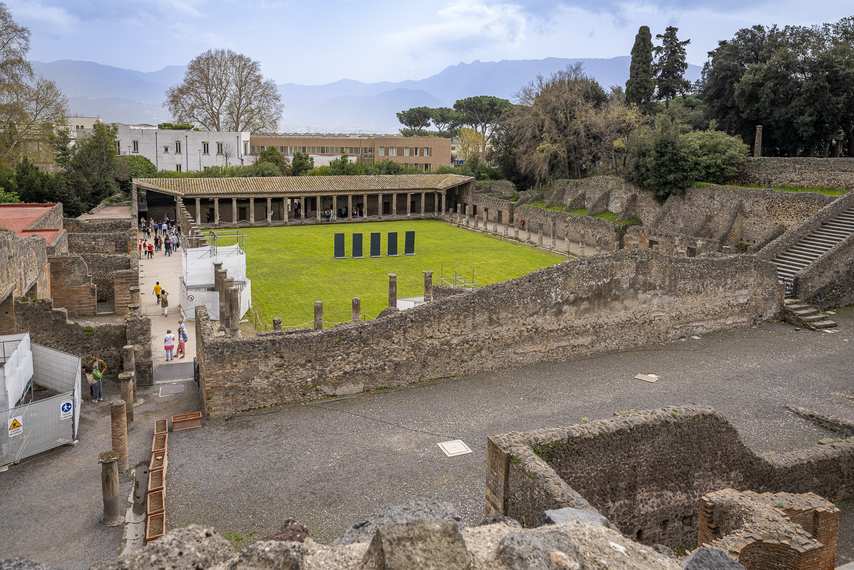
The Quadriporticus of the Theatres, also known as the Gladiator Barracks, is an imposing Roman structure in Pompeii. Initially built in the first century BC as a waiting area for spectators at the theatres, it became a school for gladiators after the 62 AD earthquake.
However, the eruption of Vesuvius in 79 buried it before renovations were completed. Bourbon excavations unearthed fascinating evidence of gladiatorial art, including helmets, decorated swords, and fighter skeletons.
Google Maps indication:
https://maps.app.goo.gl/vG96NYB1Nrt8vcHf8
Why visit the Quadriporticus of the Theatres
The Quadriporticus of the Theatres offers an interesting perspective on two crucial aspects of Pompeian society: theatrical performance and gladiatorial training. This space represents an evolution in the use of public buildings, transforming from a gathering place for spectators to an actual barracks for gladiators.
What to admire in the Quadriporticus of the Theatres
- The Doric colonnade, with 74 tufa columns, borders the large central courtyard.
- The gladiators’ rooms were small cells built after the 62 AD earthquake.
- The original architecture of the quadriporticus, with its entrances to the theatres and the staircase that led to the Triangular Forum.
Beyond the Quadriporticus, you can reach the Large Theatre.
Large Theatre (Regio VIII – 10)

The Large Theatre of Pompeii is one of the most impressive structures in the ancient city, a witness to Pompeii’s vibrant cultural life. Built in Samnite times and expanded by the Romans, the theatre could seat up to 5,000 spectators, demonstrating the importance of entertainment and sociability in ancient society.
Performances of comedies, tragedies and mimes were held here, attracting citizens of all social classes. Today, the Large Theatre is a fascinating place, where one can still feel the atmosphere of the performances of two thousand years ago.
Google Maps indication:
https://maps.app.goo.gl/zouDe2ULNk5SSx8eA
Why visit the Large Theatre of Pompeii
Visiting the Large Theatre allows one to immerse oneself in the culture and social life of ancient Pompeii and understand the fundamental role the theatre had for the community. The size of the building and its ability to accommodate large audiences show the importance of performances in daily life, transforming the theatre into a meeting point for the city.
What to admire in the Large Theatre of Pompeii
- The semicircular tiers of seats are arranged in such a way as to provide an excellent view for spectators.
- The exceptional acoustics are still experienced today when speaking from the centre stage.
- The Roman architecture had the cavea divided into sectors for different social classes.
- The historical suggestion is to sit in the stands and imagine the ancient spectacles that enlivened the city.
An unmissable experience to understand the charm and vibrancy of Pompeii two thousand years ago.
After visiting the Large Theatre, you can enter the Small Theatre (Odeon), located immediately next door on the right.
Small Theatre (Odeon) (Regio VIII – 12)
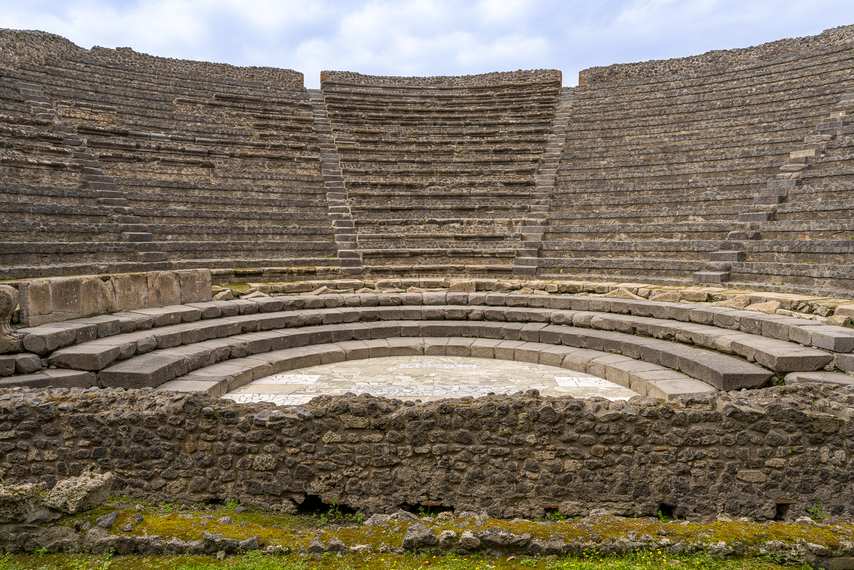
The Small Theatre, also known as the Odeon, is a Roman-era theatre structure built between 80 and 75 B.C. thanks to funding from two Roman magistrates. This small covered theatre was intended for musical performances and poetry recitations, offering excellent acoustics due to its architecture.
With a capacity of about 1,300 spectators, the theatre features marble decorations and frescoes in the second style. Restored to light in the 19th century, it represents an essential testimony to Pompeii’s cultural life.
Google Maps indication:
https://maps.app.goo.gl/bg85xqLf7rcunNfK7
Why visit the Small Theatre
The Small Theatre is a perfect place to discover the more intimate and refined side of Pompeian entertainment. It was reserved for performances that required exceptional acoustics, such as concerts and plays.
The structure still retains architectural and decorative details that allow you to imagine the atmosphere of these exclusive events.
What to admire in Pompeii’s Small Theatre
- The colored marble orchestra was donated in the Augustan period.
- The kneeling tufa telamons are sculptural elements typical of Hellenistic art.
- The tufa bleachers with rear cavities are designed for maximum spectator comfort.
- The refined acoustics made the theatre ideal for musical performances and declamations.
- The balustrades are decorated with winged griffon legs, symbols of power and protection.
A small jewel of Pompeii that offers an immersive experience in Roman theatre culture.
Want to learn more about the Large Theatre and the Small Theatre? Read our in-depth article.
Exit the Odeon onto Via Stabiana and continue north to the intersection with the Vicolo del Menandro. Before turning into it, pause to admire the striking Via Stabiana extending northward. Once you enter Vicolo del Menandro, after about 100 meters, you will find Menander’s House on the right.
House of Menander (Regio I – 7)
The House of Menander is a sumptuous Pompeian domus measuring approximately 1,800 m², a perfect example of a wealthy family’s residence in ancient Pompeii.
Excavated between 1926 and 1932, the house takes its name from a fresco depicting the Greek poet Menander. The house underwent several modifications over time, including a peristyle and private baths.
Of particular significance is the discovery of a “treasure” of silver objects and coins, hidden during restoration work before the eruption of Vesuvius.
Google Maps indication:
https://maps.app.goo.gl/QYgCpTMt186otZEn7
Why visit the House of Menander
The House of Menander is one of the best-preserved domus in Pompeii and provides insight into the daily life of the Roman elite.
The elegance of the decorations and the presence of private baths testify to the luxury and prestige of this dwelling, offering a unique window into Pompeian society.
What to admire in the House of Menander
- The atrium is one of the house’s oldest rooms, built around 250 BC.
- The peristyle: a large porticoed courtyard added in the Augustan period.
- The paintings of the fourth style include the fresco of Menander, which gives the domus its name.
- The calidarium mosaic: with a depiction of acanthus surrounded by fish and dolphins.
Directly opposite the House of Menander, also in the Alley of Menander, is the House of the Cryptoporticus, which is certainly worth a visit.
House of the Cryptoporticus (Regio I – 5)

The House of the Cryptoporticus, located in a central area of Pompeii, is a luxury residence built on two levels, characterised by the presence of an elegant cryptoporticus with frescoes inspired by the Iliad, a private bath complex and a large oecus with Dionysian decorations.
The dwelling, originally attached to the House of the Iliac Sacellum, was separated after the 62 AD earthquake and underwent significant transformations. In 1914, the remains of several victims of the eruption were found. The domus is a rare example of an urban residence with structures typical of suburban villas.
Google Maps indication:
https://maps.app.goo.gl/9Y3ERApJd8WZWhJt5
Why visit the House of the Cryptoporticus?
The House of the Cryptoporticus is an exceptional testimony to its owners’ wealth and aesthetic taste. The presence of a cryptoporticus decorated with mythological scenes and a private bath complex makes it unique among Pompeian domus.
Moreover, by visiting it, one can understand how the lives of its inhabitants were dramatically interrupted by the eruption of Vesuvius, evidenced by the casts of victims found in the garden.
What to admire in the House of the Cryptoporticus?
- The cryptoporticus: an elegant underground corridor decorated with frescoes depicting scenes from the Iliad, evidence of the family’s high culture.
- The private baths, rare in Pompeii’s urban houses, feature Second Style frescoes and fine mosaics.
- The oecus with mosaic: a large living room with decorations inspired by the Dionysian world.
- The summer triclinium: a banquet hall with red-painted walls and plant motifs.
Would you like to learn more about the House of the Cryptoporticus? Read our in-depth article.
Exit onto Vicolo del Menandro and continue a few meters until you meet Vicolo di Paquius Proculus.
Take it and walk north about 50 meters until the intersection with Via dell’Abbondanza. Turn left (west) and pass the intersection with Via Stabiana, which heads north.
Stay on Via dell’Abbondanza, and a little further on, you can visit the Stabian Baths by entering through the door on the southern side, facing Via dell’Abbondanza.
Stabian Baths (Regio VII – 16)

The Stabian Baths represent one of the oldest bath complexes in Pompeii, dating back to the 3rd-4th centuries BC. Located along the Via Stabiana, they were expanded in the 2nd century BC and underwent restoration until the eruption of Vesuvius in 79 AD.
The complex includes a trapezoidal gymnasium with a pool, two separate sections for men and women, and thermal rooms typical of Roman times, such as the frigidarium, tepidarium, and calidarium, heated by an advanced hypocaust system.
Google Maps indication:
https://maps.app.goo.gl/km5xkvCPxsa5ey5k7
Why visit the Stabian Baths?
Visiting this spa complex offers an immersion in ancient Rome’s wellness and hygiene culture. The baths were a place for socialising and relaxation, allowing visitors to understand better the Pompeians’ daily life and the sophisticated heating system used.
What to admire in the Stabian Baths?
- The gym and swimming pool are places for training and relaxation.
- The thermal rooms, with their progressive temperature, are.
- The hypocaust system was an ingenious heating mechanism.
- The decorations and stucco are well-preserved in the women’s section.
Would you like to learn more about the Stabian Baths? Read our in-depth article.
Leaving the Stabian Baths on Via dell’Abbondanza, continue west for a few meters, then turn right into Vicolo del Lupanare.
If you are already in Vicolo del Lupanare, continue north for about 80 meters until you reach the famous Lupanar on your left.
Lupanar of Pompeii (Regio VII – 18)

Lupanare of Pompeii is the most famous brothel in the ancient city, a testament to an often-overlooked social reality.
Built on two levels, it was organised into small rooms with masonry beds and decorated with explicit frescoes that served as a “catalogue” for clients. Graffiti left by visitors provides a vivid record of the daily life and sexual habits of the time.
This site offers a novel perspective on Pompeian society, including the plight of prostitutes, who were often slaves.
Google Maps indication:
https://maps.app.goo.gl/fqRKhjNyiBCQjyAV8
Why visit the Lupanar?
The Lupanar allows you to explore an authentic, often ignored aspect of Roman life. Visiting it helps you better understand the mentality of the time, the role of prostitution in the economy, and the way sexuality was lived and regulated in Roman society.
What to admire in the Lupanar?
- Erotic frescoes, painted on the walls, depict sexual scenes and were used as a catalogue of the services offered.
- Small rooms (cubicula): each equipped with a stone bed, representing the essential furnishings of the place.
- Ancient graffiti: engravings left by clients and prostitutes, containing names, ironic jokes and references to the brothel’s activity.
- It was a two-level structure: the lower level was for the common clientele, while the upper level probably housed wealthier clients or the female workers themselves.
Would you like to learn more about the Lupanar? Read our in-depth article.
Leaving on Vicolo del Lupanare, continue north until you reach Vicolo degli Augustali. As soon as you turn left, you can visit the House of the Wounded Bear.
House of the Wounded Bear (Regio VII – 19)

The House of the Wounded Bear is a fine domus in Pompeii, known for its extraordinary floor mosaic that depicts a bear wounded by a spear. This is considered an apotropaic symbol to ward off negative influences.
The dwelling, which had been closed for nearly two decades, has been restored and is now accessible thanks to a glass walkway that preserves the precious mosaic floors.
Among the most fascinating elements of the domus is the nymphaeum fountain, decorated with shells and coloured tiles, featuring mythological figures of Neptune and Venus, which evokes the charm of Pompeian domestic life.
Google Maps indication:
https://maps.app.goo.gl/3bvjWYkVX8XYN1ug9
Why visit the House of the Wounded Bear
This domus offers an immersion into the art and spirituality of the ancient Romans, revealing the value of symbolic imagery in protecting the home.
Its mosaic and splendid fountain show the elegance and luxury of Pompeii’s aristocratic dwellings, offering a unique insight into the private life and aesthetic tastes of the time.
What to admire in the House of the Wounded Bear
- The mosaic of the wounded bear, now restored and visible through a glass protection, is one of the most evocative examples of Pompeian mosaic art.
- The nymphaeum fountain, decorated with polychrome mosaics and natural stones, features Neptune and Venus, mythological figures.
- The decorated rooms, with refined frescoes and marble and coloured limestone floors, testify to the dwelling’s elegance.
- The entrance to the tablinum features a striking mosaic floor that introduces visitors to a path of discovery between art and history.
Would you like to learn more about the House of the Wounded Bear? Read our in-depth article.
When the visit is over, return to Vicolo degli Augustali and continue west for 150 meters until you turn right onto Via del Foro. Continue north, taking Via di Mercurio, then turn right into Vicolo di Mercurio.
Continue down the alley and go down Vicolo del Fauno for about 40 meters until you reach the entrance to House of the Faun.
House of the Faun (Regio VI – 1)
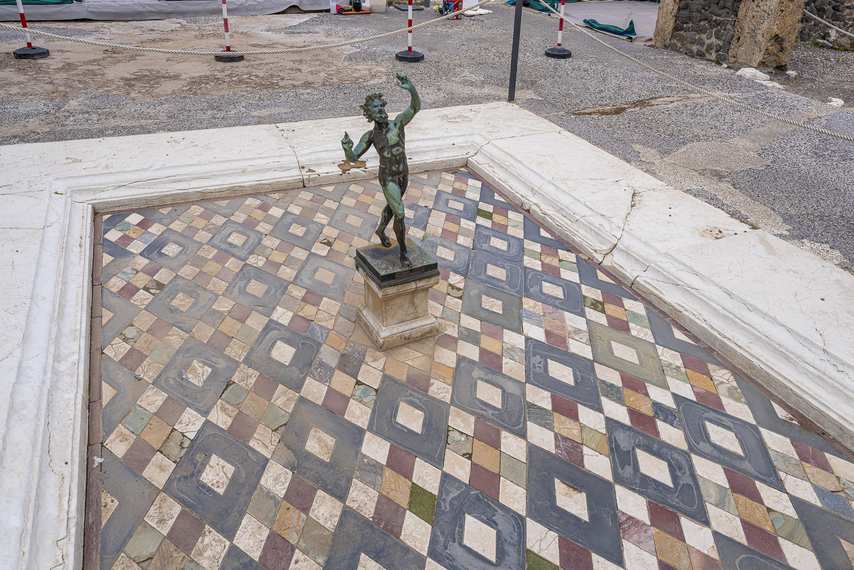
The House of the Faun is one of the most impressive dwellings in Pompeii, occupying an entire block with its 3,000 square meters. Built in the 3rd century BC and expanded in the 2nd century BC, it was one of the most luxurious dwellings in the city.
It owes its name to the bronze statue of a dancing faun in the atrium impluvium. In addition to its vast size, the house is famous for the Battle of Issus Mosaic, an artistic masterpiece depicting the clash between Alexander the Great and Darius III.
The structure includes two atria, two peristyles, numerous rooms, and a private bath quarter.
Google Maps indication:
https://maps.app.goo.gl/8itPen1snV5qunRh6
Why visit the House of the Faun?
This domus allows visitors to discover the elegance and grandeur of Roman aristocratic life in Pompeii. Its size, fine mosaics and innovative architectural solutions make it an outstanding example of a patrician dwelling of the Republican era.
What to admire in the House of the Faun?
- Statuette of the Dancing Faun: Placed in the impluvium of the atrium, it is the symbol of the house and one of Pompeii’s most iconic elements.
- Mosaic of the Battle of Issus: an artistic masterpiece depicting the clash between Alexander the Great and Darius III, now in the National Archaeological Museum in Naples.
- Minor mosaics, detailed depictions of animals, still lifes, and scenes of everyday life decorate various rooms in the Domus.
- Great peristyle: Surrounded by a double order of columns, it represents one of the house’s most scenic spaces.
- Architecture and perspective play a role: the layout of the rooms creates a visual effect that enhances the mansion’s majesty, with expansive views from the tablinum to the inner gardens.
Would you like to learn more about the House of the Faun? Read our in-depth article.
From Vicolo del Fauno, go up Vicolo di Mercurio by turning right, then continue until you cross Vicolo dei Vettii on the left.
After a few meters, you will find the entrance to the House of the Vettii.
House of the Vettii (Regio VI – 11)

The House of the Vettii is one of the best-preserved domus in Pompeii, rich in frescoes and delicate decorations. Belonging to the Vettii brothers, wealthy freedmen devoted to trade, the house reflects their social status with luxurious rooms and symbols of prosperity.
The peristyle, with its fountains and bronze statues, mythological frescoes, and the famous Priapus in the atrium, is an element that makes this dwelling a perfect example of the elegance and refinement of the Roman era.
Google Maps indication:
https://maps.app.goo.gl/Sn9dypSD9eBdqcZt9
Why visit the House of the Vettii?
Visiting the House of the Vettii is to immerse yourself in the life of a wealthy family in ancient Pompeii, where you can discover the luxury and aesthetic taste of the well-off freedmen.
With its perfectly preserved frescoes, this domus offers a journey into Roman myth and symbolism, highlighting the role of art in daily life.
What to admire in the House of the Vettii?
- The mythological frescoes with scenes of Ariadne and Theseus, Daedalus and Pasiphae, and the torment of Pentheus.
- The mosaic of Priapus in the vestibule is a symbol of fertility and prosperity.
- The peristyle had columns, basins, and bronze statues as fountains.
- The triclinium and oecium have delicate decorations, including cupids, which are intended for games and crafts.
- The kitchen and lararium are evidence of Roman domestic life.
Would you like to learn more about the House of the Vettii? Read our in-depth article.
Return to Vicolo di Mercurio, retrace your route west to the intersection with Via di Mercurio, then turn left. Immediately after, you will find the entrance to the Small Fountain House.
House of the Small Fountain (Regio VI – 3)
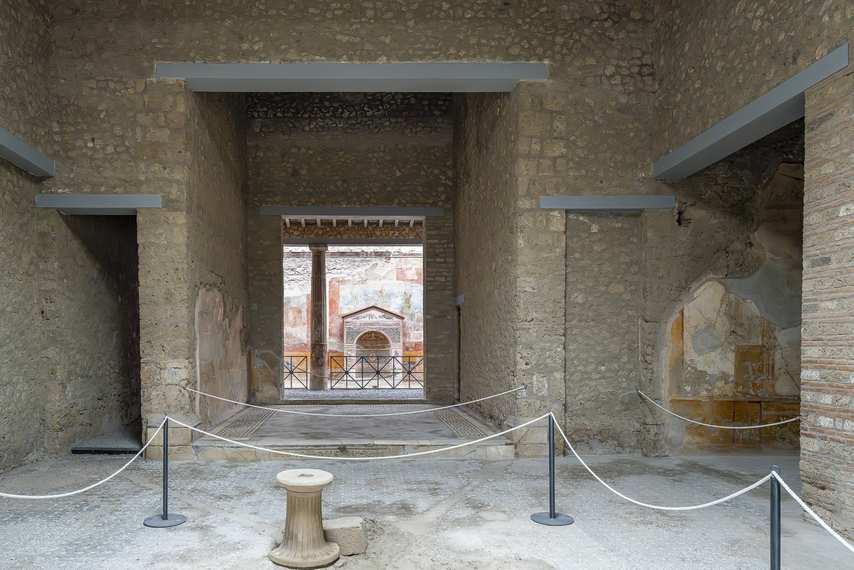
The House of the Small Fountain, located on Via di Mercurio, is one of Pompeii’s finest dwellings, famous for its fountain-ninfeo decorated with colourful mosaics, shells and bronze statues.
Built in the first century B.C., it features a typical Roman living scheme with an atrium, tablinum and peristyle, the walls of which are adorned with frescoes of landscapes and seascapes.
After extensive restoration, which consolidated the structure and preserved the decorative elements, the house has been reopened to the public, offering a journey into the domestic elegance of Roman times.
Google Maps indication:
https://maps.app.goo.gl/mzFHx7C5T2cHRx8F8
Why visit the House of the Small Fountain
This house represents a perfect example of refinement and luxury in Pompeian dwellings. Its rich decoration testifies to the owner’s aesthetic taste and social status, making it a must-see for those who want to discover the private lives of Pompeii’s citizens.
What to admire in the House of the Small Fountain
- The splendid fountain-ninfeo, covered with mosaics and adorned with statues.
- The frescoes in the peristyle depict landscapes and maritime cities.
- The mosaic floor of the atrium and the Pompeian-style wall decorations.
- The architecture of the domus, with well-preserved rooms that offer insight into domestic life in ancient Pompeii.
Exit onto Via di Mercurio and continue south to the intersection with Via delle Terme. Turn right and, after about thirty meters, you will find the entrance to the House of the Tragic Poet.
House of the Tragic Poet (Regio VI – 4)
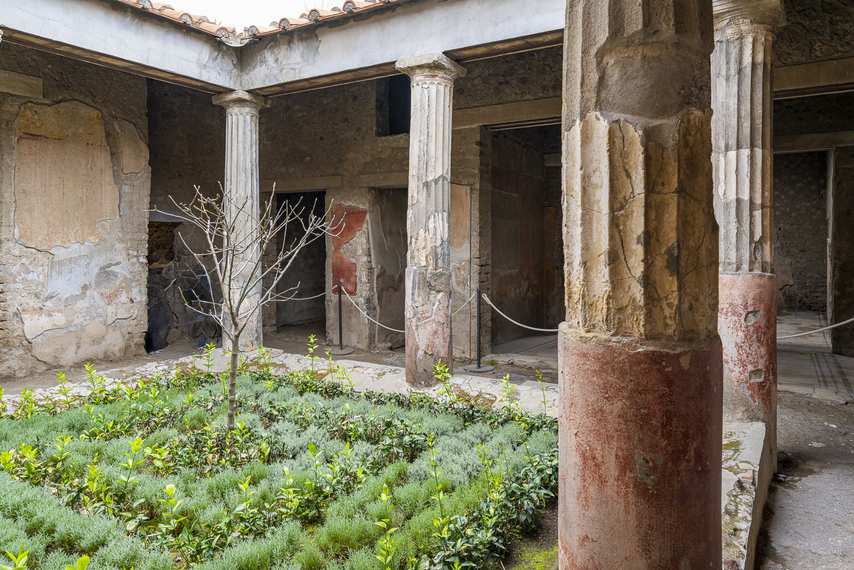
The House of the Tragic Poet, dating back to the 2nd century B.C., is one of Pompeii’s most famous dwellings, thanks to its extraordinary frescoes and mosaics.
The name comes from a mosaic depicting a theatre scene, while the famous Cave Canem (Beware of the Dog) mosaic greets visitors at the entrance. The decorations belong to the fourth Pompeian style and include frescoes inspired by Greek myths, such as Achilles and Briseis and the sacrifice of Iphigenia.
Nineteenth-century excavations transferred many works to the National Archaeological Museum in Naples.
Google Maps indication:
https://maps.app.goo.gl/iA2JxgLhysV9LyebA
Why visit the House of the Tragic Poet
This house allows visitors to immerse themselves in the elegance of Pompeian art, featuring high-quality mythological scenes. It is an extraordinary example of domestic life from the period, with decorations that reflect the refined taste of its owners.
What to admire in the House of the Tragic Poet
- The Cave Canem mosaic is a symbol of ancient Pompeii.
- The mythological frescoes, including Achilles and Briseis and the Sacrifice of Iphigenia.
- The refined decoration in the Fourth Pompeian Style, with bright colours and elaborate details.
- The house structure, with atrium, tablinum and peristyle, is typical of Roman patrician dwellings.
Whether you exit on Vicolo della Fullonica or Via di Mercurio, head south down Via delle Terme.
Continue on Via del Foro and pass the Arch of Nero. On the left, you will find the Macellum, which is well worth a visit.
Macellum (Regio VII – 12)

The Macellum was Pompeii’s main food market, located in the northeast corner of the Forum. Built in the 3rd century BC and renovated between 130 and 120 BC, it underwent various restorations until the eruption of Vesuvius in 79 AD.
Inside were stores selling meat, fish, and food products, with a central area covered by a wooden conical structure for cleaning fish. Decorated with mythological frescoes and statues of the imperial family, the Macellum provides a glimpse into ancient Rome’s commercial and social life.
Google Maps indication:
https://maps.app.goo.gl/oQZN1HK6uivARgbG8
Why visit the Macellum
Pompeii’s Macellum was the city’s primary food market and is a remarkable testament to daily life in ancient Rome. Here, meat, fish, and groceries were bought and sold, showing the efficiency of Pompeian trade.
In addition, the presence of frescoes and statues related to imperial worship underscores this space’s political and religious importance. By visiting it, you can immerse yourself in the atmosphere of a Roman market and discover how the economy of the time functioned.
What to admire in the Macellum
- The stores (tabernae) along the north and west sides were once used to sell food and perfumes.
- The central market area has twelve tufa bases that support a wooden roof and a basin for cleaning fish.
- The marble counter for selling meat and fish has a drain for water runoff.
- The mythological frescoes include depictions of Odysseus and Penelope and Medea contemplating killing her children.
- The statues of the imperial family, which once adorned the inner sanctum and are now in the Archaeological Museum of Naples.
Opposite the Macellum, inside the Forum, is the Temple of Jupiter.
Temple of Jupiter (Regius VII – 8)

The Temple of Jupiter, located in the northern part of the Forum of Pompeii, was built in the 3rd century BC and became the city’s principal place of worship.
After the Roman conquest, it was dedicated to the Capitoline Triad, consisting of Jupiter, Juno, and Minerva. The structure, raised on a high podium with three interior naves, was decorated with Corinthian columns and monumental statues.
Damaged by the 62 AD earthquake, it was still under restoration when the 79 AD eruption buried it. Excavations have unearthed impressive remains of the cella and a large altar in the Forum.
Google Maps indication:
https://maps.app.goo.gl/S1pzikv7FRXUWPNXA
Why visit the Temple of Jupiter
The Temple of Jupiter is one of Pompeii’s symbols and represents the Forum’s importance as the city’s religious and political centre. Its scenic location, with Mount Vesuvius in the background, makes it one of the most iconic stops at the archaeological site.
What to admire in the Temple of Jupiter
- The majestic raised podium is accessible by a flight of steps.
- The Corinthian columns and the remains of the temple cell.
- The great altar was placed on the temple’s axis in the Forum.
- The spectacular view of Vesuvius emphasises the link between Pompeii and its tragic end.
On the left, right next to the Temple of Jupiter, are the Granaries of the Forum.
Granaries of the Forum (Regio VII – 7)
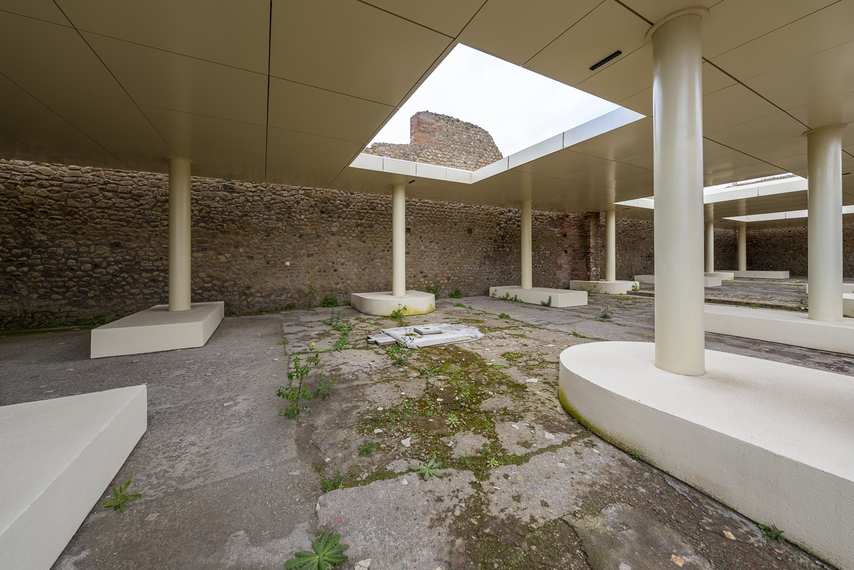
The Granaries of the Forum of Pompeii, located in the western part of the Forum, were initially thought to be grain deposits, but subsequent studies have disproven this theory.
Today, they represent one of the site’s primary archaeological deposits, containing about 9,000 artefacts, including amphorae, pottery, kitchen utensils, fountains, and some casts of victims of the eruption.
Originally a grain market, the granaries were reused in the 19th century as storage for excavated materials.
Currently undergoing a redevelopment project, they will soon become an archaeological exhibition open to the public, offering a unique insight into daily life and trade in Pompeii.
Google Maps indication:
https://maps.app.goo.gl/wV7dgTPwK2LvJzST9e
Why visit the Granaries of the Forum
The Granaries of the Forum offer an extraordinary daily life and trade record in ancient Pompeii. The objects preserved here make it possible to reconstruct the city’s relationships with the Mediterranean and better understand the Pompeians’ diet and habits.
With its future opening to the public, the site will become one of the city’s major archaeological sites.
What to admire in the Granaries of the Forum
- Amphorae from different regions of the Mediterranean bear witness to Pompeii’s trade.
- The casts of victims of the eruption, including that of a dog and a tree.
- The large marble basins and fountains that once decorated the houses of Pompeii.
Returning to the Forum, right next to the Macellum, you can visit the Sanctuary of the Public Lares.
Sanctuary of the Public Lares (Regio VII – 13)
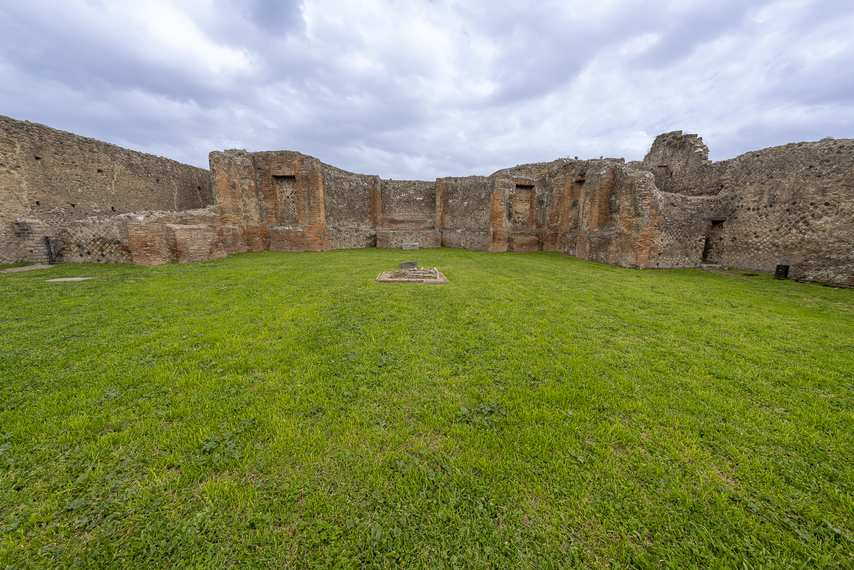
The Sanctuary of the Public Lares is a Roman temple, probably built after the 62 AD earthquake, to worship the city’s patron deities. Some scholars speculate that it may have been dedicated to the worship of the imperial family or even used as a public library.
However, the most widely accepted hypothesis is that it was a place of worship for the Lares. At the time of the eruption in 79 AD, the temple was still under construction and was buried under lapilli and ash.
Today, it is one of the most fascinating sites in Pompeii for understanding the relationship between religion and public life in the ancient city.
Google Maps indication:
https://maps.app.goo.gl/2d1xQEsPHwWg66tr5
Why visit the Sanctuary of the Public Lares
The Sanctuary of the Public Lares represents a unique example of public worship in Pompeii. Its strategic location next to the Temple of Vespasian and the Macellum demonstrates the importance of religion in the city’s political and economic life.
Looking at its incomplete structures, one can imagine the construction process and the sudden interruption caused by the eruption.
The visit allows visitors to learn more about the role of the Lares in Roman religion and to admire the architectural techniques of the period.
What to admire in the Sanctuary of the Public Lares
- The central atrium, with the marble pavement’s remains and the sacrificial altar’s base.
- The side niches, which probably housed statues of deities or emperors.
- The apsidal basin, with the central niche and decorative columns.
- The construction techniques are visible in the brickwork, uncertain and reticulated walls.
- The bases of the unfinished columns reveal that the temple was still under construction in AD 79.
Having finished your visit to the Temple of the Public Lares, move on to the following structure, the Temple of the Genius Augusti.
Temple of the Genius Augusti (Regio VII – 14)

The Temple of the Genius Augusti, also known as the Temple of Vespasian, is a place of worship in the Forum of Pompeii, dedicated to the genius of the Roman emperors. Its dating is uncertain: some scholars believe it dates from the Augustan age, while others place it later.
The eruption of Vesuvius in 79 AD buried it before work could be completed. Excavated in the 19th century, it now contains an important marble altar with a bas-relief depicting a sacrifice.
Google Maps indication:
https://maps.app.goo.gl/tTqcW6UoAoCWXWqf9
Why visit the Temple of the Genius Augusti
The Temple of the Genius Augusti is a fascinating example of Roman sacred architecture, reflecting imperial devotion in Pompeii. Its location in the Forum makes it a must-see for those who want to understand the link between religion and political power in the ancient city.
In addition, the altar decorated with scenes of sacrifice offers rare evidence of the public rituals of the time.
What to admire in the Temple of the Genius Augusti
- The marble altar features a bas-relief of a bull sacrifice.
- The central courtyard has columns and architectural decorations that remain.
- Triangular and lunate tympana surmount the blind windows on the walls.
- The temple’s podium, where the emperor’s statue once stood.
- The back rooms were probably used by priests and merchants.
Exit the Temple of the Genius Augusti and enter the last building on this stretch of road: the Building of Eumachia.
Portico of Concordia Augusta (Building of Eumachia) (Regio VII – 15)
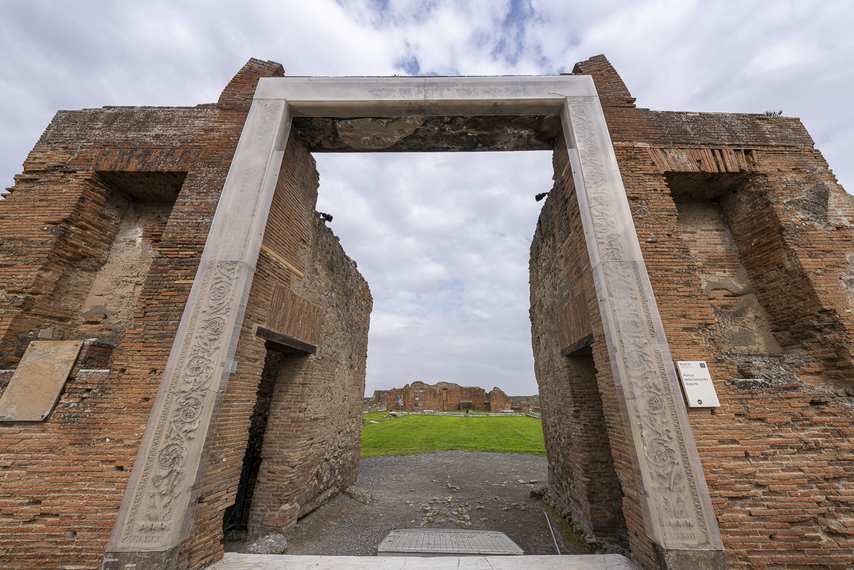
The Portico of Concordia Augusta is one of the most impressive structures in the Forum of Pompeii, built in Tiberian times at the behest of the priestess Eumachia.
Probably intended for the wool trade or as the headquarters of the guild of fullones (launderers), the building features elegant architecture with marble columns and fine decoration.
Damaged by the earthquake in 62 AD, it was still being restored when it was buried by the eruption of Vesuvius in 79 AD. Today it is an example of public architecture from the imperial era.
Google Maps indication:
https://maps.app.goo.gl/esqqFYS2KSxg3wxL6
Why visit the Portico of Concordia Augusta
The Portico of Concordia Augusta is an essential record of Pompeii’s economic life, offering a glimpse into the role of local guilds and trade. Its construction by a woman underscores female influence in Roman society.
The site is an essential stop for those who want to understand ancient Pompeii’s urban and commercial structure.
What to admire in the Portico of Concordia Augusta
- The monumental facade is decorated with marble reliefs depicting acanthus leaves and animals.
- The double-tiered collonaded portico has Doric and Ionic columns.
- The exedras housed statues of Caesar, Augustus, Aeneas and Romulus.
- The side corridor, covered in colored marble and used as a storehouse.
- The statue of Eumachia, once located in the building, is now housed in the National Archaeological Museum in Naples.
Continue past Via dell’Abbondanza (on the left) and head toward Via delle Scuole, on the southern side of the Forum. On the right, you will see three structures: the Municipal Buildings.
Municipal Buildings (Regio VIII – 3)
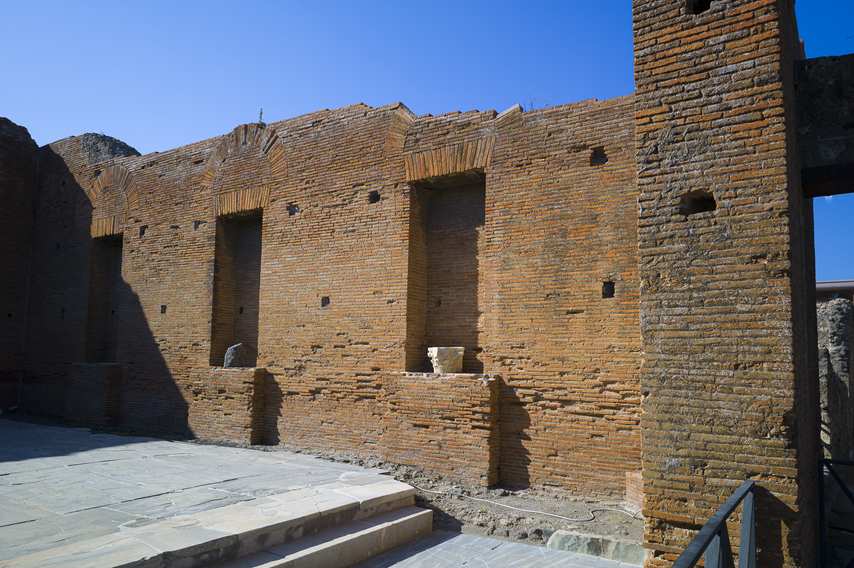
The Municipal Buildings of Pompeii, located on the southern side of the Forum, housed the city’s administrative bodies.
They consisted of three very similar structures, intended respectively for the Curia, the seat of the decurions (a kind of city councillors), the seat of the duoviri, the city’s highest representatives (comparable to mayors), and the seat of the edifices, responsible for urban maintenance and public services.
Although the general function of the buildings is clear, there is still uncertainty about their precise purpose.
Google Maps indication:
https://maps.app.goo.gl/n6T6BQfLV2abSfXQ6
Why visit the Municipal Buildings
Visiting Pompeii’s municipal buildings provides insight into the political and administrative organisation of the Roman city. These buildings tell the story of how public life functioned and show the central role of the Forum as the community’s decision-making centre.
What to admire in the Municipal Buildings
- The marble floor of the Curia is still visible, and the niches housed honorary statues.
- The podium is where the administrative archives were kept in the Duoviri headquarters.
- The symmetrical architecture of the three structures reflects the order and organisation of the Roman city.
- The central location in the Forum highlights the political and administrative importance of these buildings.
Continue westward and take Vicolo di Championnet. After a few steps, you will find the entrance to the House of Championnet.
House of Championnet (Regius VIII – 4)
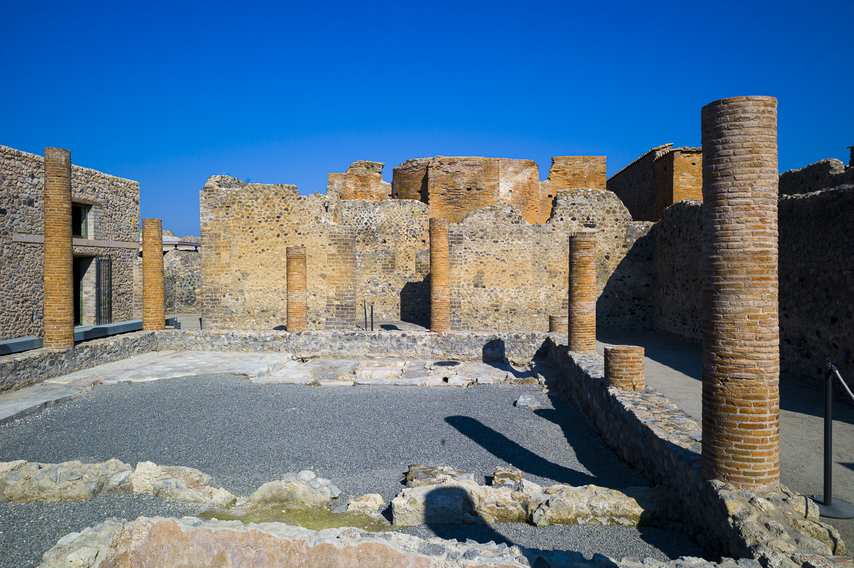
The House of Championnet is a luxury residential complex located south of the Forum of Pompeii. Featuring panoramic terraces overlooking the gulf and a multi-level structure, the neighbourhood was inhabited by wealthy Pompeian aristocrats.
Recently restored thanks to the Great Pompeii Project, it features more than 60 rooms, including kitchens, a bakery, a private bathhouse, and splendid mosaics protected by innovative covers.
The exhibition tour also allows visitors to explore the nearby House of the Sailor, known for its naval mosaics.
Google Maps indication:
https://maps.app.goo.gl/aopLjkF9CA6zoE9S7
Why visit the House of Championnet
This residential neighbourhood, with sumptuous mansions and a privileged location, provides insight into the lifestyle of the Pompeian aristocracy. Its recent opening and careful restoration offer a unique opportunity to explore an area long off-limits to the public.
What to admire in the House of Championnet
- The panoramic terraces overlooking the Bay of Naples
- The underground rooms, including a kitchen and bakery
- The geometric mosaics, protected by modern covers
- The Sailor’s House, with a mosaic depicting ships and a private spa facility
- The Moray Courtyard, with a large fish pond
- The exhibits, including amphorae, kitchen utensils, and fragments of frescoes
Exit back into Vicolo di Championnet and turn right onto Via delle Scuole. Walk down to the end and find the House of Geometric Mosaics.
House of the Geometric Mosaics (VIII – 5)
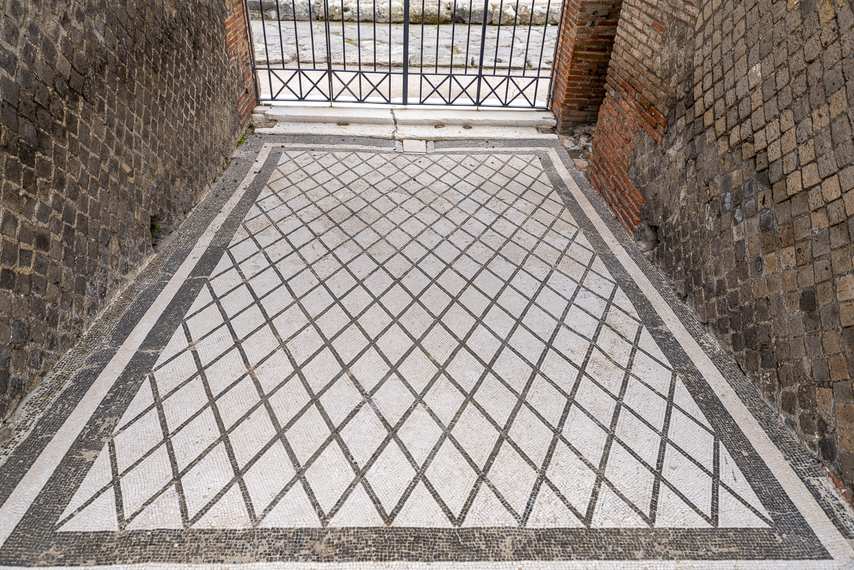
The House of Geometric Mosaics is one of the largest domus in Pompeii, with more than 60 rooms arranged on panoramic terraces overlooking the Sarno Valley.
Dating from the 2nd century B.C., the house results from the merger of two pre-existing dwellings, enriched with a large peristyle and a porticoed garden. It owes its name to the exquisite black-and-white mosaics decorating the floors with geometric motifs.
After significant restoration, the domus was reopened to the public in 2016 as part of the Great Pompeii Project.
Google Maps indication:
https://maps.app.goo.gl/yrfJNfsDhUmywEss7
Why visit the House of Geometric Mosaics
Visiting the House of Geometric Mosaics allows you to discover one of Pompeii’s most sumptuous dwellings, expressing the luxury and power of the city’s aristocracy.
Its panoramic location and extraordinary floor decoration offer a unique experience that helps you understand the evolution of Roman domestic architecture.
What to admire in the House of Geometric Mosaics
- Geometric mosaics with labyrinth and checkerboard motifs in black and white tiles.
- Scenic structure with multi-level terraces overlooking the Sarno Valley.
- Monumental atrium with impluvium and access to tablinum and large peristyle.
- Porticoed garden, created with the extension of the house in a later period.
- View of the city walls and the Forum, testifying to the domus’ privileged position.
Turn back along Via delle Scuole to the Forum, then continue on Via Marina heading west. On the right, stop to admire the Temple of Apollo.
The Temple of Apollo (Regio VII – 5)
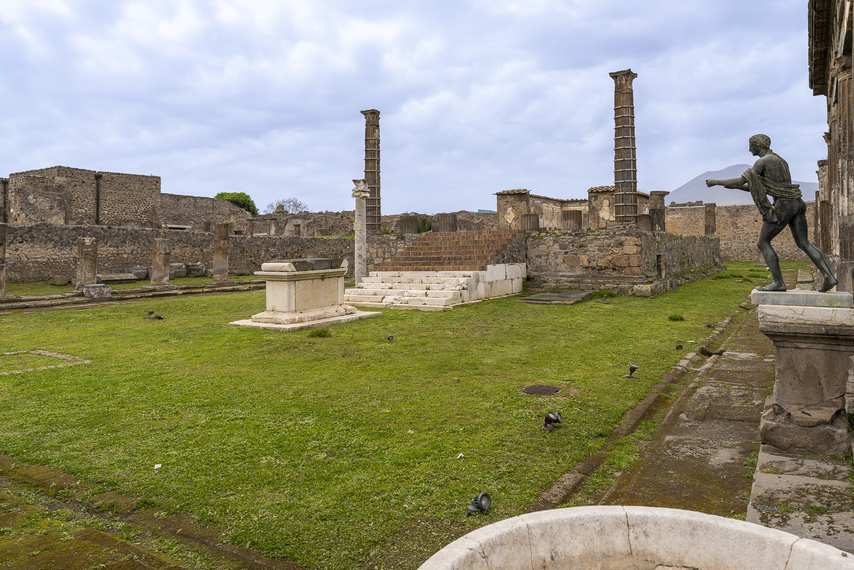
Among the oldest places of worship in Pompeii (8th-7th cent. BC), it was rebuilt in the Samnite age on the initiative of the quaestor Oppio Campano.
In the Augustan age, it was enriched with a sundial and a wall to separate it from neighbouring houses. It features a large courtyard with Ionic (later Corinthian) columns and housed statues of Apollo, Venus, and Hermes.
Damaged by the earthquake of 62, it was still under restoration in AD 79.
Google Maps indication:
https://maps.app.goo.gl/u9fmfRWBmWHkcgct7
Why visit the Temple of Apollo
The Temple of Apollo tells the story of Pompeii’s earliest origins and the importance of Apollonian worship. It also shows the layering of styles and restorations that testify to its long history.
What to admire in the Temple of Apollo
- The fluted tuff columns and Corinthian capitals were painted after the earthquake.
- The remains of the altars and the omphalos, a Delphic symbol in the cella.
- The inscriptions documenting the restorations and the dedication of Oppio Campano.
Exit back onto Via Marina, where the Basilica is opposite the Temple of Apollo.
Forum Basilica of Pompeii (Regio VIII – 2)

The Forum Basilica of Pompeii, built between 130 and 120 BC, is one of the city’s most important public buildings. It was located in the southwestern corner of the Forum and was a centre for legal and commercial functions.
Its imposing structure, characterised by a central nave with Ionic columns and a tribunal, makes it one of the most representative examples of Roman architecture. Buried by the 79 A.D. eruption, it was unearthed in the 19th century and is now a key stop for those visiting the excavations.
Google Maps indication:
https://maps.app.goo.gl/3SceqPBYMhhyaLvw8
Why visit the Basilica
The Forum Basilica of Pompeii provides insight into the organisation of public and political life in the Roman city.
Trials and commercial activities took place here, providing citizens with a safe and covered space. Its architectural majesty, with Ionic columns and a wide nave, testifies to the Forum’s importance as the city’s hub.
What to admire in the Basilica
- Central nave: surrounded by 28 Ionic columns about 11 meters high.
- Tribunal: a space where justice was administered, with Corinthian columns.
- Portico of Popidius: an architectural element that masked irregular buildings.
- Remains of stucco decoration: simulation of marble blocks on the walls.
- Well and fountain: witnesses to the management of water resources.
Want to learn more about the Forum Basilica of Pompeii? Read our in-depth article.
Continuing toward Porta Marina, next to the Forum Basilica, you will find the Temple of Venus.
The Temple of Venus (Regio VIII – 1)
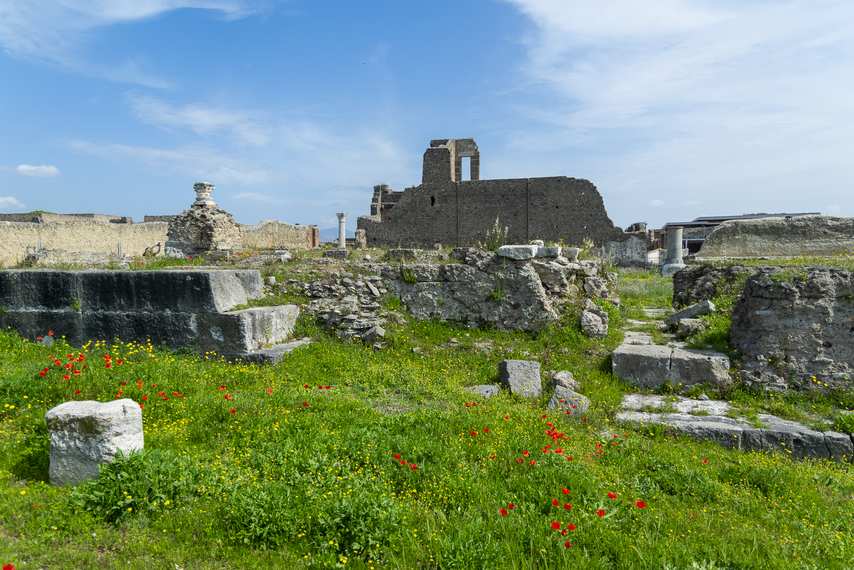
The Temple of Venus in Pompeii is one of the city’s most important temples. Built after the Roman conquest to honour the colony’s patron goddess, it is situated in a scenic location.
The temple was expanded during the Julio-Claudian period but was severely damaged by the earthquake of 62 AD and subsequently buried by the eruption of Vesuvius in 79 AD.
Today, the remains of the colonnade, the travertine altar, and the pavement provide a fascinating record of ancient Pompeii’s religious and social life.
Google Maps indication:
https://maps.app.goo.gl/ct1x9rZGqkWmHUFH8
Why visit the Temple of Venus
The Temple of Venus is a symbolic site for understanding the religion and culture of ancient Pompeii. Dedicated to the goddess of love and beauty, the temple also had a political and social role, serving as a focal point for public ceremonies and city festivities.
Its panoramic location, overlooking the Gulf of Naples, makes it an imposing site to explore.
What to admire at the Temple of Venus
- Ionic colonnade: Remains of the imposing columns that surrounded the temple.
- Travertine altar: Central point of religious ceremonies, where sacrifices and offerings occur.
- Original paving: Fragments of mosaics and colored marble that decorated the temple.
- Equestrian pedestals: Probable bases for statues of prominent figures in Roman society.
- Architectural remains: Traces of the podium, underground passages and structures connected to the temple.
Want to learn more about the Temple of Venus at Pompeii? Read our in-depth article.
Before you leave Porta Marina and conclude your visit, if you still have some time left, I recommend you devote it to the Antiquarium, the museum of the Pompeii Archaeological Park.
Antiquarium (Regio VIII – 19)
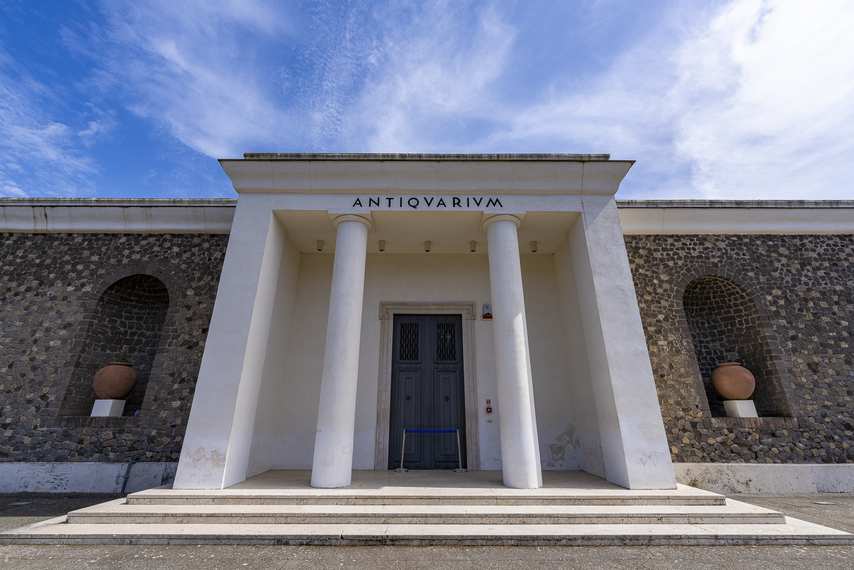
The Antiquarium of Pompeii is a museum located within the Archaeological Park. It offers a comprehensive overview of the city’s history from its founding in Samnite times to its destruction by the eruption of Mount Vesuvius in 79 AD.
Renovated in 2021, the museum displays frescoes, sculptures, everyday objects, and the famous casts of victims.
Thanks to a modern layout and multimedia aids, visitors can better understand life in Pompeii, enriching their excavation experience with a more detailed view.
Google Maps indication:
https://maps.app.goo.gl/C9F5RrCHCTCoyqL1A
Why visit the Antiquarium?
The Antiquarium is essential for those who wish to fully understand Pompeii before exploring its ruins.
In addition to displaying fragile artefacts that could not withstand being outdoors, it provides historical context through multimedia reconstructions, display cases and explanatory panels.
The tour allows visitors to observe everyday objects, architectural decorations, and tools used by ancient Romans, providing a clearer perspective on Roman culture, art, and society.
What to admire in the Antiquarium?
- The casts of the eruption victims are among the most poignant testimonies to Pompeii’s tragedy.
- The original mosaics and frescoes are from villas and temples in the city.
- The everyday furnishings and objects, such as pottery, work tools and surgical instruments.
- The immersive room, which digitally recreates environments from the famous Pompeian domus.
- The mythological statues and reliefs, including the bust of Dionysus and the metope with the Supplizio di Issione.
- The silverware from Moregine is a precious artefact from the Roman period.
- The interactive digital media makes the visit engaging and informative.
The Antiquarium is a must-visit stop for those who want to explore Pompeii with greater awareness and appreciate its artistic and cultural richness.
Want to learn more about the Antiquarium of Pompeii? Read our in-depth article.
Leaving Porta Marina and heading towards Piazza Esedra, you can end this short itinerary with a visit to the Imperial Villa.
Imperial Villa (Regio VIII – 18)
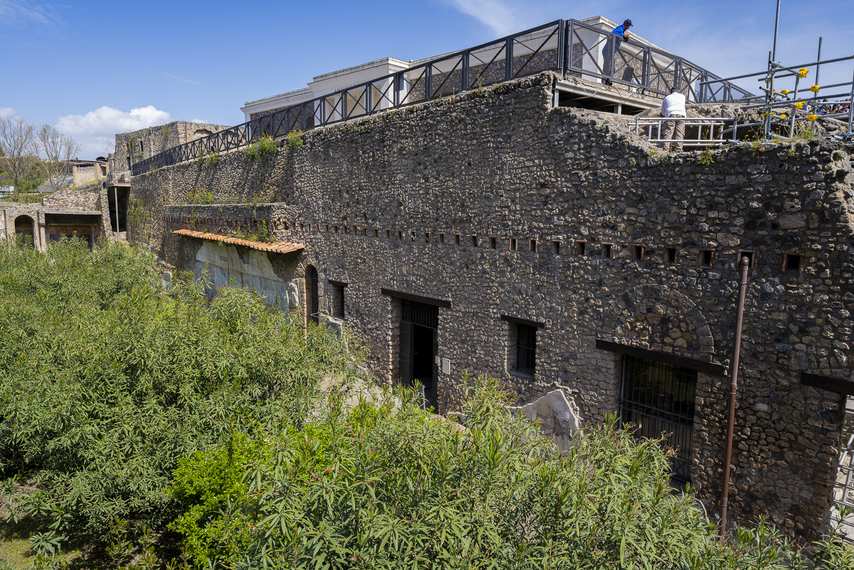
Imperial Villa is a Roman suburban residence near Porta Marina in the western part of the Pompeii Archaeological Park, below the Temple of Venus.
Built at the end of the 1st century BC, it suffered damage during the 62 AD earthquake, was renovated, and then partially demolished to make room for granaries.
Rich in frescoes in the third and fourth styles, it preserves delicate mythological and architectural decorations. It was discovered in Bourbon times and excavated again in 1947 by Amedeo Maiuri.
Google Maps indication:
https://maps.app.goo.gl/gkUTYT2sTL6Hd7tCA
Why visit Imperial Villa
The Imperial Villa offers a rare example of Pompeii’s artistic and architectural development. Its well-preserved frescoes chronicle the life and culture of the period. Its panoramic location and third—and fourth-style decorations allow visitors to immerse themselves in the refined atmosphere of an aristocratic Roman residence.
What to admire in the Imperial Villa
- Mythological frescoes, including Daedalus and Icarus, Theseus and the Minotaur, and the Theban cycle.
- Architectural decorations in the third and fourth styles, with friezes of putti and Dionysian motifs.
- The peristyle garden features fluted stucco columns and a stunning sea view.
- The triclinium and diaeta feature geometric decoration, candelabra, and depictions of poets such as Sappho and Alcaeus.
- The portico, consisting of 43 columns, framed the villa’s garden.
Conclusion of our three-hour itinerary in the Pompeii Archaeological Park
We have reached the end of our three-hour itinerary among the wonders of Pompeii.
This itinerary offers an optimal duration to discover the most significant sites of the ancient city without hurry, allowing you to immerse yourself in its extraordinary history.
We hope that the beauty and charm of these ruins have moved you and left you wanting to return.
Pompeii is a treasure that deserves to be explored at a leisurely pace, which is why we have created more in-depth itineraries for those who want to continue the journey and still be surprised.