The House of the Faun in Pompeii is one of the most impressive and famous dwellings in the entire archaeological area. Located in a prestigious neighbourhood, in an affluent area of seventeen blocks, this “pharaonic house” alone occupies a whole block, covering about three thousand square meters.
Just think that a standard-sized domus like the House of the Tragic Poet could fit entirely in its garden! This speaks volumes about the standard of living and prestige of the family that inhabited it.
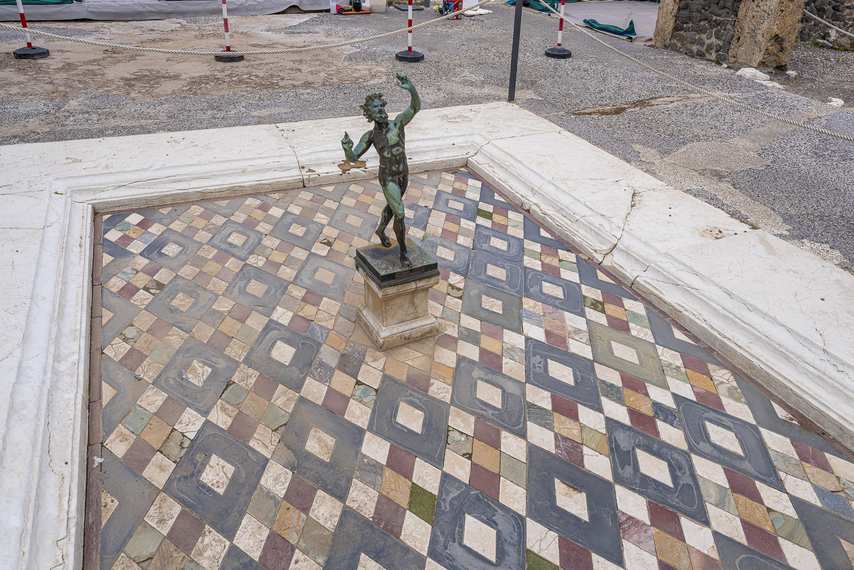
The house owes its name to the bronze statuette depicting a dancing satyr (interpreted as a faun) found in the atrium impluvium- a detail that is now a veritable symbol of the site. However, the grandeur of this housing complex lies not only in its size: an extraordinary concentration of artworks, mosaics, and innovative architectural solutions can be found here, making it an unmissable stop for anyone wishing to discover the evolution of the Roman domus in the Republican era.
Where is it located?
Map of Pompeii: Regio VI – 1
Google MapsHistory and Origins
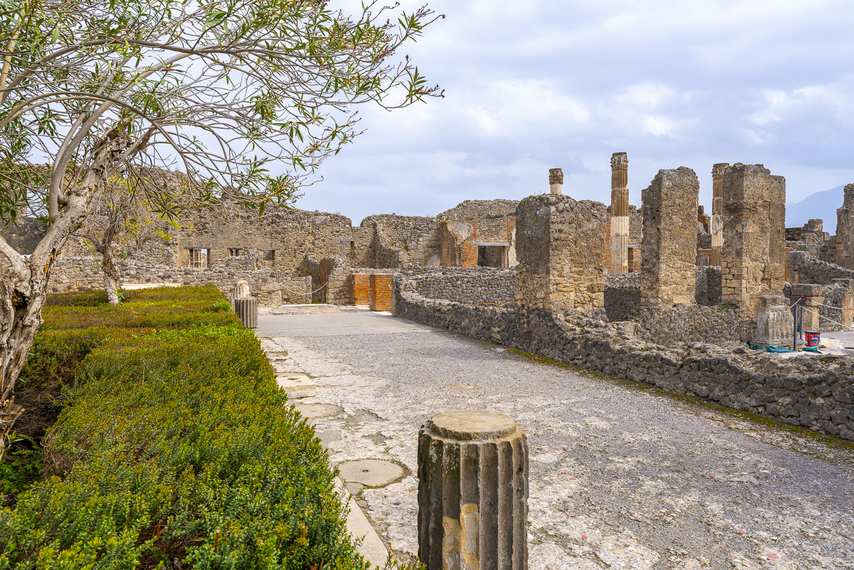
The earliest construction phase of the House of the Faun in Pompeii probably dates back to the 3rd century BC, when the house was simpler and smaller, with a large garden.
However, in the 2nd century B.C., around 120 B.C., the house took on the monumental appearance for which it is famous today. It was expanded by incorporating nearby structures, raising the floors and building new rooms, including two majestic peristyles. In this way, the owner, probably a member of the local elite, perhaps a magistrate, could manifest his wealth through a lavish dwelling, rich in ornamentation and decoration.
Like the rest of the city, the house was buried by the eruption of Vesuvius in 79 AD and was brought to light during excavations in the 19th century. Today, it is an emblematic example of how Pompeii’s treasures have come down to us in a state of preservation that allows scholars and visitors to relive, to some extent, the atmosphere of the time.
Architecture and Structure of the House
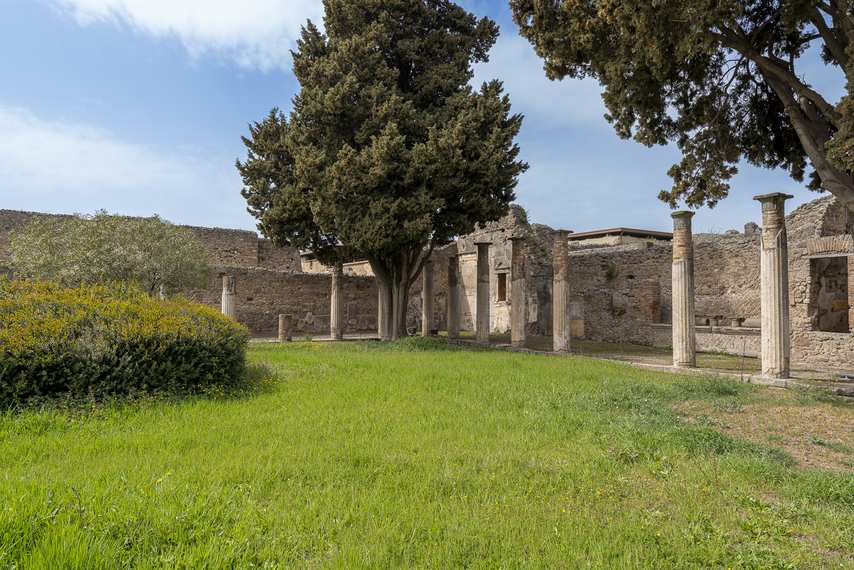
Looking at the House of the Faun, one immediately gets the impression of standing in front of a real “palace” of antiquity. The complex includes:
- Two atria:
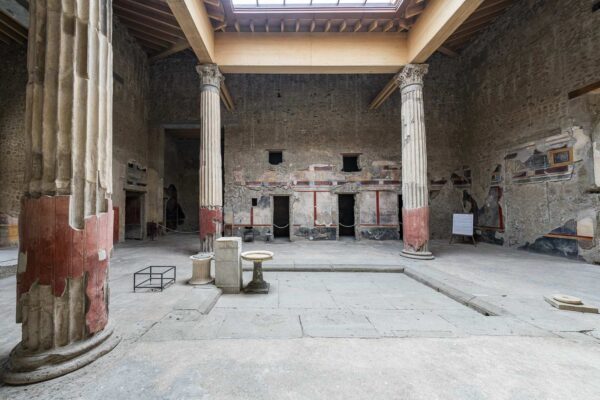
- The first is the Tuscan type, with a central impluvium.
- A second tetrastyle atrium, supported by four columns, connects to other rooms and serves as an additional reception space.
- Two large peristyles:
- The first smaller is decorated with columns in the Ionic style.
- The second largest, surrounded by a double order of columns, has a vast inner garden.
- About 30 rooms:
- Bedrooms (cubicula).
- Service and storage areas.
- Living and reception rooms (tablinum – reception room, triclinium – dining room).
- A domestic bath complex equipped with a tepidarium and calidarium is a luxury more typical of suburban villas.
The extraordinary ceiling that covered the central atrium deserves special mention: unfortunately, no longer visible today, it was supported by a system of exceptionally large cross-beams, which ensured the stability of the structure without the need for additional columns.
This expedient gave an unparalleled glance: once crossed the threshold, the visitor’s gaze could stretch from the atrium, through the tablinum, to project onto the inner gardens of the peristyles. It was a dramatic effect designed to amaze anyone who entered and simultaneously testify to the sophistication and economic power of the owner.
The fact that the House of the Faun also included a small bath complex confirms the enormous economic availability of the family who lived in it: they could thus enjoy the comfort of hot, lukewarm and cold baths directly at home, instead of going to the public baths.
This architectural choice was in response to the desire to fully meet the needs of an upper-class family, offering the same functions and comforts inside as in communal or suburban facilities.
Together, all these features highlight how the House of the Faun was designed to display and flaunt its owners’ prestige, weaving functionality, comfort, and opulence into one grandiose housing complex.
The Mosaic of the Battle of Issus (Alexander Mosaic)
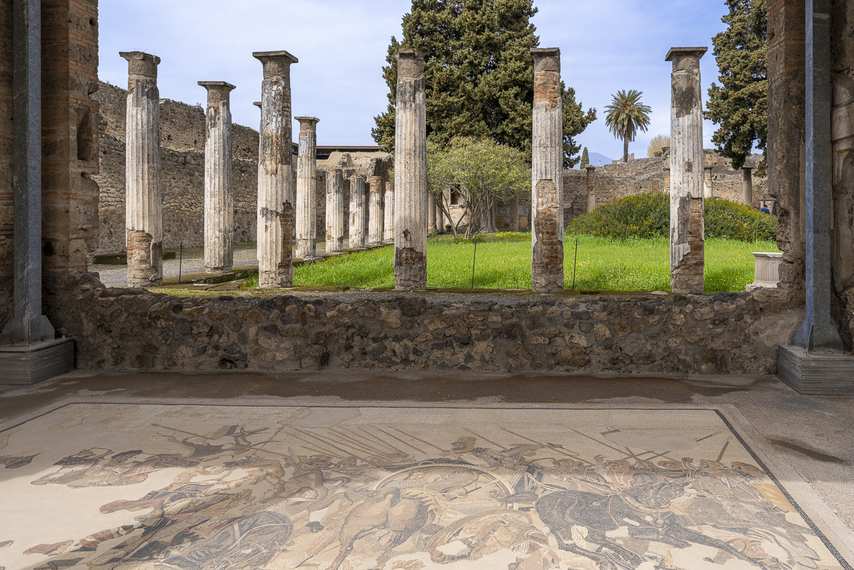
Among the treasures that make the House of the Faun famous is the mosaic of the Battle of Issus (also known as “Alexander Mosaic“), depicting the decisive clash between Alexander the Great and Persian king Darius III.
It is a monumental work composed of some 1.5 million tiny tesserae (opus vermiculatum), now housed in the National Archaeological Museum in Naples and replaced in situ by a copy. It is a genuine masterpiece of artistry, probably made on site by skilled workers from North Africa, famous for their ability to create impressive polychrome mosaics.
Although today we are accustomed to considering it a “Roman” work, the mosaic is a copy of a famous Greek painting from the 4th century B.C., which was probably lost even in ancient times.
The House of the Faun owner wanted to reproduce this glorious scene to celebrate its epic value: one can see the faces of Alexander, determined and confident, and Darius fleeing, frightened, with a Persian soldier on the ground whose face is reflected in the shield.
This play of reflections reveals the extraordinary refinement of the ancient artists, who were able to convey realism and tension in a work that, centuries later, continues to amaze anyone who looks at it.
Placed in a large exedra overlooking the first peristyle, the mosaic occupied a strategic place in the house where the owners could proudly display it to guests. The idea of reproducing a Greek painting of great fame in mosaic form also represents a clear manifestation of cultural prestige, emphasising the high social status of those who lived in this dwelling.
Pictorial Decorations and Furnishings
In addition to the incredible mosaic of the Battle of Issus, the House of the Faun preserves numerous other examples of decorations of the highest standard. Notable among the best-known mosaics are the small-format ones depicting a cat pouncing on a rooster, or the scene of three white doves extracting a pearl necklace from a casket.
These striking modernity and delicacy subjects attest to the period’s thematic variety and extraordinary aesthetic taste.
The famous bronze statuette of the Dancing Faun, from which the house takes its name, was placed in the impluvium of the central atrium and still, not in the centre of the pool, as we see it today, but on the edge, raised on a small pedestal to give the figure greater prominence (a copy of the Dancing Faun can be seen in the house; the original is housed in the National Museum).
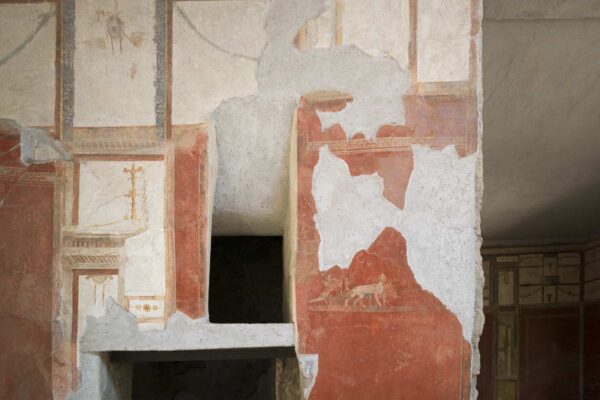
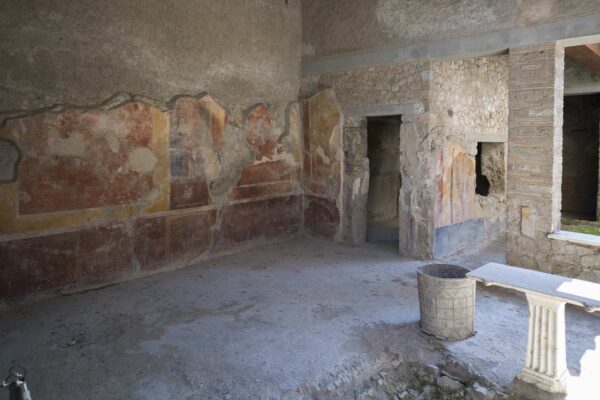
In addition to the mosaics and sculptures, the house must have been embellished with numerous frescoes and luxurious furnishings, as well as a careful system of doors and window frames (some even mention cracks and small deformations of the ground during the days before the eruption).
These furnishings and decorations, combined with the vastness of the interior and exterior spaces, confirm that a decidedly wealthy and culturally sophisticated family lived in the House of the Faun, capable of commissioning works from the best craftsmen of the time.
The mosaics, statues and frescoes reflected a desire to flaunt economic power and, simultaneously, a love of Hellenistic art and culture, still alive in the first century BCE and the early imperial age.
The Allure of Roman Culture
Visiting the House of the Faun in Pompeii means observing the remains of an ancient building and getting in touch with a way of life from far back in time. Here, you will be able to perceive the importance of hospitality, an appreciation for beauty, domestic religiosity, and the daily rituals of a large family at the time.
The house was not just a refuge, but a place of representation, a tool for expressing power, prestige and culture. Its architecture, decorations, rich mosaics, and sculptures document the Romans’ ability to create environments where art, nature, and practical function blended harmoniously.
The House of the Faun: An Emblem of Pompeii
In the vast panorama of the Pompeii Archaeological Park, the House of the Faun has become a symbol of the luxury and elegance achieved by the city in its heyday.
Many travel guides, brochures, and websites dedicated to archaeological tourism in Pompeii cite it as one of the most beautiful and significant residences to visit. Its success and popularity are due to the presence of unique artefacts, such as the mosaic of the Battle of Issus, and the state of preservation that still allows one to admire the general plan and perceive the opulence of the original furnishings.
The Role of the House of the Faun in Understanding Roman Civilisation
The House of the Faun is not simply an archaeological monument, but an extraordinary educational tool for understanding how Roman society developed in a city of ancient Campania.
We can infer the owner’s role in the community, culture, and ambitions through its structures and decorations. We can imagine the religious rites performed in the lararium, the conversations in the reception hall, the slow steps of those who strolled under the colonnades, perhaps discussing politics, trade or literature.
Those who visit this domus do not just see mere stones and columns, but gain awareness of the past and better understand the complex web of social and cultural relationships that made the Roman Empire one of the most influential in the ancient world.
What to Expect from the Visit
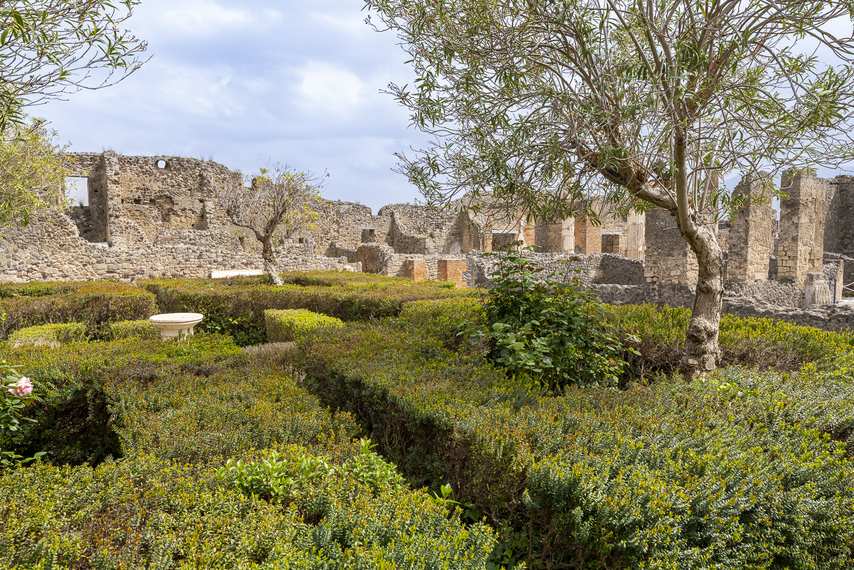
The House of the Faun in Pompeii represents one of the milestones in understanding the level of splendour achieved by the city before the catastrophe of 79 AD. Walking through its spaces allows one to observe Roman architectural genius, aesthetic sensibility, the relationship with the Hellenic world, and the extraordinary skill of local craftsmen.
The mosaics, frescoes, sculptures, opus sectile floors, elegant columns of the peristyles, the variety of interior spaces, and the complexity of the building layout are elements that transform the visit into an evocative journey through time.
Those who are not experts in Roman archaeology will still appreciate the beauty and complexity of the House of the Faun.
The complex’s overall refinement does not require extensive knowledge. Anyone will find in this domus a place where the imagination can reconstruct moments of daily life: a banquet in the triclinium with friends and clients, a walk in the inner garden, the contemplation of a mosaic, possibly engaging in discussions of politics or philosophy.
If you are still pondering what to see in Pompeii, the House of the Faun is a valid reason to put this destination at the top of your list. Walking into the same domus that over two thousand years ago hosted banquets, political meetings, religious celebrations, and private moments is unique.
The eruption of Vesuvius stopped time, preserving a heritage of inestimable historical and artistic value.
Conclusion
The House of the Faun in Pompeii is one of the jewels of the excavations, an extraordinary testimony to the past that still knows how to speak to the modern visitor. Its rooms, mosaics, gardens and architectural decorations tell us a story of power, wealth, artistic taste, architectural innovation and daily life.
To include a visit to the House of the Faun in your discovery of the ancient ruins of Pompeii is to add an essential tile to the mosaic of knowledge of Roman civilisation, enriching your experience of archaeological tourism in Pompeii.
If you wish to immerse yourself in the atmosphere of a Roman city of the 1st century AD, perceive the grandeur and refinement of an elite family, appreciate extraordinary works of ancient art, and better understand what to see in Pompeii. The House of the Faun is a must-see on your itinerary.
Thanks to the beauty, complexity and historical importance of this dwelling, your visit to the Pompeii Archaeological Park will become a lasting memory, a journey through time that will enrich your mind and spirit.
FAQ About the House of the Faun in Pompeii
The House of the Faun is one of Pompeii Archaeological Excavations’ largest and most prestigious Roman domus. It owes its name to the bronze statuette of a dancing faun found in the impluvium of the central atrium. With its over three thousand square meters, it occupies an entire block, testifying to the wealth and elevated social status of the family that lived there.
To reach the House of the Faun, head toward the Forum of Pompeii and continue past the Honorary Arch. Go down Vicolo del Foro and turn right onto Via della Fortuna. On this street, you will find the entrance to the Domus, in an area of Pompeii traditionally associated with the most prestigious quarters of the Roman era.
In addition to its monumental dimensions, the House of the Faun holds artistic masterpieces, such as the famous mosaic of the Battle of Issus (now in the Archaeological Museum of Naples). To visit it is to enter an environment that synthesises luxury, advanced architecture and artistic taste typical of a large family of the Pompeian elite.
The first construction phase dates back to the third century B.C., but it was around 120 B.C. that the house took on its majestic appearance. Expanded through the annexation of neighbouring structures, it became an actual “palace” of antiquity, equipped with two atria, two large peristyles and multiple living quarters. The eruption of Vesuvius in 79 AD buried it, preserving it through the centuries.
The dwelling includes two atria (one Tuscanic and one tetrastyle) and two peristyles: a small Ionic one, and a larger one surrounded by a double order of columns. The interiors and residential and service areas also include a small bath complex, indicating excellent economic availability. The combination of these structures makes the House of the Faun a sublime example of a Roman domus.
Also known as the “Alexander Mosaic,” it is one of the most famous mosaics in Roman art history. It depicts the clash between Alexander the Great and Darius III. Made of millions of polychrome tiles, it shows details of extraordinary realism, such as the face of a soldier reflected in the shield. Today, the original is kept at the National Archaeological Museum in Naples, while a copy can be admired in the House of the Faun.
In addition to the Mosaic of the Battle of Issus, the domus offers a remarkable variety of mosaics and statues, such as the one depicting a cat zeroing in on a rooster, or the famous statuette of the Dancing Faun (a copy of the Dancing Faun can be seen in the house; the original is housed in the National Museum). Likely, the interiors were further embellished with frescoes and luxurious furnishings, some of which have been lost but are evidenced by archaeological finds.
The mansion shows how the Pompeian elite lived in opulent surroundings. Extensive gardens, private baths, and staterooms (such as the tablinum and triclinic) underscore the importance of hospitality and social prestige in Roman culture. The house was designed to impress guests and reaffirm the owner’s status.
The quantity and quality of mosaics, sculptures, and frescoes found in this complex highlight the high skill level of the artisans of the time. The extensive use of the Hellenic world (e.g., the Battle of Issus, a copy of a famous Greek painting) shows how Pompeian society looked to Greek culture for artistic inspiration and a sign of prestige.
One peculiarity concerns the famous faun statuette: it was initially not placed in the centre of the impluvium, but on a small pedestal at the edge, to give it greater prominence. In addition, the innovative ceiling of the central atrium was supported by large cross beams, providing a striking scenic effect for visitors at the time.
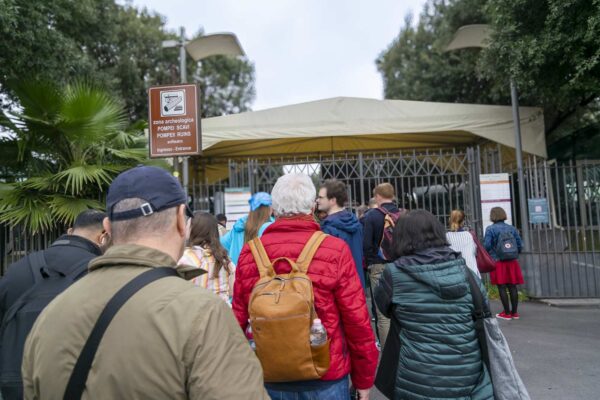
It is advisable to devote at least 20-30 minutes to appreciate its architecture and decorative remains. You can include it in a tour that starts from the Forum, continues along Via della Fortuna, and touches on other prestigious Domus, such as the House of the Vettii or the House of the Tragic Poet. Consider a guided tour or audio guide to catch all the historical and artistic details, if possible.
In addition to its exceptional size, this residence preserves unique vestiges of luxury and refinement, such as the private spa district and the famous mosaics. It has always attracted the attention of historians, archaeologists, and tourists, becoming a landmark for those who want to discover the pinnacle of wealth and sophistication achieved by the city before the eruption of 79 AD.