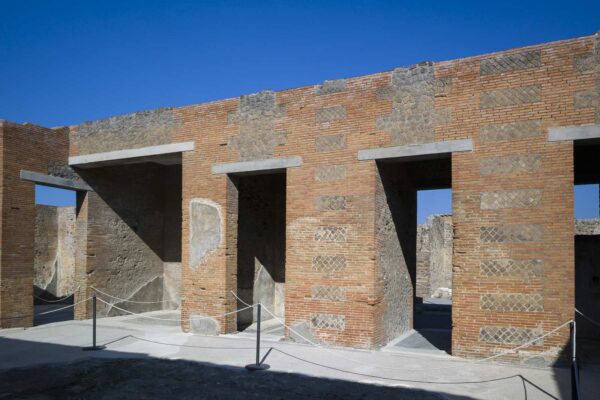
Tucked away among the streets of Pompeii’s monumental centre and after a long period of closure, the House of the Wounded Bear has returned to visit, offering all visitors a path full of charm and artistic evidence.
Dating back to the mid-first century AD, this domus is surprising for the beauty of its floor mosaics and wall decorations, as well as for the presence of a valuable nymphaeum in the garden.
Its decidedly evocative name derives from the famous mosaic depicting a bear struck by a spear, placed near the entrance and accompanied by the welcoming inscription “HAVE.”
Where is it located?
Map of Pompeii: Regio VII – 19
Google MapsHistorical Introduction
The House of the Wounded Bear is located in Regio VII, in an archaeological area adjacent to Via degli Augustali and Lupanare alley. Excavations, carried out between 1865 and 1868 (although some sources also cite 1862 as the start of the work), revealed a housing complex of limited size but considerable artistic merit.
During the 1980 earthquake, the house was already closed to the public, making it almost invisible to the large tourist circuit for decades.
Only in 2016-2017, thanks to a major restoration, was the House of the Wounded Bear returned to visitors, completing a recovery process that involved mosaics, frescoes, and the spectacular fountain-ninfeo.
In Roman times, the house was distinguished by the quality of its hospitality and decorative richness: the inscription “HAVE” (“hello” or “welcome”) at the entrance symbolized the owner’s willingness to show himself hospitable, while the depiction of the wounded bear had, most likely, an apotropaic value-that is, protection against evil influences, according to a belief widespread in Pompeii and the Roman world in general.
The Wounded Bear: The Emblem of the Home
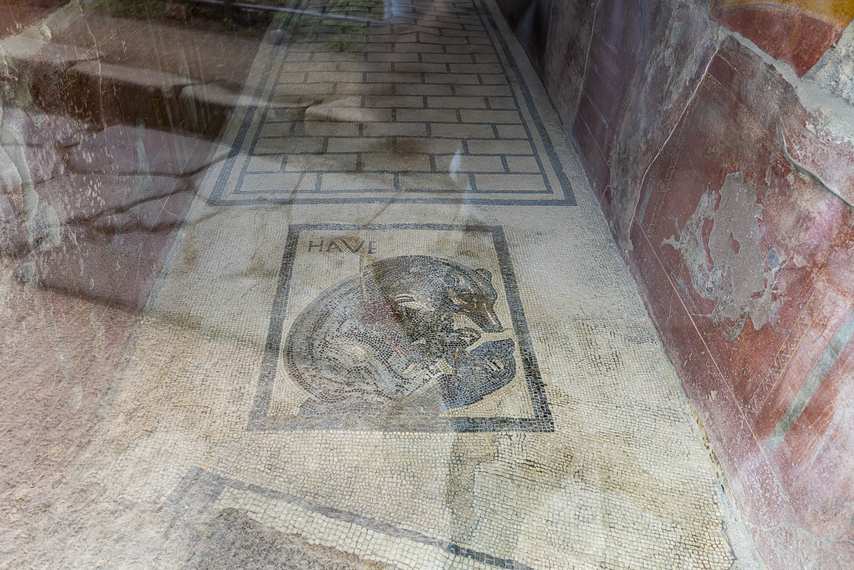
At the corner of Augustali Street and Lupanare Alley, the ancient entrance to the House of the Wounded Bear greets visitors with a small polychrome marble mosaic depicting a bear struck by a spear.
The animal is shown in the act of attempting to tear off the weapon stuck in its side, while blood is leaking from its body: a dramatic scene that reinforces the effectiveness of the apotropaic symbol.
Today, to preserve the original floor from the thousands of tourists who pass through each year, the main entrance to the house has been relocated to a side entrance.
An unbreakable pane of glass now protects the original entrance. Nonetheless, the wounded bear mosaic is visible, illuminated and cleaned up: an excellent example of Pompeian musivaria at the turn of the 1st and 2nd Roman styles, distinguished by tesserae of varying sizes and the refined cut of the marbles.
The bear, in Roman symbolism, could evoke both ferocity and resilience —an apt icon for symbolically defending the house against ill-intentioned attackers or evil spirits.
Many other domus in Pompeii displayed entrances decorated with animals (dogs, lions, panthers) and phrases of greeting (“Salve,” “Have,” “Cave canem”): signs of a coexistence of aesthetics, religiosity, and magic.
The Architecture and Floor Mosaics

Although modest in size, the House of the Wounded Bear is striking in the quality and variety of its decorative apparatus. The main spaces are:
Vestibule and fauces: the entrance area, where the famous bear mosaic is located. It was originally the obligatory passage to enter the domus; now, for preservation, it is only observed from behind the glass plate.
Atrium: past the short corridor, one enters the atrium, a central room typical of Pompeian houses. Here are two-tone (black and white) mosaic floors decorated with geometric motifs, some of which are enriched with inserts in opus sectile (slabs of marble or coloured stone).
Tablinum: the room overlooking the atrium that had functions of representation and study for the master of the house. The mosaic floor and wall frescoes, some of which have been preserved, testify to the care with which these spaces intended for social ostentation were outfitted.
Side rooms: from the tablinum and atrium, there is access to cubicula (bedrooms) and other small service rooms, some of which offer remarkable fragments of frescoes and details of flooring.
Some mosaics feature refined combinations of white and black tiles, along with coloured stone “inserts,” creating an elegant colour effect.
The passage between the atrium and the garden is further embellished with opus sectile pavements leading toward the true scenic centrepiece of the house: the small fountain-ninfeo.
Careful restoration removed old cement mortars introduced in the past, restoring cohesion to the tiles and restoring the original brilliance of the colours.
The Fountain-Ninfeo and the Garden

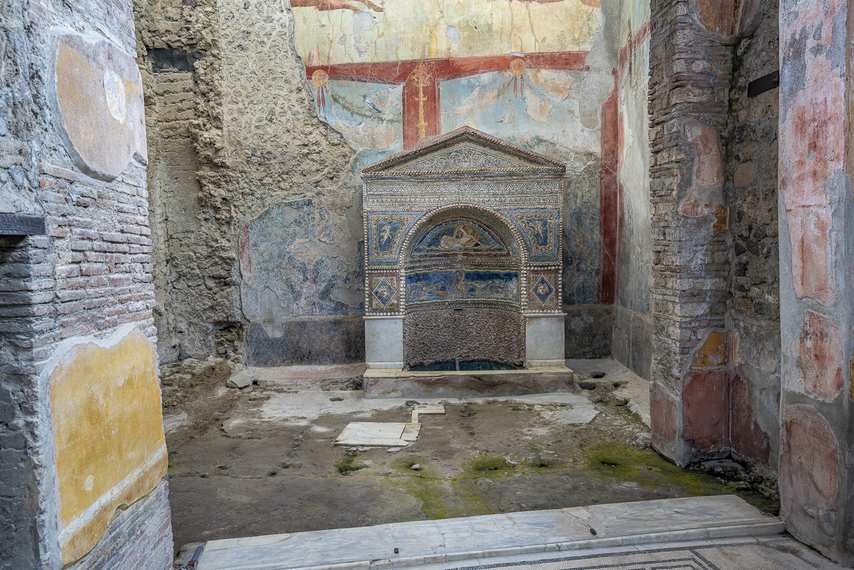
The most spectacular spot in the House of the Wounded Bear is probably the small garden at the back of the dwelling, enhanced by an aedicule fountain or nymphaeum. The latter represents a true masterpiece of polychromy, made of mosaic on glass paste and featuring the inclusion of natural shells, pieces of lava, and limestone in various shades.
The effect is that of an artificial cave, an “insula” of peace and freshness in the heart of the house.
The upper lunette of the fountain depicts a seabed full of fish and details of aquatic flora. In the centre stand the figures of Venus, lying in a large shell, and Neptune, lord of the sea, both immersed in a fairy-tale underwater world.
This type of composition, featuring shells and glassy tesserae, was designed to reflect the play of water and light, creating a strong visual and aural impact (the sound of flowing water) for guests invited to a nearby dinner or banquet.
Immediately behind the fountain, the walls are decorated with a large fresco depicting a fantasy garden, populated by animals such as wild boars, wolves, and birds. It is a typical example of garden painting, prevalent in first-century AD Pompeian art, where the illusion of a larger natural space was combined with the scents of real plants grown in the house’s small garden.
The Frescoes: From the Myth of Danae to Narcissus
In addition to the mosaics and bear-related iconography, the house features some remarkable frescoes, which are well-restored and visible in certain rooms. In particular, the triclinium preserves small paintings inspired by Greek mythology:
Danae with baby Perseus: the princess impregnated by Zeus in the form of a rain of gold, while holding the newborn Perseus in her arms.
Narcissus: the young man who falls in love with his image reflected in water, a myth emblematic of self-love taken to the extreme.
These mythological subjects, common in the homes of aristocratic and wealthy Pompeiians, were selected to provoke learned conversation and entertain diners at banquets.
The Fourth Style, predominant in the second half of the first century CE, favoured compositions rich in fantastic architecture and mythological scenes framed in bright colours (reds, yellows, blacks, whites), often embellished with gilded inserts or perspective illusions of columns and balconies.
The Restoration and Reopening to the Public
Closed for nearly two decades, the House of the Wounded Bear has reopened its doors to the public after a comprehensive consolidation and restoration project, which involved:
Mosaic floors: removal of cement mortars, replacement with mortars compatible with the original Roman composition, cleaning and integration of missing tiles.
Fountain-nymphaeum: cleaning of glass paste elements and shells, consolidation of the plaster behind and reconstruction of the pictorial gaps, to restore the chromatic vivacity of the seascape.
Frescoes: removal of deposits and encrustations, consolidation of parts in danger of detachment, integration of non-readable gaps with techniques recognisable by sight.
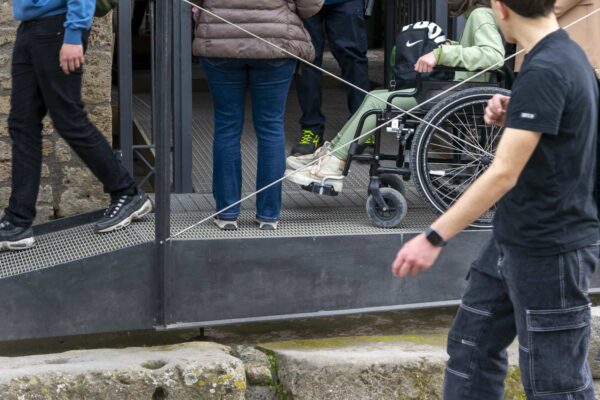
Protective measures: glass walkways and metal balustrades that simulate Cor-Ten, to protect the most delicate floors and allow for full enjoyment. A large pane of shatterproof glass protects the wounded bear mosaic without blocking the view.
The reopening project was also designed to relieve congestion on Via dell’Abbondanza, Pompeii’s main street, offering visitors the possibility of alternative routes along Via degli Augustali, which intersect other important domus, such as the House of Siricus. This gives them a less crowded but equally rich itinerary of wonders.
The Importance of Apotropaic Value
Beyond artistic beauty, the mosaics and depictions in the House of the Wounded Bear reflect the Roman mentality, in which images had concrete power to defend and influence the domestic environment.
The wounded bear, placed to guard the entrance, was a warning to anyone who wanted to cross the threshold with harmful intentions: a powerful animal, although wounded, ready to repel evil influences.
This aspect relates to a usage shared in Pompeii, a city where supernatural dangers were averted through paintings of ferocious animals, theatrical masks, and engravings of magical formulas.
Tour Route and Practical Suggestions
Visiting the House of the Wounded Bear is now a remarkable experience, made more comfortable by the walkways and protective glass that protect the mosaics. Here are some valuable suggestions for interested tourists:
Side access: the original entrance with the bear mosaic is visible only externally; enter through a specially arranged secondary passageway.
Transparent walkway: a glass path about a meter wide leads from the tablinum up to the small garden, avoiding direct contact with the mosaic floor.
Stop in the viridarium: take a few minutes to observe the fountain-ninfeo, dwelling on the details of the marine mosaic and shells. At certain times, the sunlight accentuates the colour contrasts, giving particularly striking effects.
It is also worth continuing on to the House of Siricus, located a short distance away, to admire another example of a richly decorated domus and, if you want to delve deeper, to explore the entire Regio VII district, which has long been undergoing restoration and is being returned to the public.
Conclusion: A Little-known Jewel of Pompeii
Although Pompeii is famous for larger domus (such as the House of the Vettii, the House of the Faun, or the House of Menander), the House of the Wounded Bear is a small jewel that combines refinement, symbolism, and art of the highest order.
Restoration work has rescued it from oblivion, making it accessible once again- an important milestone both for the preservation of cultural heritage and for travellers in search of lesser-known, but equally evocative places.
If you are planning your itinerary in the Pompeii Archaeological Park, a visit to the House of the Wounded Bear will give you a glimpse of how Pompeians lived in the first century AD, combining the elegance of the spaces with the practice of protecting themselves from adversity through images and rituals.
Admiring mosaics, fountains and frescoes restored to their ancient splendour allows you to tune in to a world that has remained silent for nearly two millennia, but is still able to speak to our eyes with vivid intensity.
FAQ About the House of the Wounded Bear in Pompeii
The name comes from the spectacular mosaic at the entrance, depicting a bear struck by a spear. The scene probably had an apotropaic, i.e., protective, function and was accompanied by the greeting inscription “HAVE.”
The mosaic floors, the nymphaeum (aedicula fountain) decorated with shells and glass tesserae, as well as frescoes with mythological subjects (e.g., Danae and Narcissus) in the triclinium. All of this is enhanced by glass walkways that make it possible to walk over the mosaics without damaging them.
At the entrance to the House of the Wounded Bear is a mosaic depicting a bear pierced by a spear, in the act of removing it from his side. This scene had apotropaic significance, that is, protection against adversity- a strong and dramatic image that symbolised the determination to fend off dangers and evils that might threaten the domus and its inhabitants.
A shatterproof glass pane protects the mosaic and is visible only from the outside. For conservation reasons, access is through a secondary entrance. In any case, the view of the mosaic remains excellent, and the lighting highlights it.
The house had been inaccessible for nearly two decades. Restoration, completed around 2016-2017, allowed it to reopen to the public, returning a hitherto little-known but historically and artistically important gem to the archaeological area.