The House of the Cryptoporticus in Pompeii is located along Via dell’Abbondanza, with a secondary entrance on Vicolo del Menandro, in a rather busy area of the ancient city, not far from the Forum. It owes its modern name to the presence of a luxurious underground passageway, or “cryptoporticus,” which runs beneath the large, quadrangular garden.
In Roman times, it served as a cool, shady place for walks and moments of idleness. By contrast, this structure, which is found more frequently in large country villas, is quite rare in Pompeii’s urban dwellings, underscoring the high status and refinement of the house’s owners.
Where is it located?
Map of Pompeii: Regio I – 5
Google MapsOrigin and History of the House

The original layout of the domus dates back to the 3rd century BC, but it underwent numerous modifications over the following centuries. In the late 2nd and early 1st centuries BC, the House of the Cryptoporticus in Pompeii was expanded to include the nearby house, Casa del Sacello Iliaco (also known as Casa del Larario di Achille), thus forming one large property with a garden at the back and a portico on three sides.
Later, in the years 30-40 B.C., the garden level was raised, and the porticoes were converted into a basement cryptoporticus, overlooking Vicolo del Menandro. A small private bath complex and a large oecus (living or banquet hall), decorated with rich Second Style frescoes, were also added at this stage.
The 62 CE Pompeii earthquake marked a crucial moment for the house. It was then that the property was again subdivided: the part that had been united with the House of the Iliac Sacellum became an independent dwelling again, while the House of the Cryptoporticus in Pompeii lost some of its sumptuousness, undergoing structural changes that altered its volumes and uses.
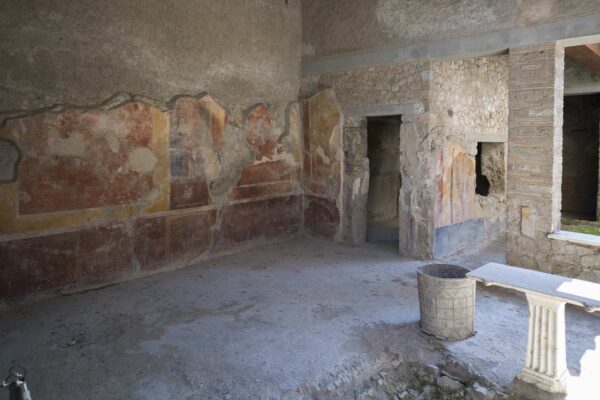
In particular, the loggia facing south was transformed into a banquet hall, featuring a masonry triclinium that was entirely covered with red plaster and decorated with depictions of plants and birds.
In 1914, during excavations in the garden, the remains of several victims of the 79 AD eruption of Vesuvius were found, gathered in groups of six to ten individuals. Some of these skeletons were used to make casts, which can be seen today in the “Kidnapped to Death” exhibition at Pompeii’s Amphitheatre.
Unfortunately, the house also suffered damage during the 1943 bombing, when part of the frescoes were irreparably damaged or destroyed.
Structure and Description of the Domus

The House of the Cryptoporticus at Pompeii is on two levels, connected by stairs that start from the garden and lead, respectively, to the upper floor (where the summer triclinium was located) and the lower floor (where the cryptoporticus, bath complex, and oecus unfolded).
Upper Floor
The upper level contains the brightest reception rooms, including the banquet hall (triclinium) built after the earthquake in 62 CE, where diners could enjoy a view of the garden. The walls of this triclinium are adorned with vivid red plaster, featuring depictions of flowering plants, birds, and other ornamental motifs along the sides.
A roof system was probably installed here that could shelter from the sun or bad weather, allowing the room to be used during much of the year. To the side of the triclinium was the kitchen (or service room), also accessible from the loggia.
Lower Floor

The lower floor of the house is what makes it particularly famous. In addition to the cryptoporticus, there are several private bath rooms and a large oecus (living room or winter banquet hall).
Cryptoporticus
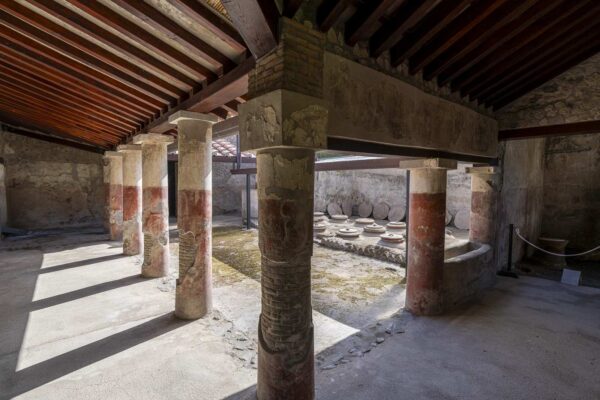
This luxurious, vaulted (barrel-vaulted) subterranean corridor, decorated with stucco and frescoes, runs along three sides and was well-lit initially by upper openings (clerestory windows). The walls of the cryptoporticus featured exquisite Second Style frescoes, with a pictorial cycle inspired by scenes from the Iliad and, according to some sources, also from Aethiopis.
Painted herms lined the walls, interconnected by garlands of foliage. At the same time, the upper band featured a long frieze with epic episodes, depicting heroes and gods of the Trojan War, identified through Greek captions.
The most famous characters, such as Achilles, Hector or Aeneas, followed one another in a kind of “illustrated scroll” that surrounded those who walked inside this space.
Over time, following post-earthquake renovations, the eastern and western sides of the cryptoporticus were walled up, and the space was partially buried to serve as a wine cellar (cella vinaria). This phase of use altered the original appearance of the room and contributed to partial damage to the frescoes.
The 1943 bombing further damaged some scenes, but fortunately, many of them had already been documented photographically.
Private Spa Complex
Opposite the staircase leading down to the cryptoporticus is a small bath complex, one of the few remaining examples of private baths in Pompeii. Four rooms remain here, probably corresponding to the typical functions of Roman baths (dressing room, frigidarium for cold baths, tepidarium and calidarium).
The vaults of these rooms were originally adorned with finely crafted stucco, featuring architectural and illusionistic motifs, which gave depth and prestige to the whole.
Oecus (living room or winter banquet hall)
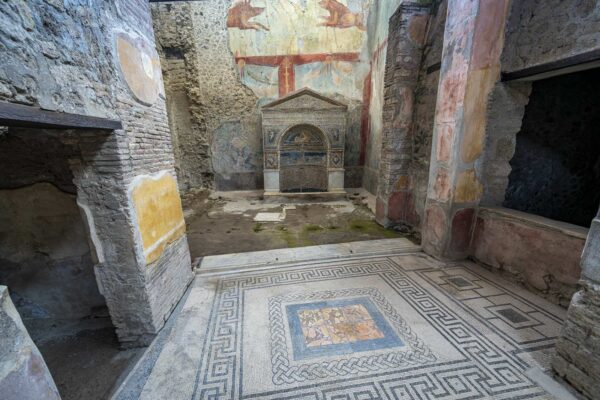
At the end of the corridor, near the eastern sector of the cryptoporticus, is a large room, the oecus. Its walls were adorned with Second Style frescoes featuring representations of caryatids and mythological panels, while the floor was decorated with an exceptional mosaic, partly featuring Dionysian themes.
The miniature paintings, with subjects such as satyrs and maenads, as well as other figures connected to the cult of Dionysus, recalled the festive and convivial atmosphere that probably characterised the events held in this environment.
Pictorial Decorations in the Second Style
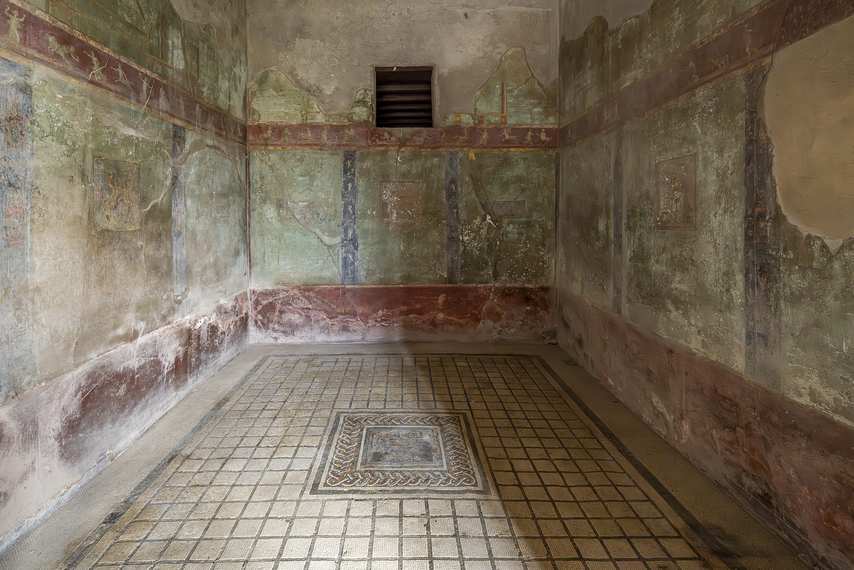
One of the most fascinating features of the House of the Cryptoporticus in Pompeii is its rich pictorial decoration of the Second Style (late 2nd century to mid 1st century BCE). This style is characterised by marked architectural illusionism, which creates the effect of visually extending the room’s space through the use of faux columns, balustrades, or perspective views.
The cryptoporticus: The decoration was organized along the walls in a “paratactic” manner, that is, with a repeated sequence of herms and panels. The herms (half-length figures) separated squares with epic scenes, generating a rhythm that invited walking.
The festoons between the herms seemed to hook behind the figures, lending three-dimensionality to the whole. The upper part was occupied by the long frieze dedicated to the Iliad and other poems from the Trojan cycle. At the same time, the lower band could feature geometric motifs or perspective meanders.
Baths: Some bathrooms show more complex decorations, with painted faux architecture and stucco of great finesse. It is possible that these representations were intended to enhance the idea of luxury and well-being, accentuating the difference between the cool shade of the cryptoporticus and the rejuvenating warmth of the baths.
The oecus: The living room or winter banquet hall was embellished with fine mosaics and frescoes, possibly featuring Dionysian and mythological references (such as Oedipus and Laius, or Niobe and her children), which served as cues for learned conversations among guests during banquets.
Building Vicissitudes and Modifications

Like many other domus in Pompeii, the House of the Cryptoporticus has gone through numerous phases of transformation, reflecting the tastes, needs, and budgets of its various owners.
First unification: In the 2nd century BC, the house joined the nearby House of the Iliac Sacellum, expanding its interior spaces and garden.
Construction of the cryptoporticus: Between 40 and 30 BCE, the garden was raised, and the porticoes were transformed into underground corridors, decorated with frescoes and stucco. The baths and oecus were added.
After the 62 AD earthquake, the mansion again became separate from the Iliac Sacellum. The cryptoporticus was partly walled up and converted into a cellar, and a large summer triclinium was set up on the upper floor, with walls plastered in bright red.
The end of the eruption: In 79 AD, the eruption of Vesuvius buried the house and its inhabitants. Some of the bodies were found in 1914, along with jewellery, keys and various tools.
Archaeological Excavations and Restoration

The most crucial excavation phases for this domus date back to the early 20th century. Vittorio Spinazzola conducted research and work between 1911 and 1919. Amedeo Maiuri continued this work between 1927 and 1929.
The house, located in Regio I, was immediately recognised as a relevant example of a luxurious residence, thanks to the presence of the cryptoporticus and a private spa facility. In 1914, the discovery of human remains in the garden led to the creation of some casts.
Unfortunately, during World War II, the area was hit by bombs that damaged many frescoes. In recent times, restoration work has been carried out, particularly aimed at stabilising and preserving the remains of the wall paintings.
Some parts of the frescoes, especially the more deteriorated ones, have been detached for conservation purposes and are now stored in a more protected location. In any case, several original sections can still be admired in situ.
Valuable Elements and Findings

Frescoes with scenes from the Iliad: An authentic masterpiece of Pompeian Second Style painting. Despite the damage, several scenes remain visible, testifying to the importance that these epic subjects had in the Roman cultural context.
Stucco decorations: Especially in the vaults (cryptoporticus and baths), depictions of crowns, floral motifs and geometric figures are found in a delicate and elegant style.
Private thermopolium: Although not a true thermopolium (food and drink store), the house possessed a bath complex of considerable size and sophistication, a privilege reserved for wealthy families.
Finds of pottery and amphorae: The amphorae found in the cryptoporticus (during its transformation into a wine cellar) attest to trade with various places in the Mediterranean, such as Libya, Tunisia, Greece, and Turkey, and testify to the food wealth enjoyed by the owners.
Human remains and casts: Several victims of the eruption were found in the garden, some of whom are on display in temporary exhibitions. Personal items (jewellery, coins, keys) were discovered near the bodies, evidence of a desperate attempt to take valuables with them during their escape.
Why Visit the House of the Cryptoporticus?
To visit the House of the Cryptoporticus is to immerse oneself in a truly peculiar example of an urban residence, combining the elegance of a large cryptoporticus (usually typical of rustic or maritime villas) with the presence of private baths and finely decorated banquet halls.
The subterranean pathway, clerestory windows, refined Second Style frescoes, and references to the Iliad and epic and mythological events make this house a highly evocative place.
Despite the damage suffered over the centuries, the domus’ charm remains unchanged, giving visitors a glimpse of aristocratic life and passion for ancient art and culture.
If you are planning your visit to the Pompeii Archaeological Park, add the House of the Cryptoporticus to your itinerary: you will discover a unique environment and, along with other large complexes such as the House of Menander and the House of the Citharist, you will gain a better understanding of how the wealthy classes of the time lived, amid luxury, conviviality and a desire to impress guests with works of art and refined architectural details.
FAQ About the House of the Cryptoporticus
The mansion takes its name from its underground passage, or cryptoporticus, a fresco-rich basement corridor that runs under the garden. This architectural element, rare in urban homes, provided shade and coolness while also lending prestige to the property.
The frescoes are in the Second Style and depict episodes from the Iliad and the Aethiopis, with heroes and gods identified by Greek captions. They were organised in a kind of narrative sequence, designed for people walking along the corridors.
It is among the few examples of private bath complexes in Pompeii. It probably featured several rooms, including a frigidarium, tepidarium, and calidarium, as well as vaults decorated with stucco. It had architecturally themed and illusionistic floors and walls, emphasising the luxury enjoyed by its owners.
We do not know the exact names of the owners, but the size and decoration of the domus suggest that it belonged to a wealthy family, part of the local elite. The discovery of numerous imported artefacts, including amphorae and valuable objects, indicates extensive trade and cultural relations.
Although the house has suffered damage over time (the AD 79 eruption and 1943 bombing), it still retains parts of the cryptoporticus with original frescoes, the private bath area, and remains of the oecus. The upper floor, featuring the summer triclinium and various internal passages, offers insights into the structural evolution of the domus and the daily life of its inhabitants.