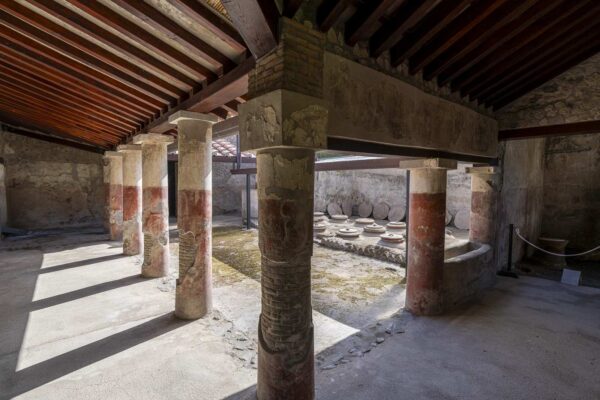
The Forum of Pompeii represents the beating heart of the ancient city and is one of the most iconic sites of the Pompeii Excavations. This rectangular square, 143 meters long and 38 meters wide, was the city’s political, religious, and economic life centre.
Surrounded by an imposing colonnade, the forum was a space dedicated to public ceremonies, commercial meetings, and religious celebrations. Debates were held here, justice was administered, and essential public business was transacted, making it the hub of Pompeii’s daily life.
Built in Samnite times in the 4th century BC, the forum underwent significant renovation after the Roman conquest in the 2nd century BC, becoming a perfect example of Roman architecture.
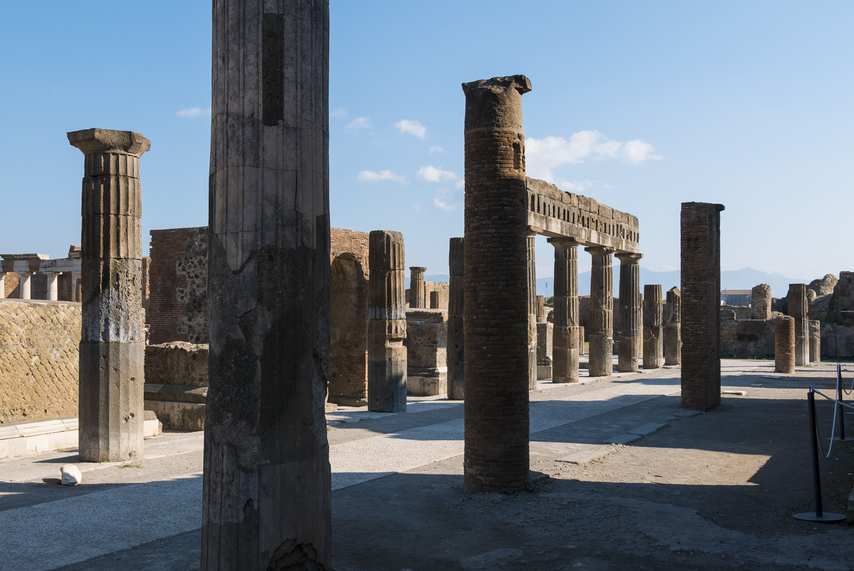
During the Augustan period, between the end of the 1st century B.C. and the beginning of the 1st century A.D., the forum was further embellished: the original tufa pavement was replaced with travertine slabs, while porticoes with Doric columns at the bottom and Ionic columns at the top were built around the square.
These architectural details give the Forum of Pompeii a unique beauty, making it one of the best-preserved squares in the Roman world.
Thanks to a raised pavement and access steps, the forum was entirely off limits to chariot traffic and was surrounded by public buildings of primary importance. Prominent among these were the Forum Basilica, the judicial and economic centre; the Temple of Jupiter, dedicated to the Capitoline Triad; the Macellum, the city market; and the Temple of Apollo, one of the oldest places of worship in Pompeii.
Also on the square’s north side were the honorary arches dedicated to Roman emperors, which further embellished this grandiose space.
To visit the Forum of Pompeii is to immerse yourself in a place where history, architecture and daily life are intertwined. Here you can walk among columns still standing, admire the vestiges of temples and imagine the lives of ancient Pompeians.
The forum also offers stunning views of Mount Vesuvius, a constant and majestic feature in the background, a reminder of the city’s tragic fate.
Whether planning a trip to Pompeii, a guided tour, or an organised trip from Naples, the Forum of Pompeii is an essential stop that will allow you to understand the importance and beauty of this extraordinary city. Every stone tells a story, and every corner reveals a detail of the great Roman civilisation that flourished here until the fateful eruption of 79 AD.
Where is it located?
Map of Pompeii: Regio VII – 6a
Google MapsHistory of the Forum of Pompeii
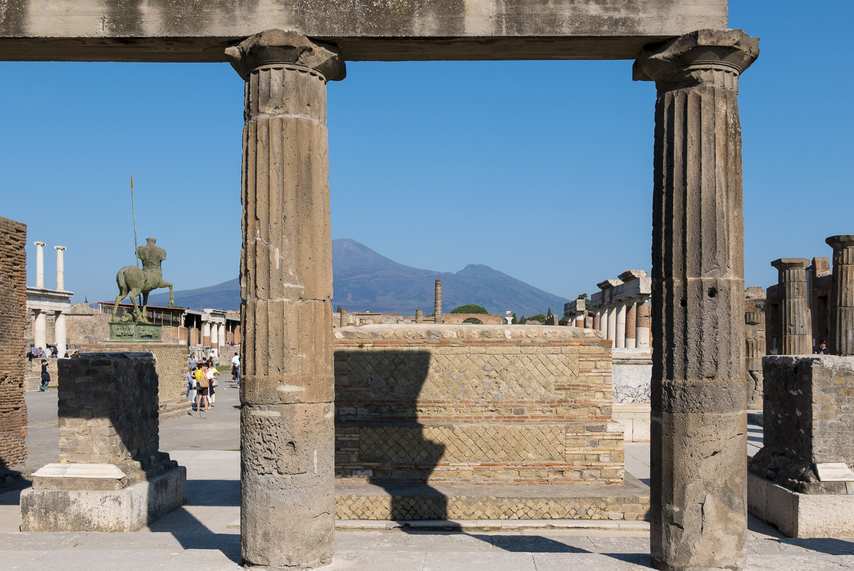
A structure with a Roman lintel and columns in the Pompeii Forum taken with a covered sky. The Pompeii Forum was built in the 4th century BC, during the Samnite period, when Pompeii was not yet under Roman influence.
Located at a strategic point near the roads that connected the city to Neapolis (Naples), Nola, and Stabiae, the forum was a small square surrounded by stores. After the Roman conquest, in the second century B.C., the forum was completely renovated and expanded to become the city’s nerve centre.
During the Augustan era, between the end of the 1st century BC and the beginning of the 1st century A.D., further beautification was carried out: the pavement was redone in travertine and perimeter porticoes were built.
This made the Forum of Pompeii a perfect example of a Roman square, dedicated to political, commercial and religious activities. However, in 79 AD, Vesuvius destroyed the city, burying the forum under a blanket of ash and lapilli. The site remained buried until its excavation in the 19th century, becoming one of the landmarks of the Pompeii excavations.
A Centre of Life and Activity

The forum was the vibrant heart of the city, a place of meetings, business and celebrations. It hosted markets, religious ceremonies, political debates, and public trials. This open space also served as a focal point for newcomers conducting trade or official business.
Unlike many Roman forums, the Forum of Pompeii does not entirely follow the dictates of Vitruvius and features Greek influences, an element that underscores its Samnite origin. This combination of styles makes the Forum of Pompeii unique.
Why Visit the Forum of Pompeii
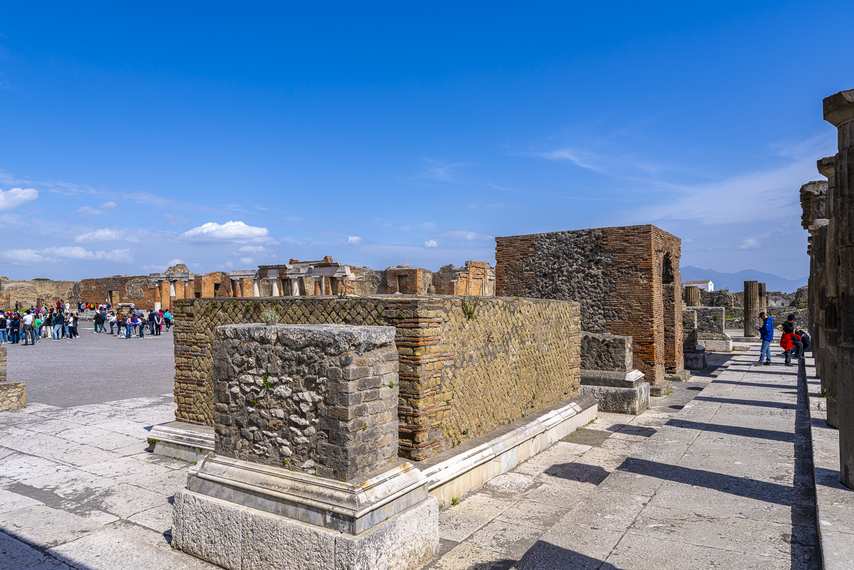
Visiting the Forum of Pompeii is an unmissable opportunity to immerse oneself in ancient history and understand the workings of a Roman city. Strolling among its standing columns, admiring the ancient temples, and imagining the daily life of Pompeii’s inhabitants is an experience not easily forgotten.
Because of its central location, the forum is an ideal starting point for exploring the Pompeii Archaeological Park and visiting other nearby attractions such as the Temple of Jupiter or the Macellum.
Visiting the forum also offers spectacular views of Mount Vesuvius, creating a link between the city and the volcano that sealed its fate.
What to See in the Forum of Pompeii
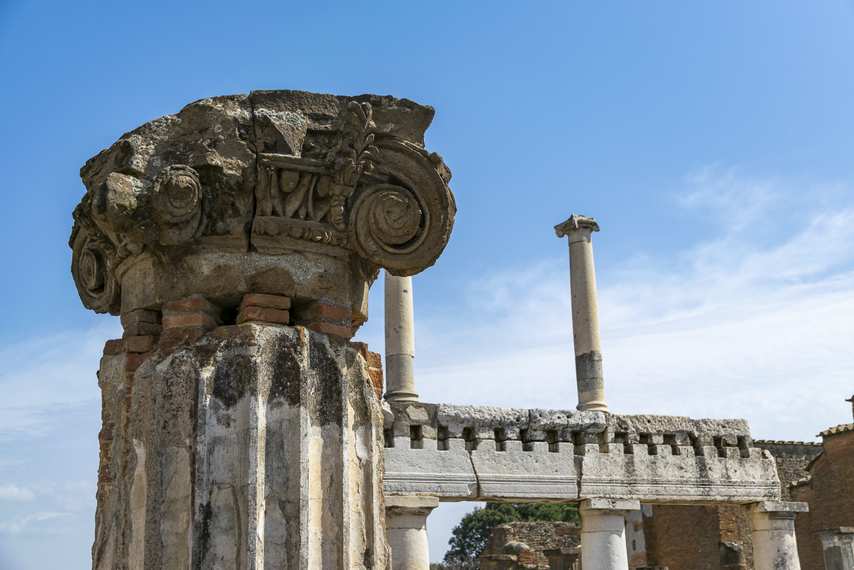
The Forum of Pompeii is surrounded by symbolic buildings that tell the story of the city’s history and everyday life. Here are the main places not to miss:
- Temple of Jupiter
Located on the north side of the forum, the Temple of Jupiter dominated the square and was dedicated to the Capitoline triad: Jupiter, Juno, and Minerva. This building symbolised Rome’s power and offered an extraordinary view of Mount Vesuvius. - Forum Basilica
On the west side is the Forum Basilica, the city’s economic and judicial centre. This imposing three-aisled building was where trials and commercial transactions took place. - Macellum
The Macellum, on the northeast side of the forum, was Pompeii’s covered market, where meat, fish and other foodstuffs were sold. Inside, Pompeian frescoes and decorations are still visible. - Temple of Apollo
One of Pompeii’s oldest temples, the Temple of Apollo, is located on the southwest side of the forum. This sacred place was dedicated to the god of music and poetry and features well-preserved statues and columns. - Building of Eumachia
This building, located on the east side, was dedicated to the guild of fullones (launderers) and was built by the priestess Eumachia. It is an example of the active role of women in the Pompeian economy. - Honorary Arches
On the north side of the forum are honorary arches dedicated to Roman emperors, including one dedicated to Augustus. These arches testify to the political and cultural ties between Pompeii and Rome. - Mensa Ponderaria
Carved out of a niche in the Temple of Apollo, the mensa ponderaria verified the weights of goods to ensure proper exchanges. Under the magistrates’ control, a stone slab with cavities for units of measurement was used, preventing abuse and adapting weights to the Roman system.
Interesting Facts About the Forum of Pompeii
- Honorary statues: Although many pedestals are still visible, the original statues have not been found. They are believed to have been removed for restoration after the earthquake in 62 AD.
- Unique architecture: The forum combines Greek and Roman elements, distinguishing itself from other forums in the Empire by its structure and placement of statues.
- Fine paving: The square’s travertine slabs signify Pompeii’s wealth and importance in Roman times.
Conclusion
The Forum of Pompeii is more than just a square: it is a place where history, architecture, and daily life intertwine to tell the story of the greatness of Roman civilisation. If you plan a trip to Pompeii or an organised tour from Naples, the Forum is an essential stop.
Discovering the forum means understanding the city’s soul and central role in its inhabitants’ lives.
This experience will enrich your visit to the Pompeii Archaeological Park, giving you a journey back in time that you will not forget.
FAQ About the Forum of Pompeii
The Forum of Pompeii is the main square and beating heart of the ancient Roman city. It is about 143 meters long and 38 meters wide and was surrounded by a columned portico. Pompeii’s inhabitants concentrated their political, commercial, and religious activities here, making it a key space for social and public life.
Within the Pompeii Excavations, the forum represents the nerve centre of an ancient civilisation. Justice was administered there (in the Forum Basilica), the gods were honoured (in the temples), and markets and negotiations were held (in the Macellum). To walk among its ruins is to immerse oneself in a place that chronicles the daily life, politics and religion of an entire Roman community.
Forum Basilica: the courthouse and economic centre of the city, where trials were held and contracts were signed.Temple of Jupiter: dedicated to the Capitoline triad (Jupiter, Juno and Minerva), it dominates the north side of the forum.Sanctuary of Apollo: one of the oldest places of worship in Pompeii, dedicated to the god of poetry and music.Macellum: the covered market, where meat, fish and other foodstuffs were for sale.Building of Eumachia: dedicated to the guild of fullones (launderers), it testifies to the influence of women in the Pompeian economy.Honorary arches: celebratory structures, such as the arch dedicated to Emperor Augustus, symbolising Pompeii’s link with Rome.
A visit to the Forum of Pompeii can take 20 to 40 minutes, depending on how much you want to delve into its history and architectural details. If you also plan to explore the surrounding buildings (Temple of Jupiter, Forum Basilica, Macellum, etc.), the time required can increase to an hour or more. It is advisable to include the forum at the beginning of the tour to orient yourself within the Pompeii Archaeological Excavations better.
Travertine slabs replaced the older tufa pavement during the Augustan age. Doric and Ionic colonnades, decorating the perimeter porticoes.Access steps and a raised floor to prevent the passage of carts, reserving the area for pedestrians. Greek and Samnite influence in the original layout was later reworked according to the canons of Roman architecture.
Understand Roman life: The forum was the hub of political, religious and commercial activities. Admire ancient architecture: The harmony of the columns, the large travertine-paved plaza, and the surrounding public buildings represent a valuable example of Roman architecture. Discover the history of Pompeii: Here you find real evidence of the organisation of a city, from the administration of justice to religious ceremonies. Enjoy striking views: From the plaza, you have an extraordinary view of Mount Vesuvius, which towers above and constantly reminds you of the city’s fate.
Unlike many forums designed in imperial times according to Vitruvian canons, the Forum of Pompeii retains Samnite traces and Greek influences. The result is an original architectural fusion from Pompeii’s historical evolution and its transition from Samnite settlement to Roman colony.
The forum was the hub of political (meetings, elections, assemblies), religious (festivals honouring the gods) and commercial (markets, bargaining) activities. It was also a place of passage for travellers and traders from nearby Nola, Stabiae and Neapolis, making Pompeii a critical economic hub in the Campania region.
The forum is situated in a panoramic position that allows visitors to admire the majestic profile of Mount Vesuvius, a constant presence in Pompeii’s landscape. From here, it is possible to take evocative photos in which the imposing volcano provides a backdrop for ancient Roman buildings, recalling the dramatic eruption that destroyed the city in 79 AD.