What is the House of the Golden Cupids and why Visit it?
The House of the Golden Cupids, located in Regio VI of the Archaeological Excavations of Pompeii, is one of the most refined domus in the city.
Famous for its mythological frescoes and rare Rhodian-style peristyle, it offers visitors an authentic glimpse into the life of Pompeii’s elite.
It owes its name to small glass discs with gold foil depicting cupids, which decorated a cubicle and are now mostly preserved in the National Archaeological Museum of Naples.
Where is it Located?
Map of Pompeii: Regio VI – 16.7
A Brief History of the Domus
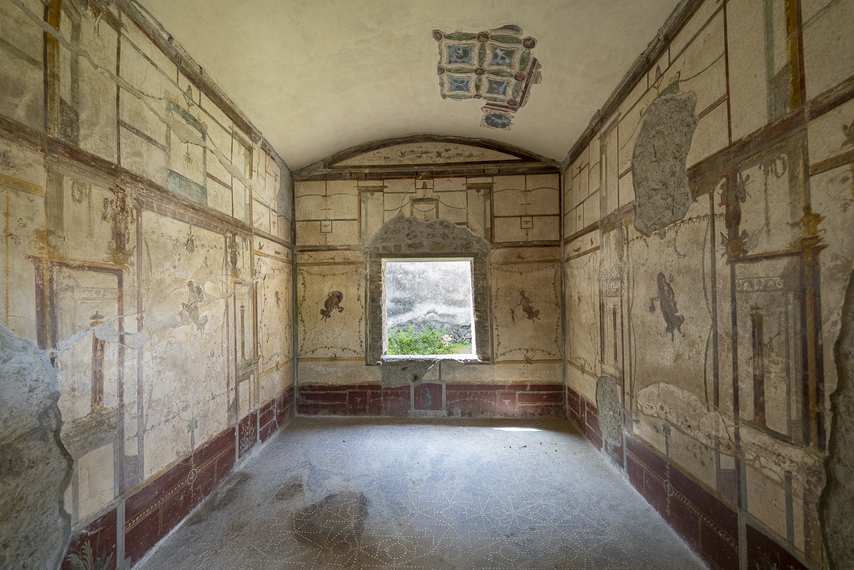
The construction phases
The building is the result of the union of two older houses (3rd–2nd century BC). Between the end of the Republican era and the Augustan age, the spaces were reorganised and the decorations renovated, transforming the original dwellings into an elegant domus of approximately 830 square metres.
The earthquake of 62 AD and ancient restorations
After the earthquake of 62 AD, some of the decorations were restored: today, it is still it is possible to appreciate the original quality, testifying to the value that the owner attributed to the works of art in his home.
The archaeological discovery
The House of the Golden Cupids was unearthed between 1903 and 1905 during post-unification excavations.
The garden with its marble furnishings was carefully restored careful restoration during the excavation phase, making it one of the best-preserved domus in the archaeological park of Pompeii.
Modern Restoration
A major restoration project was completed in 2013, involving the renovation of the roofing, the consolidation of the wall paintings, the cleaning of themosaic and cocciopesto floors, and the restoration of the garden according to archaeological data.
Other maintenance work has been carried out on the building in subsequent years.
The Owner and Social Status
Graffiti and a seal indicate that the owner was Cnaeus Poppaeus Habitus, of the Gens Poppeae, a prominent family in Pompeii and probably related to Poppea Sabina, the second wife of Emperor Nero.
This connection would explain the luxury of the dwelling and the presence of valuable works of art, some of which may be Greek originals.
The glass discs with gold foil decorated the cubicle that gave the house its name and reflect not only the luxury of the owners, but also the cultural and aesthetic links with the Hellenistic world.
Recommended tour route (15-20 minutes)
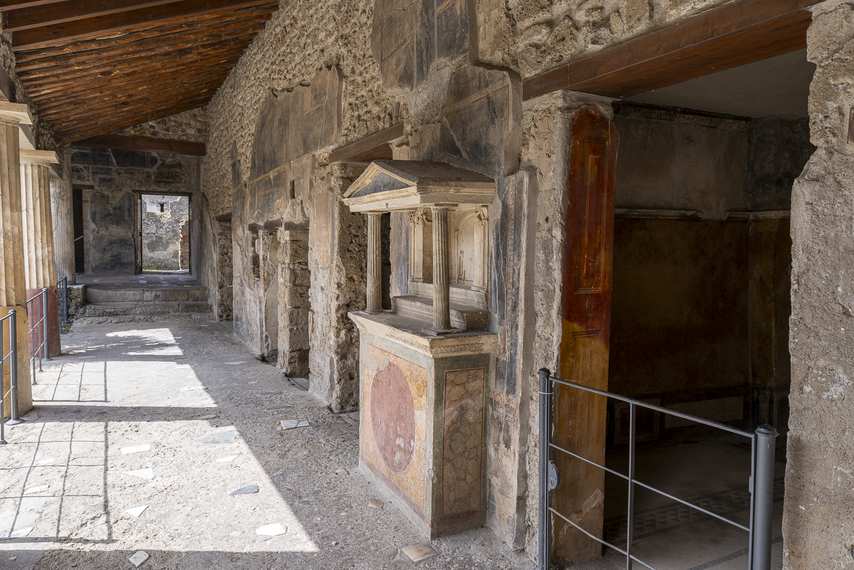
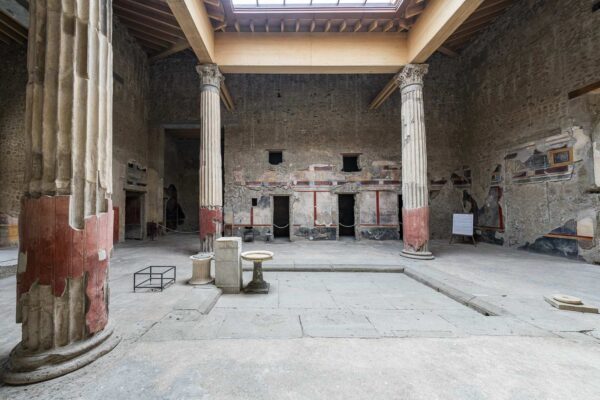
1. Atrium and Tablinum
Observe the division between public and private areas. In the tablinum, look for the fresco depicting the meeting between Paris and Helen.
2. Rhodian Peristyle
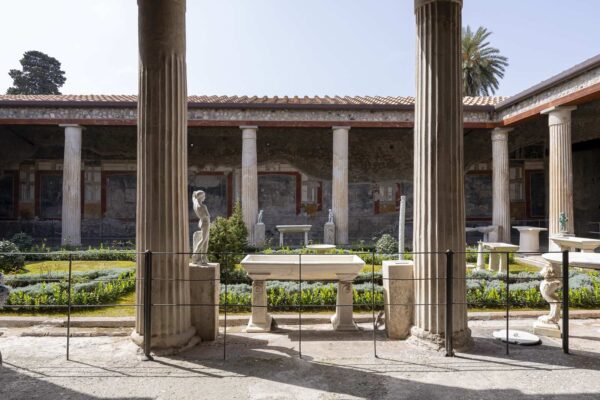
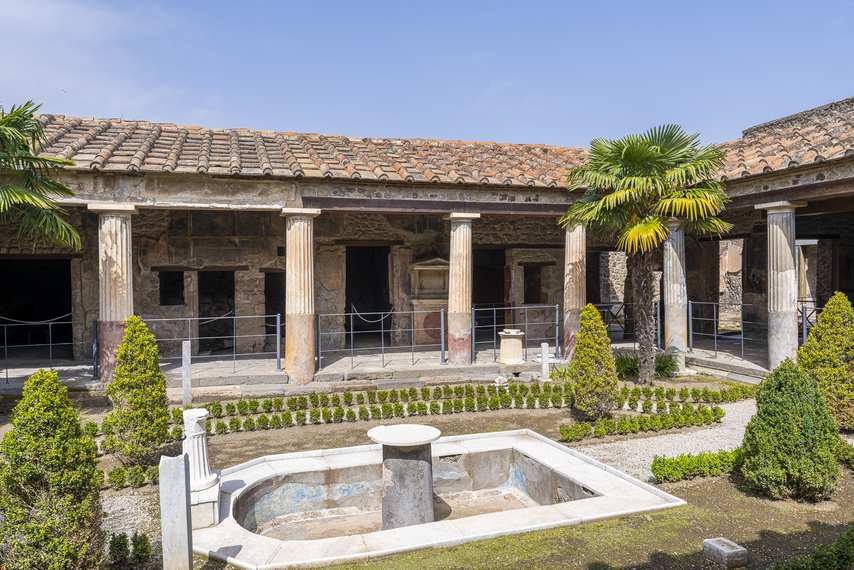
After crossing the atrium, you arrive at the heart of the house: the Rhodian peristyle. This is a rare colonnaded courtyard in Pompeii, where one side of the colonnade is higher than the others, creating a monumental effect.
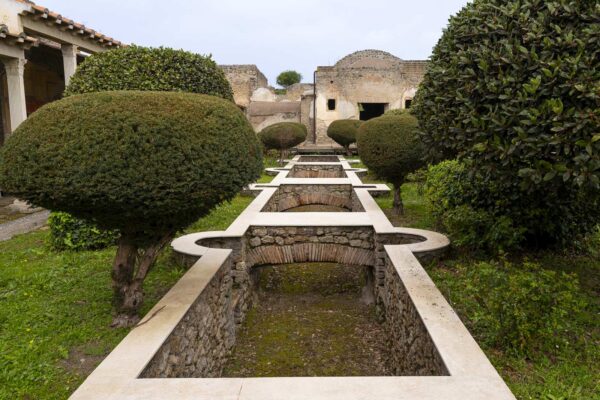
In the centre stands a semicircular pool, while all around it was a garden that must have amazed guests with its sculptures, reliefs and theatrical masks. If you want to find out more, you will find details in the section dedicated to the garden.
3. Reception Room
Look for the floor mosaic with a central rosette (Augustean style) and observe the walls decorated with mythological scenes in the Third Pompeian style, characterised by formal elegance and plain panels with small figurative squares.
4. Cubicle of the Cupids
Discover the room that gave the house its name, where the famous golden discs were located.
5. Lararium and Sacellum
Compare the two places of worship:
- Lararium: intended for traditional Roman domestic worship
- Sacellum: dedicated to Egyptian deities (Isis, Serapis, Harpocrates, Anubis)
What to Look for in the Frescoes
In the large reception hall, you can admire some of the masterpieces of the Third Pompeian style. The walls tell mythological stories: Achilles bidding farewell to Patroclus and Briseis, Thetis turning to Vulcan to obtain her son’s weapons, or
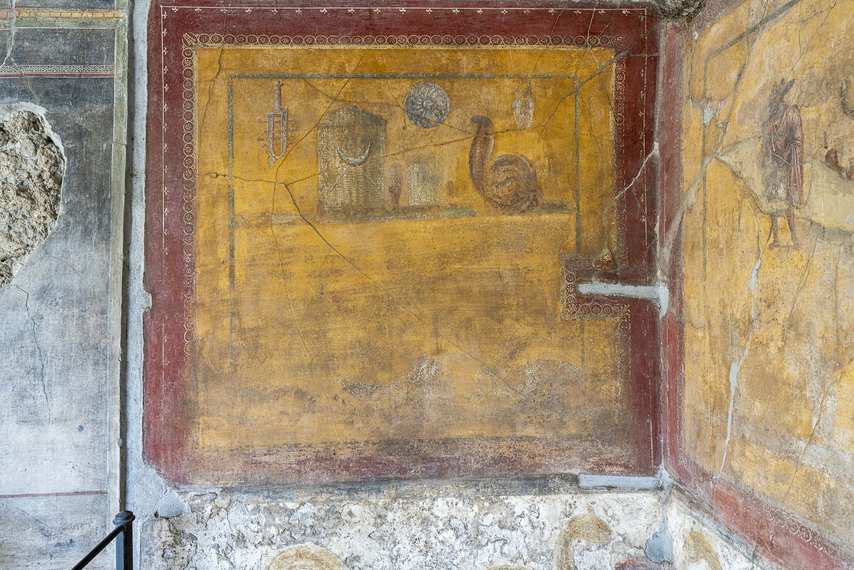
the dramatic escape of Jason and Medea. These are not mere decorations, but actual painted stories that accompanied the daily life of the owners of the house.
The Garden with Rhodian peristyle
The garden was designed as a small open-air museum. At its centre, the semicircular pool with its flowerbeds introduced a visual path made up of animal statues, marble herms of deities and theatrical reliefs that recalled the world of Dionysus. It was a place where guests could stroll, discuss art and politics, but also be surprised by the beauty and variety of the decorations.
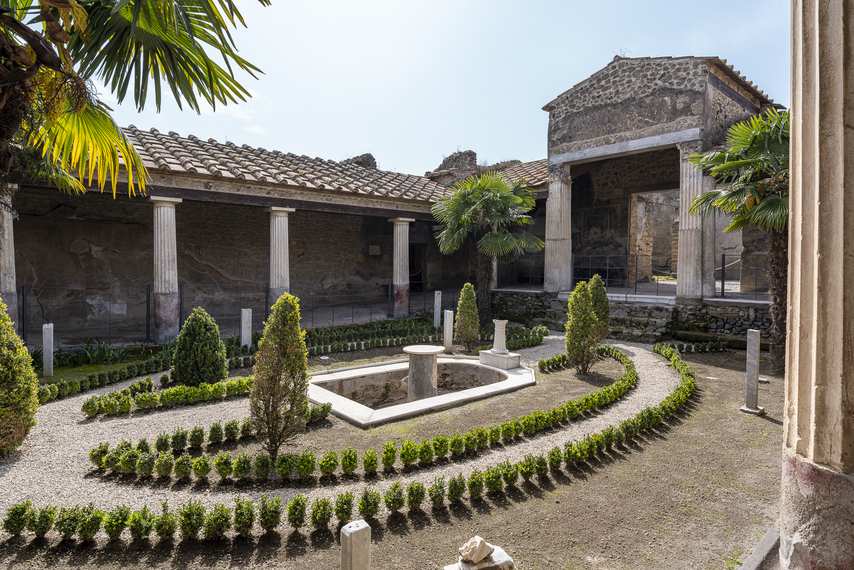
In the Rhodian peristyle, one side of the colonnade is higher than the others: the effect is monumental and highlights the rooms facing it.
This architectural style, which takes its name from the island of Rhodes, was rare and prestigious in Pompeian domestic architecture.
Places of worship: Roman tradition and Eastern cults
Inside the house, walking along the peristyle, you come across two small sacred spaces that reveal a great deal about the spirituality of the owners.
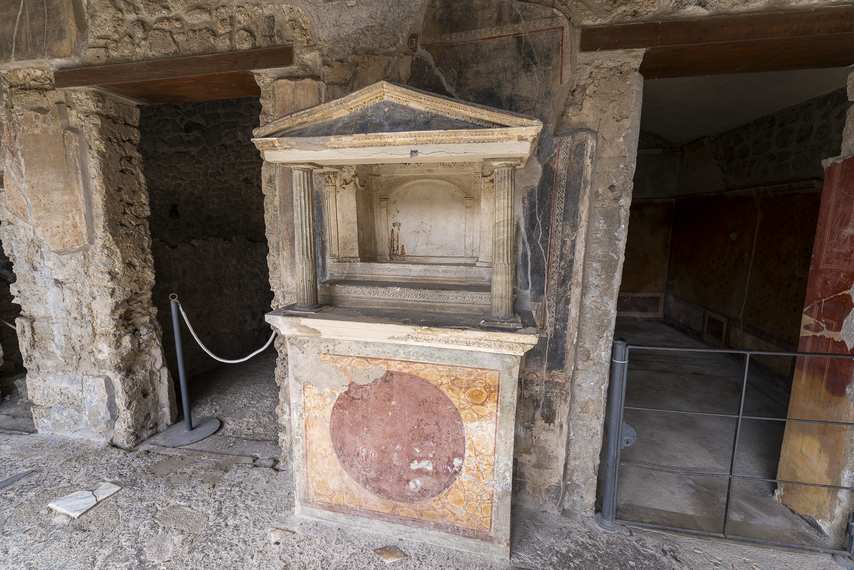
On one side is the lararium, the domestic temple where the family worshipped the traditional Roman deities.
Here were the Lares, protectors of the house, alongside figures such as Mercury, god of commerce and guide of souls, and the classical triad representing the strength of Rome.
Not far away, almost unexpectedly, a different environment opens up: a small chapel dedicated to the worship of Isis and the Egyptian gods, which was very common in Pompeii in the 1st century AD.
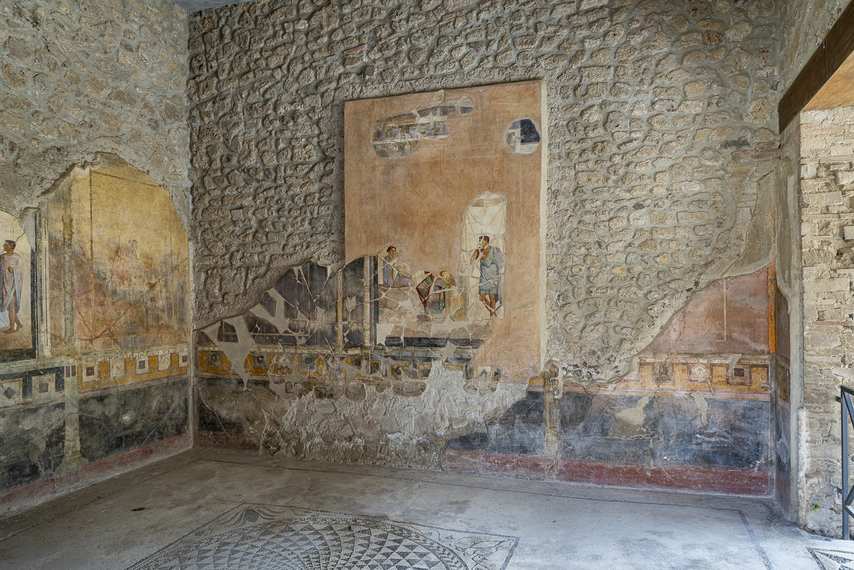
The walls depicted Anubis with his jackal head, the little Harpocrates, son of Isis, Isis herself, goddess of motherhood and magic, and Serapis, revered as the god of healing.
The simultaneous presence of these two places of worship – one linked to Roman tradition, the other to an Eastern religious horizon – clearly illustrates the cosmopolitan character of imperial Pompeii. We do not know for certain whether the owner was an Isiac priest, but the decision to place the two cults side by side in the same dwelling shows the openness and cultural eclecticism of those who lived there.
Private spaces
A corridor served as a small private museum with statues, including one of Venus. This led to a room with yellow decoration, interpreted as a feminine environment due to its secluded location. The atrium and the side rooms at the entrance, intended for servants, retain traces of the different decorative phases of the house.
Practical information for visitors
Where it is
The House of the Golden Cupids is located in Regio VI, Insula 16, number 7 (VI.16.7)
Access: Easily accessible from the Porta Marina entrance or Piazza Anfiteatro
How much time to allow
- Quick visit: 15-20 minutes
- In-depth visit: 30-40 minutes if you want to linger over the frescoes and garden
Access
Some areas may have uneven surfaces or irregular flooring typical of archaeological excavations. We recommend wearing comfortable shoes and checking for updates on accessibility on the official website.
When to visit the House of the Golden Cupids
The house is normally open during the opening hours of the Archaeological Park of Pompeii.
Important: Always check the official website of the Archaeological Park of Pompeii for updated opening hours and any temporary closures for restoration work.
Tickets
Admission is included in the general ticket for the Pompeii Excavations. Check online for updated prices and free admission days (first Sunday of the month).
Conclusion
Visiting the House of the Golden Cupids means taking a leap back two thousand years, entering a space that once resounded with voices, laughter and family rituals.
Among frescoes depicting distant myths and gardens designed as museums, this domus reveals the most intimate and refined side of imperial Pompeii.
It is a stop that impresses not only for its artistic beauty, but also for the atmosphere it still manages to evoke today.
FAQ About the House of the Golden Cupids
The name Casa degli Amorini Dorati derives from small glass discs with gold foil depicting cupids that decorated a cubicle. These ornaments are now
preserved in the National Archaeological Museum of Naples.
The house belonged to Cnaeus Poppaeus Habitus, a member of the Poppaean family, who was probably related to Poppaea Sabina, Nero’s wife.
On average, 15-30 minutes. If you want to linger over the frescoes and garden, allow 30-40 minutes.
The peristyle is of the Rhodian type, with one side of the colonnade higher than the others, creating a monumental scenic effect. It was decorated like an open-air museum with sculptures and marble reliefs.
The presence of a Roman lararium and a sacellum for Egyptian deities testifies to the
religious syncretism typical of Pompeii in the 1st century AD. The owner may have had links with the cult of Isis, which was widespread in the city.