The House of the Ephebe (or Ephebus) is a Roman-era dwelling located in Pompeii, in Regio I, insula VII (civic number 11), within the Pompeii Archaeological Park.
The name derives from the discovery of a bronze statue depicting an ephebe (a young man of ancient Greece) in the garden of the dwelling. Although the house is often known as the “House of the Ephebe,” it has also been referred to as the “Villa of Publius Cornelius Tegeste” after its owner, who probably belonged to the Pompeian middle class and had become wealthy through trade.
The house was buried during the eruption of Vesuvius in 79 AD and was brought to light in two main phases of excavation: first, in 1912, and second, between 1925 and 1927.
Excavating to a depth of about three meters from the current ground level, archaeologists found numerous artefacts that allowed them to reconstruct the daily life of the inhabitants and the progress of the restoration work underway at the time of the eruption.
The presence of abandoned rubble, beds placed in rooms not used for their intended purpose, and the lack of kitchen utensils suggest that the House of the Ephebe in Pompeii was undergoing renovation when Vesuvius buried the city under ash and pumice.
Where is it located?
Map of Pompeii: Regio I – 9
Google MapsHistory and Owner
As already mentioned, the dwelling belonged to Publius Cornelius Tegeste (perhaps a freedman, according to some archival documents), who, thanks to his activity as a wine merchant and building speculator, had been able to acquire several small neighbouring houses, uniting them into one large building complex of about 650 square meters.
It is likely that after the 62 AD earthquake, or at the latest before the 79 AD eruption, the owners had temporarily moved away from Pompeii, leaving the building in the care of servants or slaves.
The presence of three human skeletons found inside the house would confirm that, at the time of the eruption, the dwelling was still occupied, though not quite ready to be inhabited in its full glory.
The Origin of the Name: The Statue of Ephebe
The reason this house is particularly famous stems from the discovery of a bronze statue of the Ephebe, a copy of a 5th-century BCE Greek original.
Discovered wrapped in a linen cloth near the garden, where it had probably been secured during construction, this sculpture (also known as the “ephebe candelabrum” or “lychnophoros”) originally held candelabra and thus had the function of a light source.
Today, the statue of the ephebe is no longer displayed in the house itself: it can be admired at the National Archaeological Museum in Naples, along with many other works found in the Pompeii Archaeological Park.
General Structure of the House
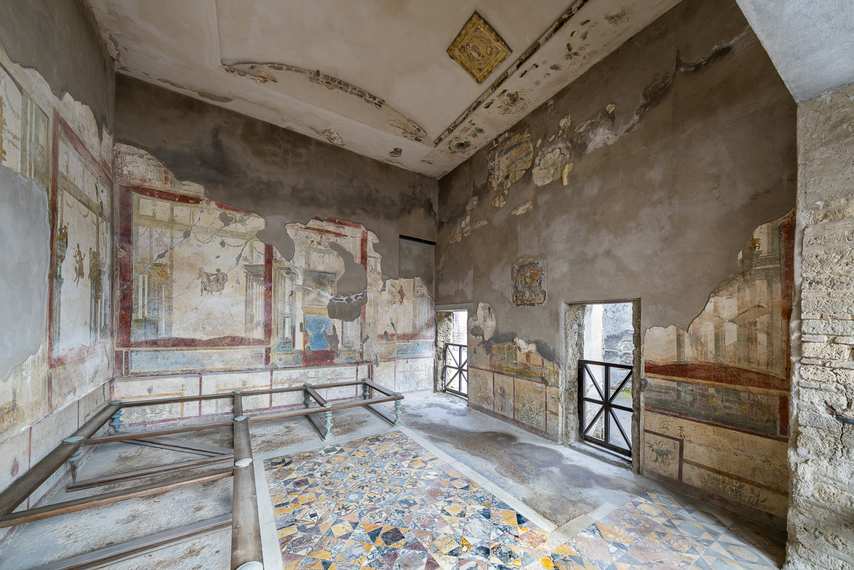
The House of the Ephebe in Pompeii is the result of aggregating several housing units (some sources mention five small houses), unified through various building interventions to create a larger and more prestigious structure. It is spread over two floors (of which the upper one is mostly collapsed) and has three different entrances:
Upper entrance: probably intended for the family and characterised by a double doorway, barred internally. On the outside are half-columns with cubic capitals, while the entrance corridor has frescoes in white, with candelabra motifs and ornaments typical of the so-called Fourth Style.
The floor is made of lavapesta (mortar with lava fragments). From here, there is access to a first atrium without an impluvium, the walls of which feature black and white decorations with plant and still-life designs. In the understairs cupboard, bronze and glass vases were stored, as well as an arm of the statue of the Ephebe, later reunited with the body found in the garden.
Median entrance: in use probably at the time of the eruption. It can be recognised by two outer seats and a frescoed corridor with black wainscoting and yellow and red bands at the top. Game objects, a hammer, ceramic and bronze containers, and a coin were recovered here. From this entrance, one passes to the second atrium, of a Tuscanic type, with a central impluvium and a staircase to access the upper floor.
The lower entrance is located near the garden and was possibly used to access the green area directly. The walls feature white or pink wainscoting, and adjacent rooms contain service rooms, including a kitchen with a latrine, a wooden staircase to the upper floor, and a storage room.
The Main Spaces: Atria, Cubicles, Exedras, and Service Rooms
First Atrium
From the corridor of the first entrance, one enters an atrium without an impluvium, which is quite unusual. The walls have white background frescoes, with plant motifs in the lower part (wainscoting) and still lifes enriched with ornamental borders in the middle band.
This space leads to two cubicles, which serve as sleeping or resting rooms, their walls painted yellow with figures of Maenads, Cupids, garlands, sphinxes, and doves. Here, the use of yellow is typical of the Pompeian Fourth Style, which was widespread in the last decades before the eruption.
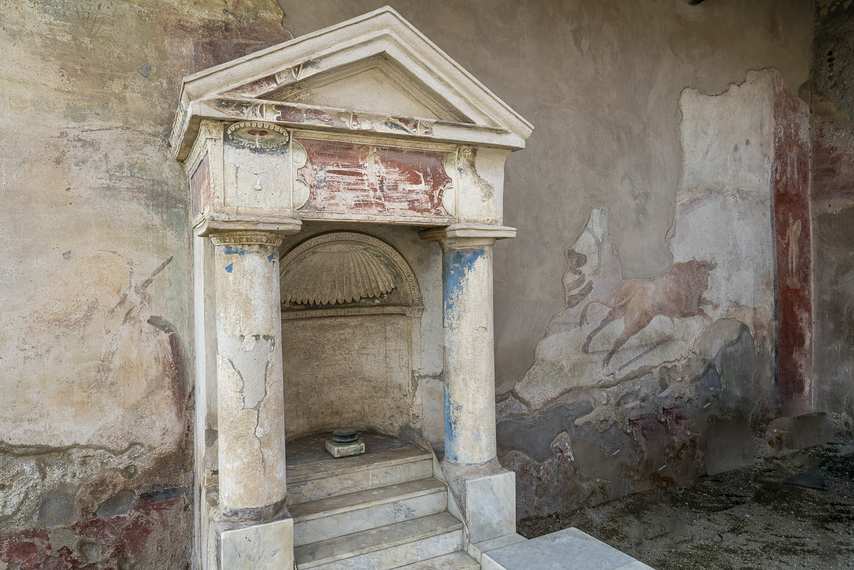
In one corner is a small niche used as a lararium, featuring a fresco that depicts a Genius pouring libations, a flautist, an attendant, and two dancing larii. In the lower part of the fresco, two protective snakes are noted, one of which has a red beard and crest, auspicious symbols in Roman domestic religion.
Second Atrium
From here, one passes to the second atrium (also accessible from the middle entrance), this time in a Tuscan style and equipped with an impluvium to collect rainwater.
The walls are more restrained, partly only plastered, with some decorations simulating glass inserts. In the centre, near the impluvium, fragments of marble furniture (table legs) and metal vessels were found.
On the side facing the median entrance are several service rooms, including one that was probably used as a kitchen (given the remains of pots, pans, and an adjacent latrine) and a cubicle with walls imitating marble through red and yellow bands in the wainscoting.
The upper part is white, with ornamental borders. Next to it opens an oecus (a kind of winter hall or dining room) decorated in the Second Style, featuring architectural elements painted in perspective.
Also on the opposite side is a room that may have served as a storeroom or tablinum. Her charred chest was found to contain four gilded bronze figurines (each with a tray, where sweets were likely placed), now on display at the National Archaeological Museum in Naples.
On either side of this space, other rooms hold shelves with vases, lamps, small glass jewellery and a terracotta mask.
Exedra and Bath
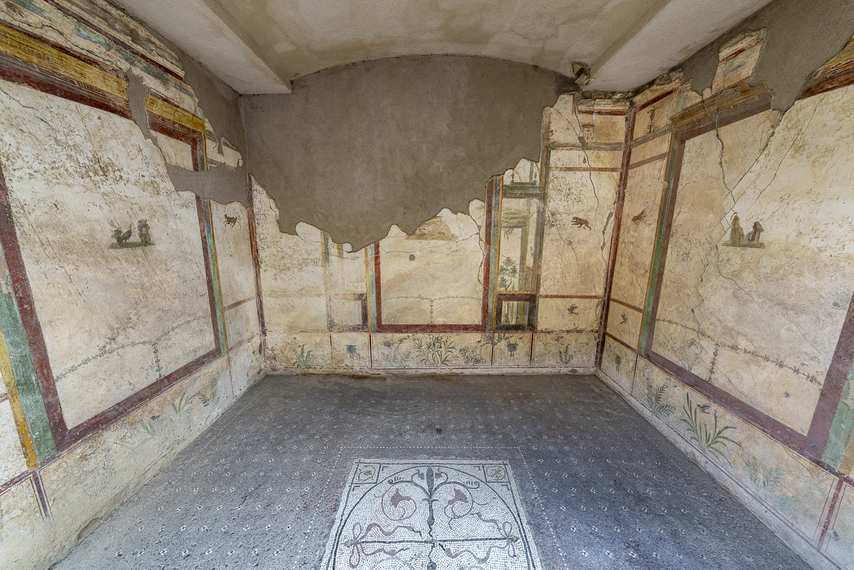
On the same side of the atrium, one encounters an exedra (originally it may have been a tablinum or study) with a cocciopesto (terracotta cement) floor and white tile inserts. The walls are white, with plant designs in the lower section and medallions featuring architectural motifs in the upper section.
This area was temporarily used as a bedroom or dining room, as suggested by the remains of a bed found during the excavation.
Adjacent to the exedra is a small thermal room, a miniature bathhouse equipped with a bronze washbasin, a niche for a mirror (placed about five feet high), and a hole in the floor connected to the courtyard oven. This indicates that the house was served by hot water.
Transit and Service Areas
Passing beyond the exedra, there is a small courtyard frescoed in dark red in the wainscoting. Initially considered a storeroom due to the significant accumulation of objects and materials, it was later interpreted as a functional room for collecting and heating water, as many artefacts must have come from the collapsed upper floor.
From here, there is access to a rustic triclinium with hearth, characterised by red walls in the lower part and white walls in the upper part, a decorative scheme typical of the last Pompeian period.
The Garden and the Nilotic Decorations
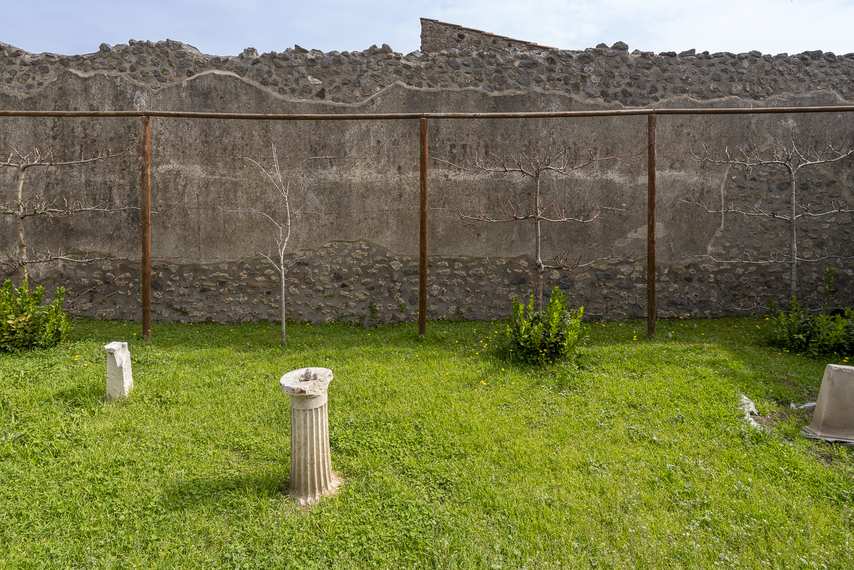
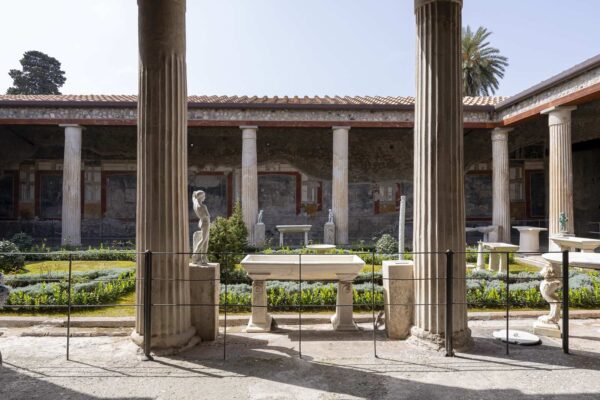
One of the most fascinating areas of the House of the Ephebe in Pompeii is the garden, located in the southern part of the house and divided into several sections. At the time of the eruption, this area was in disuse, likely due to ongoing restoration work. Rubble, building materials, and several incomplete fresco fragments were found.
The garden is also accessible from the third entrance, which is the lower one. Along the ambulatory that introduces the green area, the walls feature a white background with decorations including plants, candelabras, garlands, birds, and dolphins in the middle part.
At the bottom, near a temple lararium, is a real castellum aquae with a capacity of three cubic meters, which supplied the garden fountain.
The walls of the garden have areas with red plinths and hunting scenes at the top, while others are plastered in white. In one section of the garden is an outdoor triclinium, consisting of a three-sided masonry couch (where diners could sit or lie down during banquets), topped by a pergola supported by four stuccoed columns.
The sofa is adorned with Nilotic frescoes, or scenes that evoke landscapes along the Nile River, featuring pygmies navigating among floodwaters, exotic plants, and animals. A curious erotic scene is depicted on the front of the sofa, with pygmies being observed by musicians or characters playing the flute.
A marble table was placed in the centre of the triclinium, while around it, we notice plinths where statues stood, perhaps from other areas of the house. Along the south wall of the garden, a fountain-ninfeo in the shape of a temple is preserved, in which a bronze statue of Pomona once stood (also now on display at the National Archaeological Museum in Naples).
Water leaked from the statue and then flowed out through a channel (fistula) that continued beyond the perimeter wall, perhaps connecting to the neighbouring house, also owned by the same owner.
In the eastern part of the garden, a large basin contained amphorae and ceramic vessels, along with a table and chairs in a semicircle. Not far away was an earthenware altar and a staircase leading to a neighbouring house.
This suggests a kind of continuity between several dwellings owned by the same merchant, typical of those who wanted to expand their living space luxuriously over time.
The Main Triclinium and Floor Decorations
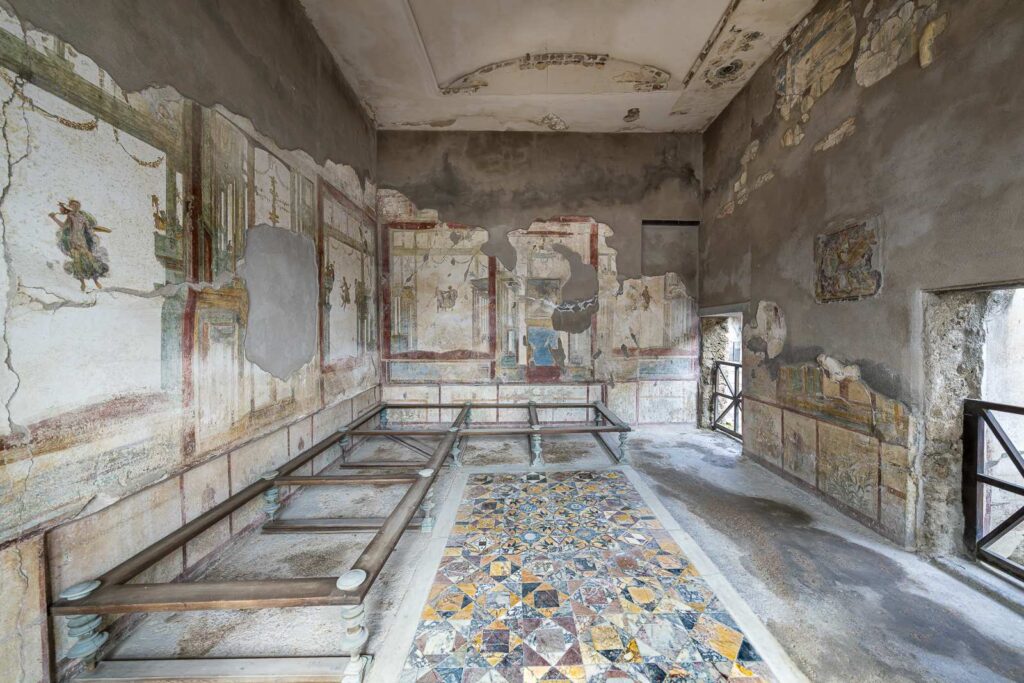
One of the most visually striking rooms is the inner triclinium, where traces of partially reconstructed sofas and a cocciopesto floor with opus sectile inserts, made from coloured marbles arranged in geometric shapes (squares, triangles) or millefiori glass inserts, have been found.
The walls, often white or red in the lower area, are embellished with fluttering figures, plant motifs, and medallions. Mythological paintings are also noted on one wall, including one that depicts Helen and Menelaus. However, some of these frescoes have been damaged over the centuries, possibly due to clandestine excavations conducted before official excavations.
Near the triclinium is a painted lararium featuring two protective serpents: one larger and bearded, with a red crest, and the other smaller.
In the centre is a brazier with eggs, a symbol of prosperity and rebirth. Next to the lararium, a pantry or storeroom still held a brazier and an amphora: evidence of a domestic life abruptly interrupted by the fury of the volcano.
The Restoration and Reopening to the Public
After being excavated between 1912 and 1927, the House of the Ephebe in Pompeii remained closed for an extended period, partly due to the precarious condition of many of its structures. In 2010, major consolidation and restoration work began, and it reopened to the public in December 2015.
Today, visitors to the Pompeii Archaeological Park can once again admire the frescoed rooms, garden, and evidence of daily life in this luxurious Roman-era dwelling.
Where can you find the Statuettes today?
It is important to remember that many of the most valuable sculptures and objects recovered during the excavations, including the famous statue of Ephebe, are no longer in the house but are on display at the National Archaeological Museum in Naples. In particular:
The bronze Ephebe and its candelabra arms;
The four gilt bronze figurines with a tray;
The statue of Pomona from the fountain-nymphaeum.
So if you want to admire these works up close, you should also plan a visit to the Neapolitan museum, where you can learn more about the art and culture of ancient Pompeii.
Why Visit the House of the Ephebe in Pompeii?
The House of the Ephebe exemplifies how a wealthy, though not necessarily aristocratic, owner could transform a series of more modest dwellings into a luxurious domus, embellished with fine pictorial decorations, sculptures, and refined architectural solutions.
The contrast between the completed rooms and those still under renovation when Vesuvius erupted testifies to the sense of a life suddenly interrupted, as well as understanding Pompeii’s complex social and urban stratification.
A visit to the House of the Ephebe reveals the elegance of the triclinia (banquets were a key social event in ancient Rome), the variety of frescoes (from the Fourth Style to the older Second Style), and the richness of the furnishings, which testify to the owner’s passion for art and beauty.
In addition, the garden with the pergola and the Nilotic pygmy frescoes creates an evocative atmosphere that can transport the imagination to a distant era.
If you’re planning your itinerary for the Archaeological Excavations of Pompeii, the House of the Ephebe is worth a visit. It will give you a privileged glimpse into the daily life of a wealthy Pompeian merchant, including his decorative choices and how his dwelling was structured to combine representation, relaxation, and practicality.
Interested in exploring more fascinating places like the House of the Ephebe?
To better understand the historical context in which Pompeii’s residents lived, take a look at our full article on the History of Pompeii.
If you’re captivated by elegant Roman residences, don’t miss the famous Villa of the Mysteries, known for its mysterious frescoes, and the stunning Villa of Poppaea in Oplontis, one of the finest examples of Roman architecture in the Bay of Naples.
FAQ About the House of the Ephebe in Pompeii
The original Ephebe statue is in the National Archaeological Museum in Naples.
The House of Ephebe in Pompeii was reopened in 2015 after a restoration phase. However, openings may vary depending on maintenance or conservation work. It’s advisable to check the official website of the Pompeii Archaeological Park for the latest information.
The house has three entrances: the upper one, probably reserved for the family, the middle one for guests, and the lower one, which leads to the garden and service rooms.
Not to be missed: the two atria (one of which lacks an impluvium), the cubiculae with Fourth Style frescoes, the exedra, the small bath with hot water, the striking triclinia, and the garden, decorated with Nilotic scenes and fountains.
The visit can vary greatly depending on the individual tourist’s curiosity and the route within the excavations. On average, to fully appreciate the architectural details, frescoes, garden, and triclinia, it is advisable to allow 20-30 minutes, especially in relation to the rest of your Pompeii itinerary.