Visiting Pompeii with children is a fantastic leap into the past. Walking on the ancient basalt streets and observing the remains of houses, stores, and temples allows the little ones to touch upon daily life almost two thousand years ago.
Many people consider Pompeii an “adult” or “too historical” place. Still, if we properly prepare children and engage them with anecdotes and simple explanations, we will find that this huge archaeological park can become an exciting field of exploration.
One aspect that particularly fascinates children is the story of the gladiators, who trained in the gymnasium and fought in front of thousands of spectators in the amphitheatre.
Another curious theme is “street food”: along the streets are the remains of thermopolia, stone stalls where food was kept hot in large sunken amphorae.
Amid graffiti, intensely colored frescoes and casts of people caught in the eruption, Pompeii offers continuous surprises that stimulate the imagination of young children.
Before you leave: Organisational and Practical Tips
Choosing the Best Time of Year to Visit Pompeii
Pompeii is located in the heart of Campania, a short distance from Naples, in an area with a typical Mediterranean climate. In July and August, temperatures can easily exceed 30-35°C, and much of the site has no shady areas.
That is why it is advisable to plan your visit in spring (April-May) or fall (September-October), when the weather is more pleasant and you can walk for a long time without getting tired. If you go in the summer, try to enter early in the morning or visit the park in the latter hours of the afternoon, bringing hats, sunscreen and plenty of water.
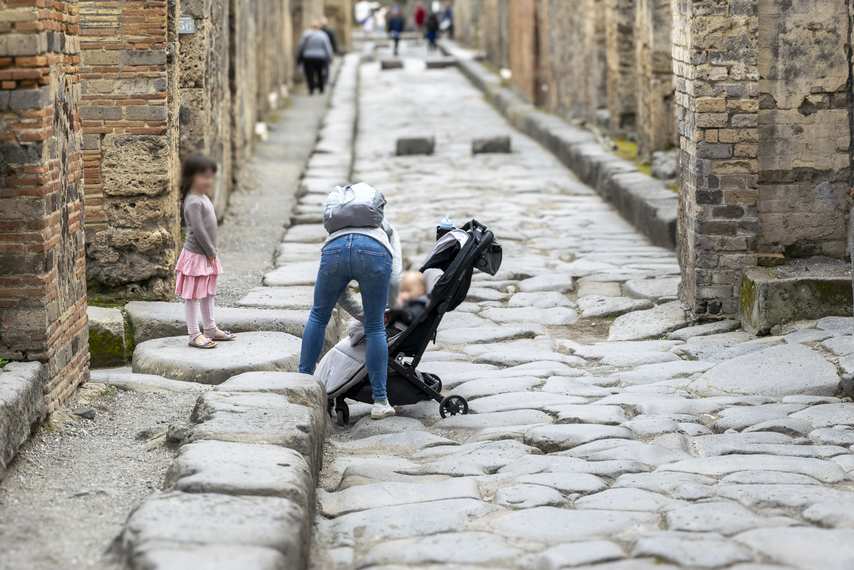
Family Tickets and Reductions
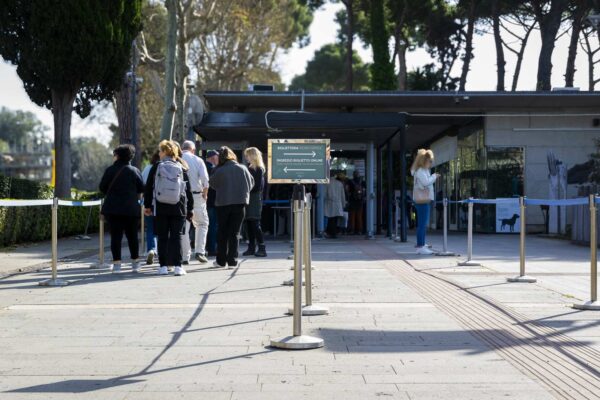
Children under 2 get in free, as do children under 18 (by showing ID). For adults, there are often reduced rates and family packages. You can buy tickets online- this helps avoid lines, although for reduced or free tickets, sometimes you have to go to the ticket office to show ID.
If you prefer not to worry about anything, there are “all-inclusive” guided tours that include transfer (from Naples or Rome) and entrance fees, often with a specialised guide who can entertain the little ones.
How to Get to Pompeii
- If you are already in Naples, take the Circumvesuviana and get off at the stop “Pompei Scavi—Villa dei Misteri,” then walk to the entrance of Porta Marina.
- If you come by car, several paid parking lots are near Piazza Anfiteatro and Porta Marina.
- From Rome, you can arrive in Naples by high-speed train and then continue by Circumvesuviana, or opt for an organised day tour.
Watch out for the Sun and be Prepared with Proper Equipment
To face the visit comfortably:
- Hat and sunscreen for everyone
- Comfortable shoes, preferably sneakers or closed, sturdy sandals
- Enough water so as not to risk dehydration
- Light snacks, to be offered to the little ones during a break
Strollers: Pros and Cons?
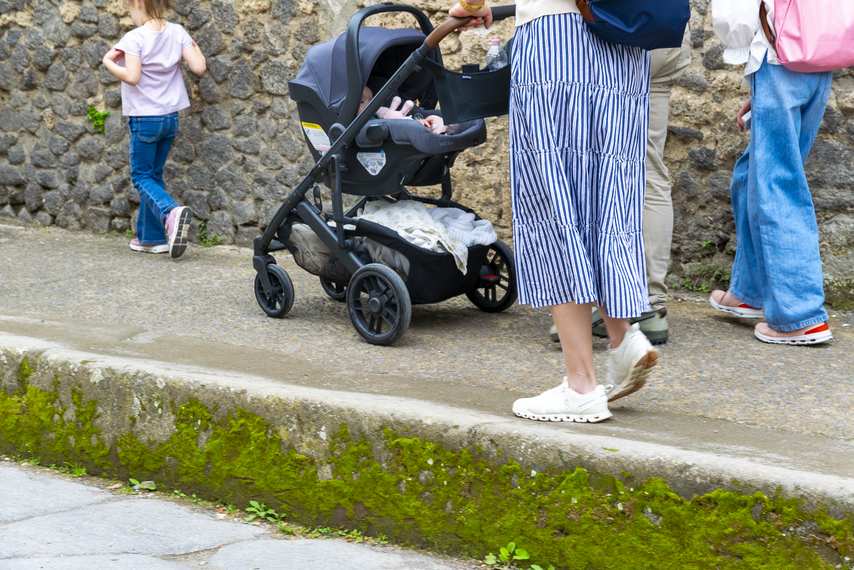
Pompeii’s ancient streets have large stone blocks and frequent elevation changes, so a stroller may prove impractical.
A baby carrier or hiking backpack is preferable if you have a very small baby. There is, however, a facilitated route called “Pompeii for All,” with non-slip walkways and ramps, which starts from Piazza Anfiteatro and ends at Porta Marina; however, it does not cover the entire site.
If you wish to move freely in uncomfortable areas, avoiding the stroller or leaving it in storage at the entrance is best.
Organizing Meals
Inside the excavations, you will find only one bar/restaurant near the Forum, which is often crowded at peak hours. There are also kiosks near the entrances.
To avoid inconvenience, you can bring sandwiches and fruit to manage the children’s hunger more independently.
If, on the other hand, you want to take a real lunch break, there are eateries and pizzerias in the vicinity of Piazza Anfiteatro and Porta Marina: pay attention to the hours, especially during the busiest times.
Baby Points and Restrooms
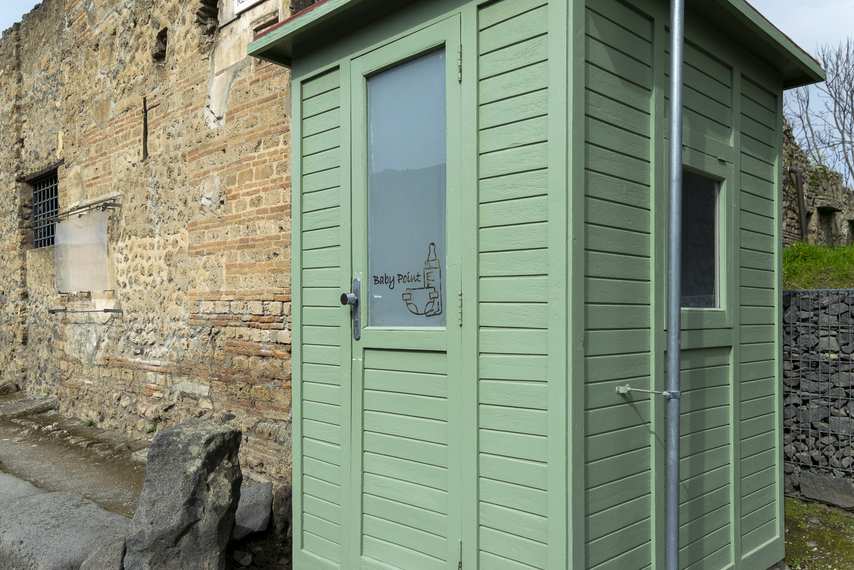
The park offers some dedicated spots for those with babies, where you can change diapers or breastfeed in peace. To find them, ask the staff at the entrance or consult the official map.
Bathrooms are spread out in different parts of the area, but queues can build up during peak hours. Best to take advantage of every available restroom to avoid emergencies.
Engaging Children Before and During Your Visit
Introduce them to the Historical Background
Before going to Pompeii, it is helpful to tell children a few anecdotes or show documentaries in which they see how the Romans lived, what the city looked like, and how it was destroyed by the eruption of Mount Vesuvius in 79 A.D. Getting them to understand that these are not “meaningless stones”.
Still, a real city, with houses, stores, theatres, and even graffiti on the walls, helps little ones better imagine life in those times.
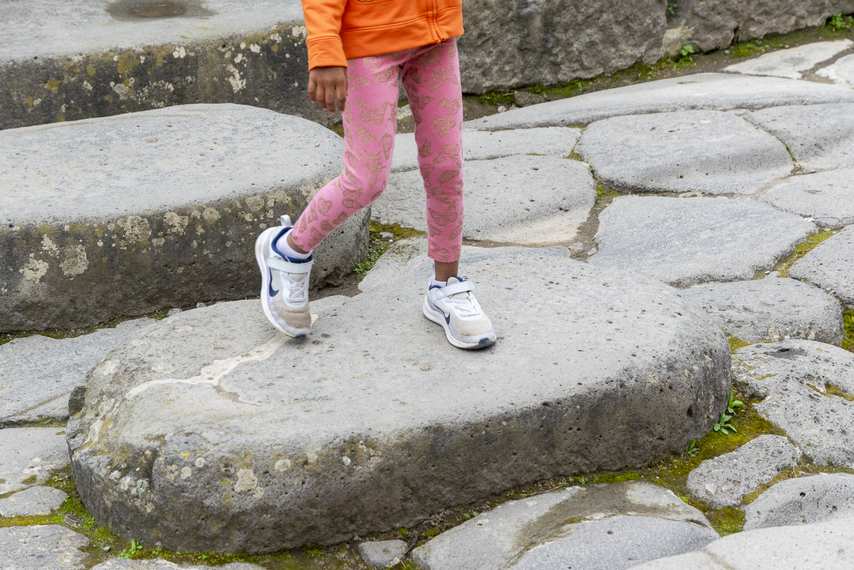
Helpful Resources for Keeping Children Engaged
- picture books, such as “Pompeii Guide for Curious Children“
- small documentaries on YouTube showing three-dimensional reconstructions of the eruption or the city
- Geronimo Stilton’s map on the park’s official website, with drawings and explanations designed just for children
Playing “Detail Hunting”
To make the visit even more stimulating, you can organise a small treasure hunt: who first spots the raised stones of the ancient crosswalks, sees a fresco with an animal, and recognises the holes left by the ropes on the stone fountains? This way, attention remains high, and children enjoy scrutinising every nook and cranny.
The Main Itinerary: Departure from Piazza Anfiteatro (about three hours)
Many tourists prefer to enter from this area, as there is plenty of parking and you immediately encounter one of Pompeii’s most spectacular monuments: the amphitheatre. Here is a route that takes about 3 hours, perfect for families:
Entrance: choose the entrance to the excavations in Piazza Anfiteatro.
Stage 1: the Amphitheatre and the Palestra Grande (Large Palestra)
Google Maps Amphitheater Google Maps Palestra GrandeJust past the entrance to Piazza Anfiteatro, we find the amphitheatre, one of the oldest and best preserved around, capable of holding up to 20,000 spectators. Here, at one time, gladiator fights and performances of various kinds took place.
Not far away is the great gymnasium, a vast arcaded space where athletes and gladiators trained. One can imagine how noisy it was, between tests of strength, shouts of encouragement and chattering spectators.
Stage 2: The Garden of the Fugitives
Google MapsProceeding for a few minutes, you come to the Garden of the Fugitives, one of the most exciting places in Pompeii.
Here you can see the casts of thirteen people, including some children, caught in the eruption while trying to save themselves. The casts were made by pouring liquid plaster into the cavities left by the bodies and are a touching document of that last, dramatic moment.
Stage 3: Via dell’Abbondanza
Google MapsFrom here, you can continue along Via dell’Abbondanza, the most important commercial street of the ancient city.
Children can have fun imagining stores with merchants calling on customers, ancient inns, ovens, and Thermopolis, a kind of “diner” of the time.
Fullonica of Stephanus stands out, where textiles were pounded in tanks filled with water and urine, a method that, at the time, replaced modern detergents!
Stage 4: The Stabian Baths
Google MapsAlong Via dell’Abbondanza are the Stabian Baths, among the oldest in the Roman world. Here, Pompeians, both men and women, came to bathe and relax.
Distinguished are the frigidarium (cold bath), tepidarium (warm bath), and caldarium (hot bath). Children will be fascinated by the ingenuity of the hypocaust heating system, with hot air circulating under the floor.
Stage 5: The Large Theatre and the Small Theatre (Odeon)
Google MapsIf the children are not overly tired, you can include a visit to the theatre area.
The Large Theatre, taking advantage of the natural slope of the hill, could accommodate thousands of people for comedies, tragedies, and mime shows.
Immediately next door is the Small Theatre, or Odeon, where performances of a more intimate nature, often involving music and readings, were held.
Little ones might enjoy experiencing the echo in the theatre, climbing into the stands, and speaking in low voices.
Stage 6: The Forum of Pompeii and the Granaries of the Forum
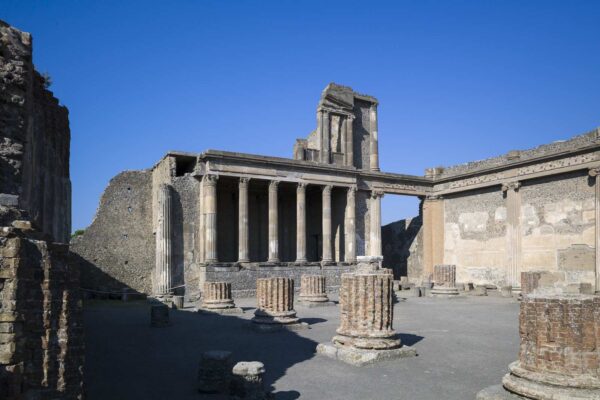
Google Maps Forum of Pompeii Google Maps Granaries of the ForumFinish by heading to the Forum, Pompeii’s main square, where political, economic and religious life was concentrated. Various buildings overlook the square, such as the Basilica of Pompeii, the seat of courts and business, and the Temple of Jupiter, with Vesuvius in the background.
In the Granaries of the Forum, originally intended for the market, you will find a storehouse with amphorae, casts and other artefacts that show the wealth of discoveries made in Pompeii.
If you can, you can also visit the Temple of Apollo or the Temple of Vespasiano, taking the opportunity to show children the architectural structures and altars.
Overall, this tour takes about 3 hours (4 with the little ones, considering stops for drinking, resting or taking pictures).
At the end of this route, the nearest exit is Porta Marina.
Other Paths and Insights
“Pompeii for All” Route
Those with accessibility needs or who still want an easier route can take advantage of the walkways and ramps installed on the “Pompeii for All” pathway, which connects Piazza Anfiteatro to Porta Marina.
The pathway does not cover the entire site but touches on some key areas, such as the forum and the baths. It is also useful for those who do not want to abandon their strollers altogether.
The Extended Itinerary
If you have a full day and the children are used to walking, you can extend your visit to the House of the Faun (with the famous mosaic of Alexander the Great) and the House of the Vettii, known for its richly colored frescoes.
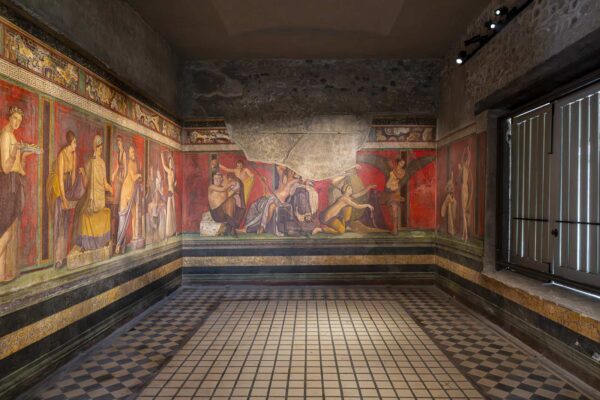
Another gem is the slightly off-centre Villa of the Mysteries, famous for its cycle of paintings devoted to Dionysian rites. These areas require more time and energy, but they provide excitement for those who want to delve into Pompeian painting.
Extra Tips for a Child-Friendly Visit
Tips to Maintain Children’s Engagement During the Visit
- make up little stories: “here lived a little boy named Lucius, who went to buy bread every morning…”
- observation contests: “who sees a fresco with an animal first?”
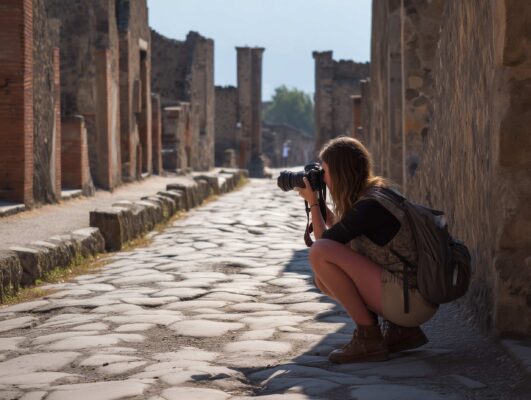
- drawing or photography break: children can capture details and glimpses, or try to copy a frieze
Educational Activities and Workshops
- Pompeii Children’s Museum
A new addition for family travellers is thePompeii Children’s Museum, a space designed to bring archaeology to life as an interactive game. Here, young children participate in thematic workshops, from creating clay artefacts to discovering ancient crafts, experimenting with materials and techniques of the time. Operators guide children along a path designed to learn while having fun, with “kid-friendly” guided tours and playtime inspired by the latest archaeological discoveries. It is a perfect way to combine a visit to the excavations with an educational experience, in which learning “by doing” proves particularly engaging. - Archaeology workshops: Some associations offer the opportunity to simulate an excavation with brushes and shovels, teaching how to record and catalogue finds
- Thematic tours for children: there are guided tours focused on specific topics (such as the life of gladiators or frescoes)
Where to Eat Near or Inside the Pompeii Archaeological Park
- Inside the Pompeii Archaeological Park, there is a bar/restaurant near the forum, but it can be crowded and pricey
- Outside the excavations: near Piazza Anfiteatro or Porta Marina, you will find pizzerias, focaccerie and restaurants that are cheaper and family-friendly.
- If necessary, you can also leave and re-enter on the same ticket, as long as you inquire about the times allowed for re-entry.
Our recommendations outside the excavations:
Garum Restaurant
Viale Giuseppe Mazzini, 63 – Pompeii
Tel: +39.081.850.11.78 – +39.347.01.04.384
info@garumpompei.it
https://www.garumpompei.it/
Closing day: Wednesday
This little restaurant is conveniently located within walking distance of the archaeological area. It is perfect for those looking for an authentic dining experience, away from the classic “hit-and-run” tourist spots.
As soon as you enter, you realise that the atmosphere here is different. The room is elegant but without being pretentious, and there’s even a small outdoor dining area.
But the real highlight? The service. With his elegant manners and slightly sly smile, Salvatore, the dining room manager, makes you feel immediately at home.
It is rare to find such a warm and professional welcome. It is like having a friend who advises you on the best, but with the class of someone who has been doing this job for a lifetime.
Garum’s cuisine is a journey through the flavors of Campania, with dishes that focus on the highest-quality ingredients. It starts with appetisers such as sliced octopuses or the classic prosciutto irpino and mozzarella di bufala pairing.
For starters, it is impossible not to try the paccheri with Neapolitan ragout prepared with an ancient tomato from the Slow Food Praesidium or the intense and unforgettable linguine with sea urchins.
If you love main courses, you’ll find dishes like cod with Neapolitan papaccella or light and crispy fried shrimp and squid. And to end on a high note, dessert: baba with ricotta mousse and apricot jam from Vesuvius is a real treat for the palate.
Garum leaves nothing to chance. From the bread basket, which includes fragrant taralli, to the possibility of ordering half bottles of wine- a treat for those who don’t want to overdo it- every detail is designed to make your meal perfect. The wine list is a feast for lovers of good drinking, with many labels from Campania and national and international offerings.
Why choose Garum?
Garum is one of those places that never disappoints. The dishes are prepared with love and respect for tradition, the service is impeccable, and the atmosphere is warm and relaxing. It is not just a restaurant: it is a pleasant break during a day full of history and beauty.
In a nutshell, drop by Garum if you want to enjoy authentic Campanian cuisine in a cosy environment with service that makes you feel special. It is worth it!
La Bettola del Gusto
Via Sacra 50, Pompeii
Tel: +39.081.8637811
info@labettoladelgusto.it
prenotazioni.bettola@gmail.com
https://www.labettoladelgusto.it/
Closing day: Monday
Located along the avenue leading to the basilica, this restaurant combines elegance and tradition in a warm and welcoming atmosphere. Tastefully decorated among living stone and wood, the rooms house an open grill and a wine cellar with more than 800 selected wine labels.
The kitchen, led by Alberto Fortunato, offers a menu that changes every six months and emphasises fresh, local ingredients, many from their 2.4-mile garden.
Must-try dishes include spaghettoni di Gragnano with colatura di alici di Cetara, truffle and buffalo butter, ricciola with artichoke cream, and the iconic crispy egg on parmesan cream.
Service, overseen by twin brother Vincenzo Fortunato, is impeccable and attentive. Two tasting menus are available, ideal for exploring the best of Campanian cuisine.
In summary, La Bettola del Gusto combines tradition and innovation in an authentic, high-quality culinary offering. It is perfect for those who want to discover the flavours of Campania in an elegant and welcoming environment. It is a must-visit in Pompeii!
Why choose La Bettola del Gusto?
Here, you will find a perfect balance between tradition and innovation, rare attention to ingredients, and a welcoming environment. It is the ideal place for a relaxing lunch or a special dinner that celebrates the authentic flavours of Campania.
After the Visit: How to Explore Further
Other Archaeological Stops Nearby
- Herculaneum: smaller than Pompeii, but with extraordinary finds, including charred wooden furniture
- Oplontis (Torre Annunziata): the Villa of Poppea, full of wonderful frescoes
- Stabiae (Castellammare di Stabia): villas such as Villa San Marco and Villa Arianna
- Naples National Archaeological Museum: preserves numerous mosaics, statues and frescoes from Pompeii
Books, Museums and Online Resources
If children come home with a curiosity to learn more:
- Picture books like “Guide to Pompeii for Curious Children” or “The Last Gladiator of Pompeii. The eruption of Vesuvius in 79 A.D.“
- For older children, readings such as “The Three Days of Pompeii” by Alberto Angela or “Pompeii” by Robert Harris
- apps and documentaries with 3-D reconstructions to relive Roman streets and houses virtually
Memories and Reflections to Share
For those who like to keep memories alive, a travel diary with photos, drawings, or cards can help children fix impressions. Some enjoy organising a small “Pompeian party” at home, with food inspired by ancient Rome and improvised tunics to make the experience even more unforgettable.
Conclusions
Overview of the Experience
Pompeii is not just a site for archaeology enthusiasts, but a true journey through time that, if well explained, can captivate even children.
The itinerary from the Amphitheatre to the Forum of Pompeii, via Via dell’Abbondanza and the Stabian Baths, offers a complete picture of life in a Roman city in the first century AD.
The emotional impact of the casts, the discovery of thermopolia and ancient graffiti, or the idea of watching a play in the grand theatre make the visit rich for the child’s imagination.
We invite you to return and Discover More – There’s Always Something New to Explore
Given the site’s vastness, exploring it all in a single day is difficult. Returning to Pompeii means delving into lesser-known or newly restored areas, discovering new details, and better appreciating the monumentality of this unique city. If you have time, it is worth combining a visit to nearby Vesuvius or other sites such as Herculaneum or Oplontis for an even more complete “archaeological tour.”
A Final Thought to Inspire
History, when experienced firsthand, becomes tangible and exciting. In Pompeii, children can understand that the past is not an abstract narrative, but a collection of lives, habits and works that still speak to us today.
Take this curious gaze with you, let the little ones accompany you as you discover every corner and let your steps intertwine with those ancient ones of Pompeii’s inhabitants.
An experience that will remain etched in the memory of the whole family.
FAQ About Visiting the Pompeii Excavations with Children
Spring (April-May) or fall (September-October) is recommended, when temperatures are milder and the streets crowded with tourists are less chaotic. If you want to visit Pompeii in summer, try to enter early in the morning or late afternoon, equipped with a hat, sunscreen and plenty of water.
Pompeii’s ancient streets are made of irregular stone blocks so that a stroller may be uncomfortable. However, a facilitated route called “Pompeii for All” includes walkways and ramps, although it does not cover the entire site. For very small children, a baby carrier or hiking backpack is best.
A basic itinerary can take about 3 hours (4 with stops and breaks), starting from Piazza Anfiteatro and touching on the Amphitheatre, Garden of the Fugitives, Via dell’Abbondanza, Stabian Baths, Large Theatre, and Forum of Pompeii. It may take the whole day if you also want to visit the famous Domus (such as the House of the Faun) and the Villa of the Mysteries.
Children under age 2 and under 18 (with ID) get in for free. For adults, there are often reduced tickets, family passes, and the option of booking online to avoid long lines. Some “all-inclusive” tours include transfers and a specialised guide to make the visit easier.
Before you leave, you can show picture books or short documentaries about life in ancient Rome. During the visit, organise small “treasure hunts” to find elevated roads, graffiti or frescoes with animals. In addition, Pompeii Children’s Museum and archaeology workshops offer hands-on activities that can actively engage children.