If you are planning a trip to Campania, visiting Mount Vesuvius is an absolute must.
This world-famous volcano is not only a geographic and landscape symbol of the Neapolitan city, but also a protagonist of ancient history, particularly for the 79 AD eruption that destroyed the Roman cities of Pompeii, Herculaneum, Stabia and Oplontis. Today, Vesuvius is a leading tourist destination for fans of nature, history, geology and volcanology.
At the same time, a trip to its slopes offers the perfect opportunity to discover the Pompeii Archaeological Park, one of the world’s best-known archaeological sites.
Before presenting you with some tour options that include a joint visit to Pompeii and Vesuvius, we would like to briefly tell you about the history of this famous volcano, considered one of Campania’s most iconic landmarks. If, on the other hand, you would like to learn more about the Pompeii Archaeological Park, you can find it in the rest of our site, where we have dedicated special sections.
At 1281 meters high (although this measurement varies over time due to volcanic activity), Vesuvius dominates the surrounding gulf and stands out sharply against the city’s skyline.
Many people are enchanted by the view from its crater or from some of the vantage points on its slopes, which can offer, on clear days, a breathtaking view of Naples, the sea and the islands of Capri, Ischia and Procida. However, Vesuvius is not only synonymous with scenic grandeur: its history and “dormant volcano” status also make it one of the most studied volcanoes in the world.
Origin of the Name and Popular Myths
The etymology of the name “Vesuvius” is the subject of numerous theories and legends. The most widely accepted view is that it is of Indo-European origin, associated with “burning” or “illuminating”.
Some scholars suggest a connection with the Latin word “Vĕsŭvĭus,” referring to roots that evoke fire and light. In ancient times, Vesuvius was believed to be consecrated to Hercules, the demigod hero linked to nearby Herculaneum. However, there is no shortage of folk tales attributing the origin of its name to legendary figures such as a Pelasgian leader named Vesbius.
Also curious are the popular etymologies: one of these believes that “Vesuvius” derives from the expression “Vae suis!” (“Woe to his own!”), to emphasise the dramatic events often related to its eruptions: think of the natural disasters that occurred near or in conjunction with the volcano’s upheavals.
Geography and Territory: The Vesuvius National Park
Vesuvius is an integral part of the Somma-Vesuvius complex, in which Mount Somma represents what remains of a very ancient volcano, which collapsed following violent eruptions. At the same time, Vesuvius proper is the “main cone” formed within the caldera.
The area is included in the Vesuvius National Park, established in 1995 to safeguard an area rich in biodiversity, historical and geological values. The park has as many as 13 municipalities and covers about 72 km². Despite its not excessive size, it is home to a truly remarkable number of plants (612 surveyed) and animal (227 among those studied) species.
To visit Vesuvius National Park is to immerse oneself in an ecosystem that fascinates everyone, from botany lovers and birdwatchers (in fact, hawks and other birds of prey can be spotted), to hikers looking for itineraries immersed in the Mediterranean maquis and extraordinary views.
When the brooms bloom in spring, the volcano’s slopes are colored bright yellow, enough to inspire poets such as Giacomo Leopardi in his famous poem “La ginestra.”
The Ascent to the Crater: An Experience Between History and Nature
One of the main reasons tourists ascend Mount Vesuvius is to reach its crater and admire its interior, which has signs of previous eruptions. Unlike other higher or less accessible volcanoes, the path to the summit is relatively easy and requires no special technical skills.
Indeed, many visitors appreciate the “moderate” effort of the climb, rewarded by a view that is nothing short of spectacular.
To climb up to the crater, it is recommended to arrive by car or shuttle bus at the Piazzale quota 1000. From there, a well-marked path (walkable in about 20-30 minutes) will take you to the summit.
Along the way, you will be accompanied by licensed volcanological guides, who are ready to tell you about the geological history and naturalistic curiosities that make Vesuvius unique worldwide.
Although it is a relatively short hike, it is still recommended that you wear comfortable shoes and bring water, especially in summer when temperatures can rise considerably.
History and the Most Famous Eruptions
Notes on Ancient Eruptions
The history of Vesuvius is long and complex. It is estimated that as early as 400,000 years ago, the area was subject to volcanic activity, but it was not until about 30,000 years ago that the central cone began to form.
Over the millennia, violent eruptions, referred to as Plinian eruptions, have characterised the evolution of the volcano: these include the “Base Pumices,” the “Market Pumices,” and the “Avellino Pumices”.
The latter, which occurred between 1880 and 1680 B.C., buried numerous Bronze Age villages and left traces in Avellino, confirming the magnitude of the destructive effects such a volcano can have.
The Eruption of 79 A.D. and the Birth of the Pompeii Archaeological Park
Of all the remembered eruptions, the one in 79 AD is undoubtedly the most famous and devastating. The pyroclastic cloud and incandescent materials that leaked from the crater buried the cities of Pompeii, Herculaneum, Stabia and Oplontis under a thick blanket of ash, causing their ruin and decreeing their unexpected preservation.
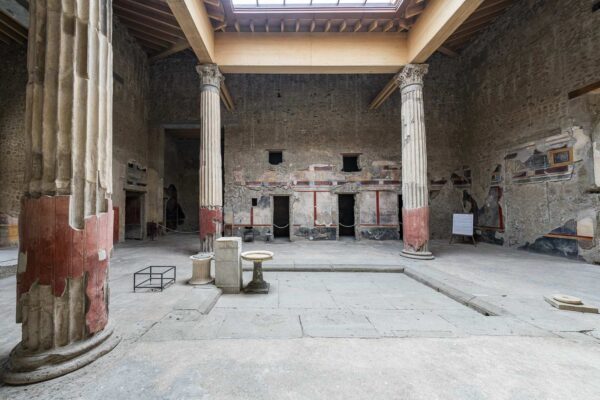
Nearly two thousand years later, the Pompeii Archaeological Park is now one of the most important archaeological sites on the planet and poignantly tells the story of the daily life of a Roman settlement stopped suddenly by the fury of the volcano.
To visit the Pompeii Archaeological Park is to walk among perfectly preserved streets, houses, temples and markets, a real journey back in time. For this reason, many tourists combine an excursion to Mount Vesuvius with a visit to Pompeii to better understand the inseparable link between the volcano and the ancient city.
Those interested in Roman history, art, archaeology, or who want to have an exciting experience, will find this stop to be an unforgettable moment of their trip.
The Eruptions from 79 AD to 1944
After 79 AD, Vesuvius recorded dozens of eruptions of varying magnitude, some less destructive, others more powerful. In the Middle Ages, the episodes of 472 and 512 are remembered, which spread volcanic ash as far as Constantinople.
The 1631 eruption, after nearly 300 years of silence, was so dramatic that it led many to believe they were facing an omen of doom.
Several eruptive phenomena marked the Vesuvian territory throughout the modern age, such as those of the early 19th century documented by Grand Tour travellers.
Among the most notable events of the 20th century is the eruption of 1906, which caused extensive damage to towns such as Ottaviano (then called Ottajano) and forced the Italian government to abandon the organisation of the 1908 Olympics.
The most recent eruption was in 1944, during World War II, when a spectacular column of fire lit up the skies over Campania, again destroying parts of San Sebastiano al Vesuvio and Massa di Somma. Since then, Vesuvius has been considered quiescent and dormant but constantly monitored.
Monitoring and Safety
Given the explosive nature of the volcano and the high population density of the Vesuvius area (it is estimated that more than 700,000 people live in areas potentially at risk), local and national authorities implement a constantly updated emergency plan.
This plan includes the identification of a so-called “red zone” of increased risk, with preventive evacuation procedures. Scientists at the Vesuvius Observatory (the oldest volcanological institute in the world) closely monitor seismic parameters, fumarole temperature, and possible ground deformation to promptly predict any signs of eruption.
For those visiting Mount Vesuvius, it is essential to know that in an emergency, there is a warning system that allows the area to be evacuated within hours.
Today, the volcano is calm, so tourists can safely devote themselves to discovering this extraordinary “sleeping giant” and its natural beauty.
Fun Facts: From the Lava Lake to Amelia, the Witch of Vesuvius
Vesuvius has been described and drawn countless times in history, inspiring poets, artists, and cartoonists. In the Disney world, for example, the witch Amelia (created by Carl Barks) lives right “on the slopes of Vesuvius,” a choice the American author justified with his love for Italy.
Other curiosities concern the “minor” eruptions of the late 19th century: in 1855, for example, a lava cascade occurred in a crevasse as deep as 300 meters, creating a natural spectacle of incredible beauty.
In 1895 and 1898, two lava domes formed, Colle Margherita and Colle Umberto, which are still visible today (the former partially buried by flows of later periods, the latter better preserved).
In the early twentieth century, scientists and volcanology enthusiasts undertook numerous studies and research, which led to the creation of photographic and documentary material that is today preserved at the Vesuvius Observatory and in important national libraries.
Gastronomy and Typical Products
The fertile volcanic soil around Vesuvius produces wines and typical products of the highest quality. One of the most famous wines is Lacryma Christi, which can be red or white.
The ancient Romans appreciated it, and it is still paired with meat, fish, or cheese dishes.
But that’s not all: thanks to the properties of the soil, vegetables and fruits take on an intense and unmistakable flavour. Among the most renowned products are the pomodorini del piennolo, which are small, have robust skin, and have a sweet-sour taste, perfect with pizza or pasta.
Remember to sample Neapolitan cuisine during your visit: in addition to the products specific to the Vesuvian area, Naples is world-famous for its pizza, desserts (baba, tagliatelle), and, of course, its coffee tradition.
A nice gastronomic tour will, therefore, further enrich your discovery of Vesuvius and its surroundings.
The Tourist Route: From the Excavations of Pompeii to Vesuvius
To best experience the deep relationship between ancient history and explosive nature, many travellers combine a visit to Pompeii Archaeological Park and a hike to Mount Vesuvius in one day (or two consecutive days). Here’s how you could organise your itinerary, starting in Pompeii and continuing to the crater.
- First stop: the Pompeii Archaeological Park
- Begin your tour by immersing yourself in the history of this Roman city buried by the eruption of 79 AD. Stroll through its paved streets, public buildings, temples, and private homes, still incredibly preserved.
- To better understand the archaeological finds and environments you’ll see, we recommend hiring an audio guide or joining a guided tour. You will then learn in detail trivia and anecdotes about daily life in the first century AD.
- Admire the casts of victims and observe how ash and volcanic debris have stopped in time, as well as the gestures and objects that characterised the routine of that era.
- Second stop: Mount Vesuvius
- After exploring Pompeii, you’ll move on to Vesuvius National Park for an experience of comfort and excitement: board a luxurious minibus that will take you stress-free up to an altitude of 1,000 meters. From there, you’ll continue on foot on the path leading to the crater, accompanied by an expert volcanological guide ready to tell you about the volcano’s secrets, its ancient eruptions, and the peculiarities of the Great Cone.
- Once you reach the summit, you will have the extraordinary opportunity to admire the crater, with its steaming fumaroles, and take in a truly breathtaking panorama: Capri, Ischia, Procida, Naples, and Pompeii itself will open up before your eyes, giving you an unparalleled view. Wear comfortable shoes and take a water bottle, especially in the warmer months.
Organising one’s trip with this lineup-first Pompeii Archaeological Park, then Vesuvius, allows one to end the day with an evocative view from above, after learning in Pompeii all the drama and fascination of a city submerged by volcanic materials. It will be a complete experience to understand the dialogue between ancient Roman civilisation and the great natural force of the volcano.
If, on the other hand, you have already explored the wonders of Pompeii and wish to discover Vesuvius, this ticket is an ideal choice for visiting the majestic volcano from Pompeii:
Have you already explored Herculaneum and want to climb Mount Vesuvius? This ticket is the perfect solution to visit the world’s most famous volcano, starting directly from Herculaneum:
Do you want to discover Mount Vesuvius starting from Naples? This ticket provides a hassle-free and comfortable experience to explore the majestic volcano and enjoy an unforgettable day in nature:
Summary of Travel Options at Vesuvius:
|
Visit to Pompeii and Vesuvius
Check availability
|
|
Visit Mount Vesuvius on a day trip from Pompeii
Check availability
|
|
Visit Mount Vesuvius on a day trip from Herculaneum
Check availability
|
|
Visit Mount Vesuvius on a day trip from Naples
Check availability
|
|
Explore Pompeii and Mount Vesuvius on a tour from Naples
Check availability
|
Why combine Vesuvius with the Pompeii Archaeological Park?
Visiting both Vesuvius in Naples and the Pompeii Archaeological Park during your stay offers a complete and compelling experience.
On the one hand, Vesuvius is an extraordinary natural phenomenon: a still-active volcano (currently in quiescence) towering over the city, a testament to the power of nature and how it can shape the land.
On the other hand, Pompeii, buried and preserved for centuries under ash and volcanic debris, represents a true cross-section of Roman history, with its mosaics, frescoes, monuments, and houses that can still be visited.
This combination will help you understand more deeply the relationship between man and Vesuvius: a relationship of fear, respect, adaptation, and exploitation of the riches of the volcanic soil. In addition, these are two places of global importance, declared World Heritage Sites to be safeguarded and preserved.
With its National Park, Vesuvius is protected for its exceptional landscape and geological value; the Pompeii Archaeological Park is inscribed on the UNESCO World Heritage List.
Conclusion: An Unforgettable Trip to Campania
Vesuvius in Naples and the Pompeii Archaeological Park represent icons of Campania and the whole of Italy.
The former, imposing and silent, keeps inhabitants and scientists with bated breath waiting for any signs of awakening.
On the other hand, the latter shows us with rawness and fascination the testimony of how a Roman city suffered the fury of the volcano, but, paradoxically, thanks to that tragic event, was preserved exceptionally, offering us a heritage unique in the world today.
Choosing to visit Vesuvius and then the Pompeii Archaeological Park means not only giving oneself a fascinating encounter with nature, but also an exciting immersion in the history and culture of a people.
These two destinations are a must for trekking lovers, archaeology enthusiasts or those who want to have a once-in-a-lifetime experience.
From the breathtaking view atop the cone of Mount Vesuvius to the awe-inspiring ancient ruins of a Roman city that has stood still in time, the trip will not disappoint anyone’s expectations.
So take advantage of this opportunity: Campania is waiting for you with its millenary culture, its food and wine of excellence, and its innate vocation for hospitality.
And if you want to make your vacation truly complete, remember to include in your itinerary a visit to the Pompeii Archaeological Park and an excursionto Mount Vesuvius. It will be a plunge into history and nature that you will remember forever.
FAQ About Visiting Pompeii and Vesuvius in One Day
Yes, many travellers combine a visit to the famous Pompeii Archaeological Park with an excursion to the crater of Vesuvius. You can easily cover both sites by organising your schedule well and having a quick means of transportation (car, minibus or organised tour).
In general, it is advisable to plan for at least 2–3 hours to visit the Pompeii Archaeological Park and about 2 hours between transferring and climbing Mount Vesuvius (the walking trail takes about 20-30 minutes). Calculate that, between transfers and breaks, the entire experience can take up most of the day.
You can take shuttles or private transfers departing from Pompeii (such as the minibuses mentioned in the article). Alternatively, if you are travelling by car, follow the signs to Vesuvius National Park and reach the esplanade at 1,000 meters, from which the path to the crater starts.
Yes, especially during peak season. Booking combined tickets for Pompeii and Vesuvius online can help you avoid lines and ensure access at more convenient times.
Wear comfortable shoes and carry a water bottle, especially in summer. On Vesuvius, the weather can be cooler at the summit, so an extra layer (such as a sweatshirt or light jacket) is always helpful. Finally, don’t forget sunscreen and a hat if you visit sites in the middle of summer.