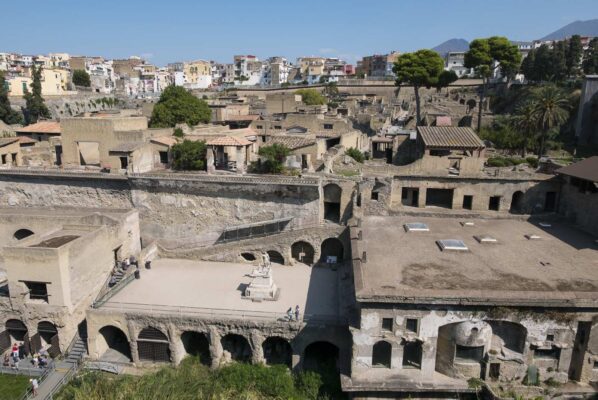
Located a short distance from Pompeii, ancient Stabiae (corresponding to present-day Castellammare di Stabia) offers an extraordinary archaeological heritage, too often overlooked by visitors who focus solely on Pompeii and Herculaneum.
Yet, the Stabiae excavations are a hidden gem of historical and artistic value, allowing one to understand even better the atmosphere of ancient Campania and to breathe in the grandeur of the “idle villas” built along the Gulf of Naples.
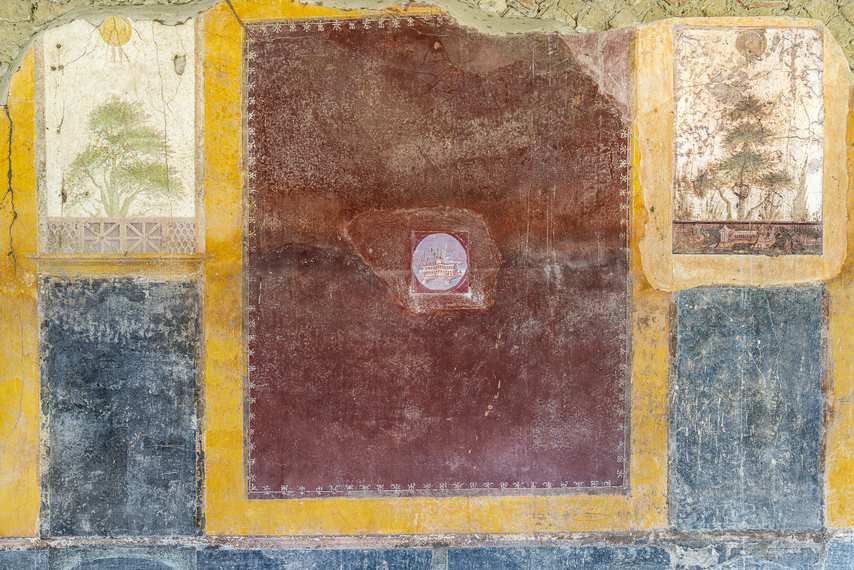
Visiting the Stabiae excavations is an enthralling experience, giving you a plunge into the past to discover frescoes, refined architecture and enchanting views of the Gulf of Naples.
Don’t miss the opportunity to add this archaeological treasure to your itinerary: it will allow you to appreciate even more the richness and variety of the Roman heritage in Campania, perfectly completing your knowledge of an area that, in addition to the famous Pompeii, holds other equally fascinating jewels.
Where is it located?
Google MapsHistorical Background
Stabiae boasts very ancient origins. As early as the Archaic period (8th century B.C.), the settlement played an important strategic and commercial role, located at a favourable point for maritime traffic. The period of most significant urban development should be placed between the destruction of the city by Silla (89 B.C.) and the fateful eruption of Vesuvius in 79 A.D.
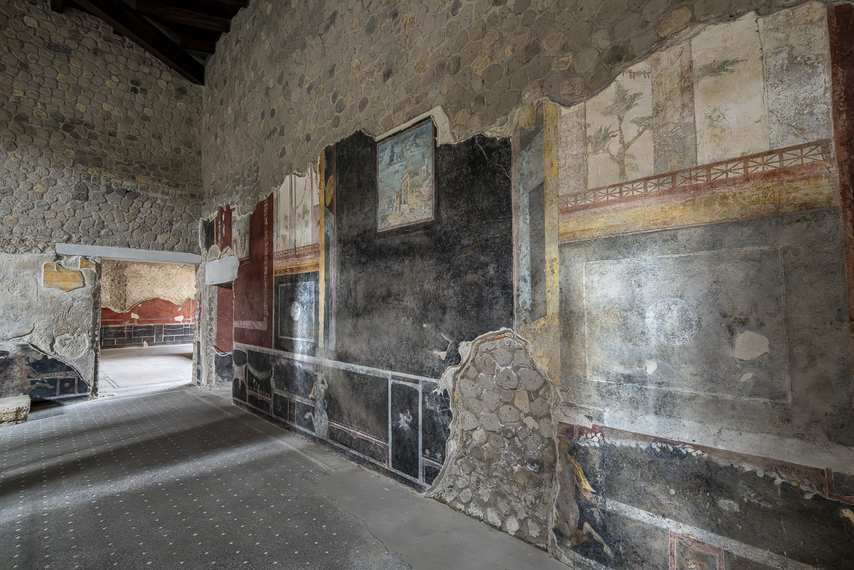
In those decades, numerous stately villas sprang up in a privileged panoramic position on the northern edge of the so-called Varano hill. These large “villae” were designed primarily for residential functions, equipped with living quarters, spa areas, porticoes, and nymphaeums, and richly decorated with frescoes and mosaics.
Guests and owners could enjoy the unique panorama and mild climate of the Gulf of Naples, making Stabiae a favourite vacation destination for critical Roman families.
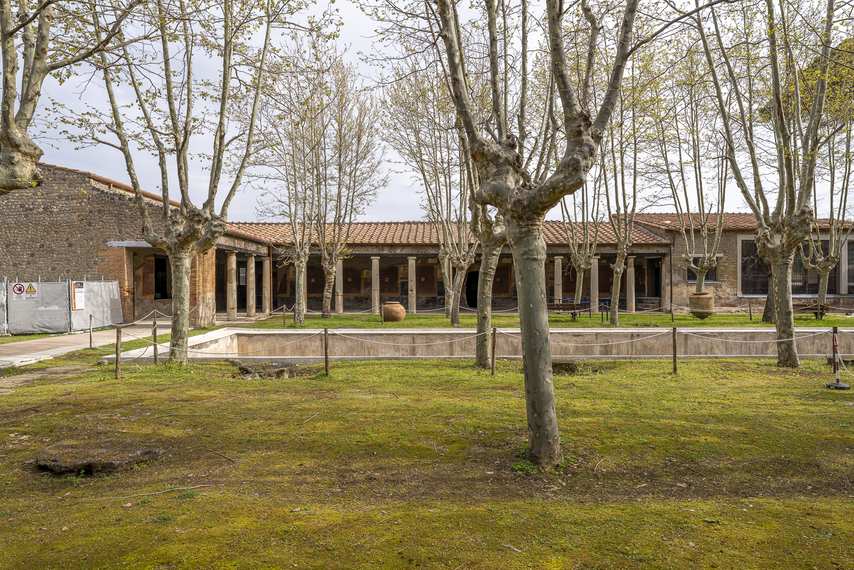
Today, walking through the remains of the Stabiae Excavations, it is possible to understand how these dwellings were real palaces intended for otium, a place of relaxation and representation. For the most part, however, these buildings have not been thoroughly investigated.
Those that have been unearthed and can be visited represent only a part of an archaeological complex that still needs to be enhanced.
The two best-known sites accessible to the public are Villa San Marco and Villa Arianna, the oldest Stabian residences. The so-called “Secondo Complesso” (Second Complex) is also separated from Villa Arianna by a minor road.
Bourbon Excavations and Modern Research
The rediscovery of Stabiae came about thanks to Charles III of Bourbon, whose excavations started on June 7, 1749. Under the supervision of the Spanish engineer Alcubierre and the Swiss Carl Weber, an urban layout with stores, streets, and as many as six villas on the edge of the Varano plateau was explored.
As was the custom at the time, excavation consisted of digging burrows and tunnels underground, removing only those finds deemed “worthy” of display in the Bourbon Museum. When no particularly valuable objects were found, the excavation would be abandoned and the tunnels closed again, leaving many areas oblivion.

The first villa to be investigated was Villa San Marco (from 1749 to 1754), followed by the “shepherd’s villa” (1754) and Villa Arianna, together with the neighbouring complex (1757-1762).
After a hiatus of about thirteen years, research resumed in 1775, focusing on Villa Arianna and some rustic villas in the surrounding area.
In 1881, architect Michele Ruggiero, a collaborator of Giuseppe Fiorelli (then director of the Pompeii Archaeological Park), published the work that collected all the Bourbon documentation: excavation diaries, drawings, and plans. These documents and the surveys made in the tunnels are still fundamental to our knowledge of Stabiae.
After a long period of neglect, interest in the site resumed in the 1950s, when Libero D’Orsi conducted new excavations, revealing large portions of Villa San Marco and Villa Arianna.
For protection reasons, numerous frescoes were detached, and since 1957, they have been preserved in a special Antiquarium, opened to protect these masterpieces from deterioration.
What are the Must-See Villas in Stabiae?
Visiting the Stabiae Excavations means, in practice, accessing two main sites:
- Villa Arianna
- Villa San Marco
Both residences offer an extraordinary insight into daily life in ancient Stabiae and show visitors the high artistic and architectural level attained by Roman aristocratic families.
Villa Arianna in Stabiae

The so-called “Villa of Arianna” is, in all probability, the oldest of the Stabiaene villas.
The name derives from a large fresco of a mythological subject that adorned the back wall of the triclinium: it depicts Arianna, abandoned by the hero Theseus and later joined by the god Dionysus, who was thunderstruck by her beauty.
This episode from the myth of Arianna is narrated with a dramatic slant and full of pathos, testifying to the incredible skill of the ancient painters and the refined taste of the villa’s owner.
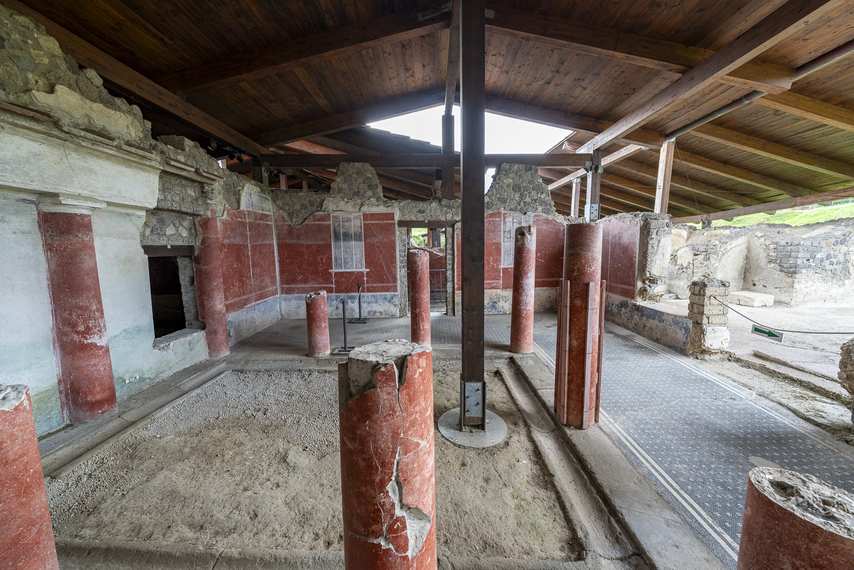
The history of this dwelling is intertwined with that of Bourbon excavations, as it was investigated from 1757 to 1762 by Karl Weber. At that time, as already mentioned, excavation was by burrows, removing valuable finds and closing up everything else.
Thus, many rooms remained unknown, and it was not until the 1950s and 1960s that excavations were resumed systematically.
Structure and Decorations
Villa Arianna spans approximately 2,500 square meters, although part of the building is still buried.
The plan is complex and articulated, as the villa underwent later extensions and adapted to the morphology of the hill, taking advantage of its slope to give guests sweeping views of the coastline.
Four essential cores can be recognised:
- Atrium and surrounding rooms, from the late Republican period.
- Service and thermal environments.
- Environments around the summer triclinium were built in the Neronian age.
- A large gymnasium was attached to the villa in the Flavian age.
A notable feature of this residence is the integration of several levels, connected by ramps and a long gallery running through the complex, starting from the plain below to the inhabited area.
This ingenious system reveals how the owners sought to exploit every angle of the slope to create scenic spaces, breathtaking views, and comfortable environments.
The frescoes are the pride of the Villa Arianna: there we find mythological scenes inspired by Dionysus, large, almost life-size figures, or delicate miniature decorations with cupids, theatrical masks, landscapes, and busts set in medallions.
Even the black-and-white mosaic floors underscore the refinement of these mansions, which were desired by wealthy families who spared no expense to demonstrate their social importance.
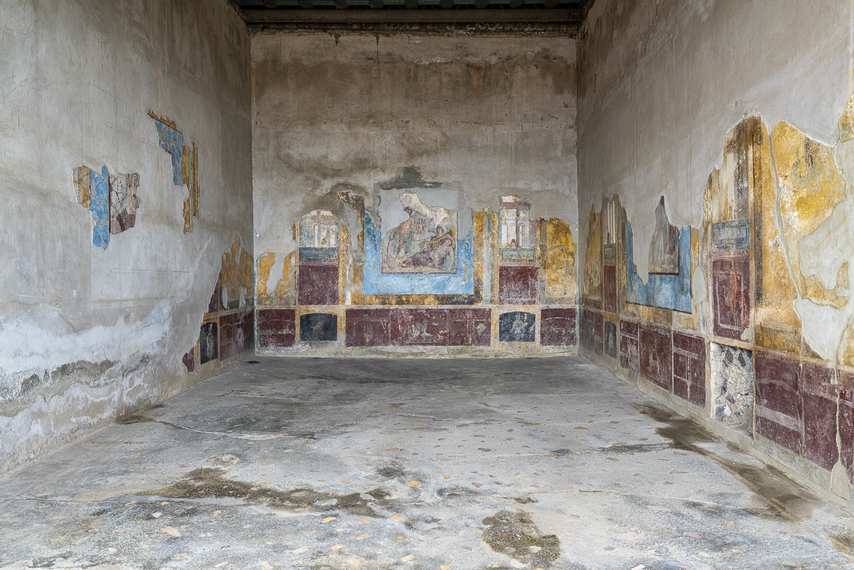
The myth of Arianna, depicted in the fresco that gives the villa its name, deserves special mention. According to legend, the Cretan princess helped Theseus defeat the Minotaur but was then abandoned on the island of Naxos.
Dionysus (or Bacchus) fell in love with her, gave her happiness and a golden crown, and made her his bride. This richly evocative story appears frequently in Roman wall decorations, as it interweaves themes of love, abandonment, salvation, and divine passion.
Villa San Marco in Stabiae
Villa San Marco takes its name from an ancient chapel built in the 18th century. Also located on the edge of the Varano hill, it enjoys a splendid view of the Gulf of Naples. Covering about 11,000 square meters (at least in total estimates), it is one of the largest residential villas of the Roman era.

It was among the first explored in the Bourbon era (1749-1754). Later, in the 1950s and 1960s, systematic excavations by Libero D’Orsi revealed most of the rooms we admire today.
Walking through the remains of Villa San Marco, one can sense the splendour and vibrancy of the life that must have taken place here before the eruption of 79 AD.
Structure and Special Features
The villa probably dates from the early Augustan age (late 1st century B.C.- early 1st century A.D.) but underwent transformations in the Claudian period.
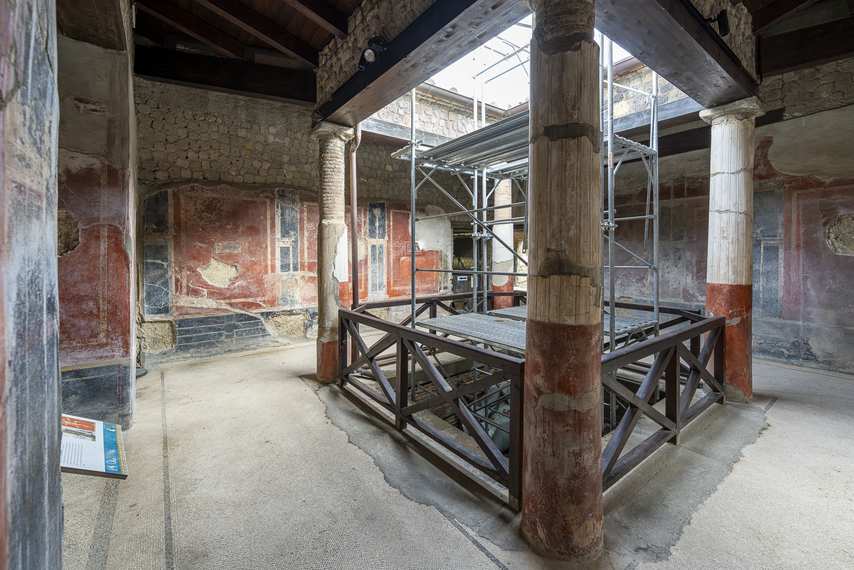
For example, the original tetrastyle atrium with Ionic columns saw the addition of new panoramic rooms, such as a large garden with triporticus and a swimming pool.
These interventions modified the structure and “displaced” the main entrance, which was originally axial with the atrium and opened onto the street (now underground).

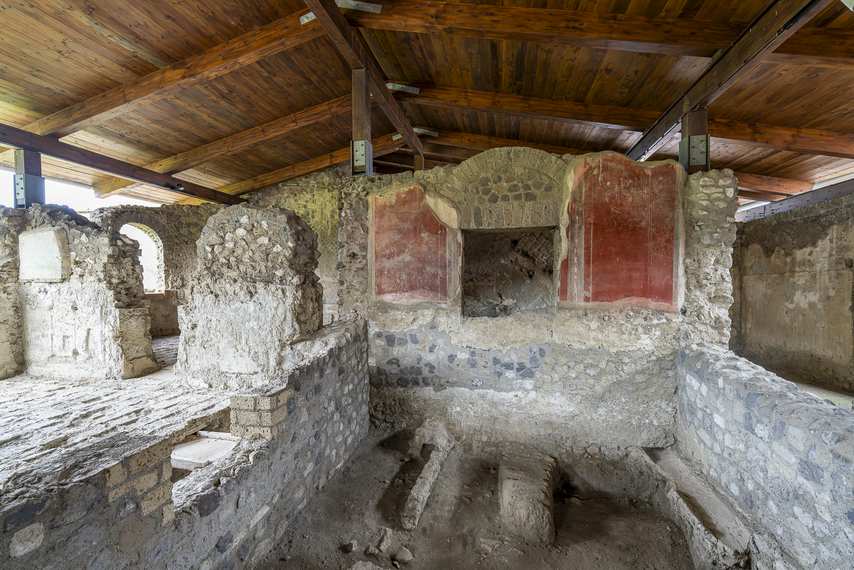
Past the atrium, one encounters the thermal quarter, designed to enjoy hot and cold baths with a particular luxury: there was the calidarium with a large pool, the tepidarium, and the frigidarium, decorated with precious frescoes often depicting wrestling cupids, boxers, or mythological scenes.
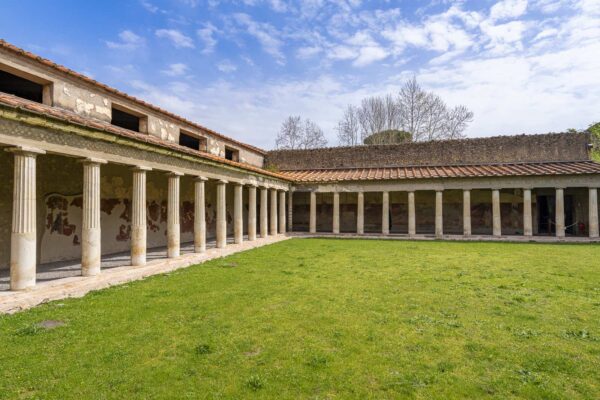
One enters a large porticoed garden with a monumental pool and a veritable nymphaeum with stucco on the hemicycle back wall. The rooms arranged on either side of the garden, intended for rest or conversation, were lavishly ornamented.
Overall, the architectural solutions employed in the Villa San Marco enhanced the panoramic view and functionally arranged the reception, living, and service rooms so that guests could spend their time between spa treatments, walks in the gardens, and banquets in the most elegant rooms.
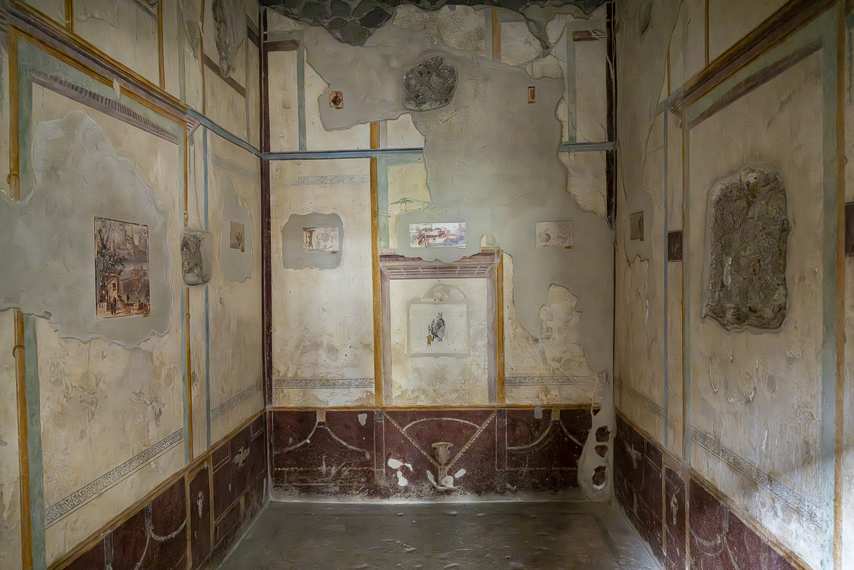
As in Villa Arianna, 18th-century Bourbon practice here involved the detachment and export of many frescoes and mosaics deemed most valuable, leaving “open” some gashes in the walls. Fortunately, modern research has made it possible to recover some of these decorations and bring some back to the site.
At the same time, the rest are preserved in various museums, including the National Archaeological Museum in Naples.
The “Second Complex”
Next to Villa Arianna, separated from it only by a narrow alley, stands the so-called Secondo Complesso (Second Complex). Entirely explored in 1762 and 1775 by Carl Weber and his successor La Vega, this villa now presents about 1,000 sq. m. of excavated area.
A study of Bourbon documents shows that the peristyle was porticoed on three sides, with a faux portico on the fourth side, embellished with half-columns. Of particular importance was the thermal quarter, with rooms equipped with calidarium, tepidarium, laconicum (dry sweating room, similar to a sauna) and a kitchen.
Many floors were detached in Bourbon times and reused to decorate the rooms of the Royal Bourbon Museum, known today as the National Archaeological Museum of Naples.
Modern research has made it possible to understand that the Secondo Complesso shares some structures and some construction techniques with the nearby Villa Arianna. However, several parts have collapsed downstream or remained buried for ground stability.
Twenty Centuries Ago: The tragedy of the Eruption
To understand the end of these beautiful places, it is worth recalling the account of Pliny the Younger, an eyewitness to the tragic eruption of Vesuvius in 79 AD.
Whether it was at Pompeii, Herculaneum or Stabiae, the terrible column of ash, pumice and hot gases was lethal for many people, including Pliny the Elder, the uncle of Pliny the Younger himself, who was in Misenum and wanted to push off by sea to Stabiae itself to help friends and acquaintances in danger.
At the time, the Stabiae area was densely urbanised, with villas and mansions along the coast, as we are also told by the historian Strabo, who described the Campanian coast as a single, continuous succession of buildings, gardens and towns.
The eruption covered everything with lapilli and ash, partly preserving its original appearance and delivering to history an actual “still image” of life in Roman times.
Tips for Visiting the Excavations of Stabiae
How to get to the Stabiae Excavations
- By train: The Circumvesuviana Napoli-Sorrento line (Castellammare di Stabia stop—Via Nocera) takes you to the city. From there, you can take a bus (1 Rosso) to the archaeological area.
- By car: from the A3 Naples-Salerno freeway (exit Castellammare di Stabia), follow the SS145 (exit Gragnano) and via Passeggiata Archeologica, following the signs to the site.
- By shuttle (Pompeii Artebus): if you are already in Pompeii and wish to continue visiting the surrounding area, Shuttle 3 connects Pompeii to Stabia. Schedules may vary between summer and winter, with departures generally between 9:30 a.m. and 4:00 p.m. (winter period) or 6:00 p.m. (in summer), with a break in the middle of the day. Recommended to consult the official website for updated schedules.
What not to Miss at the Stabiae Excavations
- The views: the view of the Gulf of Naples is breathtaking, especially from the porticoes and terraces of Villa Arianna. From here, it is immediately clear why the Romans chose this particular stretch of coastline to build their luxury villas.
- The frescoes: Although many original paintings have been transported elsewhere, decorative pieces and stuccoes can still be admired. The myth of Arianna and Dionysus is the most striking example.
- Spa facilities: typical of Roman domus and villas, spa facilities offer an interesting insight into the worship of the body and leisure relaxation. The different rooms (caldarium, tepidarium, and frigidarium) help to understand the wellness paths of the time.
- The porticoed gardens and swimming pool of Villa San Marco were once places for pleasant conversations and walks, and today, they are appreciated for the beauty of their proportions and the suggestions they still provide.
Practical Suggestions
- Length of visit: The Stabiae excavations are generally less extensive than those in Pompeii, so depending on your pace, you can plan to spend half a day or less there.
- Clothing and equipment: Wear comfortable shoes, especially since some areas may have uneven soils. In summer, bring a water bottle, a hat, and sunscreen.
- Documentation: There are explanatory panels on site, but it is recommended that you purchase a guidebook or use an audio guide (if available) to delve into architectural and artistic details.
- Joint visit to Pompeii: Many people visit Pompeii first and then Stabiae. Pompeii Artebus shuttle 3 is a practical solution, but you can also move around by train or car, depending on your needs.
Why Visit Stabiae?
Why devote part of one’s vacation to discovering the Stabiae excavations? The answer lies in their uniqueness.
Suppose Pompeii is the great Roman provincial city that has remained crystallised. In that case, Stabiae offers the key to understanding how the elite lived, the high society that invested vast resources to build dream villas with frescoes, mosaics, gardens, nymphaeums and vantage points on which to entertain guests.
In addition, a visit to Stabiae is often quieter and “more intimate” than a visit to Pompeii: no oceanic crowds, but a more serene itinerary that allows you to get in touch with the spirit of the Roman villa.
Walking through the corridors and colonnades, you can almost imagine the ancient owners relaxing in a summer triclinium, attending performances and banquets, or strolling among the columns looking out to the sea.
For those with a broader interest in archaeology, Stabiae fits into a perfect itinerary along with Pompeii, Herculaneum, Oplontis, and the National Archaeological Museum in Naples. Together, they offer a complete picture of Roman society in the first century AD.
This cross-section, rich in detail and evidence, makes the area one of the most important archaeological districts in the world.
FAQ About the Stabiae Excavations
It depends on your level of interest. Generally, Villa Arianna and Villa San Marco can be visited in about two hours, but it could take half a day if you want to delve into every detail.
Licensed guides are often available on site or by reservation. Alternatively, you can use printed or audio guides. We recommend that you inquire in advance to better organise your visit.
Yes, it is possible. Just take the A3 highway (exit Castellammare di Stabia), follow the SS145 and then the signs for Via Passeggiata Archeologica. Parking lots are available near the excavations (usually paid or free, depending on the season).
Unfortunately, some areas have architectural barriers due to the lay of the land and the presence of ancient structures. However, in recent years, interventions have been made to facilitate the visit. It is advisable to first inquire on the official website or contact the superintendency directly for updated directions.
There is no inescapable order. Many visitors start with Pompeii, as it is best known, and then move on to Stabiae. However, you could also reverse the sequence and start with Stabiae, enjoying a more relaxed and less crowded visit. Both destinations offer different and complementary experiences of life in ancient Campania.