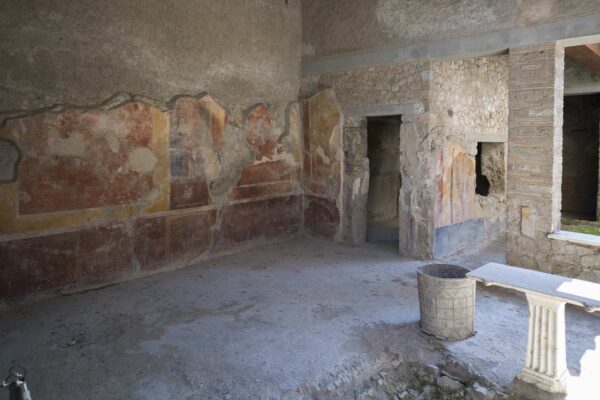
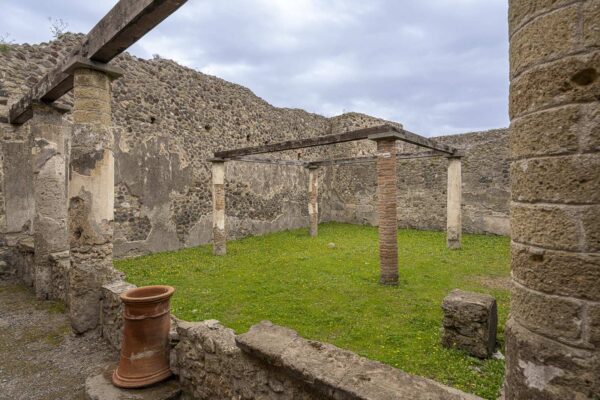
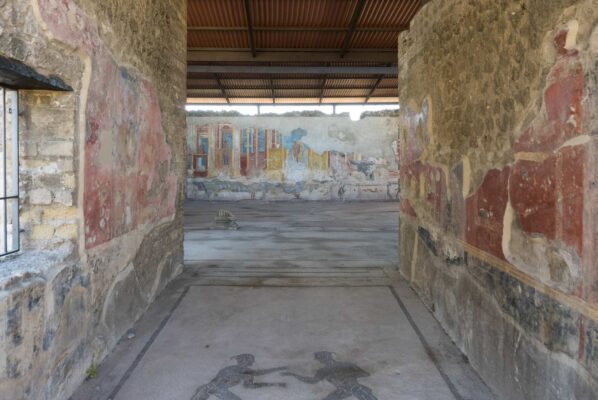
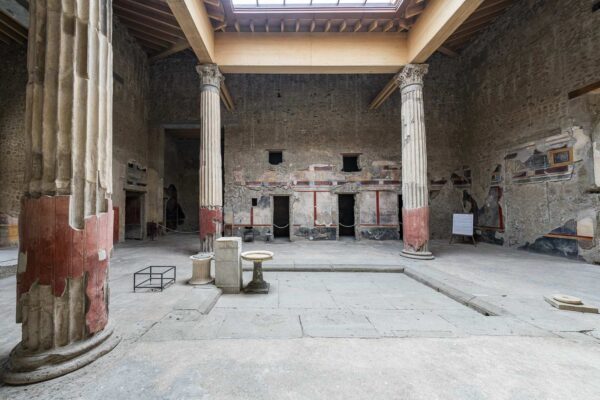
Suppose you have just concluded your visit to the Pompeii Archaeological Park and are looking for a fascinating place, less crowded but no less rich in history. In that case, the Royal Palace of Quisisana in Castellammare di Stabia might be the ideal destination.
This historic building, which stands in a panoramic position on the hills of Quisisana, boasts more than seven centuries of events that have seen the alternation of kings, noble families and even periods of total abandonment.
Its origins date back to the 13th century, when the Angevin sovereigns, attracted by the salubrity of the place and the mild climate, decided to build a “hunting and holiday lodge” in which to retire during the hottest periods of the year or to seek care and rest.
Over the centuries, the Royal Palace of Quisisana underwent extensions and remodelling, particularly during the reign of Charles III of Bourbon and his successors, until it achieved the monumental appearance we can still admire today.
During the Bourbon period, major restoration and embellishment works were carried out that gave the complex its current L-shaped structure.
The first body of the building, facing the sea, housed the reception rooms and the panoramic terraces; the second body, arranged orthogonally, was probably intended for the royal lodgings and service functions.
Despite goingthrough phases of decay and even being used as a hotel, military hospital and boarding school, the Royal Palace of Quisisana has returned to its former glory after a lengthy restoration completed in 2009.
Since 2020, the main floor of the building has housed the Stabia Libero d’Orsi Archaeological Museum, which displays some 507 artefacts from the ancient Stabia villas, with frescoes, marble furnishings and ornaments of great historical and artistic value.
Today, a visit to the Reggia offers both an opportunity to admire a historic monument of Bourbon layout and immerse oneself in the archaeology of ancient Stabia.
Where is it located?
Google MapsHistory: From the Angevin Era to the Reign of the Bourbons
Origins in the Angevin Period
The earliest records of this residence date from the reign of Charles I of Anjou (13th century). The king built a palace here to find a resting place in a healthy area with a magnificent view of the Gulf of Naples.
According to tradition, “Quisisana” derives from an exclamation of Charles II of Anjou, who, having been cured of a serious illness in this place, said, “Here he gets healthy!” Others claim that the toponym derives from the ancient name “Domus de Loco Sano,” emphasising the healthfulness of the area.
This reputation as a place of healing soon spread, and in the following decades, the Royal Palace of Quisisana became a destination for monarchs and nobles seeking summer refuge away from the epidemics that sometimes struck more populous centres.
Historical sources document that, following a plague epidemic, King Ladislaus of Durazzo (1401) took refuge here with his entire family, managing to escape the contagion. The same fate befell Queen Giovanna II, again seeking protection from the disease.
During the Angevin period, the structure was expanded and became a three-story building: the ground floor was reserved for servants, the first floor for rest, and the second floor for official functions.
The complex was surrounded by woodland, used partly for hunting and partly as a garden, in keeping with the idea of an abode designed for pleasure and relaxation.
From the Aragonese to the Farnese
Beginning in 1483, Angevin rule gave way to Aragonese rule and then to the period of the viceroys. In 1541, Castellammare di Stabia became a fief of the Farnese family.
During these centuries, the palace did not undergo any particular substantial changes, but with time and due to the neglect of the new owners, it fell into a state of semi-abandonment.
Only with the arrival of the Bourbons did the palace regain a new centrality, becoming again a favourite destination for royal stays and court appointments.
The Bourbon Period
The final turning point came in 1734, when Charles of Bourbon ascended the throne. Charles inherited significant properties from his mother, including the Casino di Quisisana (as the palace was often called), one of the oldest royal sites in the Kingdom at the time. However, it was with Ferdinand IV of Bourbon that major renovation and expansion work began in 1758.
Between 1765 and 1790, the residence was transformed into a more unified and modern architecture, with decorated facades, terraces open to the Gulf of Naples and a large park designed on the model of the English garden.
Avenues, staircases, fountains, water features and exotic plants enriched the outdoor spaces, making them an ideal place for courtly living and hunting parties. Not surprisingly, the Bourbon era was the heyday of the Royal Palace of Quisisana, which reached an extension of 49,000 square meters and became a notable stop on the Grand Tour, attracting artists, international travellers, and distinguished visitors to Campania.
From the Unification of Italy to Abandonment
With the end of the Bourbon dynasty and the unification of Italy, the palace was passed on to the Savoy family and later to the State Property. In 1878, it was sold to the Municipality of Castellammare di Stabia, which gave it to private individuals to manage several times. In the following decades, it was transformed into a hotel (named first “Margherita” and later “Royal Hotel Quisisana”), into an agricultural institute and several times repurposed as a military hospital, especially during World War I and World War II.
After the hotel closed in the 1960s, the building fell into a gradual state of neglect.
The 1980 Irpinia earthquake aggravated the situation, causing further collapse and damage. It was only at the beginning of the new millennium, thanks to a series of cultural initiatives and the availability of public funds, that a major restoration project began, completed in 2009, which restored the former royal residence to its former glory.
The Architecture of the Royal Palace of Quisisana
The architectural layout of the Royal Palace of Quisisana presents the shape of an “L” generated by the union of three different but harmoniously integrated building bodies.
The entrance body, on two floors, welcomes visitors: a large portal leads into a tree-lined avenue, while the second floor overlooks a large panoramic terrace, ideal for admiring the gulf and the city of Castellammare di Stabia below.
The second body is orthogonal to the first and comprises two floors plus an attic, with windows embellished with classical decorations and cornices.
On the other hand, the third body slopes down the hillside and is distinguished by a long portico that once served as a covered passageway between the different areas of the palace.
The original furnishings were lost mainly due to looting, moisture, and collapses before restoration. However, some decorative elements, such as Corinthian capitals and lion’s heads, were expertly recovered and brought back to light through the work of restorers.
One of the peculiarities of the restoration was the decision to use, as much as possible, the same original materials, avoiding cement mortars and favouring wood and local stone, to preserve the authenticity of the structure.
The Garden and Park of the Royal Palace of Quisisana
One of the most fascinating aspects of the Royal Palace of Quisisana is the extensive garden, partly Italian and partly inspired by the English garden, which covers an area of about 20,000 square meters.
Here you can stroll among botanical varieties typical of the Mediterranean maquis such as Aleppo pines, yews, holm oaks, asphodels and strawberry trees, ornamental plants such as cedars of Lebanon and centuries-old plane trees.
The restoration also included the construction of paving and rammed-earth pathways to allow a comfortable walk between the different green areas.
In addition to the garden closest to the palace, a vast park covers much of the slope of Monte Faito overlooking the Gulf of Naples.
In Angevin and Bourbon times, this area was used for hunting, thanks to the abundance of game and the wealth of water, evidenced by the presence of springs. Even today, some famous King’s Fountains, ornamental basins made of lava stone and marble, once enriched with scenic water features and surrounded by statues and balustrades, can still be admired, albeit in neglect.
During your visit, observe the monumental pines, Canary Island palms, and varieties of medicinal plants that grow wild in this area.
The park also offers breathtaking viewpoints, ideal for taking souvenir photos and enjoying a unique view of the Bay of Naples, with Mount Vesuvius looming on the horizon.
The Archaeological Museum of Stabia “Libero d’Orsi”
Since 2020, the Royal Palace of Quisisana has been home to the Stabia Libero d’Orsi Archaeological Museum, which is an unmissable opportunity to learn about the history of ancient Stabiae.
This Roman city flourished at the foot of Castellammare di Stabia. The museum was designed with an innovative approach, where the display of artefacts is integrated with multimedia technologies and interactive educational apparatus, allowing visitors to take a real journey through time.
Collection and Exhibition Itinerary
The Archaeological Museum of Stabia Libero d’Orsi houses more than 500 artefacts from the Roman villas of the Stabia area, particularly the maritime villas on the Varano hill and the so-called rustic villas, more like farms with production purposes. The museum tour runs through several rooms, each dedicated to a specific aspect: from residential architecture to pictorial decorations, from marble furnishings to ceramics and bronze.
- Rooms dedicated to frescoes: Here, you can admire the wall paintings that adorned rooms such as cubicula (bedrooms) and triclinic (dining rooms), with mythological scenes, landscapes, and human figures. Fascinating specimens are the portraits of villa owners, depicted with pensive and intimate expressions.
- Marble furniture and furnishings, including statues, decorative bases, and objects of daily use, testify to the luxury and level of refinement achieved in Stabiae’s villas d’otium. Precious marbles, bronze vessels, and finely crafted ceramics allow you to immerse yourself in the atmosphere of an ancient Roman residence overlooking the sea.
- Multimedia apparatuses: The museum has interactive devices that, through video mapping, 3d reconstructions, and audio guides, narrate the different historical phases of Stabiae, from the destruction caused by the eruption of Vesuvius in 79 A.D. to the subsequent rebirth witnessed by medieval finds and documents.
The New Repository Concept and Collaborations
One of the most interesting innovations at the Stabia Libero d’Orsi Archaeological Museum is the enhancement of the repositories, which are no longer simply inaccessible storage places, but spaces open to the public and researchers.
Thanks to an agreement with the National Archaeological Museum of Naples (MANN), artefacts from the Stabia area, which had been stored for years in the Neapolitan halls, returned partly to Castellammare on a three-year loan.
This made it possible to recreate, for the first time in 250 years, the original decorative contexts of the Stabiese villas, bringing together frescoes and furnishings that had long been separated.
Some of the rooms show what the peristyles and gardens of the villas must have looked like, with sets reproducing the panorama of the Gulf of Naples and the original arrangement of statues, fountains and plants.
An approach that aims to make the visit more engaging and fully understand the relationship between architecture, landscape and daily life in ancient Stabiae.
Why Visit the Royal Palace of Quisisana after the Pompeii Archaeological Park
Suppose you’re wondering why you should go as far as Castellammare di Stabia after having been to Pompeii. In that case, the answer is quickly said: the Royal Palace of Quisisana represents a perfect completion of a historical-archaeological itinerary.
After admiring the Pompeii Archaeological Park, you will discover a different face of Campania, that of the royal Bourbon residences, while admiring the remains of ancient Stabia in a modern, technological setting.
In addition, the Reggia’s panoramic location is exceptional: from its terraces and garden, there is a spectacular view of the entire Gulf of Naples. The town of Castellammare di Stabia, nestled between the sea and the mountains, offers the possibility of continuing the day by savouring typical Stabia dishes or taking a stroll along the seafront. In short, it is an experience that combines culture, nature, and gastronomy.
How to Organise the Visit
Opening Hours and Tickets
- Royal Palace of Quisisana: The outdoor spaces and park are generally accessible to the public, but it is always advisable to inquire about any restrictions or specific opening hours, especially during events or maintenance work.
- Stabia Archaeological Museum “Libero d’Orsi“:
- November 1 to March 31: 9 a.m. to 5 p.m
- April 1 to October 31: 9 a.m. – 7 p.m
Always check Pompeii Archaeological Park’s official website or institutional channels for changes in hours and admission costs.
Getting There
- Shuttle Pompeii Artebus: You can take Shuttle 3 of the Artebus line from Pompeii. The journey is about an hour. The departure times are on the official Pompeii website page.
- City buses:
- Line 5 (Piazza Matteotti – Strada Panoramica), “Strada Panoramica” stop
- Line 7 (Piazza Giovanni XXIII – Piazza Spartaco – Strada Panoramica), stop “via Panoramica”
- Circumvesuviana train: Take the Naples-Sorrento route and get off at “Castellammare di Stabia.” From there, head to Piazza Giovanni XXIII and take Line 5, stopping at Salita Quisisana.
- Car:
- From the A3 Naples-Salerno highway, take the Castellammare di Stabia exit.
- Take the SS145 for about 8.5 km (second exit Castellammare di Stabia).
- Continue straight on viale Europa, viale delle Puglie and via Panoramica.
- Turn left onto viale Ippocastani (Salita Quisisana) to reach the entrance to the Reggia.
Practical Advice
- Comfortable clothing and shoes: The palace’s park and gardens have rammed-earth paths and cobblestones, so wear closed shoes or shoes with non-slip soles.
- Visiting time: Figure out at least a few hours to visit the palace and the museum. If you want to explore the park’s paths more leisurely or stop to take pictures of the view, budget three or four.
- Photographic equipment: There are many viewpoints, and they are very scenic; carrying a camera or a good smartphone will allow you to capture gulf views and architectural details.
- Tourist services: Bars, restaurants, and other businesses may be nearby; however, it is advisable to inquire in advance, especially out of season, about the availability of such services.
The Tour: From Bourbon Architecture to Ancient Stabia
Once through the main door, you can admire the inner courtyard and the striking staircase leading to the main floor.
If you love art and history, take some time to explore the restored spaces, dwelling on the decorative details: capitals, neoclassical elements, and fragments of frescoes emerge as evidence of the palace’s past grandeur.
Then, head to the rooms that house the Libero d’Orsi Archaeological Museum of Stabia. Here, thanks to information panels and digital devices, you’ll trace the history of Stabiae from the earliest Bourbon discoveries of the 18th century to the more recent excavations conducted by Libero d’Orsi beginning in 1950.
You can virtually browse through d’Orsi’s “multimedia diary,” listening to his voice and viewing period photographs documenting how the excavations uncovered, among other things, splendid mosaics and wall paintings.
In some rooms, the exhibit realistically reproduces the ancient view of the Gulf of Naples as experienced by the owners of Roman villas from the hill of Varano.
This dynamic projection changes with the passing hours of the day to give you the illusion of being in a bygone era. You will be able to observe statues of deities and portraits of the ancient inhabitants of Stabiae, accompanied by quotations from Latin authors such as Cicero, extolling the beauty and wholesomeness of the place.
Finally, returning outside, walk along the park’s paths and pause at the King’s Fountains: imagine what they must have looked like in the old days, when water flowed abundantly and water features created a fairy-tale ambience.
Today, although in a state of partial decay, they retain an undisputed charm, witnesses to what was once one of the most beloved royal palaces of the Bourbon rulers.
Nearby Experiences and Activities
If you have time left after visiting the Royal Palace of Quisisana, consider exploring the surrounding area:
- Downtown Castellammare di Stabia: stroll along the waterfront to enjoy the city’s lively atmosphere. Stop at a café for a good coffee or to sample traditional Stabia products, such as the famous “panuozzo” from nearby Gragnano.
- Monte Faito: If you are a trekking lover, Monte Faito offers trails that wind through beech and pine forests, with breathtaking views of the Gulf. In summer, it is the perfect place to escape the heat and find some coolness.
- Other archaeological destinations: Pompeii, Herculaneum and Oplonti are within easy reach, and are a must-see itinerary for those wishing to learn more about the Roman heritage buried by the eruption of Vesuvius.
Conclusions
The Royal Palace of Quisisana is a place that combines the grandeur of a Bourbon royal residence with the charm of an exceptional archaeological site, thanks to the presence of the Libero d’Orsi Archaeological Museum of Stabia. Its long and complex history, starting in the 13th century, passing through the Angevins, the Aragonese, the Farnese and the Bourbons, is reflected in the palace’s architecture and in the events that led it to be a college, a hotel, a military hospital, and finally a fundamental cultural center for Campania.
To visit this place after the Pompeii Archaeological Park is to complete the journey through the history of an area that has seen the glory of ancient Stabiae and the sumptuous resorts of the Bourbon rulers.
Above all, it offers the opportunity to discover how art, nature and court life have intertwined over the centuries, bequeathing a heritage of extraordinary beauty to posterity.
From the museum rooms to the gardens, from the terrace overlooking the gulf to the shady paths of the park, every corner of the Royal Palace of Quisisana tells a fragment of history that deserves to be known.
If you are in Campania, add this stop to your itinerary- it is truly worth it.
FAQ About the Royal Palace of Quisisana
The Royal Palace of Quisisana is located in Castellammare di Stabia, in the province of Naples, in the hillside district of Quisisana. It is easily accessible by car (A3 Castellammare di Stabia highway exit) and public transport, such as the Circumvesuviana and local buses.
The Libero d’Orsi Archaeological Museum of Stabia is open from 9 a.m. to 5 p.m. in winter (November 1-March 31) and from 9 a.m. to 7 p.m. in summer (April 1-October 31). It is advisable to always check the updated hours on the official website or at the Pompeii Archaeological Park information channels.
Generally, it is recommended that you spend at least a couple of hours on the visit. If you want to leisurely explore the museum, linger on the multimedia apparatuses, and stroll through the gardens, you can easily take up to three or four hours.
The museum displays frescoes, marble furnishings, ceramics, and bronzes dating back to Roman times, particularly from the maritime villas of Stabiae. You can admire splendid wall decorations depicting landscapes, mythological figures, and portraits of ancient owners, as well as furnishings and everyday objects that testify to life in the first century AD.
The park is open to the public in principle, but some areas may be closed for maintenance or safety reasons. It is suggested that you inquire in advance and respect any marked routes, especially if you want to admire the ancient fountains and the most scenic spots.