The Stabian Baths of Pompeii represent one of the oldest and most fascinating thermal complexes in the Roman world, as well as a must-see stop for those who want to explore the Pompeii Archaeological Park in all their variety.
These facilities, buried by the eruption of Vesuvius in 79 AD and uncovered during archaeological excavations, provide a unique insight into the culture of wellness and hygiene in ancient Rome.
For many visitors, learning about how the baths functioned means gaining a deeper understanding of the daily life and habits of ancient Pompeians, far beyond what can be seen in private homes alone.
Where are they located?
Map of Pompeii: Regio VII – 16
Google MapsOrigins and History of the Stabian Baths of Pompeii

The Stabian Baths owe their name to their proximity to the Via Stabiana, one of the main roads of the ancient city, and were built around the 3rd-4th centuries B.C.
It is likely that this area was originally on the outskirts and was used as a cemetery, as evidenced by some underground burials found during excavations.
As urban development progressed, the area became a focal point of the city, accommodating what we now recognise as one of the oldest centres of relaxation and sociability in Pompeii.
The baths underwent considerable expansion in the second century B.C., becoming more complex and capacious. In imperial times, and especially after the devastating earthquake of 62 AD, they underwent continuous renovations.
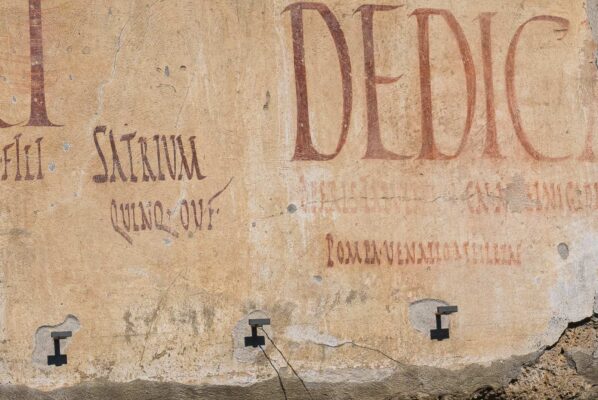
However, at the eruption, the construction sites had not yet been completed, so some parts of the building were still under construction. The heyday of the complex was around 80 B.C., as evidenced by an inscription citing expansion and restoration work by the Duoviri of Pompeii.
The Culture of Bathing in Ancient Pompeii
Why were baths so important? In Roman society and Pompeii, spa facilities extended far beyond mere body cleansing.
The baths constituted places to meet, relax, and even do business. In a city that, for the most part, lacked complex domestic plumbing (private baths were a luxury reserved for the few), public baths were the only opportunity to enjoy hot water, a heated environment, and a modicum of privacy.
One could meet friends, discuss politics, conduct business, or relax after work. For many, especially in the winter, it was the only way to warm the bones and escape the humidity.
In addition to the Stabian Baths, the city offered other similar facilities, such as the Forum Baths, the Sarno Baths (probably privately run ones), and the Suburban Baths at Porta Marina, featuring erotic frescoes on the upper floor.
There was even an ambitious project for new Central Baths, which was never completed because of the eruption. This rich presence of thermal facilities testifies to how widespread and appreciated the bathing ritual was in Pompeian society.
Structure and Main Rooms

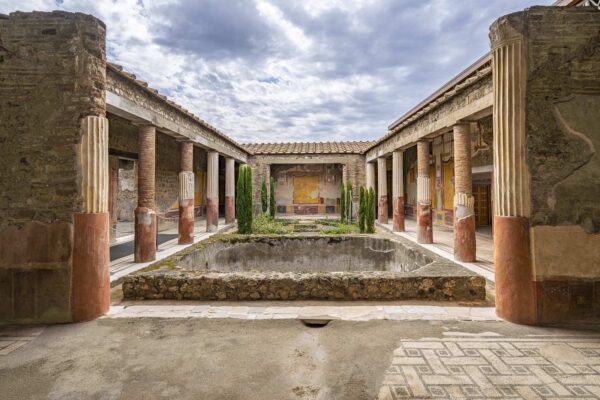
The Stabian Baths complex in Pompeii is built around a large trapezoidal courtyard (gymnasium), surrounded by a portico on three sides. This area functioned as a multifunctional space: the gymnasium was used by athletes to train and perform gymnastic exercises, while the pool (natatio), located on one side, served as an area dedicated to swimming and refreshment.
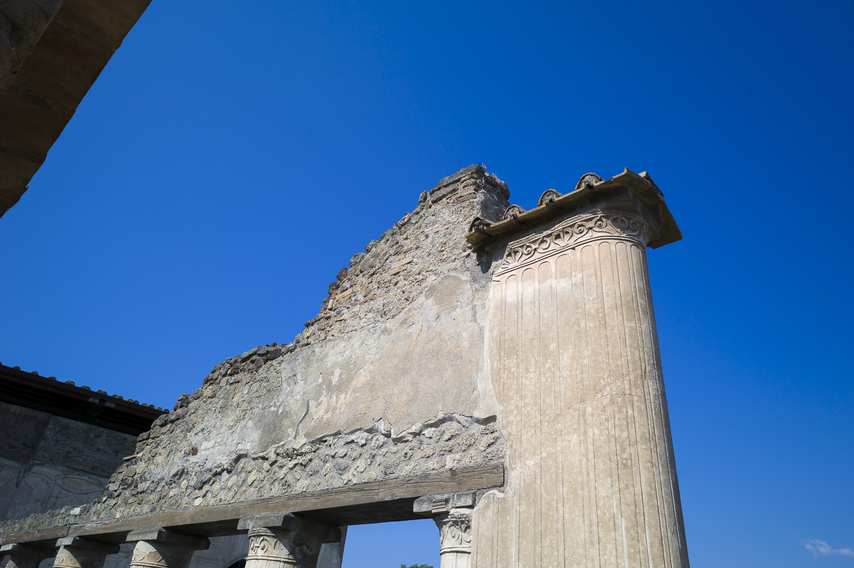
- Gymnasium and pool: The gymnasium was trapezoidal, with columns that were initially slender but later reinforced with stucco after sustaining damage in the 62 AD earthquake. The actual pool was flanked by two smaller pools, which athletes used to rinse off before or after training. A low wall separated the natatorium area from the rest of the gym, providing some privacy for those who wished to take a dip.
- Separate entrances for men and women: The Stabian Baths were strictly divided into two sections, one for men and one for women. This distinction is typical of the Roman world: although some baths may have provided alternating times for men and women, at Pompeii the separation seems to have been sharper, with entrances on different streets and distinct rooms, albeit of various sizes.
- Men’s baths: The men’s section included an apodyterium (dressing room) with stucco decoration and wall paintings, a frigidarium (a cold bathing room), a tepidarium (a warm-temperature room), and a caldarium (a hot room). In the caldarium, there was often a labrum, a large circular basin with hot water for ablutions, and the walls had cavities to allow hot air to circulate. The raised floor (hypocaust) was supported by stacks of bricks, enabling hot air produced by furnaces and braziers to keep the room at the desired temperature.
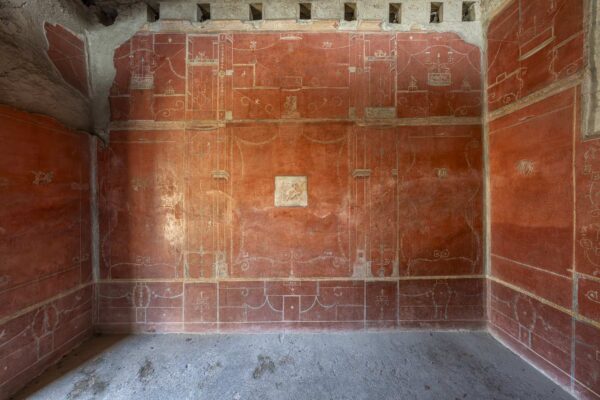
- Women’s baths: The women’s section was similarly structured, but generally smaller and less lavishly decorated. Again, progressively warmer rooms (frigidarium, tepidarium, and calidarium) were available to follow the classic Roman bathing route. The women’s apodyterium has been preserved in excellent condition, retaining the bright white plaster and the niches for storing clothing.
- Service areas: The importance of the latrine, located in the northern part of the complex, and the furnaces (praefurnia), from which the heat that heated the air and water came, should not be overlooked. The efficiency of this system was remarkable: hot air flowed into the wall cavities and under the floor, ensuring comfortable temperatures in the different rooms.
The Luxury of Hot Water: The Technological Core of the Roman spa

One of the most fascinating aspects of the Stabian Baths is undoubtedly the heating system, a concrete testament to Roman ingenuity in engineering.
Water was heated in large boilers, and the hot air generated by combustion was channelled through ducts and suspended floors, heating the room evenly.
This system, known as a hypocaust, is considered the precursor to modern underfloor heating. To increase the effect, movable braziers were also sometimes used (especially in the caldarium), which helped maintain a constant temperature.
As fresh water was brought in through the city’s aqueduct system, there was no shortage of tanks or basins to mix hot and cold water to achieve the most pleasant temperature.
Anyone who has experienced a hammam (Turkish bath) can easily recognise similarities: the path from cold to hot, passing through a changing room, a lukewarm room, and finally a hot room, has its roots precisely in Roman traditions that were passed on to the Islamic and Eastern worlds.
A Place of Sociability and Well-Being
The Stabian Baths were not just places to wash. Here, the social dimension played a central role: Pompeians went to the baths daily, or at least with some regularity, to take care of their bodies and minds.
Conversations, small affairs, moments of relaxation, and even political issues could find space within these rooms, as people moved from the tepidarium to the calidarium or lingered in the gymnasium for some gymnastic exercise.
For the less affluent classes, who lived in precarious conditions with limited space and little access to water, the baths often provided the only opportunity to enjoy a hot bath or experience some refreshment, especially during the cold months.
The Vesuvian climate was not always as warm as we might think from watching movies and documentaries: in winter, it was far from uncommon to experience frigid temperatures, rain, and even snow on the surrounding hills. The baths, therefore, became a true “heat island” for citizens who needed warmth.
Between Luxury and Everyday Life
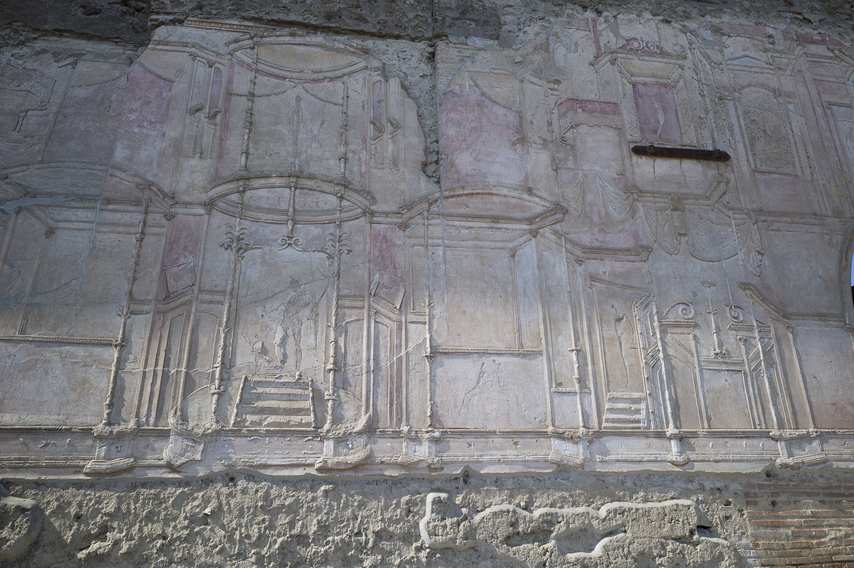
We often tend to associate the idea of Roman baths with a luxurious context reserved for the elite. In truth, Roman society — and Pompeii itself — interpreted these places as transitional spaces frequented by different social strata. Indeed, the most elaborate baths, with prestigious decorations and precious marbles, could give the impression of an opulence inaccessible to the less affluent.
Still, in reality, the same entrance fee was often capped. The differences materialised more in the entrance times and the co-presence of men and women (who, as mentioned, were usually separated).
This is also evidenced by the thefts, mentioned in several graffiti: those who could took along a slave to guard the clothes left in the apodyterium.
Otherwise, it sometimes happened that people left the baths with their clothes or footwear exchanged, or even without them — a curious but quite common case of the everydayness and petty shrewdness of the time.
Visiting the Stabian Baths of Pompeii: Practical Tips
If you are planning a visit to the Pompeii Archaeological Park and want to include the Stabian Baths of Pompeii in your itinerary, here are some valuable tips:
- Buy tickets in advance: Queues can be long, especially in high season. Buying tickets online will allow you to reduce waiting time and spend more time exploring. This ticket includes an audio guide that offers in-depth explanations of the spa.
- Choose the guided tour: Relying on an experienced guide can make all the difference in fully understanding the functioning of the thermal facilities and the technical details of heating.
- Observe the details: Pay close attention to the raised floors, clothing niches, water channels, and wall cavities. Details like these tell more than a thousand words about the Romans’ engineering genius.
- Consider the season: Bring a hat, water and sunscreen if you visit Pompeii in summer. Even the heat can add to the fascination of the experience: imagining how the Romans sought out shaded areas or cooled their rooms helps you understand the importance of the baths in combating the mugginess. On the other hand, if you want to visit Pompeii in winter, don’t underestimate the cold and rain. Paradoxically, exploring the baths on a dreary day can make the experience even more evocative, making you grasp the essence of the comfort they offered the ancients.
Roman Baths: A Legacy Still Alive Today

The importance of Stabian Baths goes beyond their historical function. They tell of a cultural and architectural legacy that has profoundly influenced the concept of “public bathing” and wellness, reaching down to us.
The hammams of many Middle Eastern and North African cities and bathing traditions in some regions of Eastern Europe are linked ideally to the ancient Roman bath.
For the ancient inhabitants of Pompeii, going to the baths was not an optional luxury but an indispensable habit. Indeed, let us not forget that personal hygiene in the ancient world was linked to health, ritual and conviviality matters.
Visiting Stabian Baths today allows one to identify with these customs, imagining the hubbub of those enjoying a hot bath or chatting in the gymnasium, the steam fogging the walls, and the peddlers of oils and strigils roaming the corridors.
Conclusion
If you are trying to figure out what to see in Pompeii besides the famous frescoed houses and the majestic Forum, the Stabian Baths are a must-see. Here, you will be able to experience Roman engineering, the daily life of a people who, although they lived two thousand years ago, shared with us the need to take care of themselves, stay warm, socialise, and carve out moments of relaxation.
So, include this extraordinary spa facility in your itinerary. See the gymnasium, pool, heated rooms and apodyterium where Pompeians left their belongings.
Consider the skill that went into the double walls and suspended floors – a true technical triumph for the time. Finally, remember that the concept of thermal wellness is a legacy that survives to this day in various parts of the world.
An in-depth visit to the Stabian Baths will deepen your understanding and enhance your experience. Between steps, you will glimpse, in the vaults and passages of this ancient complex, the splendours of a civilisation that made hygiene and sociality a raison d’être.
And, perhaps, on your way out, you will think that certain habits, such as those of a hot bath in company, should never be lost.
FAQ About the Stabian Baths of Pompeii
The Stabian Baths are one of the oldest bath complexes in the entire Pompeii archaeological site, located at the intersection of Via dell’Abbondanza and Via Stabiana. Dating back to the 4th-3rd centuries BC, they represent an outstanding example of Roman engineering and wellness culture, which can still be visited by those wishing to explore the daily life of the ancient city.
They owe their name to their proximity to the Via Stabiana, one of Pompeii’s main roads that led toward Stabiae (today’s Castellammare di Stabia). Initially on the periphery, this strategic area eventually became a vital city hub, thanks in part to the presence of this large spa complex.
The baths were places dedicated to personal hygiene and true centres of social life. Ancient Pompeians would relax, discuss business or politics, exercise in the gymnasium, and enjoy the benefits of hot and cold baths. It was a time for meeting and sharing, which people from different social classes could access.
The Stabian Baths are divided into several rooms. The apodyterium, a dressing room, had niches for storing clothes. Frigidarium (cold room): where to cool off quickly.Tepidarium (warm room): a transitional space between cold and warm, ideal for warming the body. Calidarium (warm room): heated by the hypocaust system and equipped with hot water tanks for bathing and ablutions. In addition, the trapezoidal gymnasium served as a space for exercise and socialising, while the natatio (pool) allowed for actual restorative bathing, especially during hotter periods.
Roman baths used the hypocaust, an ingenious underfloor heating system. External furnaces heated the air, circulating under raised floors and inside hollow walls, keeping the temperature inside the bath constant. This extraordinary example of Roman technology provided thermal comfort comparable to our modern heating systems for its time.
Yes, the Stabian Baths were strictly divided into men’s and women’s sections, with separate entrances. Each section had its rooms, including the apodyterium, frigidarium, tepidarium, and calidarium, although they varied in size and decoration. This separation reflects the social norms of the time, which often provided separate times or spaces for the two sexes.
The gymnasium, a trapezoidal courtyard, was a multifunctional area surrounded by a portico. Athletes could exercise or train with light equipment before using the baths. This open area underscores how the baths were also a place for physical well-being, not just a building for washing.
The Stabian Baths offer a comprehensive perspective on daily life in Pompeii, extending beyond the architecture of the large domus and official public buildings. Here we touch on the custom of communal bathing, a true pillar of Roman culture, and better understand the values of sociality, hygiene, and well-being that characterised the city.
The entrance to the Stabian Baths is located along the main path of Via dell’Abbondanza. If you are coming from Porta Marina, you can reach the complex by heading down Via Stabiana; if you have already visited the Lupanare, continue down the alley that connects the two buildings. It is advisable to plan your visit, since, like many attractions at the Pompeii Ruins, it can attract crowds.
Book tickets online to avoid waiting in lines at the entrances. Rely on a guide to find out all the details, especially about the baths’ heating systems and social workings. Take a closer look at the suspended floors and perforated walls, a testament to the genius of Roman engineering.
The city offered similar facilities in addition to the Stabian Baths: the Forum Baths, the Sarno Baths, and the Suburban Baths. The rich presence of thermal facilities highlights how deeply rooted the practice of public bathing was in the Pompeian civilisation. Visiting multiple thermal sites allows for comparing structures and decorations, enriching our understanding of Roman bathing culture.