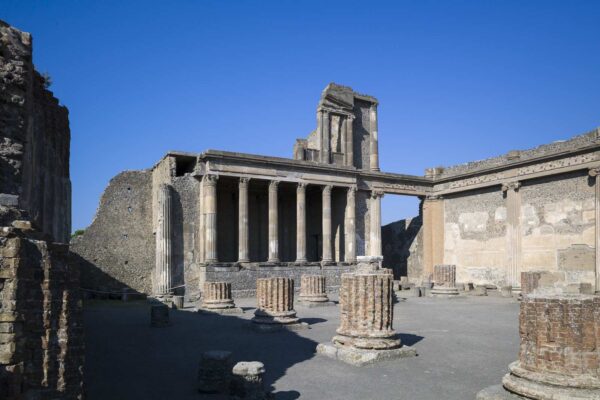
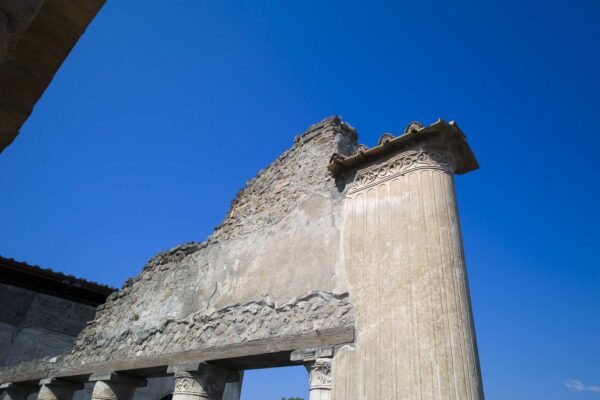
The House of Sirico in Pompeii is an impressive residence formed by the merger of two separate dwellings, located on Via Stabiana and Vicolo del Lupanare, respectively. At the time of Vesuvius’s eruption in 79 AD, the entire complex was undergoing a significant renovation phase, aimed at updating the decorations according to the artistic standards of the era.
This domus gives a vivid glimpse into the social and cultural life of Pompeii, showing how architecture, art and personal prestige were intertwined in one extraordinary testimony. To deepen your understanding of the world its inhabitants lived in, take a look at our in-depth article on the History of Pompeii, tracing the city’s origins and dramatic end.
And if you’re planning a visit, don’t miss the Antiquarium of Pompeii, the onsite museum that showcases artifacts from homes like this one and offers rich insights into everyday life in the ancient city.
Where is it located?
Map of Pompeii: Regio VII – 17
Google MapsOrigins and Owners: Who was Publius Vedius Sirico?
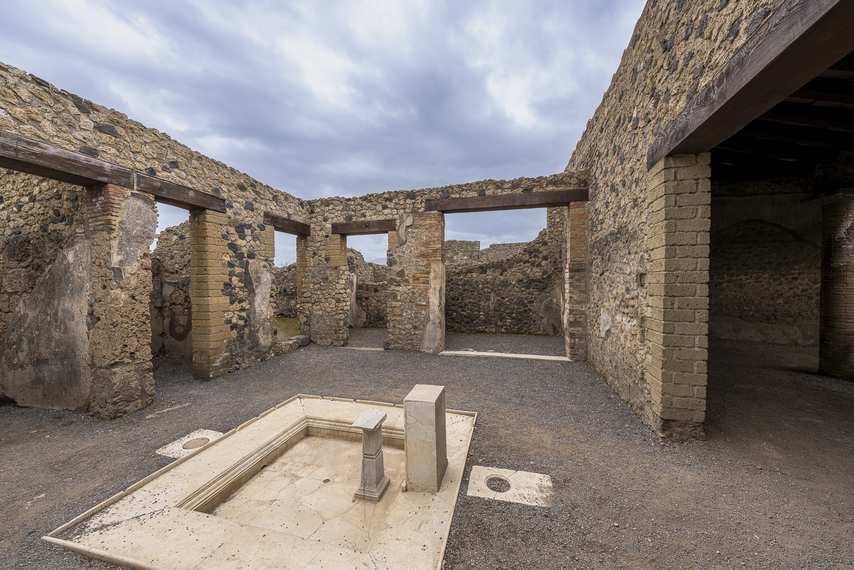
The history of the House of Sirico in Pompeii begins with the acquisition and merger of two dwelling units, dating, by final configuration, to the first century BC. Excavations conducted between 1851 and 1873 revealed the identity of the last owner: Publius Vedius Pollio, also known as Publius Vedius Sirico.
The discovery of a bronze ring seal bearing his name, along with election manifestos related to him, confirmed Sirico’s role as a prominent figure in Pompeian political and commercial life.
At the entrance of one of the two dwellings, on a cocciopesto (crushed pottery) floor, appears the auspicious inscription SALVE LUCRU, translatable to “Welcome gain!”. This greeting emphasises the mercantile character and aspiration for prosperity that distinguished Sirico and his supporters, the clients who came daily to the domus to receive favours, make deals, and support his political career.
Architectural Structure: Two Dwellings in One
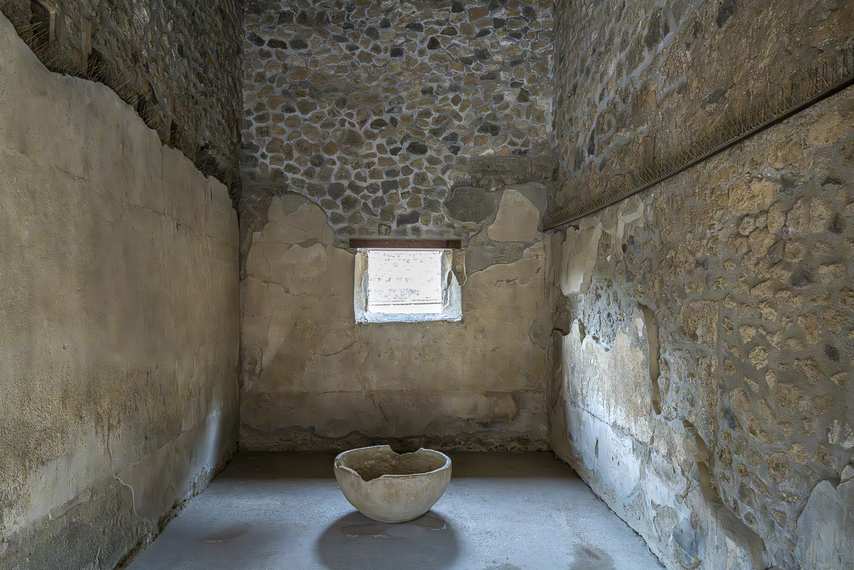
The House of Sirico occupies, in an east-west direction, the central part of insula 1 in Regio VII of Pompeii. Two main entrances can be recognised:
Via Stabiana 25: from here, there was access to an early dwelling, characterised by a Tuscan atrium, a peristyle, and several reception rooms.
Vicolo del Lupanare 47: the other entrance led to the second dwelling unit, which partially overlapped the first and was equipped with its atrium, peristyle, kitchens, and service spaces.
As the decades passed, the two buildings were combined and adapted to form a larger residence, surely intended to host supporters and friends daily. The entire property underwent massive renovations in the years leading up to the eruption, with the adoption of the Fourth Style in the wall paintings, which were particularly in vogue at the time.
Although the work was not finished, some parts, such as the large frescoed exedra, had already been completed and still show the magnificence of the new decorative apparatus.
The Nineteenth-Century Excavation and Modern Restorations
The House of Sirico was explored on several occasions in the 19th century. In particular:
1851-1852: first investigations that uncovered part of the peristyles and some reception rooms.
1857-1859; 1862: more extensive excavations, directed by scholars such as Gaetano Genovese and Giuseppe Fiorelli, introduced a horizontal-layered excavation method that enabled better preservation of the masonry and some roofing.
1872-1873: exploration of the sectors on Via del Lupanare was completed, and the findings were consolidated.
In recent years, the House of Sirico in Pompeii has undergone extensive consolidation and restoration work, completed in 2016. Thanks to this, visitors can now admire it in all its grandeur. During these interventions, special attention was paid to the pictorial apparatuses in the Fourth Style, the opus sectile floors and the open spaces of the peristyles.
The Exedra and the Splendours of the Banquet Hall
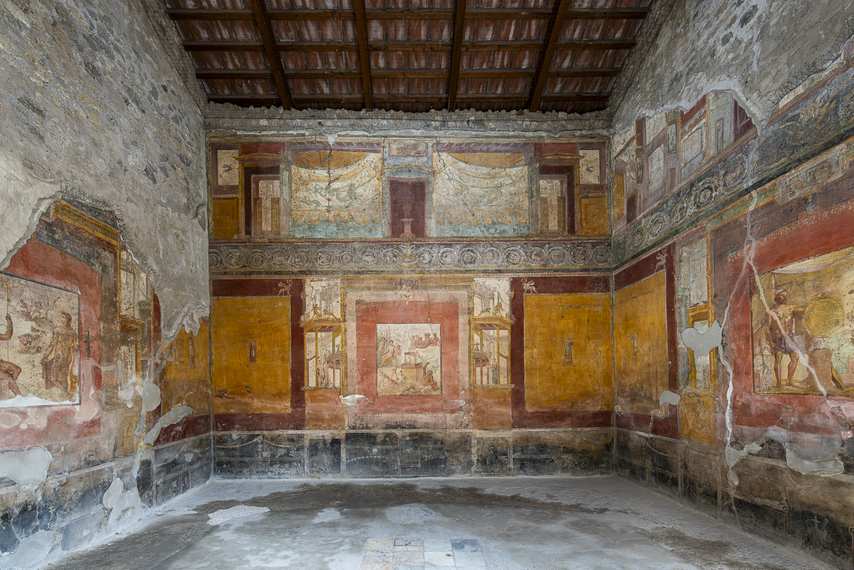
A focal point of the dwelling is the great exedra: here, guests gathered to banquet on tricliniar beds, surrounded by a floor of fine marble slabs. The room was enlivened by fine frescoes depicting mythological episodes related to the Trojan War and Aeneas’s epic events.
One of these paintings, depicting Aeneas being wounded while being treated by Iapige, is now on display at the National Archaeological Museum in Naples.
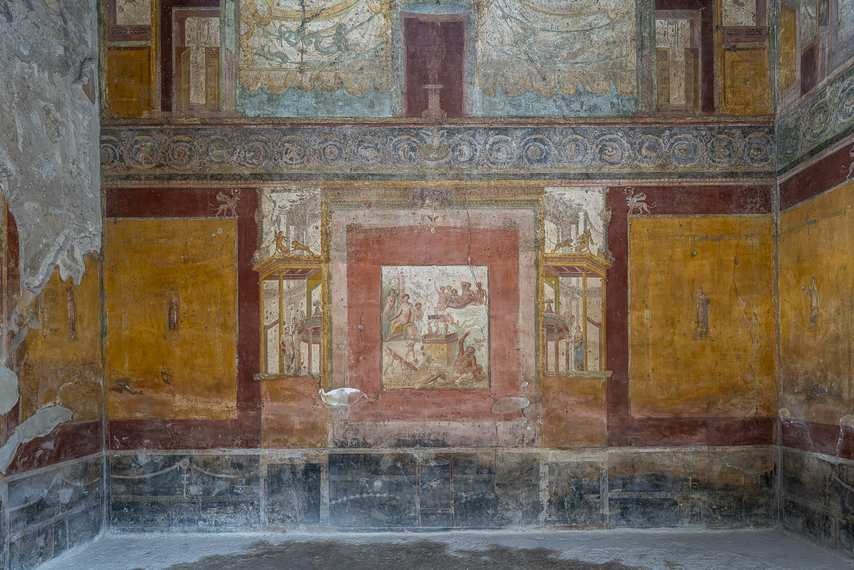
In the exedra, the walls show extensive backgrounds of colour (red, yellow, black) enriched by elegant architectural motifs typical of the Fourth Style: faux columns, aedicules, frames and theatrical perspectives. The central panels housed frescoes with striking scenes, including:
Thetis is in the workshop of Hephaestus, where the goddess asks for new weapons for her son Achilles;
Heracles intoxicated at Onphale, showing the hero overcome by a woman’s charms;
The construction of Troy’s walls, a painting in which Poseidon and Apollo oversee the work, recalls the idea of a construction site in motion and the skill of the workers.
The floor of this area features an exquisite opus sectile, made using marble of various provenance and colour. The open-air triclinium, or rather exedra, also allowed people to enjoy the two adjacent peristyles, where they could continue their summer refreshments and conversations in the sunlight or under the shade of the porticoes.
The Inscription “SALVE LUCRU”: Welcome Gain
A celebrated detail of the House of Sirico is the inscription “SALVE LUCRU(M),” made in white tiles on the entrance floor. It is a greeting addressed to all who enter.
Still, it also alludes to the lively commercial and political spirit of the dominus: Sirico received clients and friends in the vestibule, offering them protection and economic benefits in exchange for support and participation in his public life.
This aspect is crucial to understanding the role of the excellent domus in Pompeii: not just a family residence, but a true place of business and prestige, where clients could discuss trade, run for public office, form alliances, and participate in the network of relationships typical of Roman society.
The Service Rooms and Peristyles
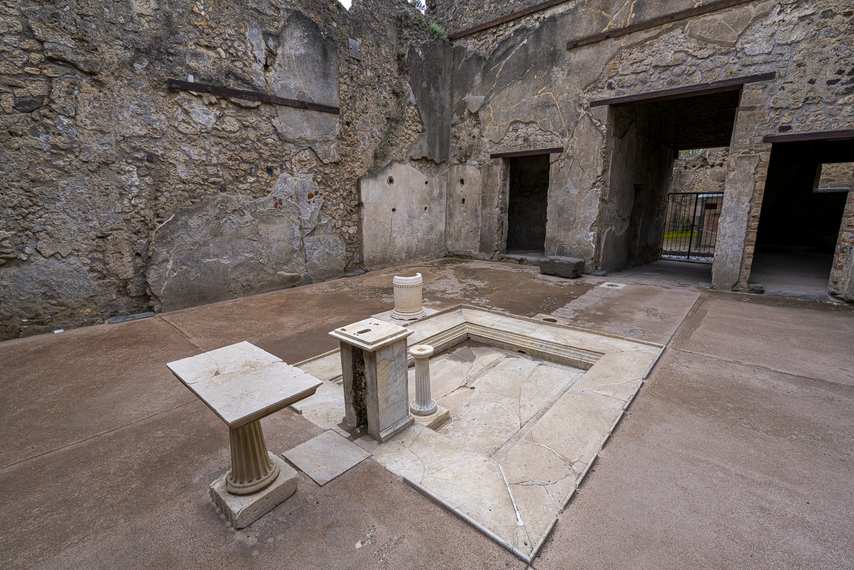
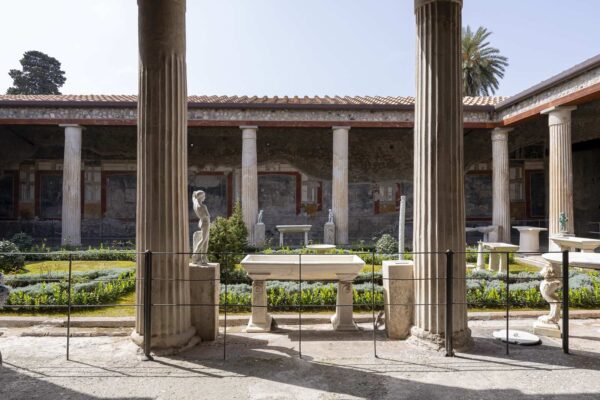
The dwelling boasts as many as two side-by-side peristyles, a sign of a truly extensive dwelling. Outdoor dining was likely set up here during the hot season, with pergolas providing shade and adding to the plant decorations. Columns supported a portico along which cubicles (bedrooms or service rooms) opened, while rooms at the corners were often used as kitchens or pantries.
In particular, peristyles connected the older area, with an entrance on Via Stabiana, to the newer one, which was developed on Lupanare Alley. During nineteenth-century excavations, domestic furnishings were found in these spaces, including vases, bronzes, and even wooden furniture (which was mineralised and reconstructed using cast techniques).
The Triclinium with Fiorelli’s Casts
One of the most moving and evocative aspects of the House of Sirico is the display in the triclinium of three human casts created by Giuseppe Fiorelli. These casts belong to the group of the first four bodies found in the so-called “alley of the Skeletons”: these are individuals who were unable to escape during the eruption, and whose voids between ash and lapilli were filled with plaster to restore the last tragic posture of the victims.
Two casts are intact, while the third preserves only the torso, damaged by bombing in 1943. Recent restoration has returned these casts to a dignified location, protected by a glass screen and accompanied by educational panels explaining their discovery and execution technique.
It represents one of the most poignant moments of the visit: the casts, “kidnapped from death,” become silent witnesses to the drama that the city has experienced.
The Frescoes with Aeneas, Virgilian Heroes and the Trojan War
Another major fresco from this domus, now in the National Archaeological Museum in Naples, depicts Aeneas wounded, being treated by the physician Iapyx, while Venus and little Ascanius watch worriedly. The background is filled with warriors ready to fight, as the episode is set in the final part of the Aeneid, during the epic’s final confrontation.
The presence of Aeneas underscores the prestige that the figure of the Trojan hero had acquired in Campania, thanks in part to the tradition that made him the founder of the Latin people.
Scenes like these, inspired by Greco-Roman epics, recur in many houses in Pompeii, especially in ceremonial settings such as triclinia and exedras, suggesting that literary culture and references to mythology were a way of flaunting one’s status and refinement.
Revival and Today’s Visit
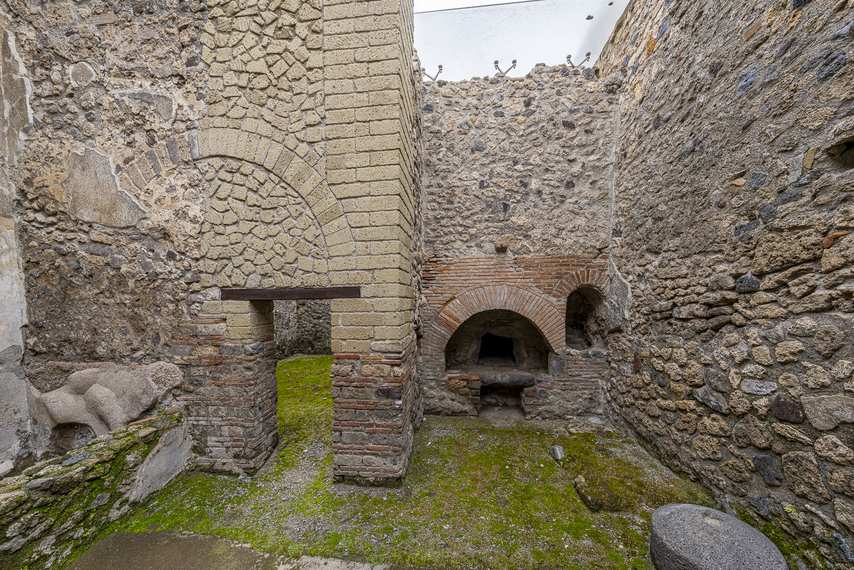
2016 saw the completion of the most recent restoration of the House of Sirico, which returned many rooms to the public: from the Tuscan-style atrium to the two peristyles, from the frescoed exedra to the triclinium where the casts rest, from the service rooms to the restored and consolidated portions of the opus sectile floor.
To visit the House of Sirico in Pompeii today is to relive the splendours of an illustrious personage, to immerse oneself in a far-reaching domestic environment and to contemplate a set of frescoes that range from mythological taste to political propaganda.
It is a place where everyday life at the end of the first century CE resurfaces in a plurality of nuances: from business ventures to attention to one’s image, from political meetings to convivial dinners in the shadow of ornate pergolas and painted columns.
FAQ About the House of Sirico in Pompeii
He was the last owner of the domus, identified by a bronze ring seal. A prominent figure in Pompeian politics and commerce, he welcomed his supporters with the inscription SALVE LUCRU at the entrance.
Visible at the entrance to one of the rooms of the House of Sirico is the inscription “SALVE LUCRU(M)” (“Welcome, gain!”), a wish for economic prosperity addressed to the owner’s visitors and clients. This formula, typical of Pompeii, emphasised the mercantile and political character of the dominus, who intended to welcome his supporters and foster business relations in his home.
The exedra served as a banquet hall, boasting an elegant marble slab floor (opus sectile) and Fourth Style frescoes that depicted mythological episodes, including the Trojan War, the forging of Achilles’ weapons, and the adventures of Hercules.
A room in the house, restored for the occasion, displays three human casts made by Giuseppe Fiorelli, found in “skeleton alley.” The casts testify to the last dramatic phases experienced by some of the inhabitants during the eruption of Vesuvius.
Among the most famous paintings transferred to the MANN is the fresco of the wounded Aeneas, in which Iapigus heal the hero under the gaze of Venus and her son Ascanius. Other mythological scenes, such as the building of Troy’s walls, were initially placed in the exedra.