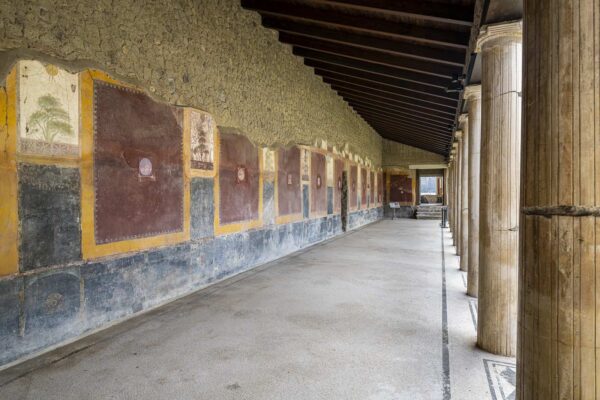
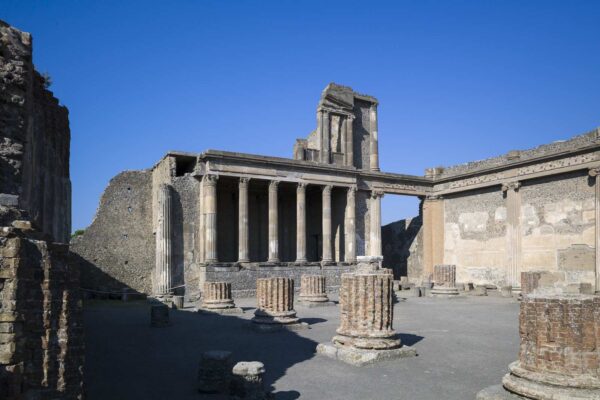
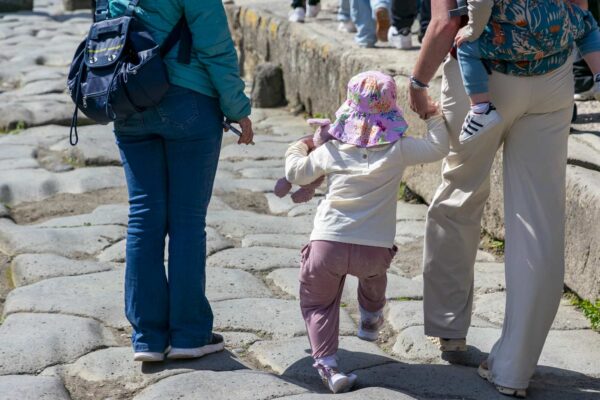
Visiting the Pompeii Archaeological Park is to immerse oneself in the life of a Roman city from the first century AD, tragically cut short by the eruption of Mount Vesuvius in 79 AD. Among the many evocative and historically rich sites, the Garden of the Fugitives stands out as particularly poignant, located in the southern part of the city, in Regio I, Insula 21.
This site, once a simple garden with a vineyard and vegetable garden, is now famous for having returned the remains of thirteen victims of the eruption, including men, women, and children.
Where is it located?
Map of Pompeii: Regio I – 16
Google MapsMeaning of the Name: Garden of the Fugitives

The name “Garden of the Fugitives” derives precisely from the location of the thirteen bodies, found in the area’s ancient vineyard (or vegetable garden) and the evidence that they were trying to flee.
The definition of “fugitives” recalls the excitement of those last moments: it makes us understand that these were not people who stayed at home waiting for fate, but individuals who, perhaps frightened by the falling lapilli, had decided to make a final attempt to escape through the southern exit of the city.
The term ‘fugitives’ aptly conveys the drama, giving a good idea of the drama: an escape driven by the will to survive, rendered futile by the arrival of a pyroclastic surge. The conditions under which the bodies were found – partly overlapping, with some children protected by adults – underscore the chaos and speed of the event.
A Garden Between Daily Life and Tragedy

Before the catastrophe, the Garden of the Fugitives was an agricultural area where vegetables, vines, and other products were grown to meet the needs of the local population. Its location, close to the Palestra Grande (Large Palestra) and not far from Porta Nocera, allowed easy access to the fields and paths outside the city.
Some sources suggest that a couple of smaller houses were located in this insula, while most of the land was used as a garden and vineyard, with a pergola-covered area for outdoor banquets. The tending of the fields reflected the city’s agricultural vocation, a characteristic that also contributed to Pompeii’s flourishing due to the fertile soils surrounding Mount Vesuvius.
Today, the area has been expertly restored to recall the ancient appearance of this green space. Walking among the reconstructed rows and decorative plants, one can imagine the daily life of the Pompeians: from working in the fields to convivial occasions, such as outdoor meals under a pergola.
However, the Garden of the Fugitives also recalls a dramatic moment in the city’s history: the one when a group of men, women, and children desperately tried to escape the fury of the eruption.
The Discovery of the Thirteen Casts
The casts of thirteen victims were unearthed during excavations conducted between April and June 1961 under the direction of Amedeo Maiuri, then superintendent of Pompeii. When archaeologists came across cavities in the ground formed by decomposed bodies, they decided to use a method invented by Giuseppe Fiorelli in the mid-19th century: they poured liquid plaster into these voids.
Once solidified, the plaster shockingly restored the last pose of the people who had lost their lives there.
The result was dramatic and deeply moving: thirteen human figures, including children and adults, appeared as if time had stopped a moment before their deaths.
Many of these victims display protective postures (such as hands on their faces or chests), a sign that they attempted in extremis to defend themselves from the heat and ash rain. Some bodies appear clutching each other, while others appear isolated, as if they were still trying to find a way out toward Porta Nocera.
Why did They Die in the Garden?

In late autumn 79 A.D., the eruption of Vesuvius began with a column of ash and lapilli that rose for miles, darkening the sky and causing roofs to collapse under the weight of the volcanic materials. Most of Pompeii’s inhabitants, realising the danger, fled in the first hours of the eruption.
Those who remained probably underestimated the severity of the events or hoped to save their property.
In the early hours of the next morning, about twenty hours after the eruption began, a series of pyroclastic clouds at high temperature (reportedly 200-300 °C, or even more) and at great speed (up to 100 km/h) swept over the entire city, killing instantly anyone still present.
The people found in the Garden of the Fugitives were either attempting to leave the city through the nearby Porta Nocera, perhaps already partially obstructed by meters of pumice and lapilli, or were looking for a secondary gateway in a southerly direction. A burning cloud engulfed them, the pyroclastic surge, which overwhelmed them instantly, causing immediate death from heat shock.
Tangible Pain
The evocative power of the casts is extraordinary: we are not dealing with mere skeletons, but with individuals whose build, facial expression, hairstyle, and clothing features we can recognise.
A woman shields her face, a child almost seems to be sleeping with his little hands on his chest, and a man supports himself on his arms, as if trying to get up. Compared to other Pompeii victims, the bodies in the Garden of the Fugitives offer a particularly moving glimpse, because they allow us to capture the emotion of the escape attempt and the sudden devastation of the moment.
When these accounts are presented, it is impossible not to feel empathy for the people who, two thousand years ago, led their lives in a way that is probably similar to our own daily lives. The portrait of despair and shattered hope is one of the most moving aspects of a visit to the Garden of the Fugitives.
Amedeo Maiuri’s Interpretations and Modern Research
Amedeo Maiuri, superintendent of the excavations in Pompeii from 1924 to 1961 and a key figure in the study of the Vesuvian area, was the archaeologist who, soon after the discovery of the casts in the Garden of the Fugitives, proposed a possible “story” for each body: he imagined them as families or groups of acquaintances, giving them an interpretive identity (the ‘merchant,’ the ‘frail mother,’ the ‘servant carrying a bag’).
These reconstructions, published in National Geographic magazine in 1961, had a strong emotional impact on the public, but turned out to be partly fictional.
Modern research has clarified that the archaeological data do not support many of Maiuri’s stories. Thanks to more precise analyses, such as X-rays or studies on the state of preservation of the bones, it has been discovered that some “bags” were simply plaster casting defects, while more objective findings have been obtained on pathologies like osteoarthritis.
Nevertheless, Maiuri’s idea of “telling” these lives contributed significantly to the general public’s interest in the Garden of the Fugitives.
The Challenge of Conservation

The Garden of the Fugitives also presents a challenge from a conservation perspective. Casts made of plaster are delicate and sensitive to moisture, weathering and possible collapse of nearby structures.
Several casts remained exposed outdoors or only partially protected for a long time. In recent decades, thanks to the “Great Pompeii Project” and increased awareness, a systematic examination of the casts has begun, using laser scanning surveys and the creation of 3D copies.
These reproductions in resin or other modern materials allow the casts to be displayed in temporary exhibitions worldwide, protecting the originals.
Even today, walking through the Garden of the Fugitives, one can see the casts displayed in situ, positioned where they were initially discovered.
Some protective covers and glass cases shelter them from the weather, but the open-air context keeps the evocative power of the in situ discovery intact. It is a delicate balance between the need to safeguard this unique heritage and the desire to show it to visitors in a setting as close as possible to the original one.
How to Visit the Garden of the Fugitives in Pompeii
For those who wish to include the Garden of the Fugitives in their itinerary, here are some valuable tips:
- Timing: Consider that visiting Pompeii requires at least a full day to see the most important sites, such as the Forum, the Amphitheatre, some frescoed domus, the Baths, etc.
- Sensibility: the Garden of the Fugitives is not merely an archaeological discovery but a proper memorial to a group of people. Respect for the victims and awareness of the drama they experienced should accompany every tourist. Avoid climbing on structures or touching casts, and maintain an appropriate attitude.
- Protection from the sun: The site is very hot in the summer and often lacks shade. Bring water, a hat and sunscreen with you. This will allow you to enjoy the experience without discomfort.
- Guided tours: If you want a comprehensive overview of the cast technique and the history of the victims, consider taking a guided tour. Professional guides can share anecdotes and trivia and explain the latest archaeological discoveries related to the area.
Why is it Worth Visiting
The Garden of the Fugitives is a stop that exemplifies the tragedy that befell the city more than any other. In a place where nature and the work of the fields merged, thirteen human beings attempted a last desperate escape. The result, unfortunately, was failure: history has delivered them to us as casts that, with disconcerting realism, tell us about the past.
Compared to other Pompeian contexts, where the focus is on architectural beauty and decoration, here the human aspect takes over: we are faced with women, men and children, snatched from life in seconds.
Many international exhibitions have recently displayed copies of these casts, leaving a lasting impression and prompting deep reflections on the fate and precariousness of existence. Yet seeing them in situ, in their original environment, retains an unparalleled emotional power.
The Garden of the Fugitives is thus a symbol of how much archaeology can tell us about real people and how a natural event can turn the course of a civilisation upside down in an instant.
Conclusion
If you plan a visit to the Pompeii Archaeological Park, including the Garden of the Fugitives in your itinerary will enrich your experience. It is not just an archaeological site, but a place of remembrance that recalls, with heartbreaking immediacy, the tragedy of 79 A.D. and puts us in direct contact with lives lived two thousand years ago.
Among rows of vines and reconstructed vegetables, in the presence of the casts of the thirteen unfortunate Pompeians, you will be able to understand the grandeur of a Roman city and, at the same time, the overwhelming power of nature.
Leave room for a moment of reflection, respecting the dignity of these victims while recognising the importance of studying, preserving, and transmitting such evidence.
The Garden of the Fugitives is an essential chapter in fully immersing ourselves in what Pompeii was and what, through tragedy, it has left us: a powerful tale of history, everyday life, and timeless humanity.
FAQ About the Garden of the Fugitives
The Garden of the Fugitives is an archaeological area in the southern part of the Pompeii excavations, in Regio I, Insula 21. Once used as a garden and vineyard, it is now sadly known for the remains of thirteen victims of the 79 A.D. eruption of Vesuvius, found in positions that testify to their last desperate attempt to escape.
One of the most poignant places to view the casts of Pompeii’s victims is precisely the Garden of the Fugitives. Here, one can see the remains of thirteen people, including children, who were trying to flee to the southern exit of the city when a pyroclastic surge swept them away.
The name comes from discovering thirteen bodies in the ancient vegetable garden, also known as a vineyard, that borders the area. They are called “fugitives” because the casts show how they were trying to escape the catastrophe. This designation emphasises the extreme attempt at salvation and the human aspect of the Pompeian tragedy.
The casts were identified during the 1961 excavations directed by Amedeo Maiuri. Using the technique devised by Giuseppe Fiorelli in the 19th century, archaeologists poured liquid plaster into the cavities left by the decomposed bodies. Once solidified, the casts revealed with dramatic accuracy the last pose of the people affected by the eruption.
Unlike simple skeletons, the casts allow us to capture details such as facial expression, posture, and signs of protection (hands on the face, bodies on top of each other). In this way, they convey the desperation and humanity of those who were trying to escape two thousand years ago, giving the visitor a powerful emotional impact.
The area was intended for cultivating vegetables and vines, near Porta Nocera, a possible escape route from the city. The thirteen individuals were there in an attempt to overtake the southern area to leave Pompeii, but they were caught in high-temperature pyroclastic clouds, which caused their instant death.
Amedeo Maiuri, superintendent of the excavations during the years when the casts were found, was instrumental in interpreting and popularising the discoveries. Although he provided the bodies with partially hypothetical “histories,” he helped acquaint the general public with the dramatic reality of the fugitives and elicited a substantial emotional impact on visitors and researchers.
Plaster casts are very delicate and susceptible to weathering. Thanks to restoration projects and the ‘Grande Progetto Pompei’ (Great Pompeii Project), a protection program has been initiated in recent years. Some casts have been protected with covers or moved to safe exhibition areas, while 3d replicas allow them to be used in international exhibitions, preserving the originals.
The Orto dei Fuggiaschi offers direct contact with the human tragedy of the eruption. Compared to other areas focused on frescoes and architecture, the emphasis here is on the catastrophe’s more dramatic and intimate dimension. Seeing the casts on the spot where they were found adds value to the archaeological narrative, reminding the visitor that Pompeii was not just a set of extraordinary buildings, but more importantly, a city of real people.
The Garden is in the southeastern part, near the Great Gymnasium and the Amphitheatre Gate. If you entered through Porta Marina, you will have to walk most of Via dell’Abbondanza until you meet Vicolo dei Fuggiaschi on the right, which will take you to the Garden.