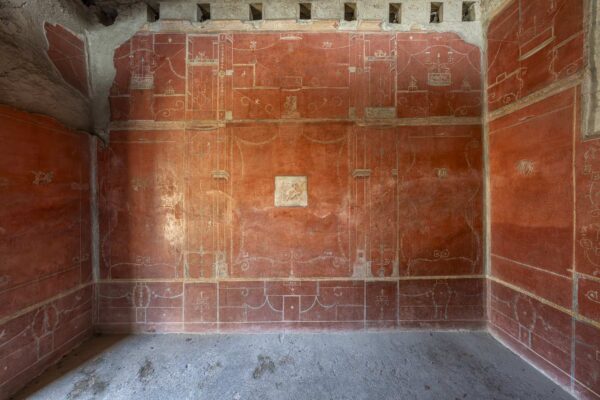
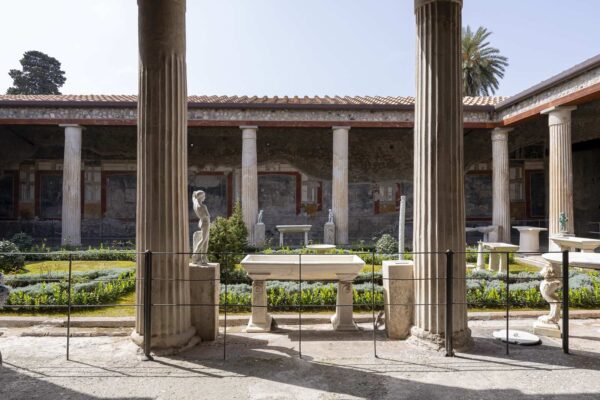
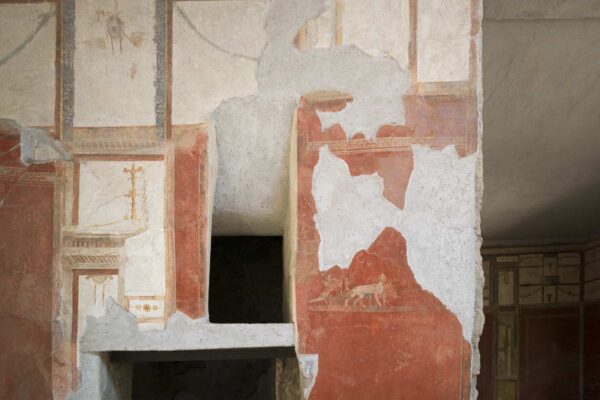
Pompeii is one of the most fascinating archaeological sites in the world, and devoting an entire day to its exploration will allow you to fully immerse yourself in the daily life of the ancient Roman city.
With one day at your disposal, you’ll be able to visit not only the iconic sites but also the lesser-travelled areas, discovering extraordinary frescoes, aristocratic dwellings, and evocative glimpses that tell the stories of a bygone era.
Our itinerary will guide you through a well-thought-out route that includes the Forum, the political and economic heart of the city, the Forum Baths and the Forum Basilica of Pompeii, not to mention the more sumptuous houses, such as the House of the Faun, the House of the Vettii and the House of the Golden Cupids, with their spectacular mosaics and decorations. Strolling along the Via dell’Abbondanza, the city’s main thoroughfare, you can admire public and private buildings until you reach the impressive Temple of Isis and the Large Theatre, with a fascinating view from the panoramic overlook.
The itinerary also includes stops at places of great emotional impact, such as the Fullonica of Stephanus, the city’s ancient laundry, and the famous Lupanar, testimony to the daily life and customs of the time.
Continuing along the most charming alleys, you will discover the House of the Tragic Poet, the House of Octavius Quartius, the House of the Orchard, and many other mansions that reveal the luxury and elegance of their ancient inhabitants.
One of the most fascinating moments of the day will be a visit to the Villa of the Mysteries, one of the most famous ancient residences, with its extraordinary frescoes of enigmatic significance.
Here you can decide whether to end the visit or continue to the Garden of the Fugitives.
This area preserves the footprints of those who tried to escape the eruption of Vesuvius. Finally, reaching the Necropolis of Porta Nocera, you will have a chance to reflect on the history and fate of Pompeii’s inhabitants before leaving the archaeological site.
Seven hours will allow you to discover Pompeii unhurriedly, allowing you time to admire the extraordinary artistic and architectural details that make this city unique in the world. If you want an even more in-depth experience, you can always return to explore every hidden corner of this incredible treasure of the past.
Note: Each stop on the recommended route is indicated in parentheses with a Roman numeral followed by an Arabic numeral, for example (Regio VI – 1).
The Roman number, known as Regio, represents one of the official subdivisions of the archaeological site of the Pompeii Archaeological Park. Each Regio corresponds to a specific geographical area or functional zone within the ancient city, such as residential, commercial, public or religious areas.
The Arabic number following the Regio identifies the exact location of the place within that specific area, according to the official map of the Pompeii Archaeological Park.
This numbering system facilitates orientation and navigation between the different attractions, allowing visitors to follow the route in an organised and informed manner, ensuring an efficient visit.
Recommended Itinerary to Visit Pompeii in One Day
A visit to Pompeii with our seven-hour itinerary begins at the entrance in Piazzale dell’Anfiteatro. After entering, continue along the Piazzale dell’Anfiteatro, where on the right you will find the Amphitheatre of Pompeii, which you can enter to begin your exploration.
Amphitheatre of Pompeii (Regio II – 5)
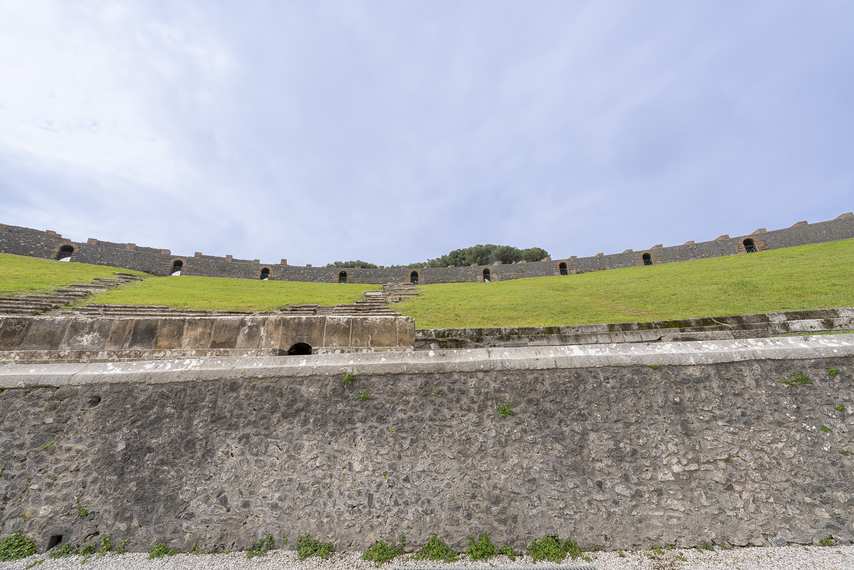
The Amphitheatre of Pompeii, built around 70 BC, is the oldest extant Roman amphitheatre and is excellently preserved. It could accommodate up to 20,000 spectators, who watched gladiator fights and public performances.
Its elliptical structure takes advantage of the natural terrain and features tiers divided by social class, a wide arena and reserved entrances for magistrates and fighters. After an earthquake in 62 AD, it was restored, but in 79 AD, the eruption of Vesuvius buried it.
Today, it represents one of the most significant attractions of the Pompeii Archaeological Park.
Google Maps indication:
https://maps.app.goo.gl/1asfZDbJM4Q14Qm67
Why visit the Amphitheatre of Pompeii?
- It is the oldest preserved Roman amphitheatre, predating even the Colosseum.
- It offers an authentic view of public life in ancient Pompeii.
- It allows visitors to immerse themselves in the atmosphere of gladiatorial shows and Roman society.
- It constitutes an impressive vantage point, with Mount Vesuvius in the background.
What to admire in the Amphitheatre of Pompeii?
- The Cavea: the tiers of seats divided into three sections according to social class.
- The Arena: the ample central space where fights took place.
- The monumental entrances: entrances reserved for magistrates and gladiators.
- The traces of the Velarium: the tent that protected spectators from the sun.
- The graffiti and inscriptions: evidence left by ancient Pompeians.
- The absence of dungeons: a difference from the Colosseum, revealing a more straightforward and more functional structure.
- The historical episode of 59 AD is the famous brawl between Pompeians and Nocerans, which led to the amphitheatre’s closure for ten years.
The amphitheatre is an essential stop for anyone visiting Pompeii. It offers a unique perspective on the spectacularity and social value of public events at the time.
Would you like to learn more about the Amphitheatre? Read our in-depth article.
Leaving the Amphitheatre, you will find yourself in Piazzale dell’Anfiteatro. Before you stands the Palestra Grande (Large Palestra): we invite you to enter and discover its history and architecture.
Palestra Grande (Large Palestra) (Regio II – 6)
Pompeii’s Palestra Grande, built in the late 1st century B.C., was the city’s central gymnastic facility and a focal point for young people associated with the collegia iuvenum, which Augustus wanted.
Damaged by the earthquake in 62 AD, it was restored but not completed before the eruption of Vesuvius. The structure features a vast portico with columns, a large central pool, and graffiti that tells stories of daily life. Today, it is a must-see place to understand physical education and social life in ancient Pompeii.
Why visit the Palestra Grande?
This space was the hub of Pompeii’s sports and educational activities, representing an essential socialisation and physical training centre. Its proximity to the Amphitheatre makes it a key point for understanding Roman public life and the link between sports, politics, and society.
In addition, recent archaeological discoveries, including frescoes and casts of eruption victims, add further historical and cultural value to the visit.
What to admire in the Palestra Grande?
- The vast colonnade surrounds the central area and features brick columns covered in white stucco, decorated with Ionic capitals.
- The central pool was used for swimming and other gymnastic activities, measuring 34 x 22 meters and with a sloping bottom allowing for different depths.
- The graffiti on the walls is evidence of daily life, with political, amorous, and erotic messages, including an engraving of Venus.
- The Sator Square: An enigmatic inscription (SATOR AREPO TENET OPERA ROTAS) engraved on a column, still a symbol of debate among scholars.
- Casts of the victims of the eruption: Human remains and personal objects found inside the gymnasium and near the perimeter wall tell of Pompeii’s inhabitants’ last moments.
Exiting onto the Piazzale dell’Anfiteatro and continuing north, you will find the entrance to the House (Praedia) of Julia Felix.
House (Praedia) of Julia Felix (Regio II – 3)

The House (Praedia) of Julia Felix represents a rare example of an “urban villa” in Pompeii, with a structure that combines luxury and functionality.
After the earthquake in 62 CE, the owner rented part of the house, including workshops and private baths, in response to the housing crisis.
The dwelling, with its elegant garden enriched by a water canal (euripus), marble colonnades, and a fine spa facility, offers an immersion into the life of a Roman-era businesswoman.
Google Maps indication:
https://maps.app.goo.gl/FgPPcGQGB8MTvEvM8
Why visit the Praedia of Julia Felice
This villa allows us to discover a previously unseen aspect of Pompeii: its ability to adapt to social and economic changes following the 62 AD earthquake.
Giulia Felice was one of the few female entrepreneurs of the time, and her dwelling shows the combination of luxury and commercial activity, testifying to the city’s economic vitality.
What to admire in the Praedia of Julia Felix
- The Euripus, the charming water channel that runs through the garden, is surrounded by a portico with marble-covered quadrangular columns.
- The frescoes, featuring scenes of daily and mythological life, are among those preserved at the National Archaeological Museum in Naples.
- The private bathhouse, which had been made public after the earthquake, had elegantly decorated baths.
- The summer triclinium, with marble beds and a cascading fountain, was a place for banquets and meetings.
Would you like to learn more about the Praedia of Julia Felix? Read our in-depth article.
Leaving the Praedia of Julia Felix, walk west along Via di Castricio until you reach Vicolo di Giulia Felice on the right. After about forty meters, enter the opening on the left to visit the House of Venus in the Shell.
House of Venus in the Shell (Regio II – 2)
The House of Venus in the Shell is a luxurious dwelling in Pompeii, located along Via dell’Abbondanza, and was brought to light in 1952.
It owes its name to the famous fresco of the goddess Venus, depicted lying on a white shell carried by the waves, surrounded by cupids and natural symbols.
The most striking room of the house is the peristyle, adorned with painted columns and frescoes that recall a lush garden.
The mansion, which probably belonged to the Satrii family, is a perfect example of a Roman aristocratic house, featuring refined spaces and impressive pictorial decoration.
Google Maps indication:
https://maps.app.goo.gl/a9W9obTPm6oaqJfW9
Why visit the Venus in the Shell House?
The House of Venus in the Shell is a masterpiece of Pompeian art, with one of the most iconic frescoes in the entire archaeological site.
The depiction of Venus, the patroness of Pompeii, not only testifies to the cult of the goddess in the city but also offers insight into the aesthetic and symbolic sophistication of aristocratic dwellings of the time.
The house’s layout, with its garden and decorations inspired by nature and myth, allows us to immerse ourselves in the daily life of a wealthy family in Pompeii before the eruption.
What to admire in the House of Venus in the Shell?
- The Venus in Shell fresco depicts the goddess on a white shell surrounded by cupids and a seascape.
- The collonaded peristyle, decorated with paintings of gardens, fountains and trees, creates an effect of continuity between interior and exterior.
- The frescoes of Mars and the fountain with birds frame the central scene, reinforcing the connection to nature and mythology.
- The house’s architecture, with its atrium, tablinum, and triclinium, tells the story of its inhabitants’ social and private lives.
Leaving the House of Venus in the Shell, continue west along Via dell’Abbondanza for about twenty meters, then enter on the left to visit the House of Octavius Quartius.
House of Octavius Quartius (Regio II – 1)
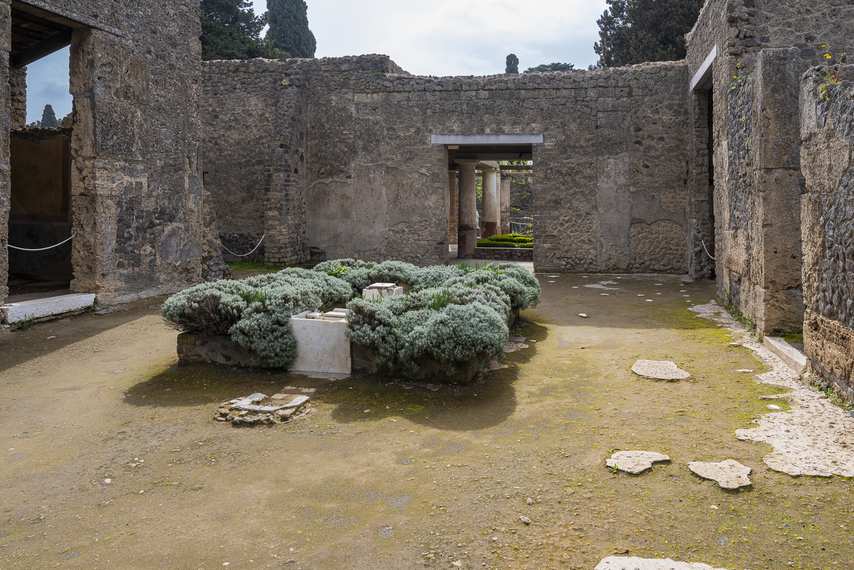
Google Maps indication:
https://maps.app.goo.gl/D3N2F3WqRz3ZrYS46
The House of Octavius Quartius, located along Via dell’Abbondanza, is one of the most fascinating dwellings in Pompeii. It features a large garden with a striking T-shaped canal, probably used for rituals inspired by the cult of Isis.
The interior rooms are decorated with fine frescoes in the IV style, including mythological scenes of Narcissus, Pyramus and Thisbe. A bronze seal identified the owner as Decimus Octavius Quartius.
The house offers a rare example of a fusion of Roman and Egyptian elements, testifying to the spread of the Isiac cult in Pompeii.
Why visit the House of Octavius Quartius?
This dwelling allows visitors to immerse themselves in Pompeii’s sophisticated and multicultural atmosphere.
Its vast garden, the canal reminiscent of the flooding of the Nile, and numerous Egyptian statuettes reflect the influence of the Isiac religion in the Roman city.
In addition, its exquisite frescoes tell myths related to love and metamorphosis, offering an artistic testimony of the highest order.
What to admire in the House of Octavius Quartius?
- The monumental garden, with a long artificial channel shaped like a “T,” symbolises fertility and is linked to Egyptian worship.
- The mythological frescoes, including those of Narcissus at the spring and Pyramus and Thisbe’s suicide, were inspired by classical literature.
- The Trojan-themed decorations featured Hercules and the expedition against Laomedon.
- Egyptian influences are evident in the statuettes of deities like Isis and the paintings of Isis priests.
- The sacred aedicule and nymphaeum, from which the canal originated, were used for religious rites and outdoor banquets.
This house is a true jewel of Pompeian archaeology, combining art, architecture and spirituality in one extraordinary space.
Exit onto Via dell’Abbondanza and continue west for about 180 meters. The entrance to the House of the Orchard is on the left.
House of the Orchard (Regio I – 13)
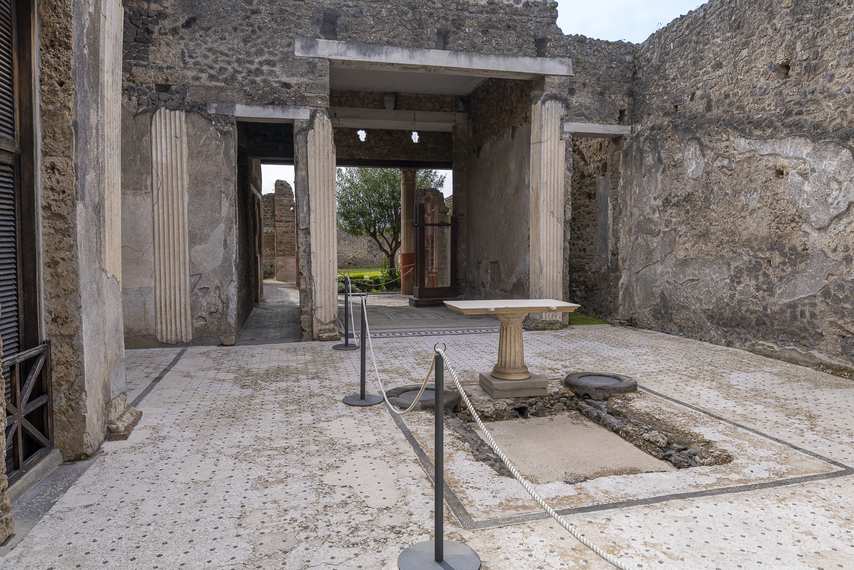
The House of the Orchard, or House of the Floral Cubicles or House of Euplia, is a small but fascinating domus in Pompeii, famous for its extraordinary garden frescoes.
Unlike other residences, the garden painting is not in the reception rooms but in the private cubicles, creating an immersive atmosphere.
The decorations depict plants, birds and Egyptian motifs, suggesting a possible devotion to the goddess Isis. The real and painted garden amplifies the sense of space and harmony.
Google Maps indication:
https://maps.app.goo.gl/eKMYBjS2RkWsnLZF8
Why visit the House of the Orchard?
This domus offers a rare example of garden painting applied to private spaces, transporting visitors to a world of colour and nature.
The presence of Egyptian elements adds an exotic and mystical touch, making it unique compared to other dwellings in Pompeii.
The house is perfect for those fascinated by art, botany and ancient religious cults.
What to admire in the House of the Orchard?
- Garden frescoes in the cubicles, with plants such as lemons, laurel and strawberry trees, as well as birds in flight.
- Egyptian symbolism features depictions of Isis, Dionysus, and Egyptian statues set against vegetation.
- The black cubicle features decorations related to the Isiac cult and an image of Dionysus on a panther.
- The triclinium was painted black, with mythological scenes and imaginary architecture.
- The royal garden, with a summer triclinium, is a green space that amplifies the mansion’s relaxing atmosphere.
Exit onto Via dell’Abbondanza and continue west for about 70 meters. Turn left into the Vicolo dell’Efebo and, after about 40 meters, enter the House of the Ephebe on the right.
House of the Ephebe (Regio I – 9)
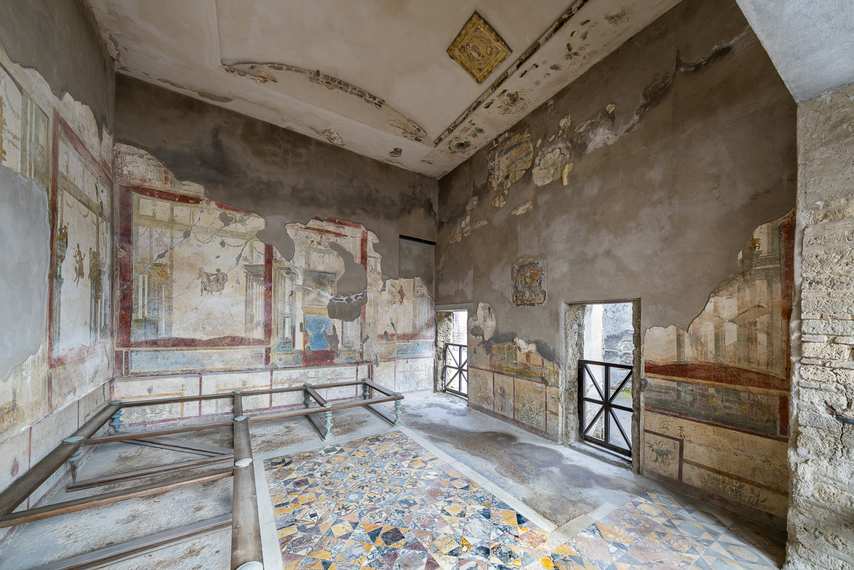
The House of the Ephebe, located on a side street of Via dell’Abbondanza, is one of Pompeii’s most luxurious dwellings. Its name comes from the bronze statue of an ephebe found in the garden.
The house, which belonged to Publius Cornelius Tegeste, a merchant who enriched himself through trade, is the result of the fusion of several dwellings.
It features rooms decorated in the fourth style, with fine frescoes, a vast garden with fountains, and a masonry sofa.
Among the findings, valuable objects and artistic furnishings demonstrate the owner’s taste for art.
Google Maps indication:
https://maps.app.goo.gl/UX1GuJkyhPuqenBo9
Why visit the House of the Ephebe?
This dwelling provides insight into the luxury and artistic refinement achieved by Pompeian elites. The rooms, decorations and objects found bear witness to the life of a wealthy merchant, offering a unique insight into Pompeian society before the eruption of Vesuvius.
What to admire in the House of the Ephebe?
- Fine frescoes: Mythological scenes and still lifes decorate the walls elegantly.
- Statue of the Ephebe: A bronze masterpiece that served as a lamp, now housed in the Archaeological Museum of Naples.
- Garden with fountain: This scenic area with Nilotic decorations and a masonry sofa is a place of refreshment and entertainment.
- Luxury rooms: Ornate triclini, hot-water baths, and fine objects found in the rooms.
This house represents an authentic jewel of Pompeii, testifying to its era’s aesthetic taste and economic prosperity.
Exit onto Vicolo dell’Efebo and continue south until you reach Via di Castricio.
Turn right and walk along it for a few meters until it intersects with Vicolo di Paquius Proculus.
Continue down this alley for about fifty meters until you find the House of Paquius Proculus entrance on the right.
Would you like to learn more about the House of the Ephebe? Read our in-depth article.
House of Paquius Proculus (Regius I – 8)
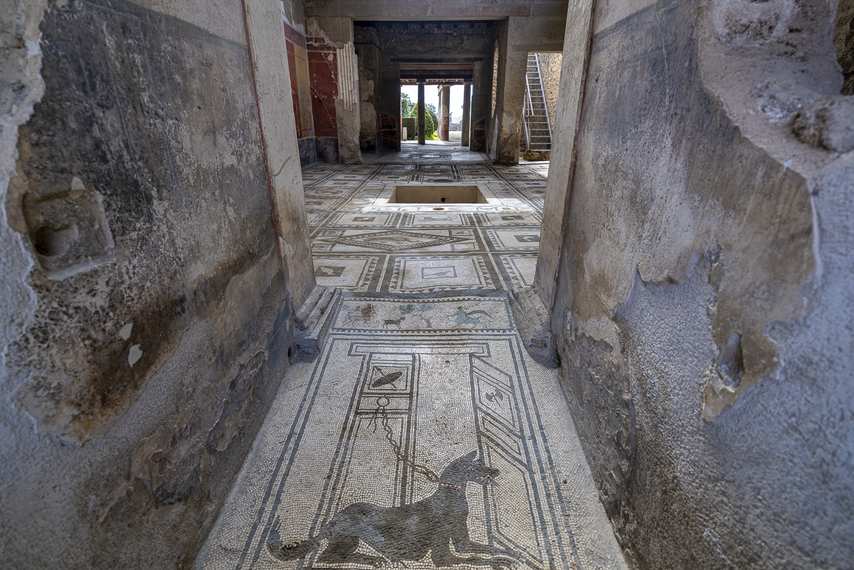
The House of Paquius Proculus, located on Via dell’Abbondanza, is one of the most representative dwellings of the Pompeian bourgeoisie.
Dating back to the 2nd century BCE, it is notable for its extraordinary floor mosaic, one of the most extensive and best-preserved in Pompeii, depicting symbolic animals.
The dwelling features a peristyle with garden, a marble pool, and decorative frescoes, including a Nilotic scene in the triclinium.
Attributed to the duovir Paquius Proculus, the famous depiction of the Pompeian couple may instead depict Terentius Neo and his wife.
Google Maps indication:
https://maps.app.goo.gl/iCAhSQ4YKmx7phDW8
Why visit the House of Paquius Proculus?
This dwelling offers a window into the social and economic life of the Pompeian middle class. Its lavish mosaics, exquisite frescoes, and perfectly organised spaces show a wealthy family’s desire for status and wealth.
In addition, the connection with the famous image of the Pompeian couple makes the visit even more evocative.
What can you admire in the House of Paquius Proculus?
- The mosaic of the dog on the chain, a warning against thieves, is located at the entrance.
- The atrium floor is decorated with geometric figures and symbolic animals.
- The peristyle, featuring a garden, is adorned with a marble basin and columns that support a pergola.
- The triclinium frescoes, particularly the striking Nilotic scene with Pygmies intent on fishing.
- The iconic depiction of the Pompeian couple, preserved at the Archaeological Museum in Naples, offers a fascinating glimpse into 1st-century AD Pompeian society.
Exiting on Vicolo di Paquius Proculus, turn right and continue south.
At the intersection with Via di Castricio, you will find the entrance to the House of Menander on the right, which we invite you to visit.
House of Menander (Regio I – 7)
The House of Menander is a sumptuous Pompeian domus, measuring approximately 1,800 square meters, a perfect example of a wealthy family’s residence in ancient Pompeii.
Excavated between 1926 and 1932, the house takes its name from a fresco depicting the Greek poet Menander.
The house underwent several modifications over time, including a peristyle and private baths.
Of particular significance is the discovery of a “treasure” of silver objects and coins, hidden during restoration work before the eruption of Vesuvius.
Google Maps indication:
https://maps.app.goo.gl/QYgCpTMt186otZEn7
Why visit the House of Menander
The House of Menander is one of the best-preserved domus in Pompeii and provides insight into the daily life of the Roman elite.
The elegance of the decorations and the presence of private baths testify to the luxury and prestige of this dwelling, offering a unique window into Pompeian society.
What to admire in the House of Menander
- The atrium is one of the house’s oldest rooms, built around 250 BC.
- The peristyle: a large porticoed courtyard added in the Augustan period.
- The paintings of the fourth style include the fresco of Menander, which gives the domus its name.
- The calidarium mosaic: with a depiction of acanthus surrounded by fish and dolphins.
When you have finished visiting the House of Menander, exit onto Vicolo del Menandro heading north. In front of you will find the House of the Cryptoporticus entrance.
House of the Cryptoporticus (Regio I – 5)

The House of the Cryptoporticus, located in the central area of Pompeii, is a luxury residence built on two levels.
It is characterised by an elegant cryptoporticus with frescoes inspired by the Iliad, a private bath complex, and a large oecus with Dionysian decorations.
The dwelling, originally attached to the House of the Iliac Sacellum, was separated after the 62 AD earthquake and underwent significant transformations. In 1914, the remains of several victims of the eruption were found.
The domus is a rare example of an urban residence with structures typical of suburban villas.
Google Maps indication:
https://maps.app.goo.gl/9Y3ERApJd8WZWhJt5
Why visit the House of the Cryptoporticus?
The House of the Cryptoporticus is an exceptional testimony to its owners’ wealth and aesthetic taste.
The presence of a cryptoporticus decorated with mythological scenes and a private bath complex makes it unique among Pompeian domus.
Moreover, by visiting it, one can understand how the lives of its inhabitants were dramatically interrupted by the eruption of Vesuvius, evidenced by the casts of victims found in the garden.
What to admire in the House of the Cryptoporticus?
- The cryptoporticus: an elegant underground corridor decorated with frescoes depicting scenes from the Iliad, evidence of the family’s high culture.
- The private baths, rare in Pompeii’s urban houses, feature Second Style frescoes and fine mosaics.
- The oecus with mosaic: a large living room with decorations inspired by the Dionysian world.
- The summer triclinium: a banquet hall with red-painted walls and plant motifs.
Would you like to learn more about the House of the Cryptoporticus? Read our in-depth article.
Exit onto Vicolo del Menandro and continue west for about twenty meters until you reach Vicolo del Citarista, where you will turn right.
Continue down the alley until you come out on Via dell’Abbondanza and turn right again.
After about thirty meters, you will find the entrance to Stephanus’ Fullonica on the right.
Fullonica of Stephanus (Regio I – 3)
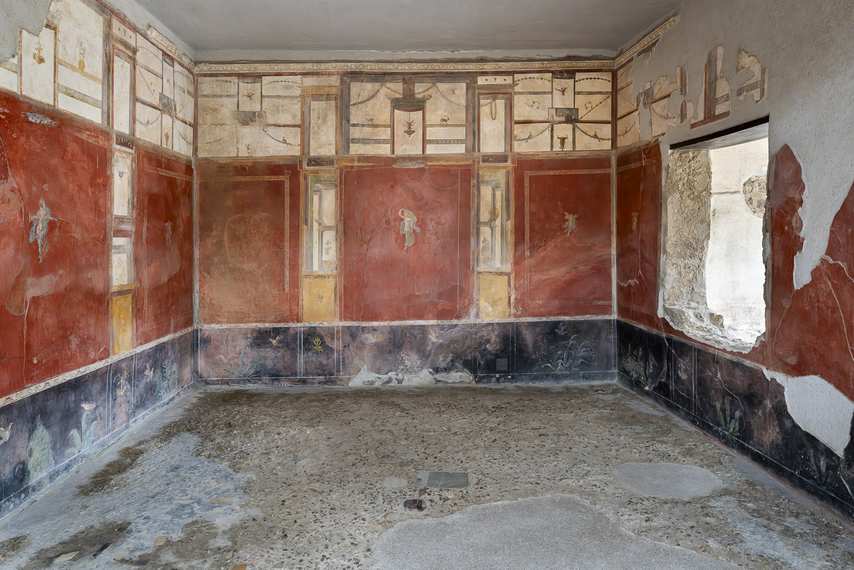
The Fullonica of Stephanus is a Roman-era laundry located on Via dell’Abbondanza in Pompeii.
Derived from the transformation of a dwelling shortly before the eruption of Vesuvius in AD 79, it is the best-preserved fullonica found in the city.
The building had tanks for washing clothes, a flat roof for drying and a press for ironing. A body and a sum of money, possibly belonging to the owner Stephanus, were found inside.
Google Maps indication:
https://maps.app.goo.gl/EoZteoLWRwU2SuSp8
Why visit the Stephanus Fullonica
The fullonica offers a unique insight into ancient Pompeii textile processing and cleaning techniques. It provides insight into how business activities function and the importance of laundries in the city’s economy.
What to admire in the Stephanus Fullonica
- The communicating tubs and pounding basins for washing clothes.
- The press for ironing clothes.
- The atrium, with its old impluvium, has been transformed into a working basin.
- The Fourth Style decorations with winged female figures representing the Seasons.
- The kitchen with pottery and tools found during excavations.
- The garden, with its peristyle, was repurposed for drying clothes.
After visiting the Stephanus Fullonica, exit onto Via dell’Abbondanza and continue west.
After about 100 meters, turn left onto Via Stabiana and continue until you reach, on the right, Via del Tempio di Iside.
Follow it for about thirty meters until you come to the entrance to the Temple of Isis on the left.
Temple of Isis (Regio VIII – 14)
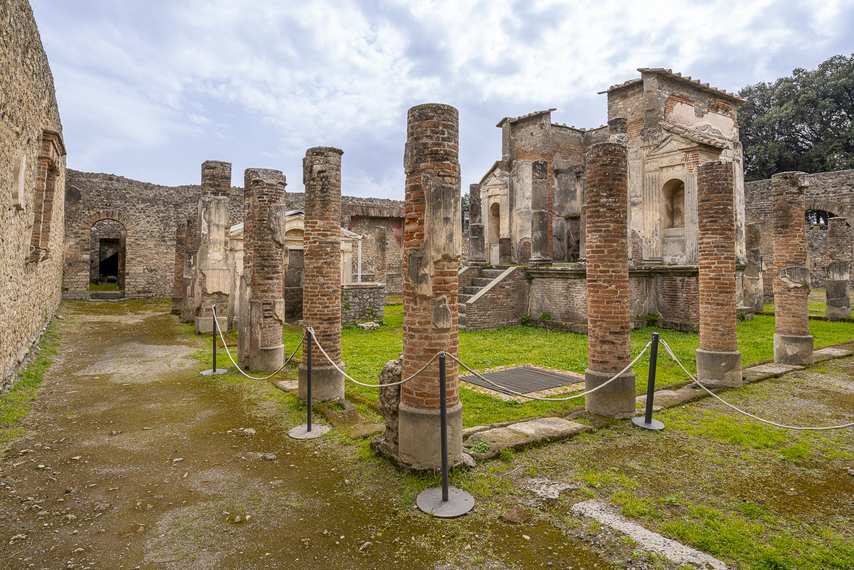
The Temple of Isis in Pompeii is one of the most fascinating buildings in the city, and it was buried by the eruption of Vesuvius in 79 AD.
Built in the second century B.C. and rebuilt after the earthquake in 62 A.D., it was a centre of worship dedicated to the Egyptian goddess Isis, who was highly revered in antiquity.
In addition to the main structure with the temple cell, the complex included sacrificial altars, a shrine for sacred water and an area for ritual banquets.
Lavishly decorated with Egyptian-themed frescoes and reliefs, it was one of the first buildings excavated in Pompeii in the 18th century, arousing great interest throughout Europe.
Google Maps indication:
https://maps.app.goo.gl/J3zJ4T24m2XYcYkNA
Why visit the Temple of Isis?
The Temple of Isis offers a rare example of the religious syncretism between Roman and Egyptian culture, testifying to the spread of Eastern cults in Pompeii.
Its excellent preservation allows visitors to appreciate the sacred art of the period.
At the same time, its history is linked to famous figures such as Mozart, who drew inspiration from it for The Magic Flute.
What to admire in the Temple of Isis?
- The architecture: a temple on a high podium with a central cella, preceded by a pronaos and a porticoed courtyard.
- The Nilotic frescoes: decorations that evoke Egypt, featuring images of priests, exotic landscapes, and naval battles.
- The holy water aedicule: used for purifying rites, with depictions of Harpocrates and Egyptian priestesses.
- The ekklesiasterion: a room for sacred meetings and banquets, featuring mosaic floors and frescoes inspired by Egyptian shrines.
- The sacrificial altar: where remains of sacrifices were found, evidence of the religious ceremonies of the time.
Exiting back onto Via del Tempio di Iside, continue west for about sixty meters until you reach, on the left, the entrance to the Triangular Forum.
The Triangular Forum (Regio VIII – 8)
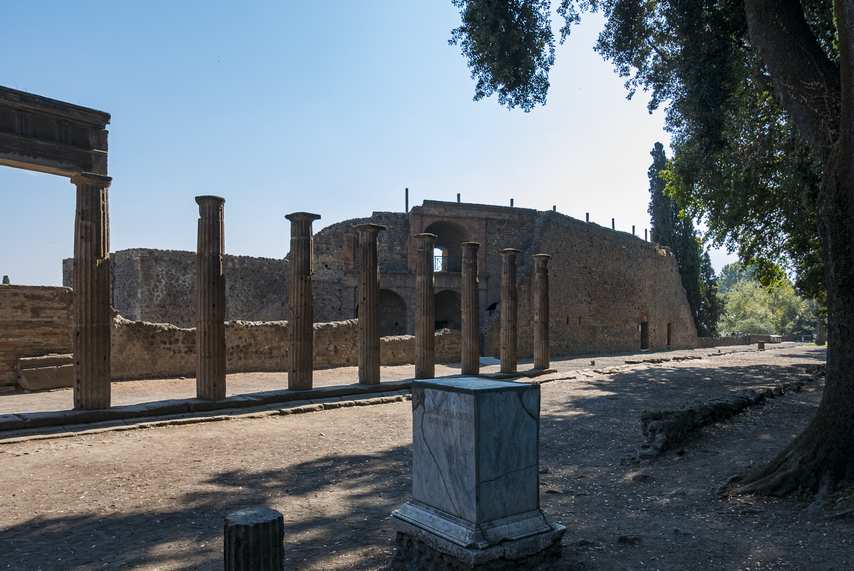
The Triangular Forum of Pompeii is a monumental square from Roman times, located in the southern part of the city. Built in the 2nd century BC, it was intended for horse races and as a meeting place before performances in nearby theatres.
Surrounded on three sides by a Doric colonnade, it features a monumental entrance with an Ionic propylaeum. It houses important sacred structures, including the Doric Temple and a tholos built around a sacred well.
The Forum also offered panoramic views and was connected to the Large Theatre, the Odeon, and the Samnite Gymnasium.
Google Maps indication:
https://maps.app.goo.gl/UE4BT6Qg5F8z5CfdA
Why visit the Triangular Forum
The Triangular Forum represents one of Pompeii’s most striking complexes due to its scenic location and significant religious and social importance in the ancient city.
It allows us to understand the urban organisation and the link between sacred spaces and places of entertainment. In addition, it is one of the rare examples of forums with a nonrectangular plan, offering an interesting variation from typical Roman architecture.
What to admire in the Triangular Forum
- The Doric colonnade surrounds the square on three sides, with its 95 longilinear columns.
- The entrance propylaeum has six Ionic columns and a double door.
- The Doric Temple, a significant sacred building, was likely dedicated to Athena or Hercules.
- The thòlos, built around a sacred well, has a conical roof supported by seven Doric columns.
- The three tuff altars, used for sacrifices and religious ceremonies.
- The Roman sundial is a witness to the advanced astronomical knowledge of the time.
- The openings on the east side connected the Forum to the theatres and the Palestra Sannitica.
The Triangular Forum is a must-see for those who want to discover Pompeii’s public and religious life in a unique and fascinating architectural setting.
From the Triangular Forum, you can enjoy a splendid view of the Large Theatre, flanked by the Small Theatre (Odeon) and, a little further to the right, the Quadriporticus of the Theatres.
Below you will find descriptions of these three places.
However, our itinerary does not include an in-depth visit to each, but if you wish to extend the tour, you can still explore them.
Large Theatre (Regio VIII – 10)

TheLarge Theatre of Pompeii is one of the most impressive structures in the ancient city, a witness to Pompeii’s vibrant cultural life.
Built in Samnite times and expanded by the Romans, the theatre could seat up to 5,000 spectators, demonstrating the importance of entertainment and sociability in ancient society.
Performances of comedies, tragedies and mimes were held here, attracting citizens of all social classes.
Today, the Large Theatre is a fascinating place where one can still feel the atmosphere of performances from two thousand years ago.
Google Maps indication:
https://maps.app.goo.gl/zouDe2ULNk5SSx8eA
Why visit the Large Theatre of Pompeii
Visiting the Large Theatre allows you to immerse yourself in ancient Pompeii’s culture and social life and understand the theatre’s fundamental role in the community.
The size of the building and its ability to accommodate large audiences show the importance of performances in daily life, transforming the theatre into a meeting point for the city.
What to admire in the Large Theatre of Pompeii
- The semicircular tiers of seats are arranged to provide an excellent view for spectators.
- The exceptional acoustics are still experienced today when speaking from the centre stage.
- The Roman architecture had the cavea divided into sectors for different social classes.
- The historical suggestion is to sit in the stands and imagine the ancient spectacles that enlivened the city.
An unmissable experience to understand the charm and vibrancy of Pompeii two thousand years ago.
Small Theatre (Odeon) (Regio VIII – 12)
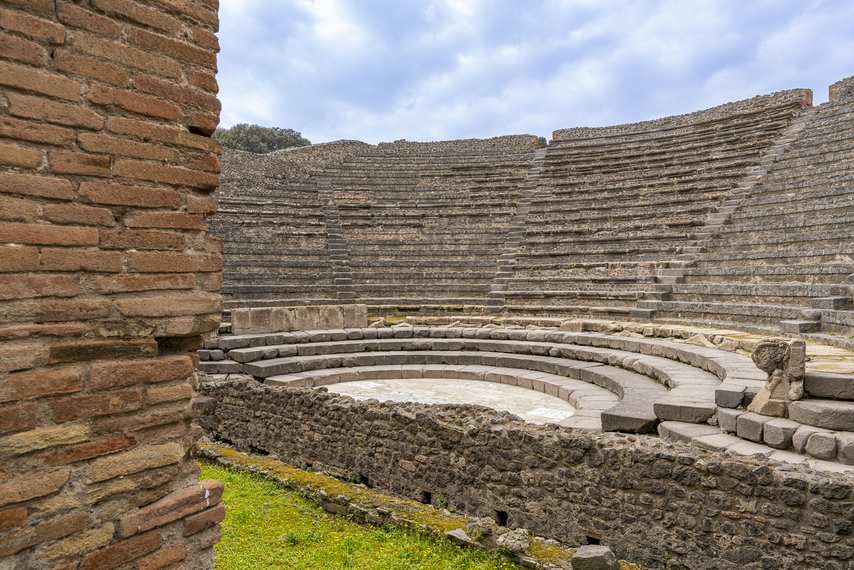
The Small Theatre, also known as the Odeon, is a Roman-era theatre structure built between 75 and 80 B.C., thanks to funding from two Roman magistrates.
This small covered theatre was intended for musical performances and poetry recitations, offering excellent acoustics due to its architecture.
With a capacity of about 1,300 spectators, the theatre features marble decorations and frescoes in the second style.
Restored to light in the 19th century, it represents a significant testament to Pompeii’s cultural life.
Google Maps indication:
https://maps.app.goo.gl/bg85xqLf7rcunNfK7
Why visit the Small Theatre of Pompeii
The Small Theatre is a perfect place to discover the more intimate and refined side of Pompeian entertainment. It was reserved for performances that required exceptional acoustics, such as concerts and plays.
The structure still retains architectural and decorative details that allow you to imagine the atmosphere of these exclusive events.
What to admire in the Small Theatre of Pompeii
- The colored marble orchestra was donated in the Augustan period.
- The kneeling tufa telamons are sculptural elements typical of Hellenistic art.
- The tufa bleachers with rear cavities are designed to provide maximum comfort for spectators.
- The refined acoustics made the theatre ideal for musical performances and declamations.
- The balustrades are decorated with winged griffon legs, symbols of power and protection.
A small jewel of Pompeii that offers an immersive experience in Roman theatre culture.
Want to learn more about the Large Theatre and the Odeon? Read our in-depth article.
Quadriporticus of the Theatres (Regio VIII – 11)
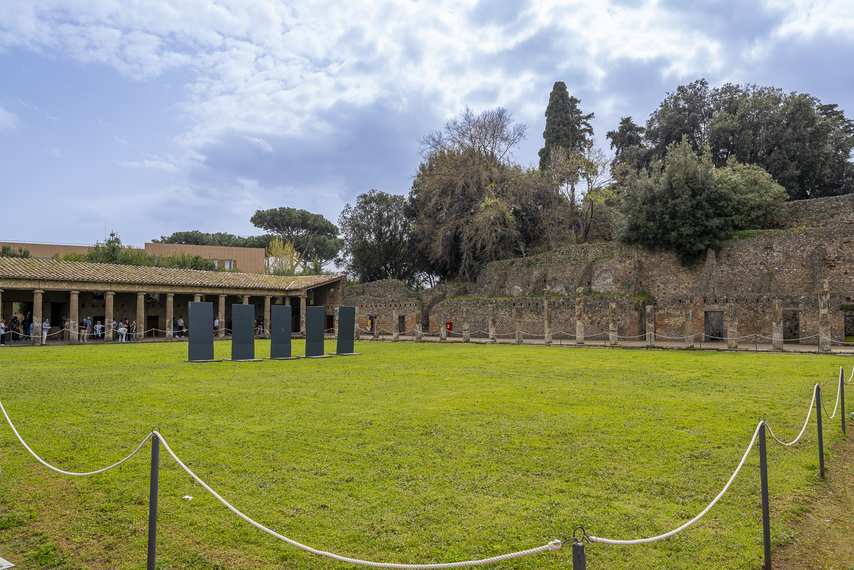
The Quadriporticus of the Theatres, also known as the Gladiator Barracks, is an imposing Roman structure in Pompeii.
Initially built in the first century BC as a waiting area for spectators at the theatres, it became a school for gladiators after the 62 AD earthquake. However, the eruption of Vesuvius in 79 buried it before renovations were completed.
Bourbon excavations unearthed fascinating evidence of gladiatorial art, including helmets, decorated swords, and fighter skeletons.
Google Maps indication:
https://maps.app.goo.gl/vG96NYB1Nrt8vcHf8
Why visit the Quadriporticus of the Theatres
The Quadriporticus of the Theatres offers an interesting perspective on two crucial aspects of Pompeian society: theatrical performance and gladiatorial training.
This space represents an evolution in the use of public buildings, transforming from a gathering place for spectators to an actual barracks for gladiators.
What to admire in the Quadriporticus of the Theatres
- The Doric colonnade, with 74 tufa columns, borders the large central courtyard.
- The gladiators’ rooms were small cells built after the 62 AD earthquake.
- The original architecture of the quadriporticus, with its entrances to the theatres and the staircase that led to the Triangular Forum.
From the Triangular Forum, take Via dei Teatri and go south, then turn right into Vicolo della Regina.
Continue 100 meters to the intersection with Vicolo dei Dodici Dei, then turn left and continue on Vicolo della Regina.
After sixty meters, turn right onto Via delle Scuole and, after a few meters, you will find the House of Geometric Mosaics entrance on the left.
House of Geometric Mosaics (VIII – 5)
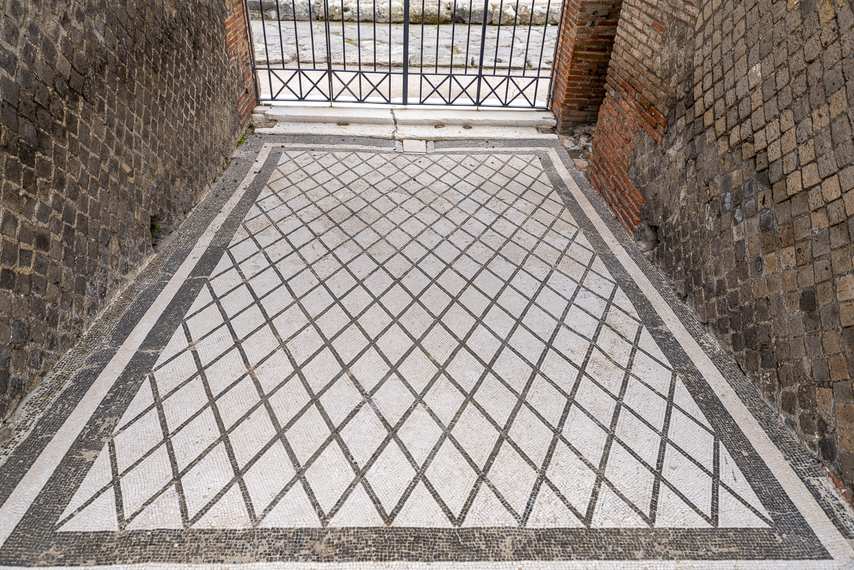
The House of Geometric Mosaics is one of the largest domus in Pompeii, with more than 60 rooms arranged on panoramic terraces overlooking the Sarno Valley.
Dating from the 2nd century B.C., the house results from the merger of two pre-existing dwellings, enriched with a large peristyle and a porticoed garden.
It owes its name to the exquisite black-and-white mosaics decorating the floors with geometric motifs.
After significant restoration, the domus was reopened to the public in 2016 as part of the Great Pompeii Project.
Google Maps indication:
https://maps.app.goo.gl/GqgD2qZNdGnTanxn9
Why visit the House of Geometric Mosaics
Visiting the House of Geometric Mosaics allows visitors to explore one of Pompeii’s most opulent dwellings, a testament to the luxury and power of the city’s aristocracy. Its panoramic location and extraordinary floor decoration offer a unique experience that helps you understand the evolution of Roman domestic architecture.
What to admire in the House of Geometric Mosaics
- Geometric mosaics with labyrinth and checkerboard motifs in black and white tiles.
- Scenic structure with multi-level terraces overlooking the Sarno Valley.
- Monumental atrium with impluvium and access to tablinum and large peristyle.
- A porticoed garden was created with the extension of the house in a later period.
- View of the city walls and the Forum, testifying to the domus’ privileged position.
Exit the House of Geometric Mosaics onto Via delle Scuole and ascend it northward for about sixty meters. When you reach the Forum of Pompeii, turn left. Here, you can visit the Municipal Buildings.
Municipal Buildings (Regio VIII – 3)

Pompeii’s Municipal Buildings, located on the southern side of the Forum, housed the city’s administrative bodies.
They consisted of three very similar structures, destined respectively for the Curia, the seat of the decurions (a type of city council), the seat of the duoviri, the city’s highest representatives (comparable to mayors), and the seat of the ediles, responsible for urban maintenance and public services.
Although the general function of the buildings is clear, there is still uncertainty about their precise purpose.
Google Maps indication:
https://maps.app.goo.gl/Y2jvWjKgPjnzXD1P9
Why visit the Municipal Buildings
Visiting Pompeii’s municipal buildings provides insight into the political and administrative organisation of the Roman city.
These buildings tell the story of how public life functioned and show the central role of the Forum as the community’s centre for decision-making.
What to admire in the Municipal Buildings
- The marble floor of the Curia is still visible, and the niches housed honorary statues.
- The podium was in the Duoviri seat, where the administrative archives were kept.
- The symmetrical architecture of the three structures reflects the order and organisation of the Roman city.
- The central location in the Forum highlights the political and administrative importance of these buildings.
Continue westward and take Vicolo di Championnet. After a few steps, you will find the entrance to the House of Championnet.
House of Championnet (Regius VIII – 4)
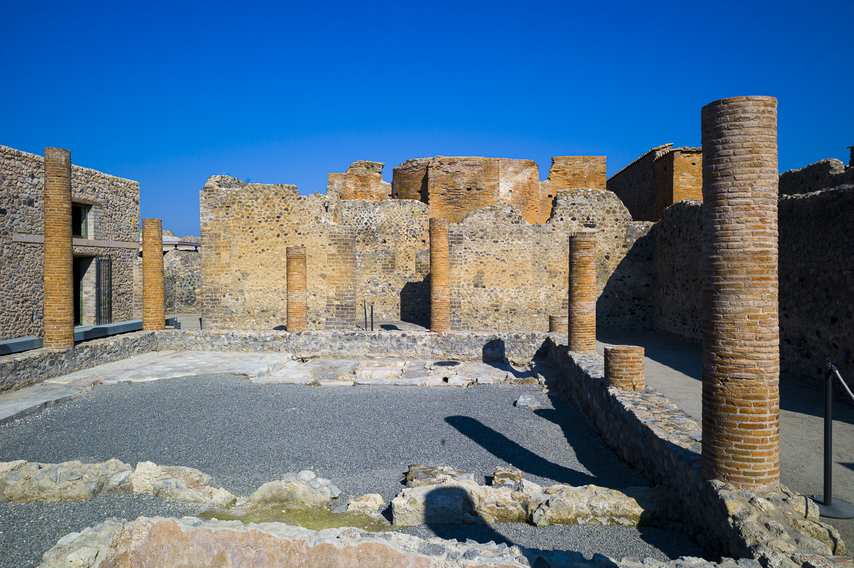
The House of Championnet is a luxury residential complex located south of the Forum of Pompeii. Featuring panoramic terraces overlooking the gulf and a multi-level structure, the neighbourhood was inhabited by wealthy Pompeian aristocrats.
Recently restored thanks to the Great Pompeii Project, it features more than 60 rooms, including kitchens, a bakery, a private bathhouse, and splendid mosaics protected by innovative covers.
The exhibition tour also allows visitors to explore the nearby House of the Sailor, known for its naval mosaics.
Google Maps indication:
https://maps.app.goo.gl/J3iCei5i4N3MsWpS8
Why visit the House of Championnet
This residential neighbourhood, with sumptuous mansions and a privileged location, provides insight into the lifestyle of the Pompeian aristocracy.
Its recent opening and careful restoration offer a unique opportunity to explore an area long off-limits to the public.
What to admire in the House of Championnet
- The panoramic terraces overlooking the Bay of Naples
- The underground rooms, including a kitchen and bakery
- The geometric mosaics, protected by modern covers
- The Sailor’s House, with its mosaic depicting ships and a private spa facility
- The Moray Courtyard, with a large fish pond
- The exhibits, including amphorae, kitchen utensils and fragments of frescoes
Exiting back onto Championnet Alley, you will find the entrance to visit the Basilica to the north.
Forum Basilica (Regio VIII – 2)
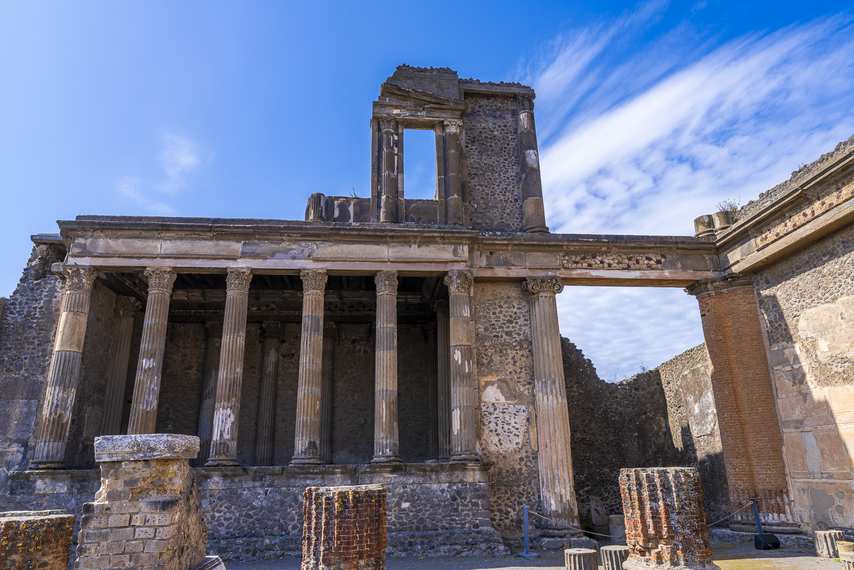
The Forum Basilica of Pompeii, built between 130 and 120 BC, is one of the city’s most important public buildings. It was located in the southwestern corner of the Forum and was a centre for legal and commercial functions. Its imposing structure, characterised by a central nave with Ionic columns and a tribunal, makes it one of the most representative examples of Roman architecture.
Buried by the eruption of 79 AD, it was unearthed in the 19th century and is now a key stop for those visiting the excavations.
Google Maps indication:
https://maps.app.goo.gl/sBhRCE39zP2MATGn7
Why visit the Basilica
The Basilica of Pompeii provides insight into the organisation of public and political life in the Roman city.
Trials and commercial activities took place here, providing citizens a safe and covered space. Its architectural majesty, with Ionic columns and a wide nave, testifies to the importance of the Forum as the city’s hub.
What to admire in the Basilica
- Central nave: surrounded by 28 Ionic columns about 11 meters high.
- Tribunal: a space where justice was administered, with Corinthian columns.
- Portico of Popidius: an architectural element that masked irregular buildings.
- Remains of stucco decoration: simulation of marble blocks on the walls.
- Well and fountain: witnesses to the management of water resources.
Want to learn more about the Basilica of Pompeii? Read our in-depth article.
Leaving the Basilica, turn right onto Via Marina and, after a few steps, you will find the entrance to the Temple of Apollo on the left.
The Temple of Apollo (Regio VII – 5)
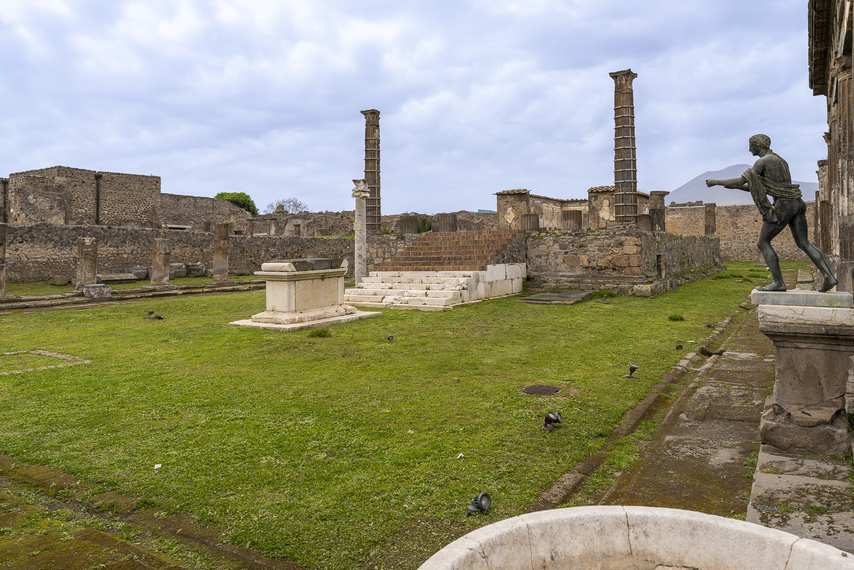
Among the oldest places of worship in Pompeii (8th-7th centuries BC), it was rebuilt in Samnite times on the initiative of the quaestor Oppio Campano.
In Augustan times, it was enriched with a sundial and a wall to separate it from nearby houses.
It features a large courtyard with Ionic (later Corinthian) columns and housed statues of Apollo, Venus, and Hermes. Damaged by the earthquake of 62, it was still under restoration in 79 AD.
Google Maps indication:
https://maps.app.goo.gl/ZrRaJRJYtL55hZJv8
Why visit the Temple of Apollo
The Temple of Apollo tells the story of Pompeii’s earliest origins and the importance of Apollonian worship. It also shows the layering of styles and restorations that testify to its long history.
What to admire in the Temple of Apollo
- The fluted tuff columns and Corinthian capitals were painted after the earthquake.
- The remains of the altars and the omphalos, a Delphic symbol in the cella.
- The inscriptions documenting the restorations and the dedication of Oppio Campano.
Leaving the Temple of Apollo on Via Marina, walk a few meters west to find the entrance to visit the House of Triptolemus.
The House of Triptolemus (Regio VII – 4a)
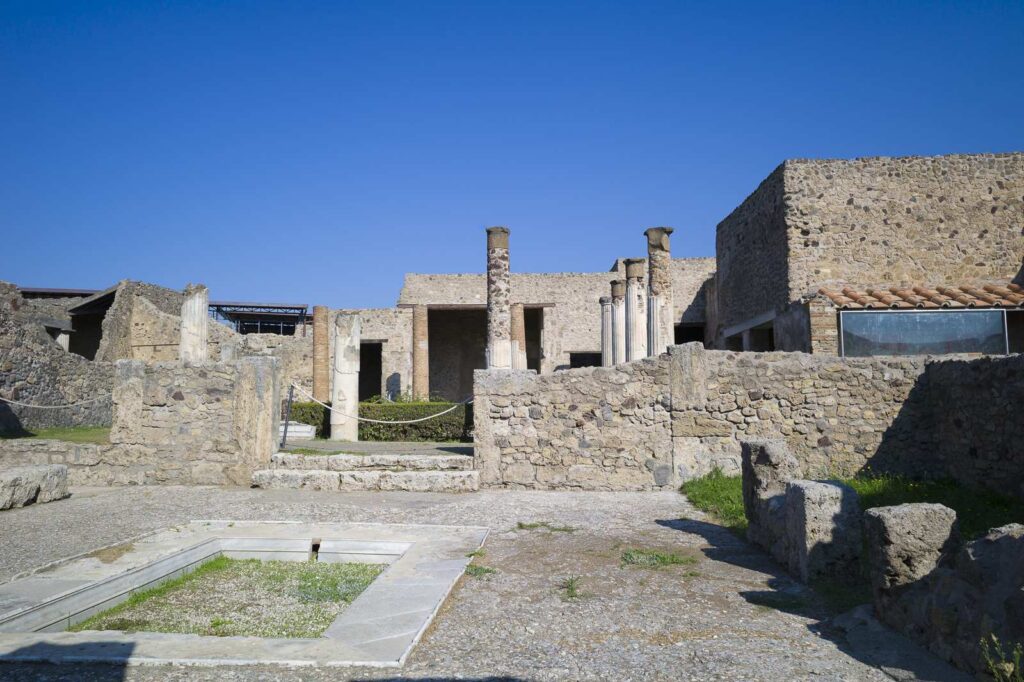
The House of Triptolemus is one of Pompeii’s finest residences, strategically located near the Forum, the Basilica and the Temple of Apollo.
Built in the 2nd century BC and enlarged after Sulla’s conquest, this domus features frescoes and mosaics of extraordinary beauty, testifying to the wealth and prestige of its owner.
Among the most interesting elements are the fresco of Triptolemus, a symbol of the link with fertility and agriculture, and a rare mosaic with perspective cubes, similar to those found in the city’s most important temples.
Google Maps indication:
https://maps.app.goo.gl/NzDnkrzXRwuS7cDv8
Why visit the House of Triptolemus:
The House of Triptolemus is one of Pompeii’s most elegant residences, offering a rare example of integrating domestic architecture and temple art. Its high-end decorations and privileged location reflect the prestige of the family that lived there.
The exquisite painting cycle and fine mosaics reveal a strong Hellenistic influence, indicating that the owner sought to connect his dwelling to the city’s sacred sites.
What to admire in the House of Triptolemus:
- Fresco of Triptolemus: depicts the mythological hero receiving a basket of ears of corn from Persephone, a symbol of the transmission of agriculture to humans.
- Perspective cube mosaic: This rare decorative example, also found in the cella of the temples of Apollo and Jupiter, gives the house an aura of sacredness and prestige.
- The main exedra: with a scenic entrance decorated with mosaics and mythological frescoes, demonstrates the owner’s importance.
- Colonaded peristyle: an open space with red and white columns that once surrounded a garden with a central pool.
- IV-style frescoes: scenes featuring Cupids, gods, and myths, such as Venus and Adonis and Hermaphroditus in the mirror, are examples of the refined art of the period.
- Mosaic decorations in the triclinia: recovered from the Suburban Baths, they feature marine motifs with shells and fish, creating an evocative atmosphere.
Exit back onto Via Marina and turn left, proceeding east toward the Forum. Immediately after the Temple of Apollo, turn left and follow the path along the Forum. After about 70 meters, you will find the entrance to the Granaries of the Forum on the left.
Granaries of the Forum (Regio VII – 7)
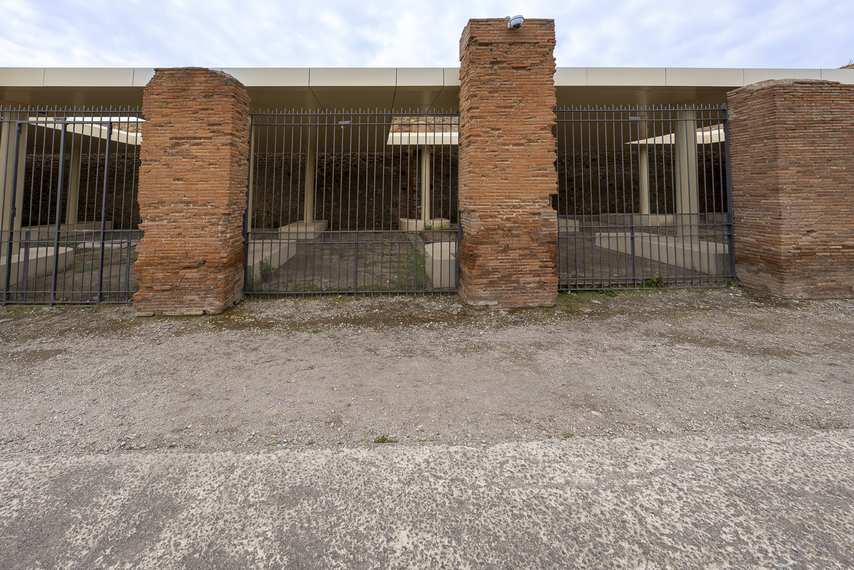
The Granaries of the Forum of Pompeii, located in the western part of the Forum, were initially thought to be grain deposits, but subsequent studies have disproven this theory.
Today, they represent one of the site’s primary archaeological deposits, containing about 9,000 artefacts, including amphorae, pottery, kitchen utensils, fountains, and some casts of victims of the eruption.
Originally a grain market, the granaries were reused in the 19th century as storage for excavated materials.
Currently undergoing a redevelopment project, they will soon become an archaeological exhibition open to the public, offering a unique insight into daily life and trade in Pompeii.
Google Maps indication:
https://maps.app.goo.gl/6nKdjcwHaMUpdFa26
Why visit the Granaries of the Forum
The Granaries of the Forum offer an extraordinary daily life and trade record in ancient Pompeii.
The objects preserved here allow reconstruction of the city’s relationships with the Mediterranean and a better understanding of the Pompeians’ diet and habits. When it opens to the public, the site will become one of the city’s main archaeological exhibitions.
What to admire in the Granaries of the Forum
- Amphorae from different regions of the Mediterranean bear witness to Pompeii’s commercial trade.
- The casts of victims of the eruption, including that of a dog and a tree.
- The large marble basins and fountains that once decorated Pompeian houses.
Right next to the Granaries of the Forum is the Temple of Jupiter, easily recognisable on the north side of the square. It is elevated on a high podium with a front staircase and remains of imposing columns.
Temple of Jupiter (Regius VII – 8)

The Temple of Jupiter, located in the northern part of the Forum of Pompeii, was built in the 3rd century BC and became the city’s principal place of worship. After the Roman conquest, it was dedicated to the Capitoline Triad, consisting of Jupiter, Juno, and Minerva.
The structure, raised on a high podium with three interior naves, was decorated with Corinthian columns and monumental statues.
Damaged by the earthquake of 62 AD, it was still under restoration when the eruption 79 buried it. Excavations have unearthed impressive remains of the cella and a large altar in the Forum.
Google Maps indication:
https://maps.app.goo.gl/GZHGvyrtpWQVsAQN9
Why visit the Temple of Jupiter
The Temple of Jupiter is one of Pompeii’s symbols and represents the Forum’s importance as the city’s religious and political centre. Its scenic location, with Mount Vesuvius in the background, makes it one of the most iconic stops at the archaeological site.
What to admire in the Temple of Jupiter
- The majestic raised podium is accessible by a flight of steps.
- The Corinthian columns and the remains of the temple cell.
- The great altar was placed along the temple’s axis in the Forum.
- The spectacular view of Vesuvius emphasises the link between Pompeii and its tragic end.
The Macellum, the city’s ancient marketplace, is on the east side of the Forum, next to the Temple of Jupiter.
Macellum (Regio VII – 12)

The Macellum was Pompeii’s primary food market, located in the northeast corner of the Forum.
Built in the 3rd century BC and renovated between 130 and 120 BC, it underwent various restorations until the eruption of Vesuvius in 79 AD. Inside were stores selling meat, fish, and food products, with a central area covered by a wooden conical structure for cleaning fish.
Decorated with mythological frescoes and statues of the imperial family, the Macellum provides a glimpse into ancient Rome’s commercial and social life.
Google Maps indication:
https://maps.app.goo.gl/oE42Bdh2uzaZAwFt9
Why visit the Macellum
Pompeii’s Macellum was the city’s primary food market and is a remarkable testament to daily life in Roman times. Here, meat, fish, and groceries were bought and sold, showing the efficiency of Pompeian trade.
In addition, the presence of frescoes and statues related to imperial worship underscores this space’s political and religious importance.
By visiting it, you can immerse yourself in the atmosphere of a Roman market and discover how the economy of the time functioned.
What to admire in the Macellum
- The stores (tabernae) along the north and west sides were once used to sell food and perfumes.
- The central market area has twelve tufa bases that support a wooden roof and a basin for cleaning fish.
- The marble counter for selling meat and fish has a drain for water runoff.
- The mythological frescoes feature depictions of Odysseus, Penelope, and Medea contemplating the murder of her children.
- The imperial family statues once adorned the inner sanctum and are now in the Archaeological Museum of Naples.
Continuing along the Forum, right next to the Macellum, is the Sanctuary of the Public Lares.
Sanctuary of the Public Lares (Regio VII – 13)
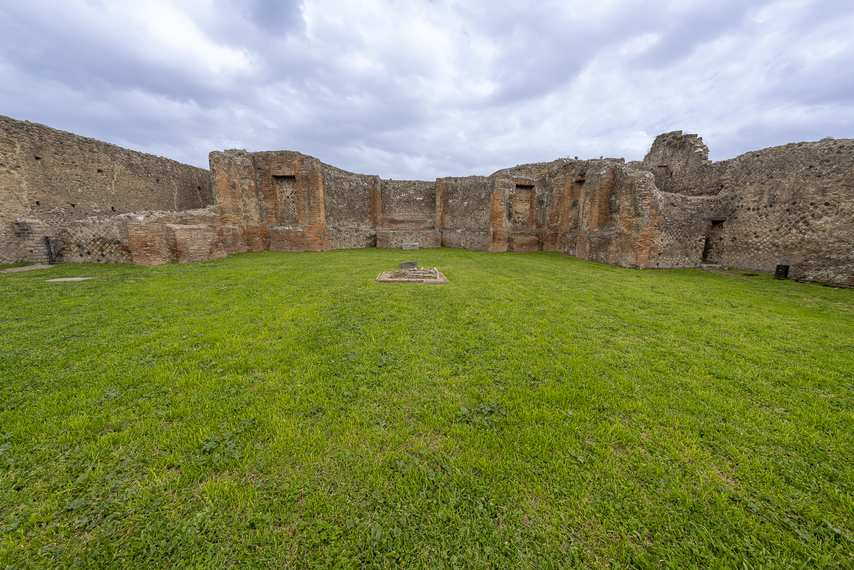
The Sanctuary of the Public Lares is a Roman temple, probably built after the 62 AD earthquake, to worship the city’s patron deities. Some scholars speculate that it might have been dedicated to the worship of the imperial family or even used as a public library.
However, the most widely accepted hypothesis is that it was a place of worship for the Lares.
At the time of the eruption in 79 AD, the temple was still under construction and was buried under lapilli and ash.
Today, it is one of the most fascinating sites in Pompeii for understanding the relationship between religion and public life in the ancient city.
Google Maps indication:
https://maps.app.goo.gl/oE42Bdh2uzaZAwFt9
Why visit the Sanctuary of the Public Lares
The Sanctuary of the Public Lares represents a unique example of public worship in Pompeii.
Its strategic location next to the Temple of Vespasian and the Macellum demonstrates the importance of religion in the city’s political and economic life.
Looking at its incomplete structures, one can imagine the construction process and the sudden interruption caused by the eruption.
The visit allows visitors to learn more about the role of the Lares in Roman religion and to admire the architectural techniques of the time.
What to admire in the Sanctuary of the Public Lares
- The central atrium, with remains of the marble flooring and the base of the sacrificial altar.
- The side niches, which probably housed statues of deities or emperors.
- The apsidal basin, with the central niche and decorative columns.
- The construction techniques are visible in the brickwork, as well as in the uncertain and reticulated walls.
- The bases of the unfinished columns reveal that the temple was still under construction at the eruption in AD 79.
Having finished your visit to the Temple of the Public Lares, move on to the following structure, the Temple of the Genius Augusti.
Temple of the Genius Augusti (Regius VII – 14)

The Temple of the Genius Augusti, also known as the Temple of Vespasian, is a place of worship in the Forum of Pompeii, dedicated to the genius of the Roman emperors.
Its dating is uncertain: some scholars believe it dates from the Augustan age, while others place it later.
The eruption of Vesuvius in 79 AD buried it before work could be completed.
Excavated in the 19th century, it now preserves an important marble altar with a bas-relief depicting a sacrifice.
Google Maps indication:
https://maps.app.goo.gl/AEVJSYmgtZVtAdVQ9
Why visit the Temple of the Genius Augusti
The Temple of the Genius Augusti is a fascinating example of Roman sacred architecture, reflecting imperial devotion to Pompeii. Its location in the Forum makes it a must-see for those who want to understand the link between religion and political power in the ancient city.
In addition, the altar decorated with scenes of sacrifice offers rare evidence of the public rituals of the time.
What to admire in the Temple of the Genius Augusti
- The marble altar, with a bas-relief of a bull sacrifice.
- The central courtyard has columns and architectural decorations that remain.
- Triangular and lunate tympana surmount the blind windows on the walls.
- The temple’s podium, where the emperor’s statue once stood.
- The back rooms were probably used by priests and merchants.
Exit the Temple of the Genius Augusti and enter the last building on this stretch of road: the Building of Eumachia.
Portico of Concordia Augusta (Building of Eumachia) (Regius VII – 15)
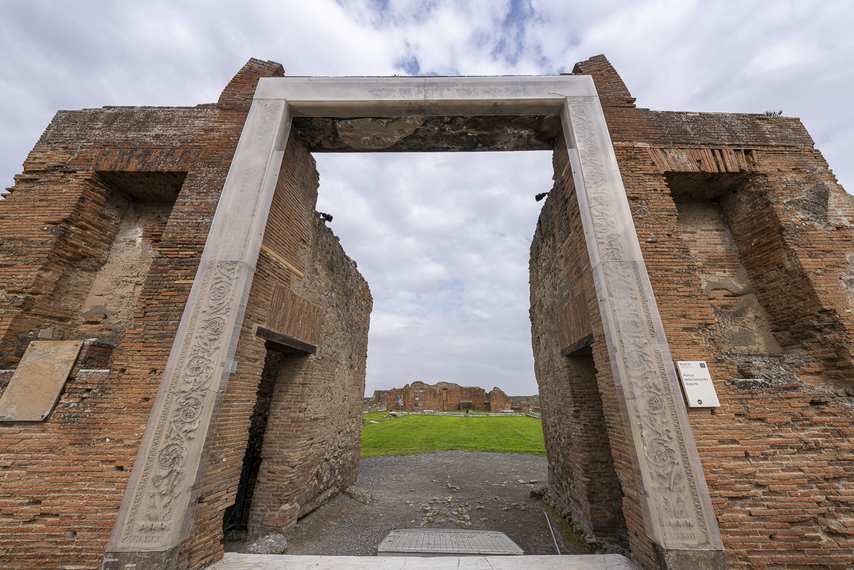
The Portico of Concordia Augusta is one of the most impressive structures in the Forum of Pompeii, built during the Tiberian era at the behest of the priestess Eumachia.
Probably intended for the wool trade or as the headquarters of the guild of fullones (launderers), the building features elegant architecture with marble columns and fine decoration.
Damaged by the earthquake in 62 AD, it was still being restored when it was buried by the eruption of Vesuvius in 79 AD. Today, it is an example of public architecture from the imperial era.
Google Maps indication:
https://maps.app.goo.gl/p3yEVVsdL9TLEY3Z6
Why visit the Edifice of Eumachia
The Eumachia Building is an essential record of Pompeii’s economic life, offering a glimpse into the role of local guilds and trade. Its construction by a woman underscores female influence in Roman society.
The site is an essential stop for those who want to understand ancient Pompeii’s urban and commercial structure.
What to admire in the Portico of Concordia Augusta
- The monumental facade is decorated with marble reliefs depicting acanthus leaves and animals.
- The double-tiered collonaded portico has Doric and Ionic columns.
- The exedras housed statues of Caesar, Augustus, Aeneas and Romulus.
- The side corridor is covered in colored marble and is used as a storehouse.
- The statue of Eumachia, once located in the building, is now housed in the National Archaeological Museum in Naples.
Exit the Portico della Concordia and retrace the avenue along the Forum in a northerly direction for about one hundred meters until you cross the Archof Nero.
Continue along the Vicolo del Foro for sixty meters, then turn left onto Via delle Terme.
You will find the entrance to the Forum Baths on the left.
Forum Baths (Regio VII – 10)
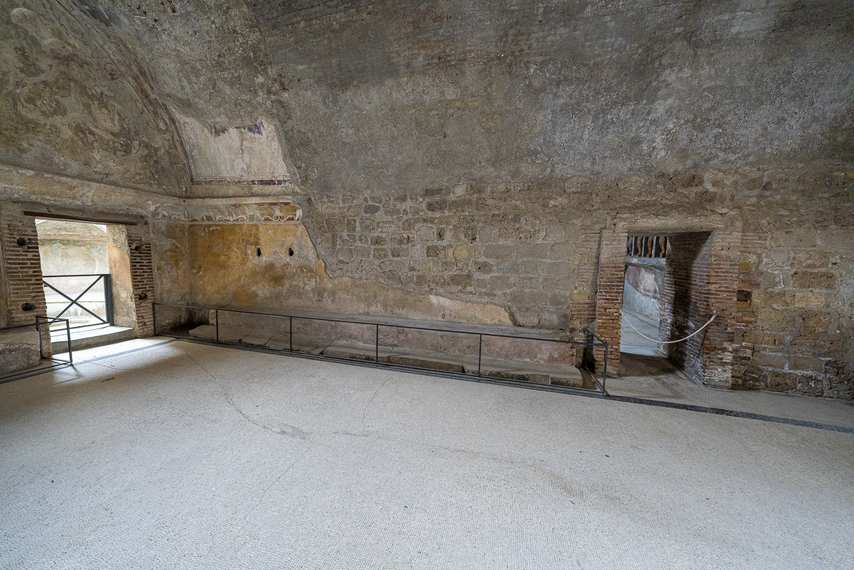
The Forum Baths, built in the 1st century BC, were one of Pompeii’s main thermal complexes near the Forum.
They were divided into male and female sectors, with rooms heated by an advanced system of boilers and pipes. After the earthquake of 62 AD, they remained the only functioning baths in the city until the eruption of 79 AD. Among the most striking decorations are frescoes, mosaics and terracotta telamons that supported the vault of the tepidarium.
Bourbon excavations in 1823 brought them back to light.
Google Maps indication:
https://maps.app.goo.gl/nqGNPFTHZKP6C2cp8
Why visit the Forum Baths
The Forum Baths offer a fascinating glimpse into daily life in Pompeii, highlighting the significance of public baths in Roman culture. Their central location makes them an ideal stop to understand the city’s social organisation.
What to admire in the Forum Baths
- The tepidarium has statues of telamons and stucco decorations.
- The frigidarium with its frescoed dome and garden scenes.
- The calidarium has a hypocaust heating system and a large marble pool.
- The ancient oil lamps, found in large numbers, illuminated the baths for evening use.
The House of the Tragic Poet is opposite the baths. You can access it from the entrance on Via delle Terme.
House of the Tragic Poet (Regio VI – 4)
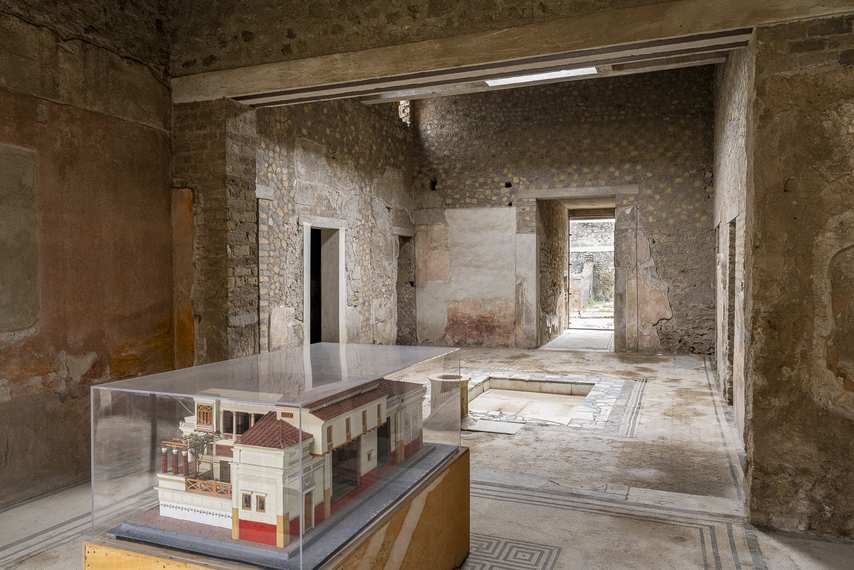
The House of the Tragic Poet, dating back to the 2nd century B.C., is one of Pompeii’s most famous dwellings due to its extraordinary frescoes and mosaics.
The name comes from a mosaic depicting a theatre scene, while the famous Cave Canem (Beware of the Dog) mosaic greets visitors at the entrance.
The decorations belong to the fourth Pompeian style and include frescoes inspired by Greek myths, such as Achilles and Briseis and the sacrifice of Iphigenia. Nineteenth-century excavations transferred many works to the National Archaeological Museum in Naples.
Google Maps indication:
https://maps.app.goo.gl/GcmUpfEUeERHQ3Mo7
Why visit the House of the Tragic Poet
This house allows visitors to immerse themselves in the elegance of Pompeian art, featuring high-quality mythological scenes. It is an extraordinary example of domestic life from the period, with decorations that reflect the refined taste of its owners.
What to admire in the House of the Tragic Poet
- The Cave Canem mosaic is a symbol of ancient Pompeii.
- The mythological frescoes, including Achilles and Briseis and the sacrifice of Iphigenia.
- The refined decoration in the fourth Pompeian style, with bright colours and elaborate details.
- The house’s structure, with an atrium, tablinum, and peristyle, is typical of Roman patrician residences.
Exit the House of the Tragic Poet onto Via delle Terme and continue west until you turn right onto Via Consolare.
Continue on Via Consolare, heading north for about 250 meters, where the road turns into Via delle Tombe.
After about 500 meters, some steps will lead you down an avenue that, after another 150 meters, will take you to the Villa of the Mysteries.
All along the way, from Via delle Terme to Via delle Tombe, you can admire beautiful sights such as the Necropolis of Porta Ercolano and the Villa of Diomede on your left.
Villa of the Mysteries (Regio VI – 19)
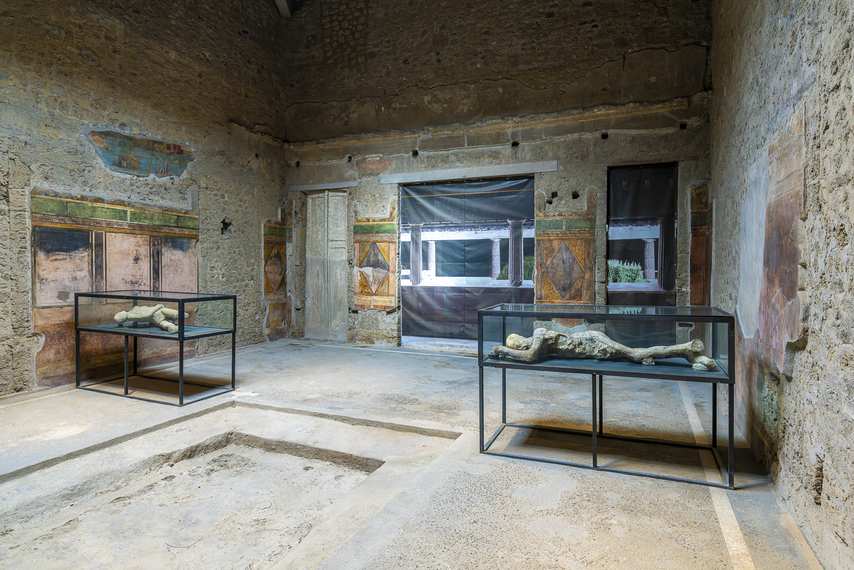
The Villa of the Mysteries is one of Pompeii’s most fascinating residences just outside the city walls. It was built in the 2nd century BC and was expanded and decorated during the Augustan age.
In addition to its fine architecture, the villa is famous for the extraordinary frescoes in the triclinium, which depict mystery rites related to the cult of Dionysus.
After the earthquake in 62 AD, it was partly converted into a production facility with winemaking facilities. Excavations, begun in 1909, have returned one of antiquity’s most enigmatic and best-preserved pictorial cycles.
Google Maps indication:
https://maps.app.goo.gl/RpAK3dcShPbPRg857
Why visit the Villa of the Mysteries?
- It is one of the best-preserved villas in Pompeii, with unique frescoes.
- It offers an intimate view of Roman aristocratic life, amid luxury and rituals.
- It allows you to explore a quieter area of the excavations, away from the more crowded routes.
What to admire in the Villa of the Mysteries?
- The triclinium frescoes: an extraordinary pictorial cycle depicting an initiation rite into the mysteries of Dionysus.
- The villa’s architecture is a perfect example of a Roman residence, featuring a peristyle, atrium, and frescoed rooms.
- The productive elements: evidence of the wine-making activity that developed in the villa after the earthquake of 62 AD.
- The panoramic location: The villa originally stood on high ground overlooking the Gulf of Naples, testifying to its owners’ prestige.
Would you like to learn more about the Villa of the Mysteries? Read our in-depth article.
Retrace your steps on Via Consolare until you reach Via delle Terme. From here, in front of the Forum Baths you have already visited, take Via della Fortuna and walk down it for about 70 meters. Past the intersection with Vicolo del Fauno, you will find the House of the Faun entrance on the left.
House of the Faun (Regius VI – 1)
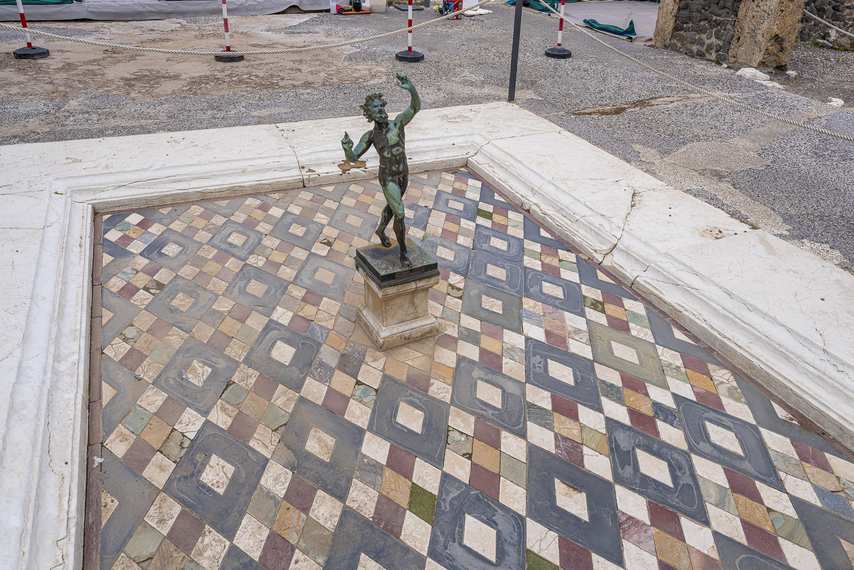
The House of the Faun is one of the most impressive dwellings in Pompeii, occupying an entire block with its 3,000 square meters. Built in the 3rd century BC and enlarged in the 2nd century BC, it represented one of the most luxurious dwellings in the city.
It owes its name to the bronze statue of a dancing faun in the atrium impluvium. In addition to its vast size, the house is famous for the Battle of Issus Mosaic, an artistic masterpiece depicting the clash between Alexander the Great and Darius III.
The structure includes two atria, two peristyles, numerous rooms, and a private bath quarter.
Google Maps indication:
https://maps.app.goo.gl/qCvE6waBgmPUuvCf7
Why visit the House of the Faun?
This domus allows you to discover the elegance and grandeur of Roman aristocratic life in Pompeii.
Its size, refined mosaics and innovative architectural solutions make it an extraordinary example of a patrician dwelling of the Republican era.
What to admire in the House of the Faun?
- Statuette of the dancing faun: placed in the atrium impluvium, it symbolises the house and is one of Pompeii’s most iconic elements.
- Mosaic of the Battle of Issus: an artistic masterpiece depicting the clash between Alexander the Great and Darius III, now in the National Archaeological Museum in Naples.
- Minor mosaics, detailed depictions of animals, still lifes, and scenes of everyday life decorate various rooms in the Domus.
- Great peristyle: Surrounded by a double order of columns, it represents one of the house’s most scenic spaces.
- Architecture and perspective games: the layout of the rooms creates a visual effect that enhances the mansion’s majesty, with expansive views from the tablinum to the inner gardens.
Would you like to learn more about the House of the Faun? Read our in-depth article.
If you exit the House of the Faun on Vicolo del Fauno, continue north until you turn right onto Vicolo di Mercurio. If you are already on Vicolo di Mercurio, turn right and walk down it for about 50 meters.
Then, turn left into Vicolo dei Vettii. After a few meters, on the left, you will find the entrance to visit the House of the Vettii.
House of the Vettii (Regio VI – 11)

The House of the Vettii is one of the best-preserved domus in Pompeii, rich in frescoes and delicate decorations.
Belonging to the Vettii brothers, wealthy freedmen devoted to trade, the house reflects their social status with luxurious rooms and symbols of prosperity.
The peristyle, with its fountains and bronze statues, mythological frescoes, and the famous Priapus in the atrium, is an element that makes this mansion a perfect example of the elegance and refinement of the Roman era.
Google Maps indication:
https://maps.app.goo.gl/Ay6v1MAsaESmeH469
Why visit the House of the Vettii?
To visit the House of the Vettii is to immerse yourself in the life of a wealthy family of ancient Pompeii, discovering the luxury and aesthetic taste of enriched freedmen.
Thanks to its perfectly preserved frescoes, this domus offers a journey into Roman myth and symbolism, highlighting the role of art in daily life.
What to admire in the House of the Vettii?
- The mythological frescoes with scenes of Ariadne and Theseus, Daedalus and Pasiphae, and the torment of Pentheus.
- The mosaic of Priapus in the vestibule is a symbol of fertility and prosperity.
- The peristyle had columns, basins, and bronze statues as fountains.
- The triclinium and oecium have delicate decorations, including cupids, which are intended for games and crafts.
- The kitchen and lararium are evidence of Roman domestic life.
Would you like to learn more about the House of the Vettii? Read our in-depth article.
Leaving the House of the Vettii on Vicolo dei Vettii, opposite you will find the House of the Golden Cupids.
House of the Golden Cupids (Regio VI – 12)
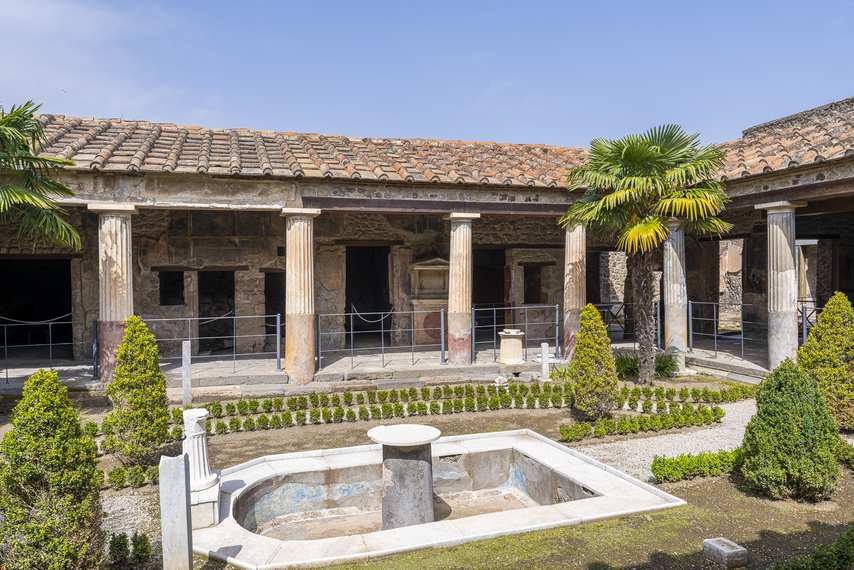
The House of the Golden Cupids is one of the most elegant dwellings in Pompeii, dated between the 3rd and 2nd centuries BC.
The name comes from a cubicle decoration consisting of gold foils depicting cupids set in glass discs.
The domus probably belonged to the gens Poppeae, a family linked to Emperor Nero.
Inside are frescoes of great artistic value, fine mosaics, a garden decorated with statues and theatrical masks, and rooms used for worship, including a shrine dedicated to Egyptian deities.
Google Maps indication:
https://maps.app.goo.gl/A8McTSssme9e8CqT8
Why visit the House of the Golden Cupids
This domus represents a magnificent example of an aristocratic residence from the imperial age, featuring a fusion of art, religion, and culture. Its delicate decorations, mosaics, and rooms devoted to both private life and domestic and Egyptian cults provide a comprehensive view of the wealth and refined tastes of the period.
The presence of mythological frescoes and apotropaic symbols make this house a true jewel of Pompeian archaeology.
What to admire in the House of the Golden Cupids
- The atrium and tablinum, with mosaics and frescoes depicting the meeting between Paris and Helen.
- The main hall, decorated with mosaics and frescoes of Achilles, Patroclus and Briseis, overlooks a garden embellished with statues and columns.
- The gilded decorations that give the house its name are made of cupids engraved on gold foils set in glass.
- The sacred areas featured an aedicule dedicated to domestic worship and a shrine dedicated to Egyptian deities, including Isis, Anubis, Harpocrates, and Serapis.
- The yellow-walled room, likely dedicated to women, was accessible through a corridor that also served as an exhibition space, featuring a statue of Venus.
Exit onto Vicolo dei Vettii and proceed south until you turn left into Vicolo di Mercurio. Continue east, then turn right onto Via del Vesuvio. Continue south and enter Via Stabiana. After about 90 meters, on the left, you will find the entrance to the House of Marcus Lucretius.
House of Marcus Lucretius (Regius IX – 1)
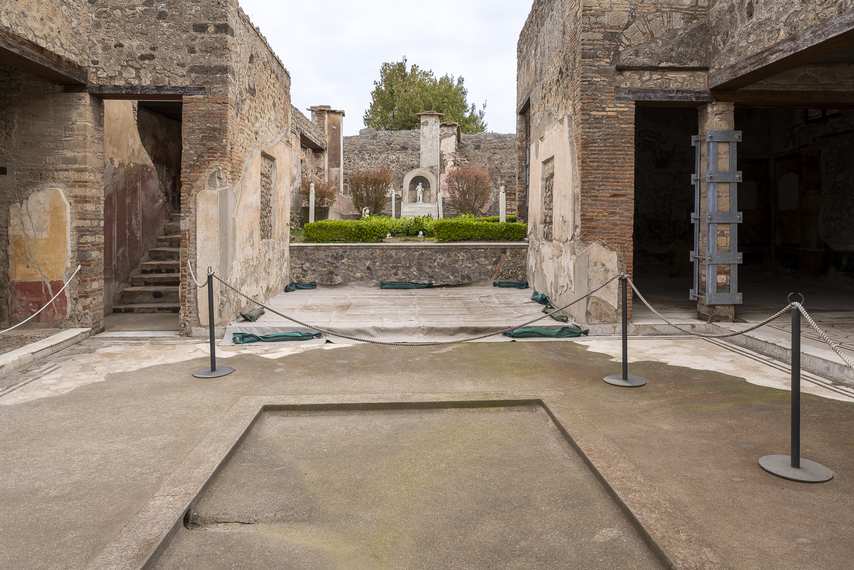
The House of Marcus Lucretius, also known as the House of the Players, is a fine domus in Pompeii, located on Via Stabiana.
Excavated between 1846 and 1847, its structure dates back to the 2nd century B.C.
It features splendid Fourth Style frescoes and an elegant garden with an ornate fountain. The house probably belonged to Marcus Lucretius, decurion of Pompeii and priest of Mars.
Among its rooms are magnificent mythological decorations, fine mosaics, and a painted letter that helped identify its owner.
Google Maps indication:
https://maps.app.goo.gl/81vB3VU6ngeFPoeh9
Why visit the House of Marcus Lucretius
This domus is an extraordinary example of the sophistication achieved by private dwellings in Pompeii during the imperial age. The richness of the frescoes and mosaics, combined with the garden’s beauty with its marble fountain, allows one to immerse oneself in the life of a family of Pompeii’s high society.
Moreover, a small picture with a painted letter makes the visit even more fascinating, as it directly connects the building to the historical figure of Marcus Lucretius.
What to admire in the House of Marcus Lucretius
- The Fourth Style frescoes have mythological scenes, including Narcissus and Cupid, Venus Fisher, and the Triumph of Bacchus.
- The mosaic floors, particularly the opus sectile floor of the tablinum and the refined black and white motifs of the triclinium.
- The garden fountain’s niche is decorated with a mosaic and a statue of Silenus holding a wineskin.
- The musicians’ cubicle, with the fresco from which the house was first named, depicting a group of women playing musical instruments.
- The painted letter is a unique detail that allows the house to be attributed to Marcus Lucretius, decurion of Pompeii and priest of Mars.
- The decorations were dedicated to domestic and Egyptian cults, and they depicted deities such as Isis, Anubis, and Serapis.
This house, with its perfect blend of luxury and everyday life, is a crucial stop for understanding the art and society of ancient Pompeii.
After visiting the House of Marcus Lucretius, exit onto Via Stabiana and continue south to the intersection with Via dell’Abbondanza.
Then turn right and walk down it for about 80 meters until you turn right into Vicolo del Lupanare.
Continue in a northerly direction for about 60 meters until you reach the entrance to the House of Sirico on the right.
House of Sirico (Regio VII – 17)
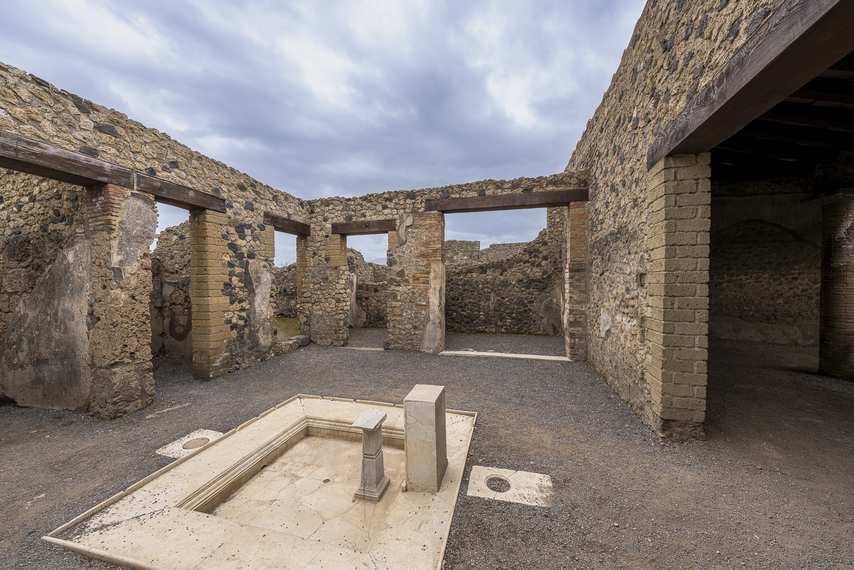
The House of Sirico is a sumptuous Pompeian mansion that belonged to the city’s political and commercial class.
The owner’s name, Publius Vedius Sunicus, is known from the discovery of a bronze ring seal.
The house, the result of combining two buildings, featured delicate decorations inspired by mythology and an exedra for banquets.
A famous fresco in the dwelling depicts injured Aeneas being treated by the physician Japix, and demonstrates the knowledge of medical art in Pompeii.
Google Maps indication:
https://maps.app.goo.gl/J4cFcNhZQs6dAsav7
Why visit the House of Sirico
Visiting the House of Sirico allows visitors to discover the luxury and prestige of Pompeii’s elites.
The dwelling, with its splendid frescoes and exquisite decoration, offers a glimpse into the social and cultural life of the time, showing how the powerful of the ancient city used art and architecture to assert their status.
What to admire in the House of Sirico
- The inscription on the entrance, “SALVE LUCRU” (Welcome, money!), signifies the owner’s business mentality.
- The exedra had fine mythological frescoes, including Heracles at the court of Onphale and the construction of the walls of Troy.
- The fine opus sectile floor.
- The two peristyles with pergolas symbolise wealth and a place for guests to enjoy summer refreshment.
- The famous fresco of the wounded Aeneas treated by the physician Japix is now in the National Archaeological Museum in Naples.
Would you like to learn more about the House of Sirico? Read our in-depth article.
Upon exiting the House of Siricus onto Via Stabiana, head south until you reach Via dell’Abbondanza, then turn right.
After a few meters, you will find the entrance to the Stabian Baths.
Stabian Baths (Regio VII – 16)

The Stabian Baths represent one of the oldest bath complexes in Pompeii, dating back to the 3rd-4th centuries BC.
Located along the Via Stabiana, they were expanded in the 2nd century BC and underwent restoration until the eruption of Vesuvius in 79 AD.
The complex includes a trapezoidal gymnasium with a pool, two separate sections for men and women, and thermal rooms typical of Roman times, such as the frigidarium, tepidarium, and calidarium, heated by an advanced hypocaust system.
Google Maps indication:
https://maps.app.goo.gl/km5xkvCPxsa5ey5k7
Why visit the Stabian Baths?
Visiting this spa complex offers an immersion in ancient Rome’s wellness and hygiene culture.
The baths were a place for socialising and relaxation, allowing visitors to better understand the Pompeians’ daily life and the sophisticated heating system used.
What to admire in the Stabian Baths?
- The gymnasium and swimming pool are places for training and relaxation.
- The thermal rooms, with their progressive temperature.
- The hypocaust system was an ingenious heating mechanism.
- The decorations and stucco are well-preserved in the women’s section.
Would you like to learn more about the Stabian Baths? Read our in-depth article.
Upon exiting the Stabian Baths, if you are on Via dell’Abbondanza, continue west for a few meters, then turn right onto Vicolo del Lupanare.
If you exit directly onto Vicolo del Lupanare, head north until you reach the entrance to the Lupanar.
Lupanar (Regio VII – 18)
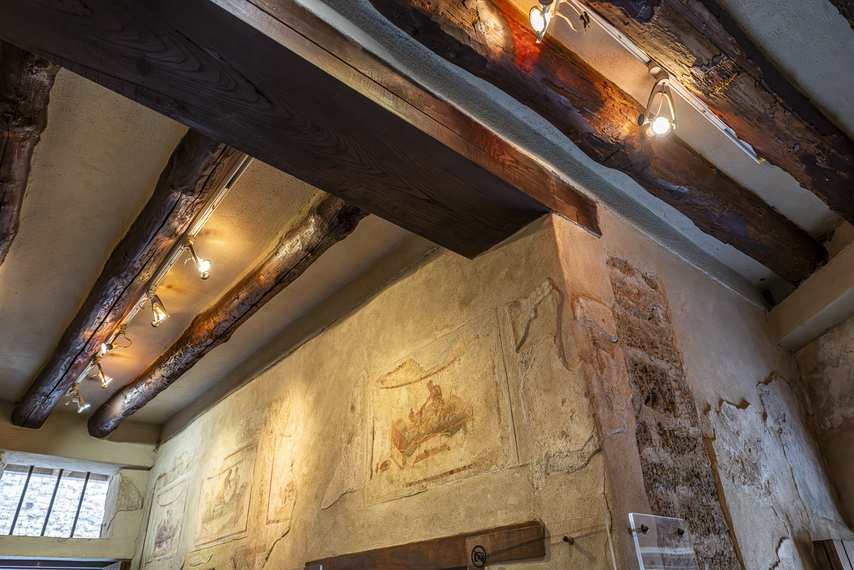
Pompeii’s Lupanare is the most famous brothel in the ancient city, a testament to a social reality often overlooked.
Built on two levels, it was organised into small rooms with masonry beds and decorated with explicit frescoes that served as a “catalogue” for clients.
Graffiti left by visitors provides a vivid record of the daily life and sexual habits of the time.
This site offers a novel perspective on Pompeian society, including the plight of prostitutes, who were often slaves.
Google Maps indication:
https://maps.app.goo.gl/fqRKhjNyiBCQjyAV8
Why visit the Lupanar?
The Lupanare allows visitors to explore an authentic, often ignored aspect of Roman life.
It helps them better understand the mentality of the time, the role of prostitution in the economy, and the way sexuality was lived and regulated in Roman society.
What to admire in the Lupanar?
- Erotic frescoes, painted on the walls, depict sexual scenes and were used as a kind of catalogue of services offered.
- Small rooms (cubicula): each equipped with a stone bed, representing the essential furnishings of the place.
- Ancient graffiti: engravings left by clients and prostitutes, containing names, ironic jokes and references to the brothel’s activity.
- It was a two-level structure. The lower level was for the typical clientele, while the upper level probably housed wealthier clients or the female workers themselves.
Would you like to learn more about the Lupanare? Read our in-depth article.
Leaving the Lupanare, take the Vicolo del Balcone Pensile and follow it until you reach the Vicolo della Maschera, where you will turn left.
Continue until the intersection with Via dell’Abbondanza, then turn left and continue in an easterly direction for 270 meters.
Turn right into Vicolo di Paquius Proculus and turn left at the intersection with Via di Castricio.
After 180 meters on Via di Castricio, turn right into Vicolo dei Fuggiaschi.
Continue for about 150 meters and you will find the entrance to the Garden of the Fugitives on the right.
The Graden of the Fugitives (Regio I – 16)

The Garden of the Fugitives is one of the most moving places in Pompeii’s excavations. Located in the southern part of the ancient city, it was a cultivated garden that 1961 returned the casts of thirteen victims of the 79 AD eruption of Vesuvius.
These people, including children, tried in vain to escape to the southern exit of the city before being swept away by the pyroclastic cloud.
Today, the site offers visitors an extraordinary testimony to the tragedy of Pompeii, preserving casts of the victims in their original context.
Google Maps indication:
https://maps.app.goo.gl/8N3hCkX37MkhzJYL9
Why visit the The Garden of the Fugitives
The Orto dei Fuggiaschi represents one of the most poignant testimonies to Pompeii’s tragedy. Here, thirteen Pompeians were trapped during their desperate attempt to escape.
Thanks to the technique of plaster casts, it is possible to observe their last poses, making this site a true memorial to the catastrophe.
The visit provides insight into the human dimension of the eruption, offering a profound and emotional experience.
What to admire in the Garden of the Fugitives
- The casts of the victims: thirteen people, including children, caught in the burning cloud and immortalised in their last moments.
- The reconstructed agricultural area, featuring a restored vineyard and garden, helps imagine daily life before the eruption.
- The historical and archaeological context: a place of significant visual and emotional impact, providing insight into the drama of Pompeii’s destruction.
Would you like to learn more about the The Graden of the Fugitives? Read our in-depth article.
Exit onto Vicolo dei Fuggiaschi and continue north until you reach Via della Palestra.
Turn right, walk to the intersection with Via di Nocera, then turn right again.
Walk down Via di Nocera for about 130 meters, passing Porta Nocera.
At the end of the street, turn left and walk east, admiring the Necropolis of Porta Nocera.
Necropolis of Porta Nocera (Regio II – 10)
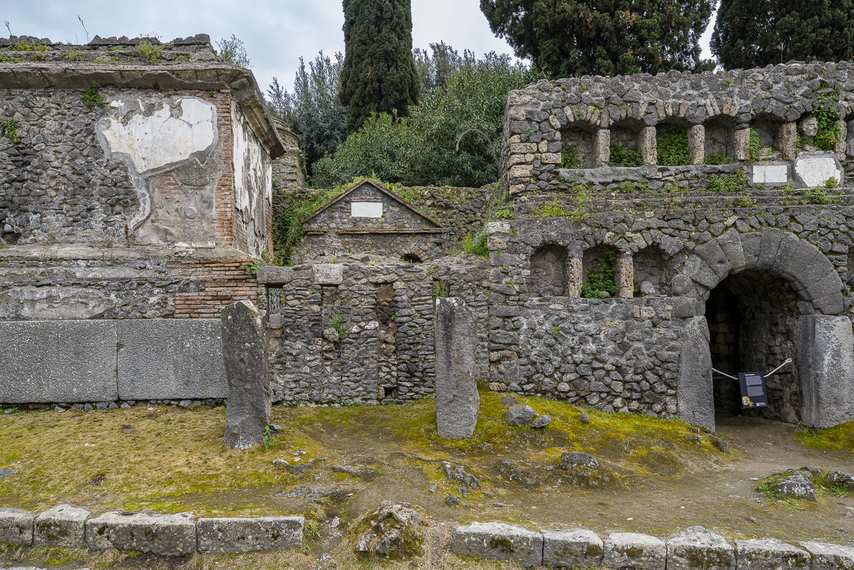
The Necropolis of Porta Nocera in Pompeii stretches along a 250-meter section outside the city walls, housing numerous funerary monuments that reflect Roman burial practices from the 1st century BC to AD 79.
Prominent among them are the monumental tomb of the priestess Eumachia and the tomb of the Flavians, characterised by niches with tuff busts and inscriptions.
High-podium tombs, such as that of Marcus Octavius and Publius Vesonius Phileros, offer further evidence of the funerary customs of the period.
Google Maps indication:
https://maps.app.goo.gl/p7c6nndp5aEuNmhX9
Why visit the Necropolis of Porta Nocera
This site offers an immersion in Roman funerary traditions, allowing a better understanding of Pompeian society through its burial practices and monuments dedicated to the dead.
What to admire in the Necropolis of Porta Nocera
- Tomb of Eumachia: An imposing structure dedicated to the priestess of Venus, who also financed the construction of a building in the Forum.
- Tomb of the Flavians: Featuring numerous niches containing tufa busts and commemorative inscriptions.
- Tomb of Publius Vesonius Phileros: Noted for a long inscription, the deceased complains about an unjust accusation he received from a friend.
- The tomb of Marcus Octavius features a high podium with four niches on the façade, representing the typical funerary architecture of the Sillan settlers.
A visit to the Necropolis of Porta Nocera offers a unique opportunity to reflect on life and death in ancient Pompeii, through monuments that tell personal and collective stories of a vanished civilisation.
Continue along the avenue until you reach Piazzale Anfiteatro, from which you can exit the excavations.
After a full day spent among the wonders of Pompeii, our journey through time ends.
This itinerary has allowed you to explore the city at your leisure, immersing yourself in the daily life, works of art and mysteries that still shroud this extraordinary archaeological site.
From the bustling streets of antiquity to the finest mansions, from places of worship to the most hidden corners, each stop revealed a fragment of history, giving back a vivid picture of Pompeii’s grandeur and drama.
But this unique place still has much more to tell: if you were fascinated by the experience, come back to discover more details, routes, and stories that make Pompeii a timeless witness.